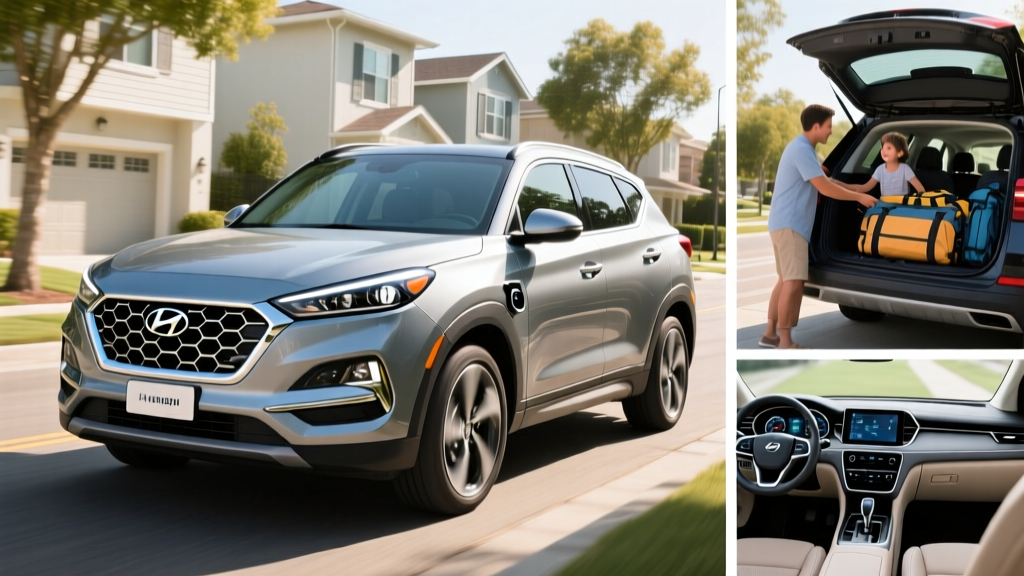
The 2024 Hyundai Tucson Hybrid Limited sits at the top of Hyundai's compact hybrid SUV lineup, pairing a turbocharged 1.6-liter engine with an electric motor for 226 horsepower and an EPA-estimated 37 MPG combined. For buyers who want hybrid efficiency without plugging in, it's one of the most feature-rich options in the segment. This guide breaks down the exact specs, real-world fuel economy expectations, battery longevity, and how it stacks up against the Tucson PHEV and full EVs.
2024 Hyundai Tucson Hybrid Limited: Core Specs at a Glance
| Specification | Value |
|---|---|
| Powertrain | 1.6L turbo I4 + electric motor (HEV) |
| Combined Horsepower | 226 hp |
| Combined Torque | 258 lb-ft |
| Transmission | 6-speed automatic |
| Drivetrain | AWD (standard on all trims) |
| Battery (traction) | 1.49 kWh lithium-ion |
| EPA MPG (city / hwy / combined) | 37 / 36 / 37 |
| Fuel Tank | 13.7 gallons |
| Total Range | ~507 miles |
| 0–60 mph | ~7.1 seconds |
| Cargo Volume (behind 2nd row) | 38.7 cu ft |
| Base MSRP (Limited trim) | $39,650 |
| Hybrid Battery Warranty | 10 years / 100,000 miles |
The Limited trim is the top-tier offering and includes features like leather seats, a panoramic sunroof, Bose premium audio, a 10.25-inch digital instrument cluster, Hyundai Digital Key, highway driving assist, and remote smart parking assist. It's a loaded compact SUV that happens to sip fuel.
Real-World MPG: What to Actually Expect
The EPA rates the 2024 Tucson Hybrid at 37 city / 36 highway / 37 combined. But real-world results depend heavily on driving style, climate, and terrain.
| Scenario | Expected MPG |
|---|---|
| EPA Combined (sticker) | 37 MPG |
| City driving (real-world) | 36–40 MPG |
| Highway cruising (70 mph) | 32–35 MPG |
| Cold weather (below 32°F, city) | 30–34 MPG |
| Hilly/mountainous terrain | 28–33 MPG |
Hybrids like the Tucson HEV typically exceed their EPA city rating in stop-and-go traffic because regenerative braking recovers energy that a gas car wastes as heat. Highway driving is the opposite — the engine runs continuously at higher loads, and the electric motor provides less benefit. In cold weather, expect a 10–15% drop because the engine runs more often to provide cabin heat and the battery's charge/discharge efficiency drops at low temperatures.
According to fueleconomy.gov, the Tucson Hybrid's 37 MPG combined places it among the most efficient AWD compact SUVs available, trailing only the Toyota RAV4 Hybrid (39 combined) and edging ahead of the Honda CR-V Hybrid (37 combined, FWD-biased AWD system).
HEV vs. PHEV: Which Tucson Hybrid Should You Choose?
Hyundai offers the Tucson in three powertrain flavors: gas-only, conventional hybrid (HEV), and plug-in hybrid (PHEV). Understanding the distinction is critical before you buy.
| Attribute | Tucson Hybrid (HEV) | Tucson Plug-In Hybrid (PHEV) |
|---|---|---|
| Plug-in required? | No — self-charging via regen + engine | Yes — plug in to access electric-only range |
| Battery size | 1.49 kWh | 13.8 kWh |
| Electric-only range | N/A (motor assists engine) | 33 miles (EPA) |
| Combined horsepower | 226 hp | 261 hp |
| EPA MPG / MPGe | 37 MPG combined | 80 MPGe (electric) / 35 MPG (gas-only) |
| Total range | ~507 miles | ~440 miles (33 electric + ~407 gas) |
| Charging (Level 2) | N/A | ~2 hours (7.2 kW onboard charger) |
| DC fast charging | N/A | Not available |
| Starting MSRP (top trim) | $39,650 (Limited) | $47,440 (Limited) |
| Federal tax credit | Not eligible | Not eligible (assembled in Korea) |
The HEV is the simpler, more affordable choice. You never plug it in — the 1.49 kWh battery charges through regenerative braking and the gasoline engine. It's ideal if you lack access to home or workplace charging.
The PHEV makes sense if you can charge at home and your daily commute is under 33 miles. You'd drive mostly on electricity during the week and use the gas engine for longer weekend trips. However, at $47,440 for the Limited trim, the PHEV carries a $7,790 premium over the HEV Limited — a gap that takes years of fuel savings to close.
Powertrain Deep Dive: How the Hybrid System Works
The Tucson Hybrid uses Hyundai's TMED-II (Transmission-Mounted Electric Device) architecture. A 44.2 kW (59 hp) electric motor is sandwiched between the 1.6-liter turbocharged GDI engine and the 6-speed automatic transmission. This differs from Toyota's planetary-gear e-CVT approach and gives the Tucson a more conventional driving feel with actual gear shifts.
The system produces a combined 226 hp and 258 lb-ft of torque, with torque available low in the rev range thanks to the electric motor's instant response. AWD is standard on every Tucson Hybrid trim, using an electronically controlled coupling to send power rearward when slip is detected.
The 1.49 kWh traction battery is small by EV standards — it's not designed for electric-only driving. Instead, it buffers energy recovered from braking and provides torque-fill during acceleration. This is the fundamental difference between an HEV and a PHEV: the HEV battery is a power buffer, not a range extender.
Pricing, Tax Credits, and Total Cost
The 2024 Tucson Hybrid Limited carries an MSRP of $39,650 (including destination). Here's what to expect at the dealership:
- Blue trim: $32,950 — well-equipped base hybrid
- SEL Convenience: $36,560 — adds panoramic sunroof, power liftgate
- Limited: $39,650 — leather, Bose audio, Highway Driving Assist, Digital Key
Federal Tax Credit Status
Tax credit reality: The 2024 Tucson Hybrid (HEV) does not qualify for the federal §30D clean vehicle credit. That credit applies only to plug-in electric vehicles (BEVs and PHEVs) meeting battery sourcing and final assembly requirements. The Tucson PHEV also fails to qualify because it is assembled in Ulsan, South Korea — the §30D credit requires North American final assembly. Always verify current rules at IRS.gov or consult a tax professional.
Some states offer their own hybrid or efficiency incentives, but these vary widely. Check your state's energy office or department of environmental quality for specifics.
5-Year Fuel Cost Estimate
At 37 MPG combined and $3.40/gallon (national average), driving 12,000 miles per year costs roughly $1,103 annually in fuel. A comparable gas-only Tucson AWD (26 MPG combined) would cost about $1,569 per year — a savings of approximately $466/year or $2,330 over five years with the hybrid.
Battery Longevity, Warranty, and Replacement Cost
Hybrid battery anxiety is the number-one concern for first-time hybrid buyers. Here's what the data says.
Hyundai Hybrid Battery Warranty
- Coverage: 10 years / 100,000 miles (whichever comes first)
- Capacity threshold: Hyundai replaces or repairs if capacity drops below a specified level during the warranty period
- Transferability: Warranty transfers to subsequent owners (reduced to 5 years / 60,000 miles for second owners in some states)
- 12V auxiliary battery: Covered under separate 3-year/36,000-mile bumper-to-bumper warranty
Hyundai's 10-year/100,000-mile hybrid battery warranty is among the best in the industry, matched only by Kia (same corporate parent). For context, Toyota covers its hybrid battery for 10 years/150,000 miles.
Real-world data from fleet operators and long-term owners suggests modern lithium-ion hybrid batteries routinely last 150,000–200,000 miles before significant degradation. The Tucson's 1.49 kWh pack operates in a narrow state-of-charge window (roughly 40–80% SoC), which dramatically reduces stress on the cells compared to a full EV battery that cycles from 10–90%.
If replacement is needed out of warranty, expect $2,000–$4,000 for a refurbished or new hybrid battery pack plus labor. This is far less than an EV traction battery replacement ($8,000–$20,000+) because the pack is small and simpler to access.
Reliability and Safety Ratings
The 2024 Tucson earned a Top Safety Pick+ rating from the IIHS when equipped with specific headlights, reflecting excellent crash-test performance. Standard safety tech includes forward collision-avoidance assist with pedestrian and cyclist detection, lane keeping assist, blind spot collision-avoidance, rear cross-traffic collision-avoidance, and safe exit warning.
Hyundai's hybrid powertrain has proven reliable across the Ioniq, Sonata, and Tucson lineages. The 6-speed automatic transmission is a conventional unit — no e-CVT complexity — which simplifies long-term serviceability. J.D. Power and Consumer Reports rate Hyundai's hybrid systems as average to above-average in predicted reliability.
Who Should Buy the Tucson Hybrid Limited?
Pros
- 37 MPG combined with no plug-in required
- 226 hp provides confident highway merging
- Limited trim loaded with premium features at sub-$40K
- 10-year/100,000-mile hybrid battery warranty
- AWD standard — no FWD-only compromise
- 38.7 cu ft cargo space competitive for the segment
Cons
- Highway MPG drops to ~32–35 in real-world driving
- No federal tax credit eligibility
- Engine noise noticeable under hard acceleration
- Infotainment learning curve with dual-screen setup
- PHEV variant exists but at a steep $7,790 premium
Decision Framework
Choose the Tucson Hybrid (HEV) if: You want a loaded compact SUV with 35+ MPG, you don't have reliable access to a charger at home or work, and you want AWD without a fuel-economy penalty.
Choose the Tucson PHEV if: You can install a Level 2 charger at home, your daily commute is under 30 miles, and you want to drive mostly on electricity while keeping a gas engine for road trips.
Choose a full EV (e.g., Ioniq 5, Tesla Model Y) if: You have home charging, your daily driving is under 250 miles, you want zero tailpipe emissions, and you're eligible for the $7,500 federal tax credit to offset the higher purchase price.
Stick with the gas Tucson if: Your annual mileage is under 8,000 miles and the hybrid premium won't pay for itself in fuel savings within your ownership window.
Frequently Asked Questions
How many MPG does the 2024 Hyundai Tucson Hybrid actually get?
The EPA rates it at 37 city / 36 highway / 37 combined. In real-world city driving with frequent stops, owners often see 38–40 MPG thanks to regenerative braking. Highway driving at 70+ mph typically yields 32–35 MPG. Cold weather can drop city MPG to the low 30s.
Does the Tucson Hybrid need to be plugged in?
No. The Tucson Hybrid (HEV) is a self-charging conventional hybrid. Its small 1.49 kWh battery charges through regenerative braking and the gasoline engine. You fuel it like any other car. Only the Tucson Plug-In Hybrid (PHEV) requires plugging in to access its 33-mile electric-only range.
How far can the Tucson PHEV go on electric only?
The 2024 Tucson Plug-In Hybrid has an EPA-rated 33 miles of electric-only range from its 13.8 kWh battery. Total combined range (electric + gas) is approximately 440 miles. The PHEV charges in about 2 hours on a Level 2 (240V) charger using its 7.2 kW onboard charger. It does not support DC fast charging.
Is the Tucson Hybrid reliable and what does a battery replacement cost?
Hyundai's hybrid system has a solid reliability track record across multiple model lines. The hybrid battery is covered by a 10-year/100,000-mile warranty. Out-of-warranty replacement runs $2,000–$4,000 for the pack plus labor — far less than an EV battery. Most hybrid batteries last 150,000+ miles based on fleet data.
Does the 2024 Tucson Hybrid qualify for a federal tax credit?
No. The federal §30D clean vehicle credit applies only to plug-in vehicles (BEVs and PHEVs) that meet North American assembly, battery sourcing, MSRP cap, and buyer income requirements. The Tucson HEV is not a plug-in vehicle. The Tucson PHEV is a plug-in but is assembled in South Korea, disqualifying it from the federal credit. Check fueleconomy.gov for the latest qualifying vehicle list.
How does the Tucson Hybrid compare to the RAV4 Hybrid?
The Toyota RAV4 Hybrid (39 MPG combined, 219 hp) edges out the Tucson on fuel economy by 2 MPG and has a slightly larger cargo area. The Tucson Hybrid Limited counters with a more premium interior, a conventional 6-speed automatic (no CVT drone), and Hyundai's 10-year powertrain warranty versus Toyota's 5-year/60,000-mile powertrain coverage. Both are strong choices — the decision often comes down to brand preference and which dealership is closer.
What's the difference between the Tucson Hybrid Blue and Limited trims?
The Blue ($32,950) is the base hybrid with cloth seats, an 8-inch touchscreen, and core safety features. The Limited ($39,650) adds leather, a 10.25-inch digital cluster, Bose audio, panoramic sunroof, Highway Driving Assist, Digital Key, and a surround-view monitor. Both share the identical 226 hp hybrid powertrain and 37 MPG rating.