Quick Verdict: The 2024 Hyundai Santa Fe Hybrid SEL
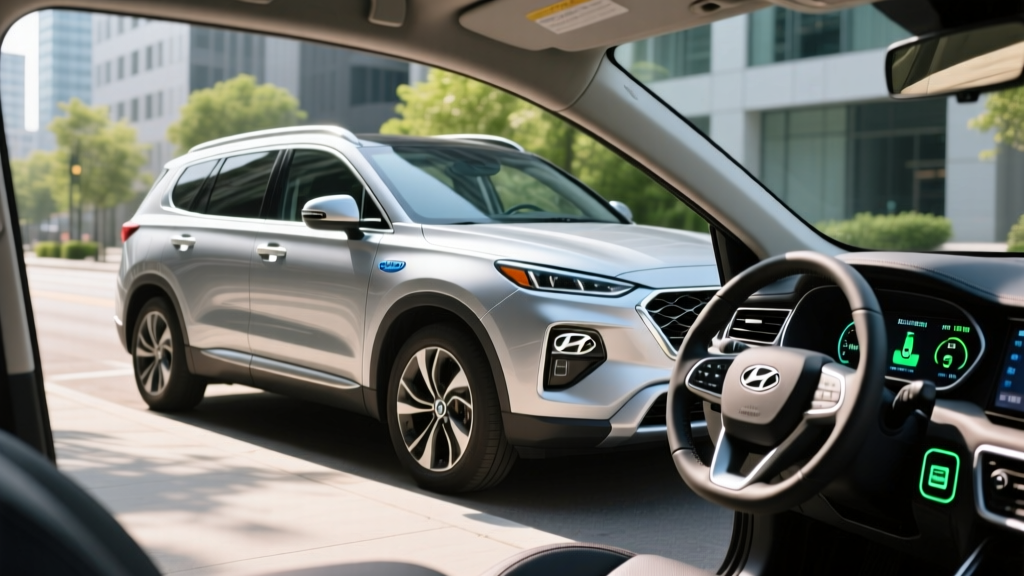
The 2024 Hyundai Santa Fe Hybrid SEL is a three-row midsize crossover that prioritizes fuel efficiency without requiring a plug. With an EPA-estimated 36 MPG combined, standard all-wheel drive, and a starting MSRP around $39,115, it occupies a practical middle ground between gas-only SUVs and full battery-electric vehicles. It's a conventional hybrid (HEV), not a plug-in — meaning you never need to search for a charger. You simply fill up with gas and let the hybrid system optimize efficiency automatically.
For 2026 buyers still shopping the 2024 model year on dealer lots or in the used market, the Santa Fe Hybrid SEL remains competitive against the Toyota Highlander Hybrid (35 MPG combined) and the Kia Sorento Hybrid (its platform sibling). This guide breaks down every number that matters: real-world MPG, powertrain specs, battery longevity, warranty coverage, and whether any tax credits apply.
HEV vs PHEV: Which Santa Fe Hybrid Are You Looking At?
Hyundai sells the Santa Fe in two electrified forms, and confusing them is the single most common mistake shoppers make. Here's the distinction:
| Feature | Santa Fe Hybrid (HEV) | Santa Fe Plug-In Hybrid (PHEV) |
|---|---|---|
| Powertrain | 1.6L turbo + electric motor | 1.6L turbo + larger electric motor |
| Combined Horsepower | 232 HP | 261 HP |
| Battery Capacity | 1.49 kWh (self-charging) | 13.8 kWh (plug-in capable) |
| Electric-Only Range | N/A (motor assists only) | EPA 31 miles |
| Needs to Plug In? | No — regenerative braking recharges | Yes — for electric-only driving |
| EPA Combined MPG / MPGe | 36 MPG | 76 MPGe (electric) / 33 MPG (gas) |
| DC Fast Charging | N/A | No — Level 2 AC only |
| Starting MSRP (2024) | ~$39,115 (SEL) | ~$48,450 (SEL Premium) |
| Federal Tax Credit (§30D) | Not eligible | Not eligible (PHEV battery <16 kWh for full credit under current rules) |
This article focuses on the HEV (conventional hybrid) SEL trim. If you're specifically researching the plug-in variant, the PHEV requires a dedicated Level 2 home charger to realize its efficiency benefits and carries a significantly higher price. The HEV is the simpler, more accessible choice for buyers who want better fuel economy without changing their refueling habits.
Fuel Economy: EPA Numbers and Real-World MPG
The headline figure for the 2024 Santa Fe Hybrid SEL is its EPA-estimated fuel economy. Here's the full breakdown from fueleconomy.gov:
| Driving Condition | EPA Estimate | Real-World Expectation |
|---|---|---|
| City | 35 MPG | 36–38 MPG (hybrids excel in stop-and-go) |
| Highway | 36 MPG | 32–35 MPG (aerodynamic drag reduces hybrid advantage) |
| Combined | 36 MPG | 33–37 MPG depending on driving mix |
Why real-world MPG often beats EPA in the city: Conventional hybrids recapture kinetic energy during braking through regenerative braking, converting it to battery charge that powers the electric motor at low speeds. Stop-and-go traffic, which destroys gas-car efficiency, actually plays to the hybrid system's strengths. On sustained highway runs above 70 MPH, the gasoline engine does most of the work, and the boxy Santa Fe design creates more aerodynamic drag than sleeker crossovers.
Cold-weather impact: Expect a 5–10% fuel economy reduction in freezing temperatures. The engine runs richer during warmup, cabin heating demands energy, and battery chemistry becomes less efficient below 32°F. Owners in northern climates typically report 31–33 MPG combined during winter months, recovering to 36+ MPG in moderate weather.
Powertrain Specs: What Moves the Santa Fe Hybrid SEL
| Specification | Value |
|---|---|
| Engine | 1.6L turbocharged 4-cylinder (Smartstream) |
| Engine Output | 178 HP / 195 lb-ft torque |
| Electric Motor Output | 47.7 kW (64 HP) / 195 lb-ft torque |
| Combined System Output | 232 HP / 271 lb-ft torque |
| Transmission | 6-speed automatic (no CVT) |
| Drivetrain | HTRAC All-Wheel Drive (standard) |
| 0–60 MPH | ~7.6 seconds (est.) |
| Towing Capacity | 2,000 lbs |
| Fuel Tank | 17.7 gallons |
| Total Driving Range | ~637 miles (EPA combined) |
| Battery (Hybrid) | 1.49 kWh lithium-ion polymer |
| Cargo Volume (behind 3rd row) | 15.9 cu ft |
| Cargo Volume (3rd row folded) | 40.5 cu ft |
The 6-speed automatic is a deliberate choice over the CVTs found in the Toyota Highlander Hybrid and many competitors. It delivers more natural shift feel and avoids the "rubber-band" drone that CVTs produce under hard acceleration. The tradeoff is marginally less seamless power delivery in low-speed electric-assist mode, but most drivers won't notice it in daily commuting.
The HTRAC AWD system uses an electric motor on the rear axle, distributing torque between front and rear based on traction needs. Unlike mechanical AWD systems, there's no driveshaft connecting the axles — this reduces weight and parasitic losses, contributing to the hybrid's efficiency advantage.
Pricing, Trims, and Tax Credit Eligibility
The 2024 Santa Fe Hybrid was offered in three trims. Here's the MSRP breakdown (destination included):
- SEL Premium: ~$42,915
- Limited: ~$46,515
Note: The base Blue Hybrid trim (starting ~$37,415) was discontinued for the 2024 model year. The SEL was renamed SEL Premium and became the entry point for the hybrid lineup.
Federal Tax Credit Status: Not Eligible
The conventional Santa Fe Hybrid (HEV) does not qualify for the IRS §30D Clean Vehicle Credit. This credit applies only to plug-in electric vehicles (BEVs and qualifying PHEVs) with battery capacities meeting minimum thresholds and critical-mineral/battery-component sourcing requirements. Conventional hybrids — which cannot be plugged in — have never been eligible for §30D.
The Santa Fe Plug-In Hybrid also faces challenges under the 2024–2026 §30D rules due to battery sourcing requirements and the 13.8 kWh battery falling below thresholds needed for the full credit. Always verify current eligibility on IRS.gov or with a qualified tax professional before purchasing.
State incentives: Some states offer rebates or HOV lane access for hybrid vehicles, though these are far less common than EV incentives. Check your state's energy office or DMV for current programs — these vary widely by jurisdiction and change frequently.
Battery Longevity, Warranty, and Replacement Cost
Hyundai Hybrid Battery Warranty
- Hybrid Battery: 10 years / 100,000 miles (whichever comes first)
- Hybrid System Components: 10 years / 100,000 miles
- Powertrain Warranty: 10 years / 100,000 miles
- New Vehicle Limited Warranty: 5 years / 60,000 miles
Hyundai's hybrid battery warranty is among the longest in the industry, matching Toyota's coverage and exceeding most competitors. The warranty guarantees the battery will retain sufficient capacity to support normal hybrid operation.
How long do hybrid batteries actually last? Real-world data from Hyundai's earlier hybrid systems (Sonata Hybrid, Ioniq Hybrid) shows that lithium-ion hybrid batteries routinely last 150,000–200,000+ miles before significant degradation. Unlike EV batteries, which must store enough energy for 200+ miles of driving, hybrid batteries are small (1.49 kWh) and operate within a narrow state-of-charge window — typically between 40% and 80%. This shallow cycling dramatically reduces chemical stress and extends cell life.
Replacement cost if out of warranty: A hybrid battery replacement for the Santa Fe Hybrid runs approximately $2,000–$3,500 for the battery pack itself, plus $500–$1,000 in labor. This is significantly less than an EV battery replacement ($10,000–$20,000+) because the pack is small and simpler. Independent hybrid specialists often offer refurbished packs at lower cost.
Who Should Choose the Santa Fe Hybrid SEL vs a Full EV or Gas SUV?
Choose the Santa Fe Hybrid SEL If:
- You want 36 MPG without changing your fueling routine (no plug, no charger install)
- You need three rows and AWD for family duty in varied weather
- Your daily commute is 30–60 miles and you take regular road trips exceeding 300 miles
- You live in an apartment or lack access to home/workplace charging
- You want lower fuel costs than a gas SUV but aren't ready for the EV price premium or charging logistics
Consider a Full EV (e.g., Hyundai Ioniq 5, Tesla Model Y) If:
- You can install a Level 2 home charger and want near-zero "fuel" cost per mile
- Your daily driving is under 250 miles and you rarely take long road trips
- You want to qualify for the §30D federal tax credit (up to $7,500, subject to income, MSRP, and sourcing rules)
- You prioritize instant torque, silent operation, and minimal drivetrain maintenance
Stick with a Gas-Only SUV If:
- You drive fewer than 8,000 miles per year (the hybrid fuel savings won't offset the higher purchase price)
- You need maximum towing capacity (3,500+ lbs — the hybrid is limited to 2,000 lbs)
- Upfront budget is the primary constraint and you're shopping the lowest-priced option
5-Year Ownership Cost Snapshot
To put the hybrid's value in perspective, here's a simplified 5-year / 75,000-mile fuel cost comparison using regular unleaded at $3.40/gallon (national average):
| Vehicle | Combined MPG | Gallons Used (75K mi) | Fuel Cost (5 yr) |
|---|---|---|---|
| 2024 Santa Fe Hybrid SEL (AWD) | 36 MPG | 2,083 | $7,083 |
| 2024 Santa Fe Gas SEL (AWD) | 24 MPG | 3,125 | $10,625 |
| 2024 Toyota Highlander Hybrid (AWD) | 35 MPG | 2,143 | $7,286 |
The hybrid saves roughly $3,542 in fuel over five years compared to the gas-only Santa Fe AWD. That nearly closes the gap between the hybrid's higher MSRP and the gas model's price, especially when you factor in the hybrid's strong resale value and Hyundai's 10-year powertrain warranty.
Pros and Cons at a Glance
Pros
- 36 MPG combined is excellent for a three-row AWD SUV
- No plug-in required — zero lifestyle change from a gas car
- 10-year/100,000-mile hybrid battery and powertrain warranty
- 6-speed automatic avoids CVT drone
- Strong cargo flexibility with fold-flat third row
- HTRAC AWD standard on all hybrid trims
- Competitive pricing vs Toyota Highlander Hybrid
Cons
- No federal tax credit eligibility (HEV)
- Towing limited to 2,000 lbs (gas model tows 3,500 lbs)
- Third-row seat is tight for adults on longer trips
- Hybrid powertrain adds ~$2,500 over gas equivalent at purchase
- Boxy styling hurts highway aerodynamics (MPG drops at 75+ MPH)
- No DC fast charging (N/A for HEV, but PHEV variant also lacks it)
Frequently Asked Questions
How many MPG does the 2024 Hyundai Santa Fe Hybrid SEL get?
The EPA rates it at 35 MPG city, 36 MPG highway, and 36 MPG combined. In real-world driving, owners commonly report 33–38 MPG combined depending on driving conditions. City driving tends to yield higher numbers thanks to regenerative braking, while sustained highway speeds above 70 MPH reduce efficiency.
Does the Santa Fe Hybrid need to be plugged in?
No. The conventional Santa Fe Hybrid (HEV) is a self-charging hybrid. Its small 1.49 kWh battery recharges through regenerative braking and the gasoline engine. You never plug it in — you simply refuel with gasoline as you would with any conventional car. This is fundamentally different from the Santa Fe Plug-In Hybrid (PHEV), which has a larger 13.8 kWh battery and can drive up to 31 miles on electricity alone when charged.
Is the hybrid battery reliable, and what does replacement cost?
Hyundai's hybrid battery systems have demonstrated strong reliability across the brand's hybrid lineup. The battery is covered by a 10-year/100,000-mile warranty. Because the pack operates in a shallow charge cycle (never fully depleting or fully charging), chemical degradation is minimal. If replacement is needed out of warranty, expect $2,000–$3,500 for the pack plus $500–$1,000 in labor — far less than an EV battery replacement.
Does the 2024 Santa Fe Hybrid qualify for any tax credit?
The conventional hybrid (HEV) does not qualify for the IRS §30D Clean Vehicle Credit, which applies only to plug-in vehicles. Some states may offer modest hybrid incentives or HOV lane access, but these vary by jurisdiction. Always check IRS.gov and your state's energy office for current programs.
How does the Santa Fe Hybrid compare to the Toyota Highlander Hybrid?
The Highlander Hybrid achieves 35 MPG combined (vs. 36 for the Santa Fe) and offers a slightly more spacious third row. The Santa Fe Hybrid counters with a lower starting price, a longer standard warranty (10yr/100K vs. Toyota's 10yr/100K hybrid battery but 5yr/60K powertrain), and a more conventional 6-speed automatic. Both are strong choices; the Santa Fe edges ahead on value, while the Highlander wins on third-row practicality and Toyota's long-standing hybrid reputation.
What's the total driving range on a full tank?
With a 17.7-gallon fuel tank and 36 MPG combined, the Santa Fe Hybrid SEL delivers approximately 637 miles of total range. In conservative real-world driving at 33 MPG combined, expect roughly 584 miles — still enough to drive from Los Angeles to San Francisco and back with fuel to spare.