2024 Honda CR-V Hybrid Oil Capacity: The Quick Answer
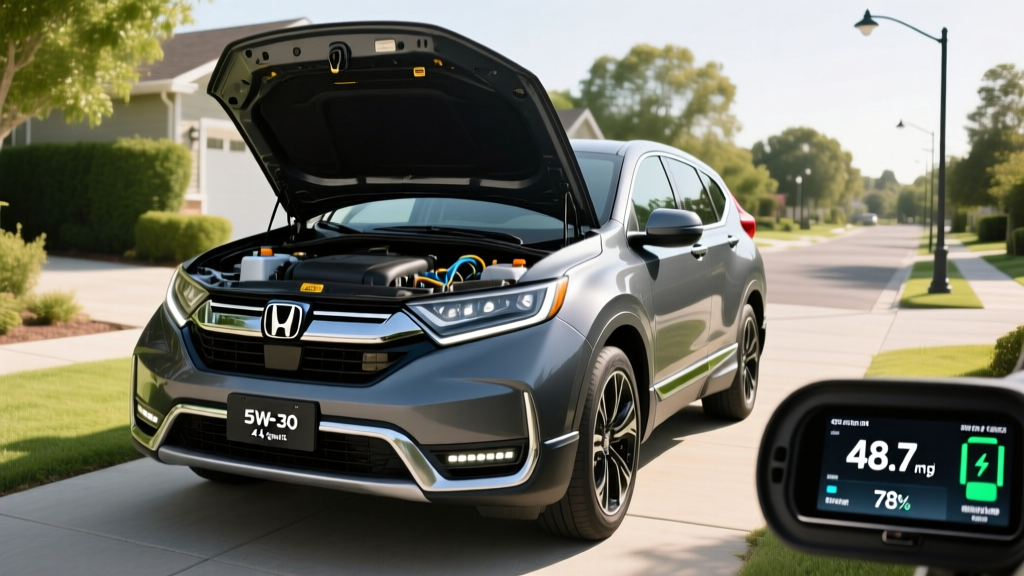
If you're looking up the 2024 Honda CR-V Hybrid oil capacity, here's the exact figure: 3.7 quarts (3.5 liters) of 0W-20 full synthetic motor oil with an oil filter change. This applies to every CR-V Hybrid trim — the Sport, Sport-L, and Sport Touring — because they all share the same 2.0-liter Atkinson-cycle inline-4 engine paired with Honda's two-motor hybrid system.
That's slightly less than the non-hybrid CR-V's 1.5L turbo engine (which takes 3.7 quarts of 0W-20 as well, though the turbo model's oil-change interval and thermal load differ). The hybrid's naturally aspirated 2.0L runs cooler under typical city driving since the electric motors handle low-speed propulsion, which translates to less thermal stress on the oil over time.
Honda's Maintenance Minder system will alert you when oil service is due — typically between 7,500 and 10,000 miles depending on driving conditions. Don't ignore the wrench icon on the dash; hybrid engines still need clean oil for the internal combustion side of the powertrain.
How Many MPG Does the 2024 CR-V Hybrid Actually Get?
The EPA rates the 2024 Honda CR-V Hybrid as follows:
| Drivetrain | City MPG | Highway MPG | Combined MPG |
|---|---|---|---|
| FWD (Sport, Sport-L) | 43 | 36 | 40 |
| AWD (Sport, Sport-L, Sport Touring) | 40 | 34 | 37 |
Source: fueleconomy.gov
Real-World MPG vs. EPA Sticker
Hybrids like the CR-V tend to exceed their EPA city rating in stop-and-go traffic because regenerative braking recovers energy that a gas car wastes as heat. In real-world testing by owners and automotive publications, FWD CR-V Hybrids regularly report 42–46 MPG in urban driving.
Highway efficiency tells a different story. At sustained 70+ mph speeds, the electric motors contribute less and the 2.0L engine carries the load — expect 32–35 MPG on the highway with AWD, slightly below the EPA sticker. Cold weather (below 35°F) knocks another 2–4 MPG off combined figures because the engine runs more frequently to heat the cabin and maintain battery temperature.
For a realistic combined expectation: 38–42 MPG for FWD, 35–38 MPG for AWD in moderate climates with mixed driving.
Powertrain Specs: Engine, Motors, and Combined Output
The 2024 CR-V Hybrid uses Honda's fourth-generation two-motor hybrid system. Here's the full breakdown:
| Specification | Value |
|---|---|
| Engine | 2.0L Atkinson-cycle DOHC inline-4 |
| Engine Horsepower | 145 hp @ 6,100 rpm |
| Engine Torque | 138 lb-ft @ 4,500 rpm |
| Electric Motor Output | 181 hp / 247 lb-ft |
| Combined System Horsepower | 204 hp |
| Combined System Torque | 247 lb-ft |
| Transmission | e-CVT (direct drive, no traditional gears) |
| 0–60 mph | ~7.6 seconds (AWD) |
| Hybrid Battery | ~1.06 kWh lithium-ion (non-plug-in) |
| Oil Capacity | 3.7 quarts (0W-20 full synthetic) |
The combined 204 hp is a meaningful upgrade over the non-hybrid CR-V's 190 hp from its 1.5L turbo. More importantly, the electric motors deliver instant torque from a stop, which makes the hybrid feel quicker in city driving than the 0–60 time suggests. The e-CVT has no rubber-band effect like older Toyota hybrid systems — Honda's system uses a lock-up clutch at highway speeds to create a direct mechanical connection between engine and wheels.
This Is a Conventional Hybrid (HEV) — Not a Plug-In
The 2024 Honda CR-V Hybrid is a conventional hybrid electric vehicle (HEV). It does not have a plug, cannot charge from a wall outlet, and has no meaningful electric-only driving range. The small ~1.06 kWh battery charges exclusively through regenerative braking and the gasoline engine.
A plug-in hybrid (PHEV) like the Toyota RAV4 Prime or Hyundai Tucson PHEV carries a much larger battery (typically 14–20 kWh), can be plugged in to charge, and offers 25–42 miles of electric-only driving before the gas engine starts. Honda does not currently offer a CR-V PHEV in the United States.
If you're shopping for a plug-in SUV with electric-only commuting capability, the CR-V Hybrid won't meet that need. You'd need to look at competitors like the Toyota RAV4 Prime (42 miles EV range, though availability is constrained), the Hyundai Tucson PHEV (33 miles EV range), or the Ford Escape PHEV (37 miles EV range).
Battery Warranty, Lifespan, and Replacement Cost
- Hybrid battery warranty: 8 years / 100,000 miles (10 years / 150,000 miles in CARB states including CA, CT, MA, ME, MD, NJ, NY, OR, RI, VT, WA)
- Powertrain warranty: 5 years / 60,000 miles
- Hybrid system components: 8 years / 100,000 miles
How Long Will the CR-V Hybrid Battery Last?
Honda's hybrid batteries in the CR-V, Accord, and Civic lines have shown strong longevity. Based on data from high-mileage owners and fleet usage, the lithium-ion hybrid pack typically retains 85–90% of its original capacity at 150,000 miles. Because the battery is small (~1.06 kWh) and Honda's battery management system keeps the state of charge in a narrow middle band (roughly 40–60% SoC), degradation is minimal compared to a full EV battery that cycles through wider charge ranges.
Most CR-V Hybrid batteries will outlast the vehicle's useful economic life. If a replacement is ever needed outside warranty, expect $2,000–$3,500 for a new OEM hybrid battery pack plus labor at a Honda dealer. Third-party refurbished packs are available for roughly $1,200–$1,800 from specialists, though availability for the 2024 model year will take years to develop in the aftermarket.
Overall Reliability
The CR-V Hybrid's powertrain has earned strong reliability marks. Honda's two-motor hybrid system has fewer moving parts than a conventional automatic transmission — there are no gear shifts, no torque converter, and no traditional friction brakes doing all the work (regen handles most deceleration). The IIHS named the 2024 CR-V a Top Safety Pick+ when equipped with specific headlights, and NHTSA awarded it a 5-star overall safety rating.
2024 Honda CR-V Hybrid Pricing by Trim
| Trim | Drivetrain | MSRP |
|---|---|---|
| Sport Hybrid | FWD | $34,050 |
| Sport Hybrid | AWD | $35,550 |
| Sport-L Hybrid | FWD | $36,750 |
| Sport-L Hybrid | AWD | $38,250 |
| Sport Touring Hybrid | AWD (standard) | $40,850 |
Source: Honda Newsroom. Prices exclude destination charge (~$1,350).
Does the CR-V Hybrid Qualify for a Federal Tax Credit?
No. The 2024 Honda CR-V Hybrid does not qualify for the federal §30D clean vehicle tax credit (up to $7,500). That credit is reserved for plug-in electric vehicles — battery electric vehicles (BEVs) and plug-in hybrids (PHEVs) with a minimum battery capacity of 7 kWh. The CR-V Hybrid's ~1.06 kWh battery falls far short of that threshold.
Under current IRS rules, only plug-in vehicles meeting critical-mineral sourcing, battery-component manufacturing, MSRP caps ($80,000 for SUVs), and buyer income limits qualify. Since the CR-V Hybrid can't be plugged in, it's ineligible regardless of price or income.
Some states and local utilities offer rebates for conventional hybrids, but these are uncommon and vary by jurisdiction. Check your state's energy office or utility provider for any current hybrid incentive programs.
CR-V Hybrid vs. Full EV vs. Gas CR-V: Which Fits You?
Choose the CR-V Hybrid If:
- You want 37–40 MPG without changing your fueling habits
- You don't have access to home or workplace charging
- You take frequent road trips and don't want to plan around chargers
- You want lower fuel costs with minimal upfront price premium (~$1,500 over gas models)
- You live in a region with extreme cold where EV range loss is significant
Choose a Full EV (e.g., Hyundai Ioniq 5, Tesla Model Y) If:
- You can install a Level 2 charger at home
- Your daily commute is under 250 miles round-trip
- You want to eliminate oil changes, spark plugs, and transmission fluid
- You qualify for the $7,500 federal tax credit (income and sourcing dependent)
- You want the lowest per-mile fuel cost (~$0.04–0.06/mile on home electricity)
The Math: 5-Year Fuel Cost Comparison
Assuming 15,000 miles/year and $3.50/gallon regular unleaded:
| Vehicle | Combined MPG / MPGe | 5-Year Fuel Cost |
|---|---|---|
| CR-V 1.5T Gas (AWD) | 29 MPG combined | $9,052 |
| CR-V Hybrid (AWD) | 37 MPG combined | $7,095 |
| Tesla Model Y LR AWD | 111 MPGe (home charging avg $0.14/kWh) | $3,108 |
The hybrid saves roughly $1,950 over gas in fuel alone across five years. The EV saves $5,947 over gas and $3,987 over the hybrid — but requires home charging infrastructure and a higher purchase price (partially offset by the federal tax credit where eligible).
Pros and Cons of the 2024 CR-V Hybrid
Pros
- 40 MPG combined (FWD) in a practical compact SUV
- 204 hp — more power than the gas-only CR-V
- Smooth, responsive electric-motor torque at low speeds
- No plug-in required — fuel like a normal gas car
- 8-year/100,000-mile hybrid battery warranty (10/150k in CARB states)
- Spacious cargo area: 36.3 cu ft behind rear seats, 76.5 cu ft folded
- Top Safety Pick+ (IIHS) with proper headlights
Cons
- No plug-in hybrid option — no electric-only commuting
- No federal tax credit eligibility
- AWD drops combined MPG to 37
- Highway fuel economy dips below EPA in real-world testing
- Hybrid trims start at $34,050 — premium over base gas LX ($30,850)
- No DC fast charging capability (it's not a PHEV or BEV)
Frequently Asked Questions
What oil does the 2024 Honda CR-V Hybrid use?
The 2024 CR-V Hybrid requires 0W-20 full synthetic motor oil. The oil capacity with a filter change is 3.7 quarts (3.5 liters). Using the correct viscosity is essential for the Atkinson-cycle engine's efficiency and the hybrid system's start-stop cycling, which places unique demands on oil film strength.
How often should I change the oil on a CR-V Hybrid?
Follow Honda's Maintenance Minder system. Under normal driving conditions, expect oil change intervals of 7,500–10,000 miles. The hybrid engine starts and stops frequently, which can introduce more condensation into the oil than a continuously running engine — so don't extend intervals beyond what the Maintenance Minder recommends.
Does the CR-V Hybrid have a plug or electric-only range?
No. The 2024 CR-V Hybrid is a conventional hybrid (HEV), not a plug-in hybrid (PHEV). It has a small ~1.06 kWh battery that charges through regenerative braking and the gas engine. It can creep short distances (a few hundred feet) on electric power at very low speeds, but it has no usable electric-only range for commuting. If you need electric-only driving, consider a PHEV like the Toyota RAV4 Prime or a full BEV like the Hyundai Ioniq 5.
Is the 2024 CR-V Hybrid more reliable than the gas version?
The hybrid powertrain has fewer wear-prone components than the gas CR-V's 1.5L turbo engine and CVT. There's no turbocharger to fail, no traditional transmission with wear components, and regenerative braking extends the life of the friction brake pads significantly (many hybrid owners report original brake pads at 80,000+ miles). Honda's hybrid system has a strong track record across the Accord and CR-V lineups.
What is the towing capacity of the CR-V Hybrid?
The 2024 CR-V Hybrid is rated to tow 1,000 pounds across all trims. This is less than the gas-only CR-V's 1,500-pound rating. If you regularly tow a small trailer or jet ski, the gas model has a slight edge, though neither version is suited for heavy towing.
Can I get a tax credit for buying the CR-V Hybrid?
The federal §30D clean vehicle credit (up to $7,500) does not apply to conventional hybrids. It's reserved for plug-in vehicles with at least 7 kWh of battery capacity. The CR-V Hybrid's ~1.06 kWh pack doesn't qualify. Check your state and local utility for any hybrid-specific rebates, but these are rare in most jurisdictions as of 2026.