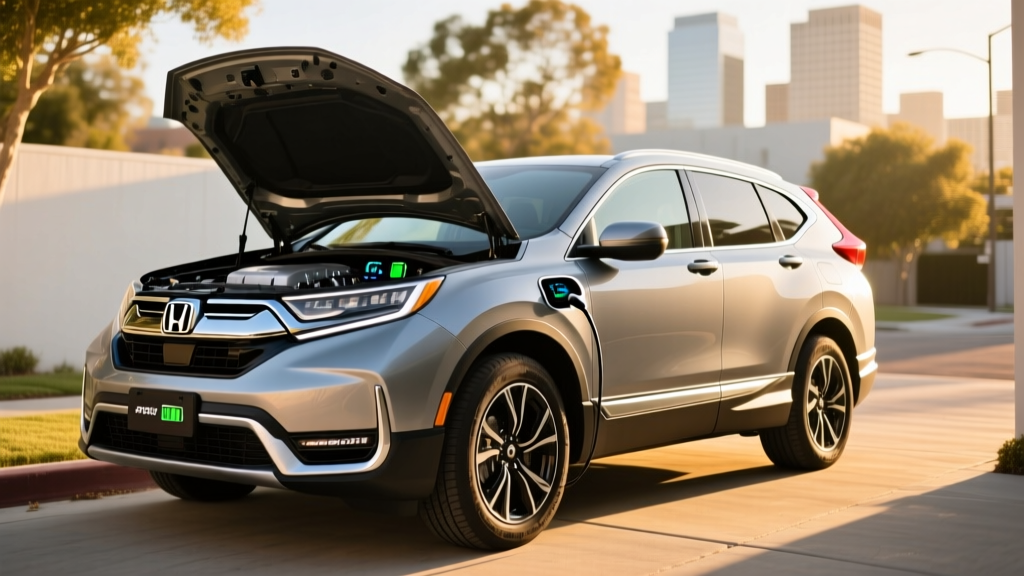
The 2024 Honda CR-V Hybrid Sport Touring sits at the top of Honda's compact SUV hybrid lineup, pairing a turbocharged 1.5-liter engine with a dual-motor hybrid system for an EPA-estimated 40 MPG combined. As a conventional hybrid (HEV), it requires no plug, no range anxiety, and no charging infrastructure — just gas it up and drive. But does the real-world fuel economy match the sticker? And how does this trim compare to stepping up to a PHEV or full EV? This guide covers every spec that matters.
HEV vs PHEV vs EV: Where the CR-V Hybrid Fits
Before diving into specs, it's critical to understand what the CR-V Hybrid is — and what it isn't. Honda offers the CR-V in three powertrain flavors for 2024: a conventional gas turbo, a conventional hybrid (HEV), and no plug-in hybrid variant in the US market. (Honda does sell the Clarity PHEV separately, but the CR-V lineup has never included a PHEV in North America.)
Conventional Hybrid (HEV) vs Plug-In Hybrid (PHEV) vs Battery Electric (BEV)
| Attribute | HEV (CR-V Hybrid) | PHEV (e.g., Toyota RAV4 Prime) | BEV (e.g., Tesla Model Y) |
|---|---|---|---|
| Plug-in charging | No — gas only | Yes — Level 1/2 | Yes — Level 1/2/DC |
| Electric-only range | Minimal (low-speed creep) | 25–42 miles typical | 250–330 miles (EPA) |
| Fuel/energy source | Gasoline | Gasoline + grid electricity | Grid electricity only |
| Tailpipe emissions | Yes | Yes (when engine runs) | None |
| Federal tax credit (§30D) | Not eligible | Up to $7,500 (varies) | Up to $7,500 (varies) |
| Starting price range | ~$34,000–$41,000 | ~$43,000–$50,000 | ~$38,000–$55,000 |
The CR-V Hybrid Sport Touring is a self-charging HEV. Its small lithium-ion battery pack (roughly 1.1 kWh usable) recharges exclusively through regenerative braking and the gasoline engine. You cannot plug it in. This is a feature, not a limitation — it means zero dependency on charging infrastructure and identical behavior whether you live in a condo without a garage or a rural area with no public chargers.
Fuel Economy: EPA Estimates and Real-World MPG
The 2024 CR-V Hybrid Sport Touring comes standard with all-wheel drive (AWD), which slightly reduces efficiency versus the front-wheel-drive hybrid trims. Here's the EPA-verified breakdown from fueleconomy.gov:
| Driving Cycle | EPA Estimate (AWD) | FWD Hybrid (lower trims) |
|---|---|---|
| City | 40 MPG | 43 MPG |
| Highway | 34 MPG | 36 MPG |
| Combined | 37 MPG | 40 MPG |
| Annual fuel cost* | ~$1,550 | ~$1,450 |
*Based on 15,000 miles/year and $3.50/gallon regular unleaded. Actual costs vary with local fuel prices.
Real-World MPG vs EPA Sticker
Conventional hybrids like the CR-V tend to exceed their EPA city estimate in stop-and-go traffic because regenerative braking recovers more energy in urban driving. Owners on Fuelly and Edmunds forums report sustained city driving in the 42–46 MPG range. Highway driving is where hybrids lose their advantage — expect 31–34 MPG at sustained 70–75 mph speeds, particularly with roof cargo or in cold weather. A realistic blended expectation for mixed driving is 36–40 MPG, closely tracking the EPA combined figure.
Powertrain Specs: 204 HP Dual-Motor Hybrid System
The CR-V Hybrid uses Honda's fourth-generation two-motor hybrid system, which is fundamentally different from Toyota's planetary-gear eCVT approach. Honda's system can decouple the engine from the wheels entirely at low speeds, running as a series hybrid (engine generates electricity, motors drive the wheels), then switches to a direct-drive clutch at highway speeds where the engine is more efficient.
| Specification | 2024 CR-V Hybrid Sport Touring |
|---|---|
| Engine | 2.0L Atkinson-cycle inline-4 |
| Engine output | 145 hp @ 6,100 rpm / 138 lb-ft torque |
| Drive motors | Dual electric motors |
| Motor output | 184 hp / 247 lb-ft torque |
| Combined system output | 204 hp / 247 lb-ft torque |
| Transmission | Direct-drive (eCVT, no fixed gears) |
| Drivetrain | AWD (standard on Sport Touring) |
| 0–60 mph | ~7.6 seconds (Car and Driver tested) |
| Towing capacity | 1,000 lbs |
| Battery type | Lithium-ion (approx. 1.1 kWh usable) |
| Plug-in capable | No (HEV only) |
The 204-hp combined output puts the CR-V Hybrid ahead of the non-hybrid 1.5L turbo CR-V (190 hp) and gives it confident merging power. The electric motors provide instant torque from a stop, which makes the hybrid feel quicker in city driving than the 0–60 number suggests. The AWD system uses a rear-mounted electric motor rather than a mechanical driveshaft, reducing parasitic loss.
Pricing, Trims, and Tax Credit Eligibility
The 2024 CR-V Hybrid is available in four trims. The Sport Touring is the range-topper:
| Trim | Drivetrain | MSRP | EPA Combined MPG |
|---|---|---|---|
| Sport Hybrid | FWD or AWD (+$1,500) | $34,795 (FWD) | 40 / 37 |
| Sport-L Hybrid | FWD or AWD (+$1,500) | $37,795 (FWD) | 40 / 37 |
| Sport Touring Hybrid | AWD (standard) | $40,895 | 37 |
Federal tax credit: The CR-V Hybrid is a conventional HEV, not a plug-in vehicle. Under current IRS §30D rules, the federal clean vehicle credit of up to $7,500 applies only to BEVs and PHEVs with plug-in capability and minimum battery capacity (7 kWh). The CR-V Hybrid does not qualify for the federal EV tax credit.
However, some states offer separate incentives for hybrid purchases, and the CR-V Hybrid's lower MSRP means lower registration fees and insurance premiums compared to equivalent PHEVs or BEVs. Check your state's energy office or AFDC state incentive database for local hybrid rebates — a handful of states still offer $500–$1,000 HEV incentives.
Battery Warranty, Reliability, and Replacement Cost
Honda Hybrid Battery Warranty
- Hybrid battery: 8 years / 100,000 miles (10 years / 150,000 miles in CARB states including CA, NY, MA, and others)
- Powertrain warranty: 5 years / 60,000 miles
- Limited vehicle warranty: 3 years / 36,000 miles
The hybrid battery warranty covers capacity loss below a Honda-defined threshold and any manufacturing defects. Honda's hybrid batteries have proven durable — fourth-gen systems in the Accord Hybrid and CR-V Hybrid show minimal degradation in owner reports at 100,000+ miles.
Battery replacement cost: If the hybrid battery fails outside warranty, a replacement from Honda runs approximately $2,000–$3,500 including labor. This is significantly less than a full EV battery replacement ($8,000–$20,000) because the CR-V Hybrid's pack is small (~1.1 kWh vs 60–80+ kWh in a BEV). Third-party refurbishers offer replacements for $1,200–$2,000.
Reliability track record: Honda's hybrid system has been in production since the Insight (1999) and the two-motor architecture since 2014. The CR-V Hybrid specifically has been on sale since 2020 (refreshed for 2023/2024). IIHS awarded the 2024 CR-V a Top Safety Pick rating. Consumer Reports rates Honda hybrid reliability as average to above-average, with the hybrid components showing lower failure rates than conventional transmissions.
Sport Touring Trim: What You Get for $40,895
The Sport Touring Hybrid is the most equipped CR-V Hybrid and adds meaningful features over the Sport-L:
- Standard AWD (mechanical rear motor drive)
- 19-inch alloy wheels (dark finish)
- Hands-free power tailgate with walk-away close
- Wireless Apple CarPlay and Android Auto
- Bose premium 12-speaker audio system
- Wireless phone charging pad
- Heated steering wheel and heated rear seats
- Low-speed braking control and traffic sign recognition
- Honda Sensing suite (adaptive cruise, lane-keeping, collision mitigation)
- Leather-trimmed seats with orange contrast stitching
- Rain-sensing wipers and auto-dimming rearview mirror
The Honda Sensing suite is a Level 2 driver-assist system under SAE classification. It provides adaptive cruise control with low-speed follow, lane-centering assist, and automatic emergency braking — but requires the driver to remain fully engaged at all times. It is not a self-driving system.
Who Should Buy the CR-V Hybrid Sport Touring?
Choose the CR-V Hybrid Sport Touring if:
- You want 37–40 MPG without changing your fueling habits (no plug needed)
- You live in an apartment or area without reliable home or public charging access
- You want AWD capability with minimal fuel-economy penalty
- You prioritize proven reliability and low maintenance costs over maximum electrification
- You want a loaded compact SUV under $42,000 before destination fees
Consider a PHEV (like the RAV4 Prime) instead if:
- You have home charging and a commute under 40 miles round-trip
- You want electric-only daily driving with gas-engine backup for road trips
- You want to claim the federal §30D tax credit (up to $7,500, eligibility varies)
Consider a full EV (like the Hyundai Ioniq 5 or Tesla Model Y) if:
- You have reliable Level 2 home charging
- Your daily driving is under 200 miles and you take occasional road trips
- You want zero tailpipe emissions and the lowest per-mile fuel cost (~$0.04/mile vs ~$0.10/mile hybrid)
- You want to maximize federal and state tax incentives
Pros and Cons at a Glance
Pros
- 37–40 MPG combined with no plug-in requirement
- 204 hp provides confident acceleration for the class
- Standard AWD on Sport Touring with minimal efficiency penalty
- Strong safety ratings (IIHS Top Safety Pick)
- 8-year/100,000-mile hybrid battery warranty (10 yr in CARB states)
- Low battery replacement cost ($2,000–$3,500) if needed out of warranty
- Well-equipped Sport Touring trim under $41,000
Cons
- No federal tax credit eligibility (HEV, not PHEV/BEV)
- Highway MPG drops to 31–34 at sustained 70+ mph
- 1,000-lb towing capacity limits utility
- 1.1 kWh battery means no meaningful electric-only driving range
- AWD-only on Sport Touring removes FWD efficiency option (40 MPG combined)
- Cargo space slightly reduced vs non-hybrid due to battery placement (~36.3 cu ft behind rear seats)
Frequently Asked Questions
How many MPG does the 2024 Honda CR-V Hybrid Sport Touring get?
The EPA rates the AWD Sport Touring Hybrid at 40 MPG city, 34 MPG highway, and 37 MPG combined. Real-world city driving often exceeds the EPA city estimate, reaching 42–46 MPG in stop-and-go traffic. Highway driving at sustained speeds typically returns 31–34 MPG.
Does the CR-V Hybrid need to be plugged in?
No. The CR-V Hybrid is a conventional hybrid (HEV), not a plug-in hybrid (PHEV). Its small battery recharges through regenerative braking and the gasoline engine. You fuel it exclusively at a gas station.
Does the 2024 CR-V Hybrid qualify for any tax credit?
The CR-V Hybrid does not qualify for the federal §30D clean vehicle tax credit, which requires plug-in capability and a minimum 7 kWh battery. Some states offer separate hybrid purchase rebates — check your state energy office for current programs.
How long will the CR-V Hybrid battery last?
Honda covers the hybrid battery for 8 years/100,000 miles (10 years/150,000 miles in CARB states). Based on Honda's track record with hybrid systems since 2014, these batteries commonly last 150,000–200,000+ miles before significant degradation. Out-of-warranty replacement costs approximately $2,000–$3,500.
How does the CR-V Hybrid compare to the RAV4 Hybrid?
The Toyota RAV4 Hybrid AWD is rated at 41 MPG combined (vs 37 for the CR-V Sport Touring AWD) and starts slightly lower. The CR-V Hybrid counters with more horsepower (204 vs 219 combined for RAV4), a more premium interior in the Sport Touring trim, and Honda's driving dynamics. Both are strong choices — the RAV4 Hybrid edges on efficiency, the CR-V Hybrid Sport Touring on refinement and features.
Is the CR-V Hybrid Sport Touring a good value?
At $40,895 MSRP (before destination), the Sport Touring includes AWD, Bose audio, wireless connectivity, leather, heated rear seats, and the full Honda Sensing suite. Comparable non-hybrid luxury compact SUVs cost $5,000–$10,000 more for similar equipment. The 37 MPG combined saves approximately $400–$600/year in fuel versus the non-hybrid CR-V AWD (28 MPG combined), making the hybrid premium worthwhile for most owners within 2–3 years.