Quick Verdict: The 2024 CR-V Hybrid at a Glance
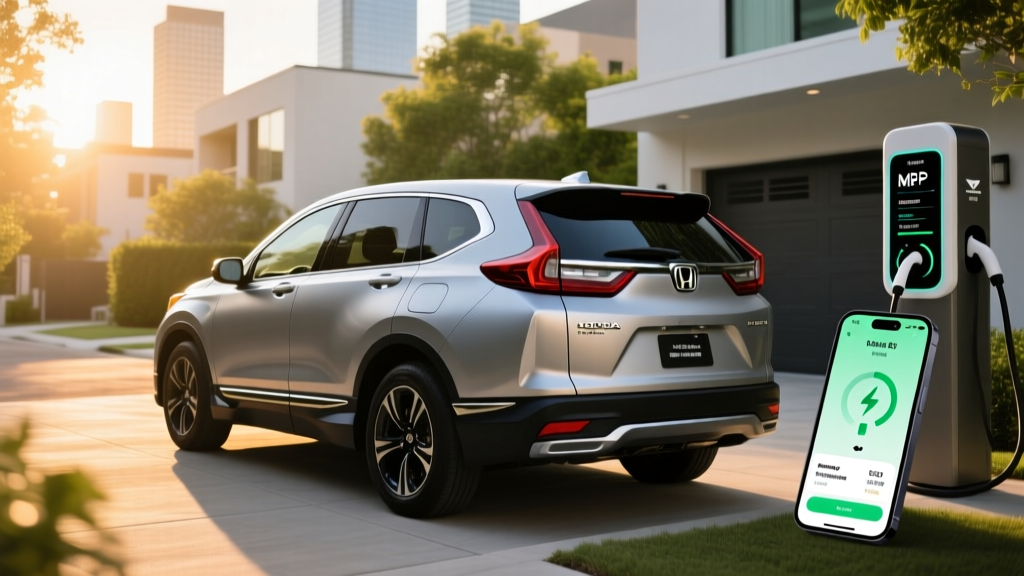
The 2024 Honda CR-V Hybrid is a conventional hybrid electric vehicle (HEV) — not a plug-in. It requires no charging infrastructure, runs on gasoline, and uses a compact battery recharged through regenerative braking and engine power. For 2024, Honda made the hybrid powertrain available on three upper trims (Sport, Sport-L, and Sport Touring), pairing a 2.0-liter Atkinson-cycle four-cylinder with two electric motors for a combined output of 204 horsepower.
The headline number is the EPA-estimated 40 MPG combined for front-wheel-drive models, making it one of the most efficient compact crossovers on the market. But as with any hybrid, real-world results depend heavily on your driving mix — and there are important nuances buyers should understand before signing a deal.
Fuel Economy: EPA Ratings vs. Real-World MPG
| Configuration | City | Highway | Combined |
|---|---|---|---|
| FWD (Sport, Sport-L) | 43 MPG | 36 MPG | 40 MPG |
| AWD (Sport, Sport-L, Sport Touring) | 40 MPG | 34 MPG | 37 MPG |
Source: EPA / fueleconomy.gov
Real-World MPG: What to Actually Expect
Hybrid powertrains shine in stop-and-go city driving, where regenerative braking recovers energy that would otherwise be lost. The CR-V Hybrid's 43 MPG city rating (FWD) is significantly higher than its 36 MPG highway figure — the opposite pattern of a conventional gas car.
Based on aggregated owner reports and third-party testing, here's what to expect in real-world conditions:
- City / suburban commuting: 38–45 MPG (FWD). Many owners report exceeding the EPA city estimate in moderate-temperature stop-and-go traffic, where the electric motors handle low-speed propulsion and the engine operates in its most efficient range.
- Highway cruising (70–80 mph): 31–35 MPG. At sustained highway speeds, the gasoline engine does most of the work, and aerodynamic drag reduces efficiency. Expect numbers at or slightly below the EPA highway rating.
- Cold weather (below 35°F): 30–36 MPG combined. The engine runs more frequently to generate cabin heat and maintain battery temperature, reducing hybrid system efficiency by roughly 15–20%.
- Mixed driving (annual average): Most owners report 36–40 MPG combined, closely tracking EPA estimates for FWD models. AWD models tend to land in the 33–37 MPG range.
Powertrain Specs: How the Hybrid System Works
| Specification | Detail |
|---|---|
| Engine | 2.0L DOHC Atkinson-cycle 4-cylinder |
| Engine Power | 145 hp @ 6,100 rpm |
| Electric Motors | Two-motor hybrid system (propulsion + generator) |
| Motor Power | 181 hp / 247 lb-ft torque (propulsion motor) |
| Combined System Output | 204 hp / 247 lb-ft torque |
| Transmission | e-CVT (electrically variable, no fixed gears) |
| Drivetrain | FWD standard; AWD available (rear motor-driven) |
| Hybrid Battery | ~1.06 kWh lithium-ion (not plug-in) |
| 0–60 mph | ~7.6 seconds (AWD tested) |
| Towing Capacity | 1,000 lbs |
Honda's two-motor hybrid system operates differently from a traditional parallel hybrid like Toyota's. In most driving conditions below ~45 mph, the gasoline engine acts as a generator, producing electricity that powers the propulsion motor. The engine only directly drives the wheels at higher cruising speeds through a lock-up clutch. This means the CR-V Hybrid drives more like an EV in everyday city conditions — smooth, responsive, and quiet — with the engine seamlessly transitioning to direct drive on the highway.
The AWD system uses a separate rear-mounted electric motor rather than a mechanical driveshaft, which allows for precise torque distribution and contributes to the minimal fuel economy penalty versus FWD (only 3 MPG combined).
Pricing by Trim and Tax Credit Eligibility
| Trim | Drivetrain | MSRP (incl. destination) |
|---|---|---|
| Sport | FWD | $35,395 |
| Sport | AWD | $36,895 |
| Sport-L | AWD | $38,395 |
| Sport Touring | AWD | $42,195 |
Source: Honda.com. Prices shown are original 2024 MSRP including $1,345 destination charge.
Does the CR-V Hybrid Qualify for a Federal Tax Credit?
No. The 2024 CR-V Hybrid does not qualify for the federal §30D Clean Vehicle Credit. That credit — up to $7,500 — applies only to plug-in electric vehicles (BEVs and PHEVs) that meet battery sourcing, critical minerals, MSRP caps, and buyer income requirements as defined by the IRS.
Because the CR-V Hybrid is a conventional HEV with no plug-in capability and a battery far below the 7 kWh threshold required by §30D, it is ineligible for the federal EV credit, the used-EV credit, or any federal plug-in incentive.
Some states and localities offer rebates or HOV lane access for hybrid vehicles, but these programs vary widely and change frequently. Check your state energy office or department of environmental quality for current offerings. Do not rely on outdated incentive lists — verify eligibility before purchase.
Hybrid vs. PHEV vs. Full EV: Which Fits Your Situation?
The CR-V Hybrid competes in a space where buyers are also considering plug-in hybrids (like the RAV4 Prime) and full battery-electric vehicles (like the Hyundai Ioniq 5 or Tesla Model Y). The right choice depends on your charging access, daily mileage, and willingness to adapt.
| Factor | HEV (CR-V Hybrid) | PHEV (RAV4 Prime) | BEV (Ioniq 5 / Model Y) |
|---|---|---|---|
| Plug-in required? | No | Yes (for full benefit) | Yes |
| Electric-only range | ~1 mi (low speed) | 25–42 mi | 250–330 mi |
| Home charging needed? | No | Recommended (120V works) | Essential (240V Level 2) |
| Federal tax credit | None | Up to $7,500* | Up to $7,500* |
| Fuel cost per mile | ~$0.09–0.11 | ~$0.04–0.10 | ~$0.03–0.06 |
| Road-trip convenience | Excellent (gas stations) | Excellent (gas backup) | Good (requires DC planning) |
*§30D credit subject to MSRP caps, buyer income limits, battery sourcing rules. Verify at IRS.gov.
- Choose the CR-V Hybrid (HEV) if: You don't have reliable home charging access (apartment, street parking, no garage), you want zero behavior change from your current gas car, or you regularly take long road trips and don't want to plan charging stops.
- Choose a PHEV if: You can install a Level 2 charger at home, your daily commute is under 35 miles (covering most trips on electricity), but you still want a gas engine for weekend road trips without charging anxiety.
- Choose a full BEV if: You have home Level 2 charging, your daily driving is under 200 miles, you want the lowest per-mile fuel cost, and you're willing to plan DC fast-charging stops on longer trips.
Battery Warranty, Lifespan, and Replacement Cost
The CR-V Hybrid's lithium-ion battery pack is approximately 1.06 kWh — far smaller than a BEV or PHEV battery. Because it's a conventional hybrid, the battery operates in a narrow state-of-charge window (roughly 40–60% SoC), which significantly reduces degradation stress. The battery never fully charges or fully depletes during normal operation, which is the primary reason hybrid batteries tend to last the life of the vehicle.
What Happens When a Hybrid Battery Fails?
Based on long-term data from Honda's hybrid systems (shared with the Accord Hybrid and Insight), outright battery failure before 150,000 miles is uncommon. When it does occur outside warranty, here are the economics:
- OEM replacement battery: $2,000–$3,500 (parts + labor at a Honda dealer)
- Refurbished / aftermarket battery: $1,200–$2,000 (installed)
- Individual cell replacement: Some independent hybrid specialists can replace failed cells within the pack for $500–$1,000, though this is less common for Honda than for Toyota Prius batteries
For context, the CR-V Hybrid's battery is far less expensive to replace than a BEV traction battery (which can cost $8,000–$20,000+). The small capacity means lower material cost, and the pack is more accessible for service.
Long-Term Reliability Indicators
Honda's two-motor hybrid system has been in production since 2014 (Accord Hybrid) and has demonstrated strong reliability in fleet and owner data. The system has fewer moving parts than a conventional automatic transmission — there's no torque converter, no multi-speed gearbox, and no traditional starter motor. The e-CVT design eliminates shift-related wear points.
The NHTSA lists recalls and technical service bulletins for the 2024 CR-V Hybrid. As of this writing, there are no widespread battery-related recalls for this model year. The vehicle earned strong safety ratings, including top marks in crash testing.
Pros and Cons: Honest Assessment
Pros
- 40 MPG combined (FWD) — best-in-class for the segment
- Smooth EV-like driving feel at city speeds
- No charging infrastructure required
- 204 hp provides confident acceleration and merging
- Spacious interior: 39.3 cu ft cargo behind rear seats
- Strong safety ratings and Honda Sensing ADAS standard
- AWD available with minimal fuel economy penalty
- Hybrid battery warranty: 8 yr/100k mi (10/150k in CARB states)
Cons
- No plug-in option — can't access EV-only commuting or federal tax credit
- Highway MPG drops to 34–36 (less advantage over gas at sustained speed)
- 1,000-lb towing capacity is low for the segment
- Hybrid trims start at $35,395 — a $4,000+ premium over gas LX
- Engine drone under hard acceleration (e-CVT characteristic)
- No spare tire (tire inflator kit only)
- Regenerative braking feel takes adjustment; no true one-pedal mode
CR-V Hybrid vs. Key Competitors
| Spec | 2024 CR-V Hybrid (FWD) | 2024 RAV4 Hybrid (FWD) | 2024 Tucson Hybrid (FWD) |
|---|---|---|---|
| Combined MPG | 40 | 39 | 38 |
| Combined HP | 204 | 219 | 226 |
| Starting MSRP (Hybrid) | $35,395 | $32,325 | $33,690 |
| Cargo (rear seats up) | 39.3 cu ft | 37.5 cu ft | 38.7 cu ft |
| PHEV Option Available? | No | Yes (RAV4 Prime) | Yes (Tucson PHEV) |
| Battery Warranty | 8 yr / 100k mi | 10 yr / 150k mi | 10 yr / 100k mi |
The CR-V Hybrid leads on combined fuel economy and cargo space, but Toyota's RAV4 Hybrid undercuts it on price by over $3,000 and offers the RAV4 Prime PHEV variant for buyers wanting plug-in capability. Hyundai's Tucson Hybrid sits in the middle on price and power but trails slightly on efficiency.
Frequently Asked Questions
How many MPG does the 2024 CR-V Hybrid actually get?
The EPA rates the FWD model at 43 city / 36 highway / 40 combined, and the AWD model at 40 city / 34 highway / 37 combined. In real-world driving, most owners report 36–42 MPG combined depending on their city/highway mix and climate. City-heavy commutes in mild weather tend to yield the highest numbers, often exceeding the EPA estimate.
Can I plug in the CR-V Hybrid to charge it?
No. The 2024 CR-V Hybrid is a conventional hybrid (HEV), not a plug-in hybrid (PHEV). It has no charging port. The battery recharges exclusively through regenerative braking and the gasoline engine. If you want plug-in capability, you need to look at vehicles like the Toyota RAV4 Prime, Hyundai Tucson PHEV, or a full battery-electric vehicle.
How far can the CR-V Hybrid drive on electric power alone?
Effectively less than one mile, and only at very low speeds (under 25 mph) with a light throttle. The hybrid system uses electric propulsion frequently in stop-and-go traffic, but the ~1.06 kWh battery is far too small for meaningful electric-only range. The system is designed for efficiency assistance, not electric driving.
Is the hybrid battery reliable, and what does replacement cost?
Honda's hybrid battery systems have a strong reliability track record. The battery is covered by an 8-year / 100,000-mile warranty (10 years / 150,000 miles in CARB states). Out-of-warranty replacement typically costs $2,000–$3,500 for an OEM pack, or $1,200–$2,000 for a refurbished unit. Most hybrid batteries last well beyond 150,000 miles because the system keeps them in a narrow, low-stress charge window.
Does the CR-V Hybrid qualify for any federal tax credit?
No. The federal §30D Clean Vehicle Credit requires a plug-in vehicle with a battery of at least 7 kWh. The CR-V Hybrid's ~1.06 kWh battery and lack of plug-in capability make it ineligible. No conventional hybrid qualifies for this credit. Some states offer separate hybrid incentives, but these vary by jurisdiction — check your state's energy office for current programs.
Is the CR-V Hybrid worth the premium over the gas model?
The hybrid trims start roughly $4,000–$5,000 above the gas-only LX and EX trims. At 40 MPG versus the gas model's 30 MPG combined, and assuming $3.50/gallon fuel with 15,000 miles/year, the hybrid saves approximately $580 per year in fuel costs. That means the premium pays back in roughly 7–9 years at current fuel prices. If you plan to keep the vehicle long-term, value the smoother acceleration, and drive predominantly in city conditions, the hybrid is the stronger choice. If you drive mostly highway miles and plan to trade in within 4–5 years, the gas model may make more financial sense.
How does AWD affect fuel economy and performance?
The AWD system costs 3 MPG combined (37 vs. 40) and adds roughly $1,500 to the Sport trim price. It uses a rear electric motor rather than a mechanical driveshaft, so the efficiency penalty is smaller than a traditional AWD system. For buyers in snow-belt states, the AWD hybrid is a compelling package — you get all-weather traction with fuel economy that still beats most FWD gas crossovers.