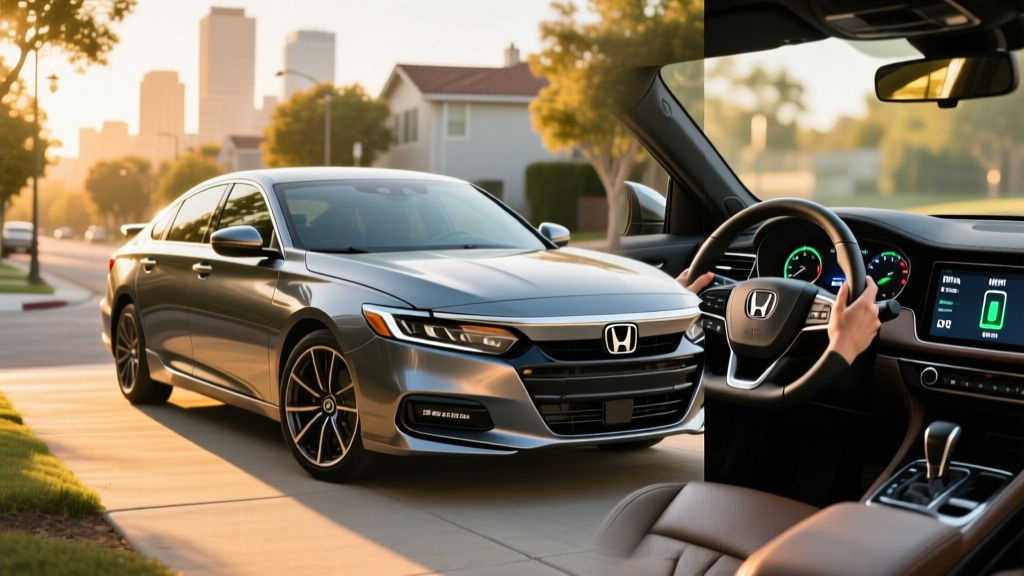
The 2024 Honda Accord Hybrid Sport-L occupies a specific niche: it's the sportiest trim in Honda's hybrid-only Accord lineup, pairing a leather-trimmed interior with the brand's fourth-generation two-motor hybrid system. For buyers cross-shopping between a full EV, a plug-in hybrid, and a conventional hybrid, this sedan makes a compelling case — especially if home charging access is uncertain. Below, we break down the exact specs, real-world efficiency, ownership costs, and where the Accord Hybrid Sport-L fits in the 2024-2026 electrified sedan market.
Quick Verdict: Who the Accord Hybrid Sport-L Is For
Choose the Accord Hybrid Sport-L if: You want 48 MPG combined without ever plugging in, you drive 12,000-15,000 miles/year mostly in mixed city/highway conditions, and you want a midsize sedan with Honda Sensing safety tech and leather-trimmed seats under $40,000.
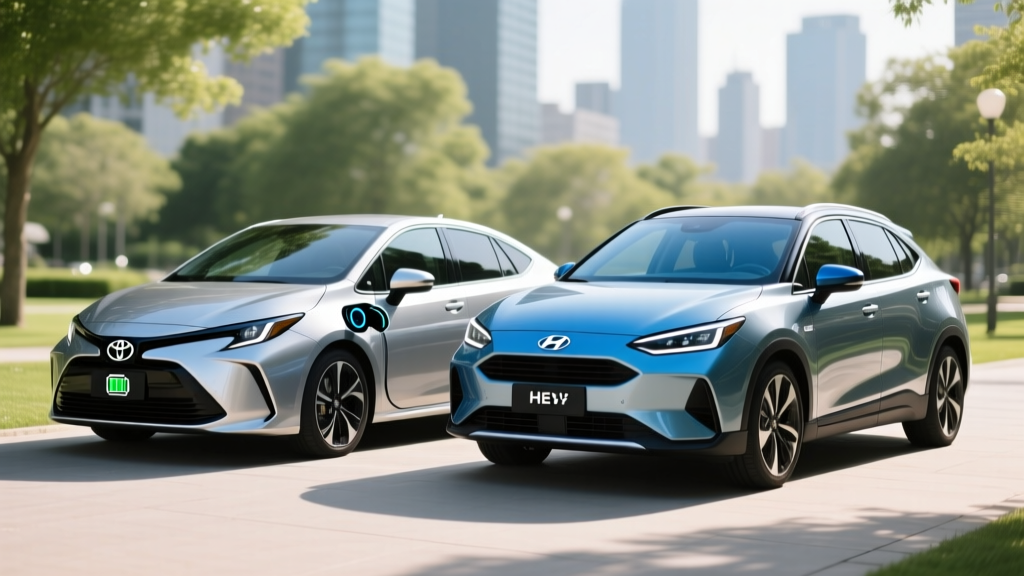
Look at a PHEV (like the Toyota Prius Prime) if: You have reliable home Level 2 charging and want 30-40 miles of electric-only daily commuting with a gas backup for road trips.
Look at a full EV (like the Hyundai Ioniq 6) if: You have home charging, your daily commute is under 60 miles round-trip, and you want to eliminate gasoline entirely.
HEV vs PHEV vs EV: Where the Accord Hybrid Fits
The 2024 Accord Hybrid Sport-L is a conventional hybrid electric vehicle (HEV). This is a critical distinction that buyers sometimes confuse:
| Feature | HEV (Accord Hybrid) | PHEV (e.g., Prius Prime) | BEV (e.g., Ioniq 6) |
|---|---|---|---|
| Plug-in required? | No — self-charging via regen & engine | Yes — Level 1 or Level 2 | Yes — Level 2 or DC fast |
| Electric-only range | ~1 mile at low speed | 30-44 miles | 270-360 miles (full battery) |
| Fuel/energy source | Gasoline only | Gasoline + electricity | Electricity only |
| EPA combined efficiency | 48 MPG | 52 MPG + 127 MPGe (elec) | 117-140 MPGe |
| Total range | ~560 miles | ~600+ miles combined | 270-360 miles |
| §30D Federal Tax Credit | Not eligible | Up to $7,500 (if eligible) | Up to $7,500 (if eligible) |
| Home charging install | None needed | $500-$2,000 (Level 2) | $500-$3,000+ (Level 2) |
The Accord Hybrid's two-motor system recovers energy during braking and deceleration, storing it in a small lithium-ion battery that assists the gasoline engine. You never plug it in — it operates exactly like a conventional car at the pump, just with dramatically better fuel economy, particularly in stop-and-go traffic where the electric motor does the heavy lifting.
Fuel Economy: EPA Ratings and Real-World MPG
The EPA rates the 2024 Honda Accord Hybrid (all trims, including Sport-L) at the following figures, per fueleconomy.gov:
| Driving Cycle | EPA Rating | Real-World Expectation |
|---|---|---|
| City | 51 MPG | 48-55 MPG (hybrids often beat EPA in city) |
| Highway | 44 MPG | 40-46 MPG (varies with speed and terrain) |
| Combined | 48 MPG | 45-50 MPG depending on driving mix |
Why city MPG exceeds highway: Conventional hybrids like the Accord recapture kinetic energy during braking and low-speed driving, using the electric motor to launch from stops — precisely where gasoline engines are least efficient. On sustained highway cruising at 70-80 mph, the 1.5L turbocharged engine carries most of the load, reducing the hybrid advantage.
Real-world variables to expect:
- Cold weather (below 40°F): Expect a 5-10% MPG reduction as the engine runs more frequently for cabin heat and battery warm-up.
- Aggressive driving: Hard acceleration bypasses the efficient Atkinson-cycle operation, dropping observed MPG into the low 40s.
- Hilly terrain: Regenerative braking on descents partially offsets climbing consumption, but net MPG typically drops 3-5 MPG in mountainous routes.
Powertrain: Two-Motor Hybrid System Specs
| Specification | 2024 Accord Hybrid Sport-L |
|---|---|
| Engine | 2.0L DOHC 4-cylinder (Atkinson cycle) |
| Engine horsepower | 146 HP @ 6,100 rpm |
| Engine torque | 134 lb-ft @ 4,500 rpm |
| Electric drive motor | 181 HP / 247 lb-ft |
| Combined system output | 204 HP |
| Transmission | e-CVT (direct-drive, no fixed gears) |
| Drivetrain | Front-wheel drive |
| 0-60 mph (est.) | ~7.2 seconds |
| Fuel tank capacity | 12.4 gallons |
| Total driving range | ~595 miles (at 48 MPG combined) |
| Hybrid battery | ~1.06 kWh lithium-ion (NMC chemistry) |
Honda's fourth-generation hybrid system uses the electric drive motor as the primary motivator at low and moderate speeds. The 2.0L engine primarily acts as a generator, producing electricity for the drive motor. Only at sustained highway speeds does a lock-up clutch mechanically link the engine to the wheels for direct drive — a design that maximizes efficiency across the widest possible speed range.
Note that the Accord Hybrid's battery is approximately 1.06 kWh — far smaller than a PHEV (typically 13-18 kWh) or a BEV (60-100+ kWh). This battery is not designed for electric-only driving beyond very low-speed maneuvering. Its purpose is to buffer energy for the electric motor assist and regenerative braking capture.
Pricing, Trims, and Tax Credit Eligibility
The 2024 Honda Accord Hybrid is available in four trims, all sharing the same powertrain:
| Trim | MSRP | Key Features |
|---|---|---|
| Sport | $34,990 | 19" alloy wheels, heated front seats, dual-zone climate |
| Sport-L | $36,635 | Leather-trimmed seats, leather-wrapped steering wheel, wireless CarPlay/Android Auto |
| EX-L | $37,635 | Ventilated front seats, heated rear seats, power moonroof |
| Touring | $40,435 | Bose 12-speaker audio, wireless charging, heated steering wheel, low-speed braking control |
The Sport-L at $36,635 (plus $1,095 destination charge) sits in the sweet spot for buyers who want the hybrid powertrain with leather and premium tech without stepping up to the Touring's $40K+ price.
Federal Tax Credit: Not Eligible
The 2024 Accord Hybrid Sport-L does not qualify for the IRS §30D Clean Vehicle Credit. Under current IRS rules, only battery electric vehicles (BEVs) and plug-in hybrids (PHEVs) with sufficient battery capacity and qualifying battery sourcing are eligible. Conventional hybrids like the Accord HEV are excluded regardless of price or buyer income.
Some states offer their own hybrid incentives — check your state's energy office or DMV for current programs, as these vary significantly by jurisdiction and change frequently.
Battery Warranty, Reliability, and Replacement Costs
Honda Hybrid Battery Warranty: 8 years / 100,000 miles (10 years / 150,000 miles in CARB states including CA, CT, ME, MD, MA, NJ, NY, OR, RI, VT, WA, and others adopting California emissions standards).
What's covered: Defects and capacity loss below a specified threshold (typically ~60-70% of original capacity, though Honda does not publish an exact degradation floor publicly).
Longevity data: Honda's hybrid systems have demonstrated strong reliability in fleet and consumer use. The Accord Hybrid's relatively small battery (~1.06 kWh) undergoes shallow charge-discharge cycles — it rarely depletes fully or charges to 100%, which significantly extends cell life. Taxi fleets using earlier-generation Honda and Toyota hybrid systems have routinely exceeded 200,000 miles on original hybrid batteries.
Replacement cost if out of warranty: Based on dealer parts pricing and independent hybrid repair shops, a replacement hybrid battery pack for the 2024 Accord Hybrid is estimated at $2,000-$4,000 (parts and labor). This is substantially less than a PHEV battery ($5,000-$8,000) or a BEV pack ($10,000-$20,000+), reflecting the Accord's much smaller battery capacity.
The powertrain (engine, e-CVT, drive motor) carries Honda's standard 5-year / 60,000-mile powertrain warranty, separate from the hybrid battery coverage.
Ownership Economics: 5-Year Cost Snapshot
Here's how the Accord Hybrid Sport-L stacks up on running costs versus a comparable gasoline-only midsize sedan (using the 2024 Toyota Camry LE 2.5L at 32 MPG combined as a baseline):
| Cost Factor (5 yr / 75,000 mi) | Accord Hybrid Sport-L (48 MPG) | Gas Sedan Baseline (32 MPG) |
|---|---|---|
| Fuel cost (at $3.50/gal avg) | $5,469 | $8,203 |
| Fuel savings vs. gas | $2,734 saved over 5 years | |
| Maintenance (est.) | $2,800-$3,200 | $3,000-$3,500 |
| Insurance (est. avg) | $7,500-$9,000 | $6,500-$8,000 |
| Upfront MSRP premium | ~$36,635 | ~$28,000 (base Camry LE) |
The Accord Hybrid Sport-L commands a significant upfront premium over a base gas-only midsize sedan, but the fuel savings are meaningful — particularly for high-mileage drivers. At 15,000 miles/year, the hybrid saves roughly $547/year in fuel at $3.50/gallon. The break-even point against a comparably equipped gas Accord (which starts around $29,000 for non-hybrid trims) narrows when you factor in the hybrid's higher resale value and lower per-mile fuel cost.
Maintenance is marginally lower on the hybrid: regenerative braking extends brake pad life (many hybrid owners report 60,000-80,000 miles on original pads), and the engine runs fewer total hours since the electric motor shares propulsion duties. Oil changes remain on Honda's standard interval (every 7,500-10,000 miles with synthetic oil).
Pros, Cons, and Real Ownership Considerations
Pros
- 48 MPG combined — genuinely excellent for a 3,500-lb midsize sedan
- No plug-in required — zero charging infrastructure dependency
- ~595-mile total range — fewer fill-ups, great for road trips
- Strong city MPG — 51 EPA city, often exceeded in real-world stop-and-go driving
- Comprehensive Honda Sensing suite — adaptive cruise, lane-keeping, collision mitigation standard on all trims
- 8-10 year hybrid battery warranty — long coverage window reduces replacement anxiety
- Quiet, smooth e-CVT operation — no gear hunting or turbo lag at low speeds
Cons
- No federal tax credit — HEVs are ineligible for the §30D credit
- Highway MPG drops to 44 — less impressive on long highway commutes vs. city driving
- ~$36,635 Sport-L MSRP — significant premium over base gas-only midsize sedans
- Front-wheel drive only — no AWD option (unlike the Toyota Camry Hybrid)
- ~1.06 kWh battery — virtually no electric-only driving capability
- Cold weather MPG penalty — 5-10% reduction in freezing temps as engine runs for cabin heat
- e-CVT drone under hard acceleration — engine RPM holds high during passing maneuvers
How the Accord Hybrid Compares to Key Rivals
The Accord Hybrid Sport-L competes against several electrified midsize sedans. Key differences:
- Toyota Camry Hybrid (2024): EPA 52 MPG combined, AWD available, slightly lower starting price. The Camry Hybrid uses a similar series-parallel system but with a marginally smaller engine. Interior materials and tech favor the Accord.
- Hyundai Sonata Hybrid (2024): EPA 47 MPG combined, solar roof panel on Limited trim, 10-year/100,000-mile powertrain warranty. Slightly lower MPG but strong warranty coverage.
- Toyota Prius Prime (PHEV): 44 miles electric-only, 127 MPGe on electricity, up to $7,500 federal credit if eligible. Better for plug-in commuters but smaller interior and cargo space.
For buyers specifically seeking the Sport-L's combination of leather, sport-tuned suspension tuning, and hybrid efficiency, the closest competitor is the Camry Hybrid XLE — but the Accord's cabin quality, rear-seat space (40.3 inches of rear legroom vs. 38.0 in the Camry), and Honda Sensing integration give it an edge for families and long-distance comfort.
Frequently Asked Questions
How many MPG does the 2024 Honda Accord Hybrid Sport-L get?
The EPA rates it at 51 MPG city, 44 MPG highway, and 48 MPG combined. Real-world testing by owners frequently shows 46-52 MPG combined depending on driving mix. City-heavy commutes tend to produce the highest numbers because the electric motor handles low-speed propulsion.
Does the Accord Hybrid need to be plugged in?
No. The 2024 Accord Hybrid is a conventional hybrid (HEV), not a plug-in hybrid. It charges its small lithium-ion battery through regenerative braking and the gasoline engine. You refuel only at gas stations, exactly like a non-hybrid car.
Is the Accord Hybrid reliable, and what does battery replacement cost?
Honda's hybrid system has a strong reliability track record across multiple generations. The hybrid battery is warranted for 8 years/100,000 miles (10 years/150,000 miles in CARB states). Out-of-warranty replacement is estimated at $2,000-$4,000 — far less than a PHEV or BEV battery replacement, thanks to the Accord's small ~1.06 kWh pack.
Does the 2024 Accord Hybrid qualify for a federal tax credit?
No. Under current IRS §30D rules, only plug-in hybrids (PHEVs) and battery electric vehicles (BEVs) with qualifying battery sourcing and MSRP/income thresholds are eligible. Conventional hybrids do not qualify for the federal Clean Vehicle Credit. Check your state for any local hybrid incentives.
How does the Accord Hybrid compare to a full EV for daily commuting?
If you have home charging and a commute under 60 miles round-trip, a BEV eliminates gasoline entirely and offers lower per-mile energy costs (typically $0.04-$0.06/mile on electricity vs. $0.07-$0.09/mile on gas in the Accord Hybrid). However, the Accord Hybrid requires zero charging infrastructure, delivers 595+ miles of total range, and avoids the range-reduction concerns of EVs in cold weather or on long road trips. For buyers without reliable home charging, the Accord Hybrid is the more practical electrified choice.
What's the difference between the Sport and Sport-L trims?
The Sport-L adds leather-trimmed seats, a leather-wrapped steering wheel, and wireless Apple CarPlay and Android Auto (the Sport trim uses wired connections and cloth seats). The powertrain, MPG, and Honda Sensing features are identical across all hybrid trims. The $1,645 Sport-to-Sport-L premium is justified for buyers who prioritize interior material quality.
Can the Accord Hybrid drive on electric power alone?
Only in very limited circumstances — typically under 1 mile at low speeds (under 25 mph) in EV mode, such as creeping through a parking lot or residential street. The ~1.06 kWh battery is not designed for meaningful electric-only range. If electric-only commuting is a priority, you need a PHEV or BEV.