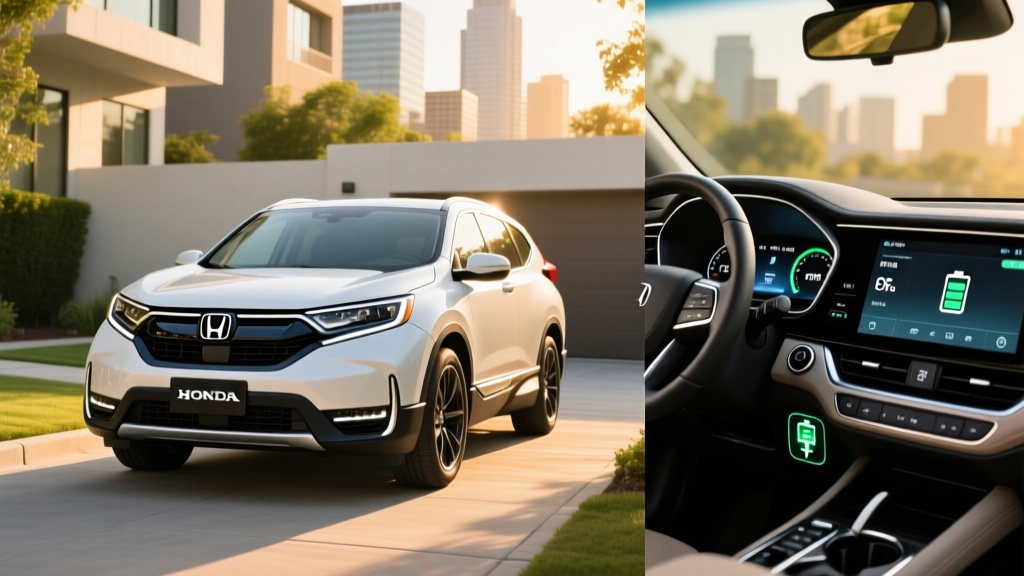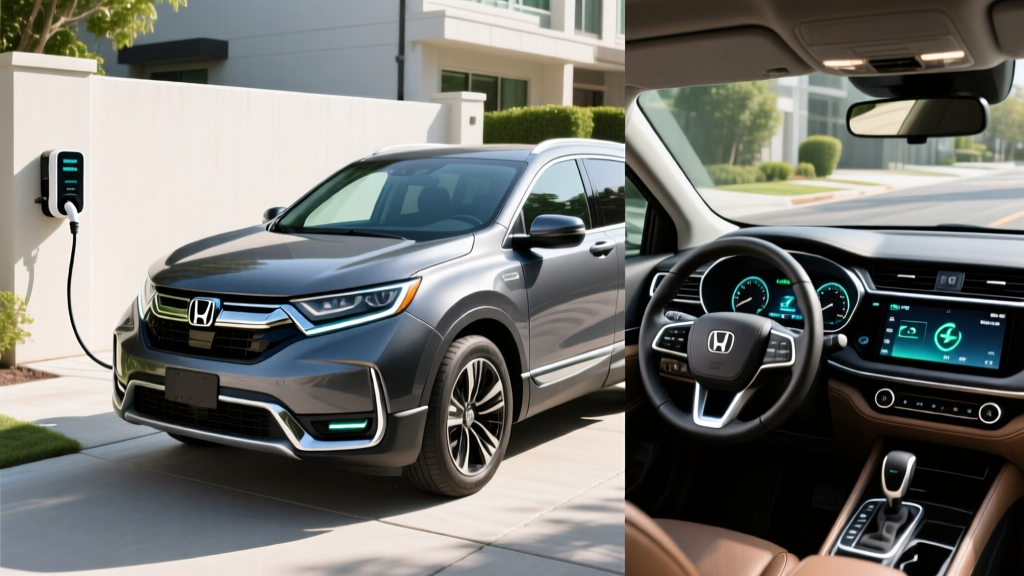
Quick Verdict: The 2024 CR-V Hybrid Sport at a Glance
The 2024 Honda CR-V Hybrid Sport occupies a strategic middle ground in the compact SUV segment. It delivers the fuel-sipping efficiency of a conventional hybrid (HEV) without requiring any change in driver behavior — no plugging in, no range planning, no charging apps. For buyers who want meaningful fuel savings over a gas-only CR-V but aren't ready for a full battery-electric vehicle, the Hybrid Sport trim pairs Honda's proven fourth-generation two-motor hybrid system with sport-tuned styling and a well-equipped cabin.
With an EPA-rated 40 MPG combined (43 city / 36 highway) in front-wheel-drive form, the Hybrid Sport undercuts the gas-only CR-V's fuel cost by roughly 30% on an annual basis. It does not qualify for the federal §30D EV tax credit — that incentive is reserved for plug-in vehicles — but its lower MSRP and zero charging infrastructure requirements make the total cost of ownership compelling for a wide range of buyers.
Fuel Economy: EPA Ratings vs. Real-World MPG
| Drivetrain | City MPG | Highway MPG | Combined MPG |
|---|---|---|---|
| FWD | 43 | 36 | 40 |
| AWD | 40 | 34 | 37 |
Source: EPA / fueleconomy.gov
Real-World MPG: What to Actually Expect
Honda's hybrid system excels in stop-and-go urban driving, where the electric motor handles low-speed propulsion and the engine operates primarily as a generator. In real-world city and suburban driving, many owners report matching or slightly exceeding the EPA city rating — 42–45 MPG is common in warm weather on routes with frequent stops. This is a hallmark of series-parallel hybrid systems: the more you brake and accelerate, the more energy you recapture.
Highway driving tells a different story. At sustained 70–80 MPH speeds, the CR-V Hybrid Sport's aerodynamic drag and the engine's direct-drive mode result in real-world figures closer to 33–35 MPG for the FWD model and 31–33 MPG for AWD. Cold weather (below 35°F) further reduces efficiency by 3–5 MPG across all driving conditions, as the engine runs more frequently to provide cabin heat and maintain battery temperature.
Powertrain: How Honda's Two-Motor Hybrid System Works
The 2024 CR-V Hybrid Sport uses Honda's fourth-generation two-motor hybrid system, which pairs a 2.0-liter Atkinson-cycle four-cylinder engine with two electric motors and a lithium-ion battery pack. Here is how the numbers break down:
| Specification | Value |
|---|---|
| Engine | 2.0L Atkinson-cycle DOHC i-VTEC 4-cylinder |
| Engine Power | 145 hp @ 6,100 RPM / 134 lb-ft torque |
| Drive Motor | 181 hp / 247 lb-ft torque |
| Combined System Output | 204 hp / 247 lb-ft torque |
| Transmission | e-CVT (direct-drive with lock-up clutch) |
| Hybrid Battery | ~1.06 kWh lithium-ion (self-charging, no plug) |
| 0–60 MPH | ~7.8 seconds (FWD) |
| AWD System | Real-Time AWD with rear motor (Sport-L Touring only) |
| Towing Capacity | 1,000 lbs |
Unlike a traditional hybrid that uses a planetary gearset (like Toyota's system), Honda's setup operates primarily as a series hybrid at low speeds — the engine generates electricity that powers the drive motor — and switches to direct engine drive at highway cruising via a lock-up clutch. The result is smooth, EV-like acceleration around town with efficient high-speed cruising. The transition between modes is nearly imperceptible in normal driving.
HEV vs. PHEV vs. Full EV: Which Powertrain Fits You?
Choosing between a conventional hybrid, a plug-in hybrid, and a battery-electric vehicle depends on your driving patterns, home charging access, and budget. Here is a direct comparison framework:
Choose the CR-V Hybrid (HEV) If:
- You lack access to home or workplace charging
- You want fuel savings with zero behavioral change
- Your budget is under $38,000
- You drive a mix of city and highway
- You want proven reliability with minimal complexity
Choose a PHEV (e.g., RAV4 Prime) If:
- You can install a Level 2 home charger
- Most daily trips are under 40 miles
- You want electric-only commuting + gas for road trips
- You qualify for the §30D federal tax credit
- You're willing to pay a $5,000–$8,000 premium
Choose a Full EV (e.g., Tesla Model Y, Ioniq 5) If:
- You have reliable home Level 2 charging
- You want the lowest per-mile fuel cost (~$0.04–$0.06/mile vs. ~$0.12–$0.14/mile for the hybrid)
- Your daily driving is under 250 miles and you can plan road-trip charging
- You want maximum federal and state incentives
- You want zero tailpipe emissions and minimal maintenance
Pricing, Trims, and Tax Credit Eligibility
The 2024 Honda CR-V Hybrid is available across four trim levels. The Sport trim sits in the middle of the lineup, offering a compelling balance of features and value:
| Trim | MSRP (incl. destination) | Key Features |
|---|---|---|
| Sport | $35,395 | 18" black alloy wheels, sport styling, 7" touchscreen, wireless CarPlay/Android Auto, Honda Sensing suite |
| Sport-L | $37,795 | Leather-trimmed seats, power tailgate, heated front seats, wireless charging pad |
| Sport Touring | $40,895 | 9" touchscreen, Bose 12-speaker audio, navigation, heated steering wheel, AWD standard |
Source: Honda Automobiles
Federal Tax Credit Status
The 2024 CR-V Hybrid Sport does not qualify for the federal §30D Clean Vehicle Credit. Under current IRS rules, the §30D credit (up to $7,500) is available only for plug-in electric vehicles — battery-electric vehicles (BEVs) and plug-in hybrids (PHEVs) that meet battery capacity, critical mineral sourcing, MSRP cap, and buyer income requirements. Conventional hybrids like the CR-V Hybrid Sport are excluded.
Some states and local utilities offer modest rebates for conventional hybrids (typically $250–$1,000), but these vary widely by jurisdiction. Check your state energy office or local utility for current programs.
Battery Warranty, Reliability, and Replacement Costs
Hybrid Battery Warranty Coverage
Duration: 8 years / 100,000 miles (whichever comes first)
Coverage: Honda warrants the hybrid battery against defects and capacity loss below functional thresholds. In California Air Resources Board (CARB) states, hybrid system component coverage extends to 10 years / 150,000 miles.
What's Covered: The hybrid battery pack, drive motor, generator motor, power control unit (PCU), and associated high-voltage wiring.
Long-Term Reliability Outlook
Honda's hybrid system has accumulated significant real-world miles across multiple model generations (Insight, Accord Hybrid, CR-V Hybrid). The lithium-ion battery pack in the CR-V Hybrid is relatively small (~1.06 kWh) and is managed conservatively — the system never fully charges or fully depletes it, maintaining a buffer zone that significantly extends cell life. Based on data from earlier Honda hybrid models, battery degradation to the point of requiring replacement is rare within the first 150,000–200,000 miles.
If replacement is needed out of warranty, a refurbished CR-V hybrid battery currently costs approximately $2,000–$3,500 installed at an independent hybrid specialist, or $4,000–$5,500 for a new OEM battery at a Honda dealer. For context, this is substantially less than a full EV battery replacement ($8,000–$20,000+), reflecting the smaller battery size.
Overall Vehicle Reliability
The CR-V platform has historically scored well in reliability surveys. The hybrid powertrain adds complexity (two electric motors, PCU, high-voltage system) but eliminates the traditional automatic transmission — a common failure point in conventional vehicles. The e-CVT in Honda's system has no belts, pulleys, or friction clutches to wear, contributing to its durability. IIHS awarded the 2024 CR-V the Top Safety Pick+ designation with acceptable ratings across all crash tests.
Daily Driving: What It's Like to Live With the CR-V Hybrid Sport
The Hybrid Sport differentiates itself from the gas CR-V in ways that matter in daily use:
- Low-speed refinement: The electric motor provides instant torque from 0 RPM, making the CR-V Hybrid feel quicker off the line than its 204-hp rating suggests. In EV mode (activated at low speeds and light loads), the cabin is near-silent.
- Regenerative braking: Steering-wheel-mounted paddle shifters let you select from three levels of regen intensity. The strongest setting provides noticeable deceleration when you lift off the accelerator, though it does not enable true one-pedal driving (the car will creep to a stop rather than holding stationary).
- Cargo space: The hybrid battery is mounted under the cargo floor, so there is no loss of cargo volume compared to the gas CR-V — 36.3 cu ft behind the rear seats and 76.5 cu ft with seats folded.
- AWD availability: The Sport trim is FWD only. If you want all-wheel drive in the hybrid lineup, you'll need to step up to the Sport-L or Sport Touring trims, where Honda's Real-Time AWD system sends torque to the rear wheels when front traction is limited.
Ownership Costs: 5-Year Fuel Savings vs. Gas CR-V
To quantify the financial case for the Hybrid Sport, we compared it against the equivalently trimmed gas CR-V EX-L (EPA 29 MPG combined) over five years and 75,000 miles:
| Cost Factor | CR-V Hybrid Sport (FWD) | CR-V EX-L (Gas, FWD) |
|---|---|---|
| MSRP | $35,395 | $36,295 |
| Fuel Cost (75K mi) | $6,563 | $9,052 |
| Fuel Savings | +$2,489 | — |
| Maintenance (est.) | ~$2,800 | ~$3,200 |
The Hybrid Sport starts at a slightly lower MSRP than the comparably equipped gas EX-L and saves approximately $2,500 in fuel over five years. Maintenance costs are marginally lower thanks to reduced brake wear (regenerative braking extends pad life significantly) and the absence of a traditional transmission. Net savings over five years: approximately $3,300–$3,800 before accounting for potential differences in insurance premiums and resale value.
Pros and Cons
✓ Pros
- 43 MPG city — class-leading urban efficiency
- No plug-in required; works with any gas station
- Smooth, EV-like low-speed driving feel
- No cargo space penalty vs. gas CR-V
- Honda Sensing ADAS suite standard on all trims
- 8-year/100K-mile hybrid battery warranty
- Lower MSRP than equivalent gas EX-L trim
✗ Cons
- No federal tax credit eligibility (HEV, not PHEV)
- Highway MPG drops to 33–35 real-world
- Sport trim is FWD only (AWD requires higher trims)
- 1,000-lb towing capacity (less than gas CR-V's 1,500 lbs)
- No electric-only driving mode for emissions-free zones
- 7" screen on Sport trim feels dated vs. 9" on Touring
- Cabin noise under hard acceleration (engine drone)
Frequently Asked Questions
How many MPG does the 2024 CR-V Hybrid Sport get?
The FWD model is EPA-rated at 43 city / 36 highway / 40 combined MPG. The AWD version (available on Sport-L and Sport Touring trims) drops to 40 city / 34 highway / 37 combined. In real-world driving, expect 38–42 MPG combined for FWD, with city driving often exceeding the EPA rating and highway driving falling slightly below.
Does the CR-V Hybrid Sport need to be plugged in?
No. The 2024 CR-V Hybrid Sport is a conventional hybrid (HEV), not a plug-in hybrid (PHEV). Its small lithium-ion battery recharges through regenerative braking and the gasoline engine. You fuel it exclusively at gas stations, exactly like a conventional car.
Is there a plug-in hybrid (PHEV) version of the CR-V?
Not in the United States. Honda offers a CR-V e:PHEV in China and Europe with approximately 44 miles of electric-only range and a 17.7 kWh battery, but this variant has not been confirmed for the US market. If you need a compact PHEV SUV, the Toyota RAV4 Prime (42 miles EV range) and Ford Escape PHEV (37 miles EV range) are the closest competitors.
How long will the CR-V Hybrid battery last?
Honda warranties the hybrid battery for 8 years / 100,000 miles (10 years / 150,000 miles in CARB states). Based on real-world data from Honda's hybrid fleet, most batteries retain sufficient capacity well beyond 150,000 miles. The conservative state-of-charge management (never fully charging or depleting the pack) significantly extends cell longevity. Out-of-warranty replacement costs approximately $2,000–$5,500 depending on refurbished vs. new OEM.
Does the 2024 CR-V Hybrid qualify for any tax credits?
No. The federal §30D Clean Vehicle Credit applies only to plug-in electric vehicles (BEVs and PHEVs). As a conventional hybrid, the CR-V Hybrid Sport is ineligible. Some state and utility programs offer small hybrid rebates ($250–$1,000), but availability varies. Check your state energy office or the Alternative Fuels Data Center for local incentives.
Is the CR-V Hybrid Sport reliable?
Honda's two-motor hybrid system has proven durable across multiple model lines and generations. The system eliminates the conventional automatic transmission (a common failure point) and uses an e-CVT with no wearable friction components. The CR-V platform consistently earns strong reliability marks from owner surveys. The hybrid battery carries an 8-year/100,000-mile warranty as additional peace of mind.
How does the CR-V Hybrid Sport compare to the Toyota RAV4 Hybrid?
The RAV4 Hybrid (EPA 39–41 MPG combined depending on trim) is the CR-V Hybrid's closest competitor. The RAV4 offers standard AWD across all hybrid trims (the CR-V Sport is FWD-only) and slightly more cargo space. The CR-V Hybrid counters with a more refined cabin, slightly better city MPG, and a more intuitive infotainment system on upper trims. Both are strong choices — test-driving both back-to-back is the best way to decide.