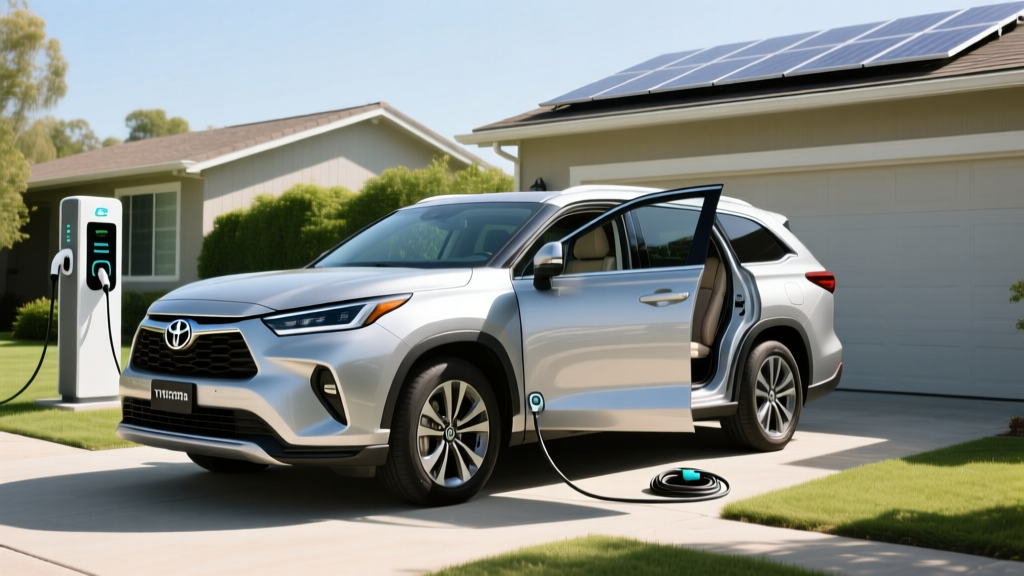
The 2023 Toyota Highlander Hybrid occupies a narrow but valuable lane in the three-row SUV market: it offers genuine hybrid efficiency without requiring a plug, a charger, or any change in daily habits. For families who want the fuel savings of electrification but lack access to home charging or don't want to manage electric-only range, this conventional hybrid (HEV) remains one of the most practical vehicles Toyota has ever built. Now available on the used market in 2026, it's also become a compelling value proposition — especially if you qualify for the federal used-EV tax credit.
This guide breaks down everything a buyer needs to know: exact EPA fuel economy, real-world MPG expectations, powertrain specs, battery longevity, and how the Highlander Hybrid stacks up against plug-in alternatives and full EVs.
HEV vs. PHEV: What the Highlander Hybrid Actually Is
Before diving into specs, it's critical to understand what you're buying. The 2023 Highlander Hybrid is a conventional hybrid (HEV) — not a plug-in hybrid (PHEV). That distinction changes everything about how you own it.
| Feature | HEV (Highlander Hybrid) | PHEV (e.g., Toyota RAV4 Prime) | Full EV (e.g., Kia EV9) |
|---|---|---|---|
| Plug-in charging required? | No — self-charging via engine & regen | Yes — for electric-only range | Yes — always |
| Electric-only range | ~1 mile at low speed | 35–42 miles typical | 230–379 miles |
| Battery size | 1.6 kWh (NiMH) | 18.1 kWh (Li-ion) | 77–100 kWh (Li-ion) |
| Federal tax credit (new) | Not eligible | Up to $7,500 (§30D) | Up to $7,500 (§30D) |
| Federal used-vehicle credit | Up to $4,000 (§25E) | Up to $4,000 (§25E) | Up to $4,000 (§25E) |
| Fuel type | Gasoline + regenerative braking | Gasoline + grid electricity | Grid electricity only |
The Highlander Hybrid's 1.6 kWh nickel-metal hydride (NiMH) battery is small by electrified-vehicle standards. It's not designed for plug-in charging or sustained electric-only driving. Instead, it captures energy during braking and deceleration, then deploys it to assist the gas engine during acceleration — the most fuel-intensive phase of driving. The result is meaningful MPG gains without any infrastructure dependency.
Fuel Economy: EPA Ratings and Real-World MPG
The EPA rates the 2023 Toyota Highlander Hybrid at 36 MPG combined, with 36 MPG city and 35 MPG highway for the LE and XLE front-wheel-drive trims. All-wheel-drive (AWD) trims drop slightly to 35 MPG combined (35 city / 34 highway). These numbers are exceptional for a three-row SUV weighing over 4,500 pounds.
| Trim / Drivetrain | City MPG | Highway MPG | Combined MPG |
|---|---|---|---|
| LE FWD | 36 | 35 | 36 |
| XLE FWD | 36 | 35 | 36 |
| LE AWD | 35 | 34 | 35 |
| XLE AWD / Limited AWD / Platinum AWD | 35 | 34 | 35 |
Source: EPA Fuel Economy
Real-World MPG: What Owners Actually See
Hybrid fuel economy is uniquely sensitive to driving style and conditions. The Highlander Hybrid's EPA numbers are achievable — and sometimes beatable — in real-world suburban and city driving. Toyota's hybrid system thrives in stop-and-go traffic, where regenerative braking constantly recharges the small battery and the electric motor handles low-speed propulsion.
Owner-reported data on Fuelly and similar platforms clusters around 33–37 MPG combined for mixed driving. Drivers who do mostly city and suburban miles at moderate speeds frequently report 37–39 MPG. Highway-heavy commutes at 75+ MPH tend to yield 30–33 MPG, as aerodynamic drag overwhelms the hybrid system's advantages. Cold weather (below 30°F) can reduce MPG by 3–5 points due to increased engine idling for cabin heat and reduced battery efficiency.
Powertrain: 243 HP from a 2.5L Hybrid System
The 2023 Highlander Hybrid pairs a 2.5-liter inline-four Atkinson-cycle gasoline engine with two electric motor-generators (three on AWD trims, which add a rear-mounted motor). Combined system output is 243 horsepower.
| Specification | Detail |
|---|---|
| Engine | 2.5L 4-cylinder Atkinson-cycle |
| Engine horsepower | 186 HP @ 6,000 RPM |
| Engine torque | 175 lb-ft @ 4,400 RPM |
| Front electric motor | 134 HP / 199 lb-ft |
| Rear electric motor (AWD only) | 54 HP / 89 lb-ft |
| Combined system output | 243 HP |
| Transmission | eCVT (electronically controlled CVT) |
| Drivetrain | FWD or electronic AWD (AWD-i) |
| 0–60 MPH | ~7.8 seconds (FWD), ~7.6 seconds (AWD) |
| Towing capacity | 3,500 lbs (all trims) |
| Hybrid battery | 1.6 kWh NiMH (sealed, no plug-in) |
| Curb weight | 4,515–4,705 lbs (trim dependent) |
The eCVT transmission isn't a belt-driven CVT in the traditional sense. It uses a planetary gearset to blend engine and motor power seamlessly — there's no rubber-band effect or droning under acceleration. The result is smooth, linear power delivery that feels more refined than the conventional automatics in many competitors.
The electronic AWD system (AWD-i) deserves specific mention: the rear motor activates only when the system detects front-wheel slip or during hard acceleration from a stop. There's no mechanical driveshaft connecting the front and rear axles. This keeps weight down and preserves interior space, but it's not a system designed for serious off-roading — it's optimized for wet roads, light snow, and launch traction.
Pricing, Trims, and Tax Credit Eligibility
When new, the 2023 Highlander Hybrid started at $40,220 for the LE FWD trim (including destination) and climbed to approximately $52,075 for the Platinum AWD. As a conventional hybrid, it did not qualify for the federal §30D new clean vehicle credit, which requires plug-in capability and minimum battery capacity.
| Trim | Original MSRP (2023) | Approx. Used Price (2026) |
|---|---|---|
| LE FWD | $40,220 | $30,000–$33,000 |
| XLE FWD | $43,270 | $32,500–$36,000 |
| XLE AWD | $44,870 | $34,000–$37,500 |
| Limited AWD | $48,870 | $37,000–$41,000 |
| Platinum AWD | $52,075 | $40,000–$44,000 |
Used pricing is approximate and varies by mileage, condition, and region.
Federal Used Clean Vehicle Credit (§25E)
Here's where 2026 buyers get an advantage: the IRS §25E used clean vehicle credit applies to the Highlander Hybrid when purchased from a licensed dealer. The credit equals 30% of the sale price, up to a maximum of $4,000. A $33,000 used LE FWD would yield a $4,000 credit (30% of $33,000 = $9,900, but the $4,000 cap applies).
Eligibility requirements for §25E:
- Vehicle price cap: Sale price must be $25,000 or less (this eliminates most Highlander Hybrid trims on the used market in 2026, as many sell above this threshold)
- Buyer income limits: AGI must not exceed $75,000 (single), $112,500 (head of household), or $150,000 (joint)
- Vehicle age: Must be at least 2 model years old (2023 models qualify in 2026)
- Dealer requirement: Must be purchased from a licensed dealer who reports the sale to the IRS
- Battery requirement: Vehicle must have a battery capacity of at least 7 kWh — the Highlander Hybrid's 1.6 kWh battery does NOT meet this threshold
Battery Longevity, Warranty, and Replacement Cost
Hybrid battery anxiety is the number-one concern for used hybrid buyers. The 2023 Highlander Hybrid addresses this with Toyota's standard hybrid battery warranty and a well-documented track record of NiMH durability.
The NiMH chemistry in the Highlander Hybrid is among the most proven battery technologies in automotive history. Toyota has used NiMH packs in the Prius since 1997, and real-world data shows these batteries regularly exceed 200,000 miles before significant degradation. Unlike the large lithium-ion packs in full EVs, the Highlander Hybrid's small 1.6 kWh pack undergoes shallow charge-discharge cycles — it rarely drops below 40% or above 80% state of charge — which dramatically extends cycle life.
Battery Replacement Cost
If the hybrid battery fails outside warranty coverage, replacement costs break down as follows:
- New OEM battery from Toyota: $2,500–$3,500 (part) + $500–$800 (labor) = $3,000–$4,300 total
- Refurbished/remanufactured battery: $1,500–$2,200 installed
- Individual cell replacement (specialist shops): $800–$1,500
For context, a 2023 Highlander Hybrid with typical mileage in 2026 is still well within its 10-year/150,000-mile battery warranty window. The likelihood of needing a battery replacement before 2033 is statistically low based on Toyota's hybrid reliability history.
The hybrid system also carries a separate 8-year/100,000-mile warranty covering the inverter, motor-generators, and related control electronics. Toyota's overall powertrain warranty covers the gasoline engine for 5 years / 60,000 miles.
Highlander Hybrid vs. PHEV vs. Full EV: Which Fits Your Life?
Choosing between a conventional hybrid, a plug-in hybrid, and a full EV comes down to three variables: charging access, daily mileage, and willingness to adapt habits.
Choose the Highlander Hybrid (HEV) If:
- You don't have access to home or workplace charging
- You want three rows and 35+ MPG without plugging in
- You take frequent road trips and don't want to plan charging stops
- You tow up to 3,500 lbs regularly
- You prefer the lowest-complexity electrified option
Choose a PHEV (e.g., Chrysler Pacifica Hybrid) If:
- You can charge at home (Level 1 or 2) and want 30+ miles electric for school runs and commutes
- Your daily driving is under 40 miles but you still need long road-trip range
- You want to reduce gas consumption by 60–80% on typical days
- You want eligibility for the §30D federal tax credit (up to $7,500 new, income/MSRP permitting)
Choose a Full EV (e.g., Kia EV9) If:
- You have reliable home Level 2 charging
- You want the lowest per-mile fuel cost ($0.04–$0.08/mi vs. $0.14–$0.18/mi for the hybrid)
- You want zero tailpipe emissions and minimal drivetrain maintenance
- You're comfortable with 270–310 miles of range and DC fast-charging on road trips
For a family with a 40-mile daily commute and a garage with a 240V outlet, a PHEV like the Chrysler Pacifica Hybrid (32 miles electric, 30 MPG on gas after that) can eliminate most gasoline use on weekdays while still handling 500-mile weekend trips. But if you live in an apartment without charging access, or if your driving pattern involves unpredictable long-distance travel, the Highlander Hybrid's zero-compromise efficiency is hard to beat.
Ownership Costs: Fuel Savings vs. Gas-Only Highlander
To quantify the Highlander Hybrid's value, compare its fuel costs to the gas-only 2023 Highlander (2.4L turbo, 24 MPG combined EPA):
| Cost Factor | Highlander Hybrid (35 MPG) | Gas Highlander (24 MPG) |
|---|---|---|
| Annual fuel cost (15,000 mi/yr @ $3.50/gal) | $1,500 | $2,188 |
| 5-year fuel cost | $7,500 | $10,938 |
| 5-year fuel savings (Hybrid) | $3,438 saved | |
| Estimated insurance (annual avg.) | $1,800–$2,200 | $1,700–$2,100 |
| Routine maintenance (5-yr est.) | $2,000–$2,500 | $2,200–$2,800 |
The hybrid saves roughly $3,400 in fuel over five years at 15,000 miles annually and $3.50/gallon. Maintenance costs are comparable or slightly lower for the hybrid, as regenerative braking extends brake pad life significantly (many hybrid owners report 80,000+ miles on original brake pads). Insurance is marginally higher due to the vehicle's higher replacement cost.
Toyota's hybrid vehicles also hold resale value exceptionally well. According to industry depreciation data, the Highlander Hybrid retains approximately 55–60% of its value after three years, compared to 48–53% for the gas-only variant. This resale premium partially offsets the hybrid's higher initial purchase price.
Reliability and Safety Ratings
Toyota's hybrid powertrain is one of the most reliability-documented systems in the automotive industry. The 2.5L Atkinson-cycle engine is under-stressed (186 HP from a 2.5L displacement) and operates primarily in its most efficient RPM range. The eCVT has no belts, clutches, or torque converters to fail — it's a simple planetary gearset with very few moving parts.
For the 2023 model year, the Highlander received strong safety ratings:
- IIHS: Top Safety Pick+ (highest rating) — Good in all crashworthiness tests
- NHTSA: 5-Star Overall Safety Rating — NHTSA 2023 Highlander
Standard driver-assistance features include Toyota Safety Sense 2.5+, which bundles adaptive cruise control, lane-keeping assist, automatic emergency braking with pedestrian detection, and lane departure alert. This is a SAE Level 1 driver-assistance system — it assists with steering and speed but requires full driver attention at all times. It is not autonomous or self-driving.
Frequently Asked Questions
How many MPG does the 2023 Toyota Highlander Hybrid get?
The EPA rates it at 36 MPG combined (36 city / 35 highway) for FWD trims and 35 MPG combined (35 city / 34 highway) for AWD trims. Real-world owners typically see 33–37 MPG combined, with city-dominant driving sometimes exceeding 37 MPG.
Does the Highlander Hybrid need to be plugged in?
No. It is a conventional hybrid (HEV), not a plug-in hybrid. The battery charges exclusively through regenerative braking and the gasoline engine. You fuel it like any other gas car — the hybrid system works automatically in the background.
Does the 2023 Highlander Hybrid qualify for any federal tax credit?
No. Its 1.6 kWh battery falls below the 7 kWh minimum required for both the §30D new-vehicle credit and the §25E used-vehicle credit. The hybrid's fuel savings come at the pump, not through tax incentives.
How long will the hybrid battery last?
Toyota's NiMH hybrid batteries have a documented track record of lasting 200,000+ miles in normal use. The 2023 Highlander Hybrid's battery is covered by a 10-year / 150,000-mile warranty that transfers to subsequent owners. As of 2026, most examples are still well within warranty coverage.
What does it cost to replace the hybrid battery?
A new OEM replacement runs $3,000–$4,300 installed. Refurbished options are available for $1,500–$2,200 installed. However, failure before 150,000 miles is uncommon based on Toyota's hybrid reliability data.
How does the Highlander Hybrid compare to a full EV three-row SUV?
A full EV like the Kia EV9 (270–310 miles range, ~$55,000 new) offers dramatically lower per-mile energy costs and zero tailpipe emissions, but requires home charging access and planning for road trips. The Highlander Hybrid costs less upfront, needs no charging infrastructure, and still delivers 35+ MPG. The right choice depends entirely on your charging situation and driving patterns.
Can the Highlander Hybrid tow?
Yes — all 2023 Highlander Hybrid trims are rated for 3,500 pounds of towing capacity, matching the gas-only Highlander. This is sufficient for a small boat, utility trailer, or a pair of personal watercraft.
Is the Highlander Hybrid good in snow?
The AWD-i system provides confident traction in light to moderate snow and ice. The rear electric motor engages automatically when front-wheel slip is detected. However, it's not a substitute for dedicated winter tires in severe conditions, and ground clearance (8.0 inches) limits deep-snow capability.