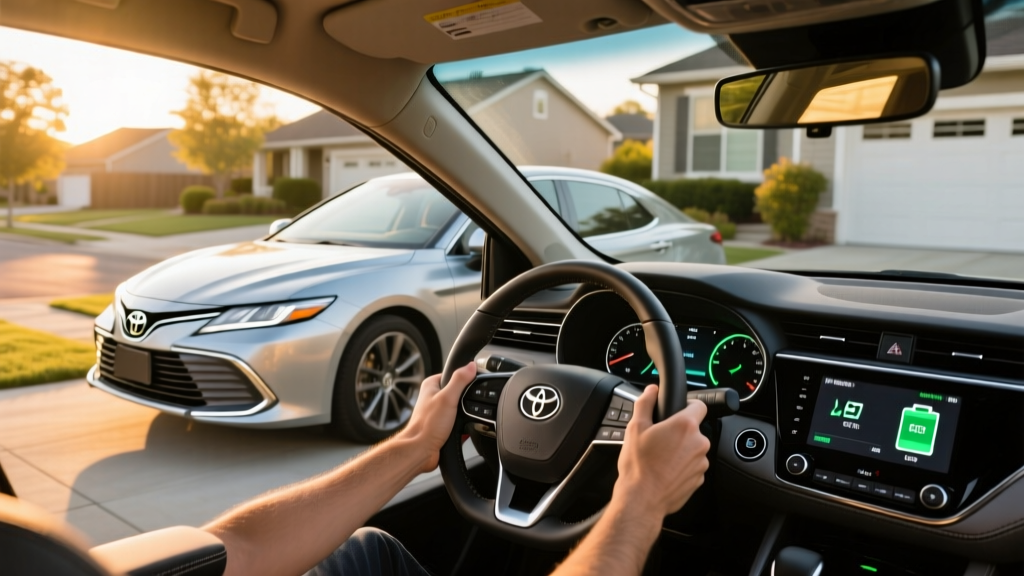
The 2023 Toyota Camry Hybrid LE remains one of the most efficient midsize sedans you can buy without plugging in. With an EPA-estimated 52 MPG combined and a proven hybrid powertrain, it targets buyers who want EV-like fuel savings without changing their refueling habits. As of 2026, used examples are entering the certified pre-owned market, making this an important model year to evaluate for secondhand buyers and anyone cross-shopping against newer plug-in hybrids and full battery-electric vehicles.
This guide covers everything you need to know about the 2023 Camry Hybrid LE — from exact fuel economy figures and real-world MPG to battery longevity, warranty coverage, and how it stacks up against plug-in and full-electric alternatives.
HEV vs. PHEV: What the Camry Hybrid Actually Is
Before diving into specs, it's critical to understand what you're buying. The 2023 Camry Hybrid LE is a conventional hybrid electric vehicle (HEV) — not a plug-in hybrid (PHEV). That distinction matters for your daily routine, your wallet, and your tax situation.
| Feature | HEV (Camry Hybrid LE) | PHEV (e.g., Prius Prime) | BEV (e.g., Tesla Model 3) |
|---|---|---|---|
| Plug in to charge? | No — self-charging via regen & engine | Yes — 120V or 240V | Yes — 240V or DC fast charge |
| Electric-only range | ~1 mile at low speed | 25–44 miles (model dependent) | 250–360+ miles |
| Fuel type | Gasoline + regenerative braking | Gasoline + grid electricity | Grid electricity only |
| Federal tax credit (§30D) | Not eligible | Up to $7,500 (if eligible) | Up to $7,500 (if eligible) |
| Home charger needed? | No | Recommended (Level 2) | Essential (Level 2) |
The Camry Hybrid LE charges its small battery pack entirely through regenerative braking and the gasoline engine. You never plug it in. You simply fill up at any gas station and drive. This makes it ideal for apartment dwellers, street parkers, or anyone without reliable access to a charging outlet.
Fuel Economy: EPA Ratings and Real-World MPG
The headline number for the 2023 Toyota Camry Hybrid LE is its EPA-estimated fuel economy. Here's the official breakdown from fueleconomy.gov:
| Driving Condition | EPA MPG |
|---|---|
| City | 51 MPG |
| Highway | 53 MPG |
| Combined | 52 MPG |
Real-World MPG: What Owners Actually See
Toyota's hybrid system excels in stop-and-go traffic, where the electric motor handles low-speed driving and the engine kicks in for higher loads. In real-world ownership, many Camry Hybrid LE drivers report exceeding the EPA city estimate — 54–58 MPG is common in urban commuting with moderate acceleration.
Highway driving tells a slightly different story. At sustained 75–80 mph speeds, expect 46–50 MPG. Hybrids lose some advantage at high constant speeds because the engine runs continuously and aerodynamic drag increases fuel consumption. In cold weather (below 35°F), expect a 5–10% drop across the board as the engine runs more frequently to provide cabin heat and maintain battery temperature.
With a 13.2-gallon fuel tank, the Camry Hybrid LE delivers a real-world range of approximately 630–700 miles per tank — enough for most drivers to visit a gas station only once or twice a month.
Powertrain Specs: Engine, Motor, and Combined Output
| Specification | 2023 Camry Hybrid LE |
|---|---|
| Engine | 2.5L 4-cylinder Dynamic Force (A25A-FXS) |
| Engine horsepower | 176 HP @ 5,700 RPM |
| Electric motor | Permanent magnet synchronous (front axle) |
| Motor horsepower | 118 HP |
| Net combined system output | 208 HP |
| Transmission | Electronically controlled CVT (eCVT) |
| Drivetrain | Front-wheel drive (AWD available on SE/XLE trims, not LE) |
| Hybrid battery | Lithium-ion, ~1.6 kWh (not plug-in) |
| 0–60 mph | ~7.2 seconds |
| Curb weight | ~3,495 lbs |
The 208 combined horsepower figure places the Camry Hybrid LE ahead of most competitors in the hybrid midsize sedan segment. Toyota's eCVT is not a traditional belt-driven CVT — it uses a planetary gearset to blend engine and motor power, which is more durable and avoids the "rubber band" feel associated with older CVT designs. This is the same hybrid synergy drive architecture Toyota has refined over two decades, and its reliability record is excellent.
Pricing, Trims, and Tax Credit Eligibility
The 2023 Camry Hybrid LE originally carried an MSRP of $28,555 (including destination charge). Higher trims — the Hybrid SE ($30,090), Hybrid XLE ($32,070), and Hybrid XSE ($33,070) — added features like sport-tuned suspension, leather-trimmed seats, and larger wheels, though these trims sacrifice 1–2 MPG due to increased weight and wider tires.
Federal Tax Credit: Does the Camry Hybrid LE Qualify?
No. The 2023 Toyota Camry Hybrid LE does not qualify for the federal §30D clean vehicle tax credit. Under current IRS rules, the §30D credit applies only to plug-in electric vehicles (PHEVs and BEVs) with battery capacities of at least 7 kWh. The Camry Hybrid LE's ~1.6 kWh battery is far below this threshold, and as a conventional HEV, it is ineligible by definition.
- Vehicle must be a PHEV or BEV (not a conventional HEV)
- Battery capacity ≥ 7 kWh
- MSRP caps: $55,000 (sedans) / $80,000 (SUVs, trucks, vans)
- Buyer income caps: $150K single / $300K joint AGI
- Battery components and critical minerals must meet sourcing thresholds
- Point-of-sale transfer available at participating dealers
Some states offer their own incentives for hybrids, though these are increasingly rare as state programs shift toward plug-in vehicles. Check your state's energy office or DMV website for current programs.
Used Market Pricing (2026)
As a 2023 model entering its third year on the road, expect used Camry Hybrid LE examples to trade between $22,000–$27,000 depending on mileage, condition, and region. Toyota Certified Pre-Owned (CPO) examples typically command a $1,000–$2,000 premium but include an extended powertrain warranty. Note: the federal used-EV credit (up to $4,000 under §25E) also does not apply to conventional hybrids.
Battery Warranty, Lifespan, and Replacement Cost
Hybrid battery longevity is the single most common concern among first-time hybrid buyers. Here's what you need to know about the 2023 Camry Hybrid LE's battery system.
- Coverage: 10 years / 150,000 miles (whichever comes first)
- Applies to: Hybrid battery pack, hybrid control module, inverter
- Capacity threshold: Toyota warrants against defects and abnormal degradation; there is no published minimum State of Health (SoH) percentage as with BEVs
- Transferable: Yes — warranty follows the vehicle, not the original owner
How Long Do Toyota Hybrid Batteries Actually Last?
Toyota's hybrid batteries are among the most proven in the industry. Data from millions of Prius and Camry Hybrid vehicles on the road shows that most original hybrid battery packs last 150,000–200,000+ miles before significant degradation. The lithium-ion pack in the 2023 Camry Hybrid LE is relatively small (~1.6 kWh) and operates within a narrow State of Charge window (roughly 40–80%), which dramatically reduces stress on the cells compared to a full BEV that cycles through a much wider range.
The hybrid system's battery management is conservative by design. Because the engine can always recharge the pack, the battery never needs to hold a large energy reserve, and deep discharge events are virtually impossible in normal operation.
Hybrid Battery Replacement Cost
If the battery does eventually fail outside of warranty coverage, replacement costs for a Toyota Camry Hybrid battery pack typically range from $2,500–$4,500 including parts and labor at a dealership. Independent hybrid specialists often perform the same service for $1,800–$3,000. Refurbished or reconditioned battery packs are available for $1,200–$2,000. This is dramatically less expensive than a full BEV battery replacement, which can exceed $10,000–$20,000.
For a 2023 model, the factory 10-year/150,000-mile warranty means coverage extends through at least 2033 — a substantial safety net for secondhand buyers.
Reliability and Safety Ratings
The 2023 Camry Hybrid benefits from Toyota's reputation for conservative engineering and long-term durability. The A25A-FXS engine is part of Toyota's Dynamic Force family, designed specifically for hybrid duty with a high thermal efficiency (41%) that reduces wear and heat stress.
Safety ratings are strong across the board:
- NHTSA: 5-Star Overall Safety Rating — NHTSA listing
- IIHS: TOP SAFETY PICK+ (when equipped with specific headlights on higher trims; LE trim headlights received a lower rating)
- Standard ADAS: Toyota Safety Sense 2.5+ includes pre-collision system with pedestrian detection, full-speed dynamic radar cruise control, lane departure alert with steering assist, lane tracing assist, and automatic high beams
Note that Toyota Safety Sense 2.5+ is a SAE Level 2 driver-assistance system. It provides steering and speed support but requires the driver to remain fully engaged and attentive at all times. It is not a self-driving system.
Camry Hybrid LE vs. PHEV vs. Full EV: Which Should You Choose?
The right electrified vehicle depends on your living situation, driving habits, and budget. Here's a practical decision framework:
- You don't have access to home or workplace charging
- You want maximum fuel efficiency without changing your refueling routine
- You drive 12,000–15,000 miles/year and want to minimize fuel cost (~$900–$1,100/year at 52 MPG and $3.50/gal)
- You prefer a lower purchase price and proven long-term reliability
- You live in an apartment or park on the street
- You can install a Level 2 charger at home
- Your daily commute is under 40 miles (covering most trips on electricity)
- You want to qualify for the $7,500 federal tax credit (if income/sourcing eligible)
- You take occasional long road trips and want gasoline backup
- You have reliable home Level 2 charging
- You want zero tailpipe emissions and the lowest per-mile "fuel" cost
- Your daily driving is under 250 miles and you're comfortable with DC fast charging on road trips
- You want to qualify for the full $7,500 federal credit and potentially state EV incentives
Annual Fuel Cost Comparison
At 15,000 miles per year and $3.50/gallon gasoline:
| Vehicle | MPG / MPGe | Annual Fuel Cost |
|---|---|---|
| 2023 Camry Hybrid LE | 52 MPG combined | ~$1,010 |
| 2023 Camry Gas (4-cyl) | 32 MPG combined | ~$1,641 |
| Toyota Prius Prime (PHEV) | 52 MPG + 44 mi electric | ~$500–$750 (mixed) |
| Tesla Model 3 RWD (BEV) | 132 MPGe | ~$540 (at $0.14/kWh) |
The Camry Hybrid LE saves roughly $630/year over the gas-only Camry. A PHEV or BEV saves more, but only if you can charge at home at typical residential electricity rates.
Pros and Cons at a Glance
- 52 MPG combined — among the best in its class
- No plug-in charging required; works with existing infrastructure
- 10-year / 150,000-mile hybrid battery warranty
- Proven powertrain with 20+ years of Toyota hybrid refinement
- Strong safety ratings (NHTSA 5-star, IIHS TSP+ eligible)
- Low annual fuel cost (~$1,000/year)
- 630+ mile real-world driving range per tank
- No federal tax credit eligibility
- LE trim lacks premium features (basic infotainment, cloth seats)
- No DC fast charging capability (HEV — not applicable)
- Electric-only driving limited to very low speeds (~1 mile)
- FWD only on LE trim (AWD requires SE/XLE)
- Highway MPG drops at sustained 75+ mph speeds
Frequently Asked Questions
How many MPG does the 2023 Toyota Camry Hybrid LE get?
The EPA rates the 2023 Camry Hybrid LE at 51 MPG city, 53 MPG highway, and 52 MPG combined. In real-world driving, city commuters often see 54–58 MPG, while highway-dominant driving at 75+ mph yields 46–50 MPG. Cold weather reduces efficiency by roughly 5–10%.
Do I need to plug in the Camry Hybrid LE to charge it?
No. The 2023 Camry Hybrid LE is a conventional hybrid (HEV). Its small lithium-ion battery charges through regenerative braking and the gasoline engine. You never plug it in — just fill up at any gas station as you would with a conventional car.
Does the 2023 Camry Hybrid LE qualify for any federal tax credit?
No. Under IRS §30D rules, only plug-in electric vehicles (PHEVs and BEVs) with battery capacities of at least 7 kWh qualify for the federal clean vehicle credit. The Camry Hybrid LE's ~1.6 kWh battery and HEV powertrain make it ineligible. Some states may offer minor hybrid incentives — check your state energy office.
How long will the hybrid battery last, and what does replacement cost?
Toyota's hybrid batteries typically last 150,000–200,000+ miles based on long-term fleet data. The factory warranty covers the battery for 10 years or 150,000 miles. If replacement is needed out of warranty, expect $2,500–$4,500 at a dealer or $1,800–$3,000 at an independent hybrid specialist. Refurbished packs are available for $1,200–$2,000.
Is the Camry Hybrid LE better than a plug-in hybrid or full EV?
It depends on your situation. The Camry Hybrid LE is the best choice if you lack home charging access and want maximum efficiency without lifestyle changes. A PHEV like the Prius Prime makes more sense if you can charge at home and commute under 40 miles daily. A full BEV offers the lowest operating cost but requires reliable charging infrastructure and a higher upfront investment.
Can the 2023 Camry Hybrid LE drive on electric power alone?
Only at very low speeds (under ~25 mph) for about one mile or less. The hybrid system uses the electric motor to assist during acceleration and to power the car in stop-and-go traffic, but the gasoline engine engages frequently. This is fundamentally different from a PHEV, which can drive 25–44 miles on electricity alone at highway speeds.
Is the 2023 Camry Hybrid LE reliable?
Yes. Toyota's hybrid powertrain has been in continuous production since 1997 (Prius) and 2006 (Camry Hybrid). The 2023 model uses the fourth-generation hybrid system with the A25A-FXS engine, which has an excellent track record. NHTSA gave it a 5-star overall safety rating. Long-term ownership costs are among the lowest in the midsize sedan segment.
For buyers in 2026 evaluating a used 2023 Camry Hybrid LE, the value proposition is straightforward: proven reliability, class-leading fuel economy for a non-plug-in vehicle, and a battery warranty that still has years of coverage remaining. If your lifestyle doesn't accommodate plug-in charging, this remains one of the smartest fuel-economy plays on the market.