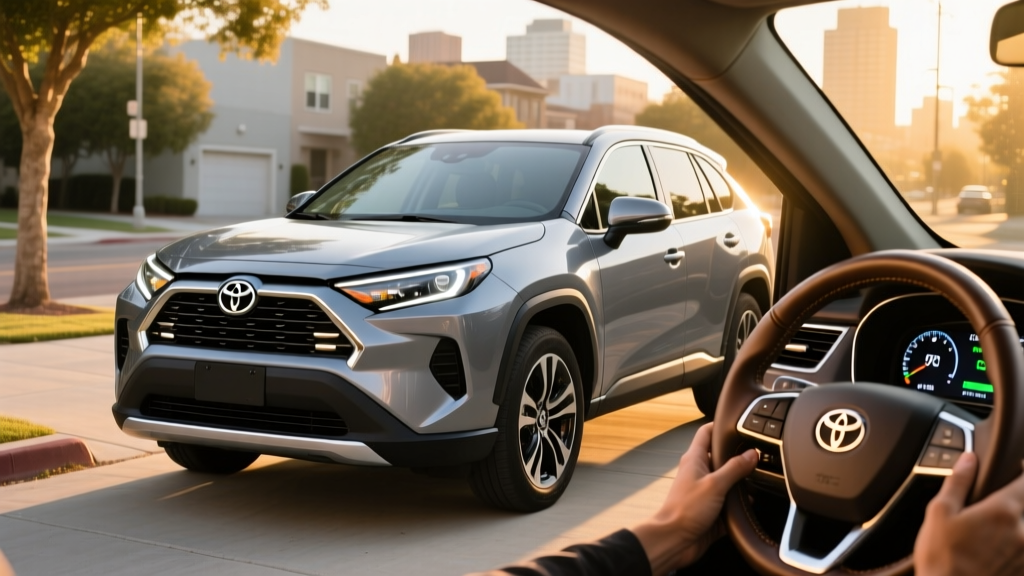
Quick Verdict: The 2023 Toyota RAV4 Hybrid XLE Premium at a Glance
The 2023 Toyota RAV4 Hybrid XLE Premium occupies a specific niche: it is a conventional hybrid electric vehicle (HEV), not a plug-in hybrid. You never plug it in. The gasoline engine and regenerative braking keep a small battery charged, and the electric motors assist the engine to deliver 219 combined horsepower while achieving EPA-rated 41 MPG city and 38 MPG highway. For buyers who want SUV practicality with dramatically lower fuel consumption — without changing their refueling habits — this trim hits a compelling sweet spot between the base LE Hybrid and the range-topping Limited.
As of 2026, the 2023 model year is available primarily on the used market, where it competes against newer 2025–2026 RAV4 Hybrid trims and rival compact SUV hybrids from Honda and Hyundai. Its powertrain remains mechanically relevant because Toyota carried the same 2.5-liter hybrid system forward with minimal changes. Below, we break down the exact numbers that matter: real-world fuel economy, battery longevity, warranty coverage, and whether any tax credits apply.
HEV vs. PHEV: What the RAV4 Hybrid Actually Is
Toyota sells two electrified RAV4 variants, and confusing them is the single most common buyer mistake:
| Attribute | RAV4 Hybrid (HEV) | RAV4 Prime (PHEV) |
|---|---|---|
| Plug-in required? | No — self-charging via engine + regen | Yes — plug in for electric-only driving |
| Electric-only range | None (EV mode limited to ~1 mile at low speed) | 42 miles EPA (2023 model year) |
| Battery capacity | ~1.6 kWh (nickel-metal hydride) | 18.1 kWh (lithium-ion) |
| Combined HP | 219 hp | 302 hp |
| EPA combined MPG/MPGe | 40 MPG combined | 94 MPGe (electric) / 38 MPG (gas-only) |
| Federal tax credit (§30D) | Not eligible | Eligible (subject to sourcing/income rules) |
| Base MSRP (2023) | ~$32,345 (LE) | ~$43,440 (SE) |
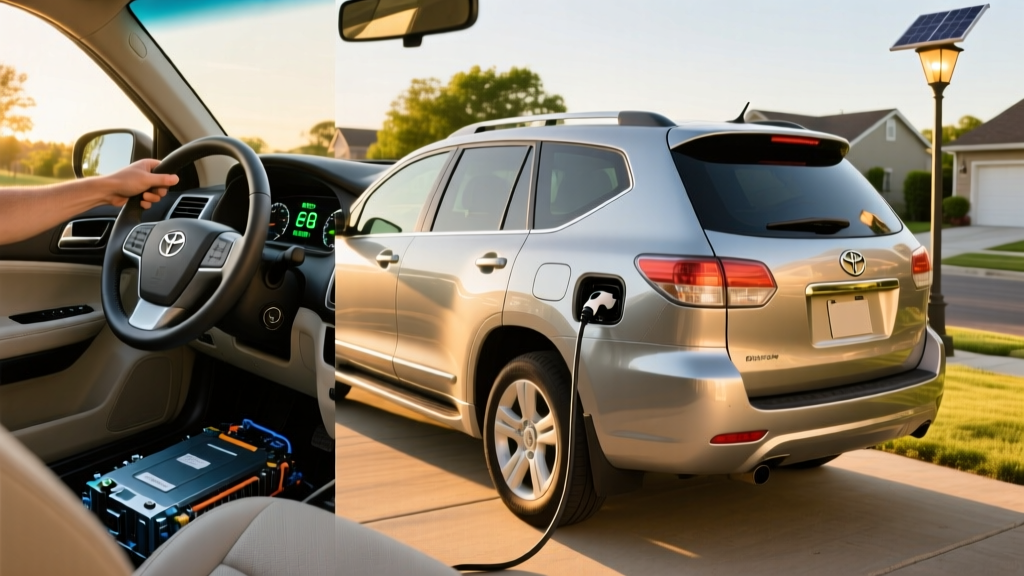
The 2023 RAV4 Hybrid XLE Premium is the HEV. It has no charge port, no electric-only commute capability, and no federal tax credit eligibility. If you want to drive on electricity alone for a daily commute, you need the RAV4 Prime (the PHEV variant) or a full battery-electric vehicle. The HEV's advantage is simplicity: you fill up at any gas station and the hybrid system handles the rest.
Fuel Economy: EPA Ratings and Real-World MPG
| Driving Cycle | EPA Rating | Real-World Expectation |
|---|---|---|
| City | 41 MPG | 40–44 MPG (hybrids often exceed EPA in stop-and-go) |
| Highway | 38 MPG | 34–37 MPG (sustained 70+ mph reduces regen benefit) |
| Combined | 40 MPG | 37–41 MPG depending on driving mix |
The RAV4 Hybrid's 41 MPG city rating is not a typo — Toyota's hybrid system recaptures energy during braking and low-speed driving, making city commutes its strongest scenario. On fueleconomy.gov, owner-reported fuel economy for the 2023 RAV4 Hybrid clusters around 38–42 MPG combined, consistent with the EPA sticker.
Cold-weather caveat: In sub-freezing temperatures, expect a 5–10% fuel economy drop. The engine runs more frequently to provide cabin heat and maintain battery temperature. Owners in northern climates typically report 36–38 MPG combined in winter months.
Highway-heavy driving: At sustained 75–80 mph, the hybrid advantage diminishes because there is minimal braking to recapture energy. Expect 34–36 MPG on long interstate trips. This still beats a comparable gas-only RAV4 (28–30 MPG highway) by a meaningful margin.
Powertrain and Performance Specs
| Specification | 2023 RAV4 Hybrid XLE Premium |
|---|---|
| Engine | 2.5L 4-cylinder Atkinson cycle |
| Engine output | 176 hp / 163 lb-ft torque |
| Front electric motor | 118 hp / 149 lb-ft |
| Rear electric motor (AWD) | 54 hp / 89 lb-ft |
| Net combined system HP | 219 hp |
| Transmission | eCVT (planetary gearset, not a belt CVT) |
| Drivetrain | Electronic AWD (eAWD) standard |
| 0–60 mph | ~7.4 seconds |
| Towing capacity | 1,750 lbs |
| Fuel tank | 14.5 gallons |
| Total range | ~580 miles (at 40 MPG combined) |
| Battery type | Nickel-metal hydride (NiMH), ~1.6 kWh |
The 219 combined horsepower figure comes from Toyota's specific formula for adding engine and motor outputs — it is not a simple sum of peak values, because the engine and motors peak at different RPMs. The result is a powertrain that feels responsive off the line (electric motors deliver instant torque) and adequate for highway merging. The eAWD system uses the rear electric motor independently of the front axle, engaging automatically when slip is detected or under hard acceleration. There is no mechanical driveshaft to the rear wheels.
The eCVT is a planetary gearset, not the rubber-belt continuously variable transmissions found in some competitors. This design has proven exceptionally durable in Toyota's hybrid lineup, with no belt to wear or fluid to service on a short interval.
XLE Premium Trim: What You Get (and What You Don't)
The XLE Premium sits in the middle of the 2023 RAV4 Hybrid lineup, above the LE and XLE but below the SE, XSE, and Limited. For the 2023 model year, the XLE Premium MSRP was approximately $35,345 (including destination charge). Key equipment includes:
- SofTex synthetic leather seats (heated front)
- Power moonroof
- 18-inch alloy wheels
- 8-inch touchscreen with wireless Apple CarPlay and Android Auto
- Toyota Safety Sense 2.5+ (pre-collision, lane departure, adaptive cruise, lane tracing)
- Smart Key with push-button start
- Blind-spot monitor with rear cross-traffic alert
- Power liftgate
What it lacks compared to higher trims: no panoramic moonroof (Limited), no sport-tuned suspension (SE/XSE), no 12.3-inch digital gauge cluster (standard on Limited), no JBL premium audio (optional on XSE/Limited). For most buyers, the XLE Premium covers the comfort and technology essentials without the price premium of the top trims.
Tax Credits and Incentives: What Applies to This HEV
The 2023 Toyota RAV4 Hybrid (all trims, including XLE Premium) is a conventional hybrid. Under IRS §30D rules, the federal Clean Vehicle Credit applies only to plug-in electric vehicles (PHEVs and BEVs) with a battery capacity of at least 7 kWh. The RAV4 Hybrid's ~1.6 kWh NiMH battery does not qualify.
- Federal §30D credit: Not eligible (HEV, not plug-in)
- Federal used EV credit (§25E): Not eligible (HEV, not plug-in)
- State hybrid incentives: A handful of states offer modest rebates for HEVs (e.g., Connecticut's CHEAPR program has historically included HEV tiers), but most state incentive programs have shifted focus to PHEVs and BEVs. Check your state's energy office for current availability.
- Insurance discounts: Some insurers offer hybrid/electrified-vehicle discounts — check with your provider.
If the federal tax credit is a priority, the RAV4 Prime PHEV is the electrified RAV4 that qualifies — though eligibility depends on battery-sourcing requirements, buyer income caps ($150K single / $300K joint for new vehicles), and the $80,000 MSRP cap for SUVs. Always verify current-year rules on irs.gov and consult a tax professional before purchasing.
Battery Longevity, Warranty, and Replacement Cost
2023 RAV4 Hybrid Battery Warranty
- Hybrid battery: 10 years / 150,000 miles (whichever comes first), transferable to subsequent owners
- Hybrid system components: 8 years / 100,000 miles (inverter, control module, etc.)
- Capacity retention threshold: Toyota warrants the battery against defects and abnormal loss of capacity — there is no published minimum SoH percentage, but warranty claims typically trigger when the battery can no longer support normal hybrid operation
Toyota's hybrid battery track record is among the strongest in the industry. The NiMH pack in the RAV4 Hybrid is far smaller and less stressed than a full EV battery. It never deep-cycles (the system keeps it between roughly 40% and 80% state of charge), which dramatically extends cell life. Data from Toyota's Prius fleet — which uses similar NiMH chemistry and management — shows hybrid batteries routinely lasting 150,000–200,000+ miles before significant degradation.
Replacement cost if out of warranty: A new OEM hybrid battery for the RAV4 Hybrid runs approximately $3,000–$4,500 installed at a dealership. Refurbished/reconditioned packs are available from aftermarket suppliers for $1,500–$2,500 installed. Individual module replacement (the NiMH pack contains multiple modules, and often only one or two fail) can cost $500–$1,200 at a hybrid-specialist shop.
Is this a realistic concern for a 2023 model? With the 10-year/150,000-mile warranty, a 2023 RAV4 Hybrid is covered through at least 2033. For the vast majority of owners, the hybrid battery will outlast the vehicle's useful life or ownership period. This is not the replacement-cost anxiety associated with full EV batteries ($10,000–$20,000+).
Reliability and Safety Ratings
The 2023 RAV4 Hybrid earned a 5-Star Overall Safety Rating from NHTSA and was an IIHS Top Safety Pick when equipped with specific headlights (the LED projector units on higher trims; the XLE Premium's reflector headlights received a lower rating, which prevented the Top Safety Pick+ designation).
Toyota's hybrid powertrain reliability is well-documented across Consumer Reports, J.D. Power, and long-term fleet data. The 2.5L Atkinson-cycle engine is under-stressed compared to turbocharged competitors, the eCVT has no wear-prone belt, and the NiMH battery chemistry is inherently stable. Common complaints on the 2023 RAV4 Hybrid are minor: some owners report a slight hesitation during the gas-to-electric transition at low speeds, and road noise on coarse pavement is noticeable (an insulation issue, not a mechanical one).
Who Should Buy This — and Who Shouldn't
Choose the RAV4 Hybrid XLE Premium if:
- You drive 12,000–20,000 miles/year and want to cut fuel costs by 30–35% vs. a gas RAV4
- You lack home charging access (apartment, street parking) and cannot plug in nightly
- You want AWD for snow/rain without the fuel-economy penalty of a traditional AWD system
- You prioritize proven reliability and a 10-year hybrid battery warranty
- You want a higher driving position and cargo space (37.5 cu ft behind rear seats) with minimal compromise
Look elsewhere if:
- You want electric-only commuting — you need the RAV4 Prime PHEV or a full BEV
- You want the $7,500 federal tax credit — HEVs do not qualify under current §30D rules
- You tow more than 1,750 lbs — consider a RAV4 gas model (3,500-lb rating with Adventure trim) or a larger SUV
- You prioritize sporty handling — the hybrid tuning favors efficiency over corner-carving dynamics
Hybrid vs. PHEV vs. EV decision framework: If you can charge at home and your daily commute is under 40 miles, the RAV4 Prime PHEV lets you drive most days on electricity while keeping a gas engine for road trips. If you can charge at home and rarely drive over 250 miles in a day, a full BEV (like the Toyota bZ4X or a Tesla Model Y) eliminates gas entirely. The RAV4 Hybrid HEV is the right answer when charging access is limited, you don't want to change your refueling behavior, and you still want meaningful fuel savings.
Frequently Asked Questions
How many MPG does the 2023 RAV4 Hybrid XLE Premium get?
The EPA rates it at 41 MPG city, 38 MPG highway, and 40 MPG combined. In real-world driving, owners report 37–44 MPG depending on conditions. City driving typically yields the highest numbers because regenerative braking recaptures energy at every stop. Highway driving at 75+ mph drops to the mid-30s. Cold weather reduces fuel economy by roughly 5–10%.
Does the RAV4 Hybrid need to be plugged in?
No. The 2023 RAV4 Hybrid is a conventional hybrid (HEV). It has no charge port. The battery is charged by the gasoline engine and by regenerative braking during deceleration. You refuel only at gas stations, exactly like a conventional car.
How far can the RAV4 Hybrid drive on electric power alone?
Effectively zero miles for practical purposes. The HEV system has an "EV Mode" button that allows very short distances (roughly 0.5–1 mile) at speeds under 25 mph, but the battery is too small (~1.6 kWh) to sustain electric-only driving. If you want meaningful electric-only range, you need the RAV4 Prime PHEV (42 miles EPA electric-only).
Is the 2023 RAV4 Hybrid reliable, and what does battery replacement cost?
Toyota's hybrid powertrain has one of the strongest reliability records in the industry. The NiMH hybrid battery is covered by a 10-year/150,000-mile warranty. Out-of-warranty replacement runs $3,000–$4,500 for a new OEM pack, or $1,500–$2,500 refurbished. In practice, these batteries routinely last 150,000–200,000+ miles. For a 2023 model, the warranty extends through at least 2033.
Does the 2023 RAV4 Hybrid XLE Premium qualify for any tax credit?
No federal tax credit applies. The IRS §30D Clean Vehicle Credit requires a plug-in vehicle with at least 7 kWh of battery capacity. The RAV4 Hybrid's ~1.6 kWh NiMH battery does not qualify. Some states may offer minor hybrid incentives, but most have shifted to PHEV/BEV programs. The RAV4 Prime (PHEV variant) is the electrified RAV4 eligible for federal credits, subject to income, MSRP, and battery-sourcing requirements.
How does the RAV4 Hybrid compare to the gas-only RAV4?
The gas-only 2023 RAV4 (2.5L 4-cylinder, 203 hp) is rated at 27 city / 35 highway / 30 combined MPG. The Hybrid's 40 MPG combined saves roughly $400–$600 per year in fuel costs for a driver covering 15,000 miles annually (at $3.50/gallon). The Hybrid also comes standard with AWD (a $1,400 option on the gas model) and delivers 219 hp vs. 203 hp, making it both quicker and more efficient. The trade-off is a higher starting price (roughly $2,000–$3,000 more than an equivalently trimmed gas RAV4) and a slightly lower towing capacity (1,750 lbs vs. 1,500–3,500 lbs depending on gas trim).
What is the difference between the XLE and XLE Premium trims?
The XLE Premium adds SofTex synthetic leather seats, heated front seats, a power moonroof, and a power liftgate over the standard XLE Hybrid. The mechanical powertrain, fuel economy, and AWD system are identical. The XLE Premium MSRP was approximately $1,500–$2,000 more than the XLE for the 2023 model year.