Quick Verdict: The CR-V Hybrid Sport in 2026
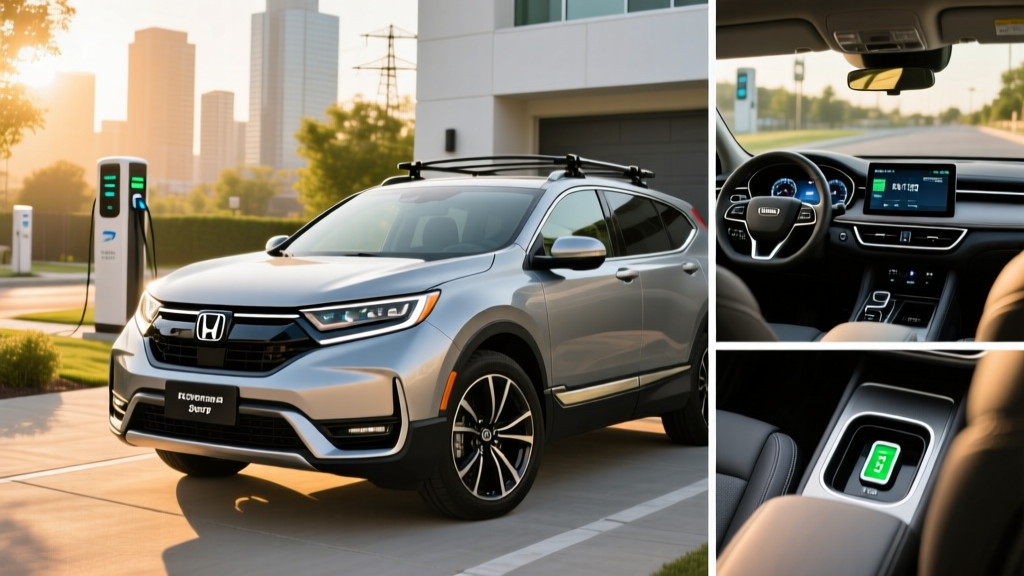
The 2023 Honda CR-V Hybrid Sport remains one of the most compelling compact hybrid SUVs on the used and certified-pre-owned market. With an EPA-rated 40 MPG combined, a 204-horsepower two-motor hybrid system, and Honda's proven reliability record, it occupies a sweet spot for buyers who want significant fuel savings without the charging infrastructure demands of a plug-in hybrid or full electric vehicle. The Sport trim adds visual aggression and standard all-wheel drive, making it a practical daily driver across climates.
| Specification | Value |
|---|---|
| Powertrain | 2.0L Atkinson-cycle 4-cyl + two-motor hybrid system |
| Combined Horsepower | 204 hp (146 hp engine + 184 hp drive motor) |
| Combined Torque | 247 lb-ft (drive motor) |
| Drivetrain | AWD (standard on Sport trim) |
| Transmission | e-CVT (direct-drive, no traditional gears) |
| Hybrid Battery | Lithium-ion, ~1.06 kWh (HEV — not plug-in) |
| EPA Fuel Economy | 40 city / 34 highway / 37 combined MPG |
| Fuel Tank | 14.0 gallons |
| Total Range | ~518 miles (EPA combined estimate) |
| 0-60 mph | ~7.6 seconds |
| Cargo Volume | 36.3 cu ft (rear seats up) / 76.5 cu ft (folded) |
| Towing Capacity | 1,000 lbs |
| Original MSRP (2023) | $34,395 (including destination) |
| Hybrid Battery Warranty | 8 years / 100,000 miles (10 yr/150,000 mi in CARB states) |
Fuel Economy: EPA Numbers vs. Real-World MPG
The 2023 CR-V Hybrid Sport carries an EPA rating of 40 MPG city, 34 MPG highway, and 37 MPG combined with standard all-wheel drive. (Front-wheel-drive Hybrid trims rated slightly higher at 43/36/40, but the Sport comes exclusively with AWD.)
| Driving Cycle | EPA Rating | Real-World Expectation |
|---|---|---|
| City | 40 MPG | 38–44 MPG (hybrids often exceed EPA in stop-and-go) |
| Highway | 34 MPG | 30–35 MPG (aerodynamic drag and sustained speed reduce hybrid advantage) |
| Combined | 37 MPG | 34–40 MPG (varies with driving mix and climate) |
Like most Honda hybrids using the two-motor system, the CR-V Hybrid operates primarily as a series hybrid at lower speeds — the gasoline engine acts as a generator while the electric drive motor turns the wheels. This architecture excels in city driving, where regenerative braking recaptures energy at every stop. Owners consistently report beating the EPA city estimate in moderate-traffic commuting, with some achieving 42–44 MPG on routes with frequent stops.
Highway driving tells a different story. Above roughly 55 mph, the system engages a lock-up clutch that connects the engine directly to the front wheels for efficiency, but sustained high speeds diminish the hybrid advantage. Expect 30–33 MPG at 75–80 mph on flat interstate terrain. Cold weather further reduces efficiency — winter MPG can drop to 32–34 combined as the engine runs more frequently for cabin heat and the battery operates less efficiently at low temperatures.
For verified data, the EPA's fueleconomy.gov listing provides the official test cycle figures and owner-reported MPG tracking.
HEV vs. PHEV vs. EV: Understanding What the CR-V Hybrid Is
A critical distinction for shoppers: the 2023 Honda CR-V Hybrid is a conventional hybrid electric vehicle (HEV), not a plug-in hybrid (PHEV). Honda did not offer a plug-in CR-V for the U.S. market in 2023. This means:
| Feature | HEV (CR-V Hybrid) | PHEV (e.g., Toyota RAV4 Prime) | BEV (e.g., Tesla Model Y) |
|---|---|---|---|
| Plug-in charging? | No — gas only | Yes — plug in for electric range | Yes — plug in exclusively |
| Electric-only range | Less than 1 mile at low speed | 25–42 miles typical | 250–330+ miles |
| Fuel source | Gasoline | Gasoline + electricity | Electricity only |
| Home charging needed? | No | Recommended for max benefit | Required |
| Federal tax credit (§30D) | Not eligible | Up to $7,500 (if eligible) | Up to $7,500 (if eligible) |
| Typical MPG / MPGe | 35–45 MPG | 35–40 MPG + 90+ MPGe electric | 100+ MPGe |
| Upfront cost premium | $1,000–$2,500 over gas | $4,000–$8,000 over gas | $5,000–$15,000+ over gas |
The CR-V Hybrid's battery pack (~1.06 kWh lithium-ion) is charged exclusively through regenerative braking and the gasoline engine. You never plug it in. The system automatically manages energy flow — there is no range anxiety, no charging logistics, and no dependence on public charging infrastructure. You simply fill up at any gas station and drive.
If you were hoping for a plug-in CR-V with 30+ miles of electric-only commuting range, that option does not exist from Honda for the 2023 model year. Competitors like the Toyota RAV4 Prime (42 miles electric-only, 94 MPGe) or the Ford Escape PHEV (37 miles electric-only) fill that niche, but at a significantly higher purchase price.
Powertrain Deep Dive: How the Two-Motor System Works
Honda's fourth-generation two-motor hybrid system pairs a 2.0-liter Atkinson-cycle four-cylinder engine (146 hp, 134 lb-ft) with a dual-motor transaxle. The drive motor produces 184 hp and 247 lb-ft of torque, and it serves as the primary motivator in most driving conditions. Combined system output is rated at 204 horsepower.
The system operates in three modes, managed automatically:
- EV Drive: Battery powers the drive motor alone — used for gentle acceleration from stops and low-speed maneuvering. Range is extremely limited (under 1 mile) given the small battery.
- Hybrid Drive: The gasoline engine spins a generator motor that produces electricity to feed the drive motor. The engine does not directly turn the wheels. This is the dominant mode in city and suburban driving.
- Engine Drive: At steady highway speeds, a lock-up clutch mechanically connects the engine to the front axle, bypassing the electric path for maximum efficiency at cruise.
The result is a powertrain that feels responsive off the line (electric motors deliver instant torque) while maintaining competitive highway fuel economy. The e-CVT produces no shift shock or rubber-band sensation typical of older CVTs, because it uses a direct-drive gear ratio rather than a belt-and-pulley system. Acceleration to 60 mph takes approximately 7.6 seconds — adequate for merging and passing, though not sporty in the way a turbocharged gas model or an EV would feel.
Pricing, Tax Credits, and Ownership Economics
The 2023 Honda CR-V Hybrid Sport launched at an MSRP of $34,395 (including $1,345 destination charge). In the current 2026 used and CPO market, well-maintained examples typically list between $27,000 and $32,000 depending on mileage, condition, and region.
Federal tax credit status: The 2023 CR-V Hybrid is a conventional HEV and does not qualify for the IRS §30D Clean Vehicle Credit. That credit applies only to plug-in hybrids (PHEVs) and battery electric vehicles (BEVs) meeting battery sourcing, MSRP cap, and buyer income requirements per current IRS guidelines. There is no federal incentive for purchasing a conventional hybrid.
Some states offer hybrid-specific rebates or HOV lane access — check your state's energy office or DMV for current programs, as these vary widely by jurisdiction and change frequently.
Where the CR-V Hybrid saves money is at the pump. Compared to the gas-only 2023 CR-V AWD (EPA 29 combined MPG), the Hybrid Sport's 37 MPG combined translates to roughly 8 fewer gallons consumed per 1,000 miles. At $3.50/gallon, that's approximately $280 saved per 10,000 miles driven, or about $1,400 over five years of average driving. The hybrid premium over the gas CR-V EX AWD (MSRP ~$33,345 in 2023) was roughly $1,050, meaning the fuel savings alone pay back the premium in under four years for most drivers.
Insurance costs for the CR-V Hybrid are generally comparable to the gas model. Maintenance is often slightly lower — the hybrid system's regenerative braking reduces wear on friction brake pads, and Honda's hybrid components have proven durable with minimal scheduled service requirements beyond standard oil changes.
Battery Warranty, Reliability, and Replacement Cost
Hybrid battery warranty: Honda covers the CR-V Hybrid's lithium-ion battery pack for 8 years or 100,000 miles (whichever comes first) under its standard hybrid component warranty. In states that follow California Air Resources Board (CARB) emissions standards — including California, New York, Massachusetts, and several others — coverage extends to 10 years or 150,000 miles.
The warranty covers battery capacity loss below a defined threshold and any hybrid system component failure. Honda does not publish the exact capacity-retention percentage that triggers a claim, but dealership technicians can read the battery's State of Health (SoH) through the diagnostic system.
Honda's hybrid systems have demonstrated strong long-term reliability. The two-motor architecture has fewer high-stress mechanical components than a traditional transmission, and the lithium-ion battery pack operates within a conservative state-of-charge window managed by the vehicle's battery management system (BMS). Unlike a full EV battery, the CR-V Hybrid's small ~1.06 kWh pack undergoes shallow charge-discharge cycles, which significantly extends its cycle life.
Real-world data from high-mileage Honda hybrids (Accord Hybrid, Insight, earlier CR-V Hybrids) suggests the battery pack routinely lasts well beyond the warranty period — often reaching 150,000–200,000+ miles before significant degradation. When replacement is eventually needed, a new OEM hybrid battery for the CR-V Hybrid typically costs between $2,000 and $3,500 installed, depending on dealership labor rates. Third-party reconditioned packs may be available for $1,200–$2,000 as the model ages and the aftermarket develops.
For reliability track records, IIHS crash-test ratings show the 2023 CR-V earning Top Safety Pick+ honors, and the model has consistently scored well in long-term dependability surveys from Consumer Reports and J.D. Power.
Sport Trim: What You Get for the Money
The Sport trim sits in the middle of the 2023 CR-V Hybrid lineup (above the base Hybrid and below the Sport Touring). Standard equipment includes:
- 18-inch Berlina Black alloy wheels
- Blind-spot information system (BSI) with cross-traffic monitor
- Honda Sensing suite (adaptive cruise control, lane-keeping assist, collision mitigation braking, road departure mitigation)
- 7-inch touchscreen with wireless Apple CarPlay and Android Auto
- Heated front seats and heated side mirrors
- Dual-zone automatic climate control
- Remote start
- LED headlights and fog lights
- Black exterior trim accents and sport-specific grille
Notable omissions from the Sport trim include the 9-inch touchscreen, wireless phone charging, Bose premium audio, heated rear seats, and the hands-free power tailgate — all reserved for the Sport Touring. The Honda Sensing suite, however, is comprehensive and represents a strong SAE Level 2 driver-assistance package (meaning you must remain fully engaged with hands on the wheel and eyes on the road at all times).
Who Should Choose the CR-V Hybrid Sport?
Choose the 2023 CR-V Hybrid Sport if:
- You want 35–42 MPG real-world without changing your refueling habits
- You lack access to home or workplace charging (apartment dwellers, street parkers)
- You regularly drive in stop-and-go city traffic where hybrids shine
- You want AWD capability with minimal fuel-economy penalty
- You plan to own the vehicle 8–12 years and value Honda's reliability reputation
- Your budget is $27,000–$35,000 for a compact hybrid SUV
Look at a PHEV (RAV4 Prime, Escape PHEV) instead if:
- You have home Level 2 charging and a commute under 35 miles
- You want to drive most weekdays on electricity alone
- You qualify for the §30D federal tax credit (income and sourcing requirements apply)
Look at a full EV (Model Y, Ioniq 5, Equinox EV) instead if:
- You have reliable home charging and want to eliminate gasoline entirely
- Your daily driving is under 250 miles and you rarely tow
- You want maximum fuel-cost savings and lower per-mile energy costs
Pros
- Strong real-world MPG, especially in city driving (often exceeds EPA)
- AWD standard on Sport — no drivetrain penalty for hybrid efficiency
- Proven Honda hybrid reliability with generous battery warranty
- No charging infrastructure required — gas-and-go simplicity
- Competitive cargo space (36.3 cu ft) with no battery-pack intrusion
- Comprehensive Honda Sensing safety suite standard
Cons
- Highway MPG less impressive than city (34 EPA, ~30-33 at 75+ mph)
- No plug-in or electric-only driving option from Honda
- Not eligible for the federal §30D tax credit
- Towing limited to 1,000 lbs (gas CR-V AWD tows 1,500 lbs)
- Sport trim lacks premium tech features (9-inch screen, wireless charging)
- Cabin noise under hard acceleration from the Atkinson-cycle engine
Frequently Asked Questions
How many MPG does the 2023 Honda CR-V Hybrid Sport actually get?
The EPA rates it at 40 city / 34 highway / 37 combined MPG. Real-world results vary: city drivers often see 38–44 MPG thanks to regenerative braking, while sustained highway driving at 75+ mph typically yields 30–33 MPG. Cold weather and short trips reduce efficiency further. Overall, most owners report 35–40 MPG in mixed driving.
Does the CR-V Hybrid need to be plugged in?
No. The 2023 CR-V Hybrid is a conventional HEV — it charges its small lithium-ion battery entirely through regenerative braking and the gasoline engine. You never plug it in. Just fill up at any gas station as you would with a standard vehicle.
How far can the CR-V Hybrid drive on electric power alone?
Less than one mile, and only at very low speeds (under 25 mph) with gentle throttle input. The ~1.06 kWh battery is too small for meaningful electric-only range. This is by design — the hybrid system uses the battery to assist the engine and recapture braking energy, not to serve as a primary power source. If electric-only commuting is your goal, you need a PHEV or BEV.
Is the 2023 CR-V Hybrid reliable, and what does a battery replacement cost?
Honda's hybrid systems have a strong reliability record, with the two-motor architecture proving durable well past 150,000 miles in real-world use. The hybrid battery is warrantied for 8 years/100,000 miles (10 years/150,000 miles in CARB states). If replacement is needed outside warranty, expect $2,000–$3,500 for a new OEM pack installed at a dealership.
Does the 2023 CR-V Hybrid qualify for any tax credits?
No. The federal §30D Clean Vehicle Credit applies only to plug-in hybrids and battery electric vehicles that meet battery sourcing, MSRP, and buyer income requirements. The CR-V Hybrid, as a conventional HEV, is not eligible. Some states may offer minor hybrid incentives or HOV lane access — check your local regulations for current programs.
How does the CR-V Hybrid compare to the gas CR-V?
The gas 2023 CR-V AWD (1.5L turbo, 190 hp) is rated at 29 MPG combined. The Hybrid Sport delivers 37 MPG combined — a 27% improvement — while offering similar power (204 hp combined) and a more refined low-speed driving experience. The hybrid carries a roughly $1,000 premium over comparable gas trims, which fuel savings typically recover within 3–4 years of average driving.
Is Honda Sensing on the CR-V Hybrid a self-driving system?
No. Honda Sensing is an SAE Level 2 driver-assistance system. It provides adaptive cruise control, lane-centering, and automatic emergency braking, but you must keep your hands on the steering wheel and your eyes on the road at all times. It does not drive the vehicle autonomously.