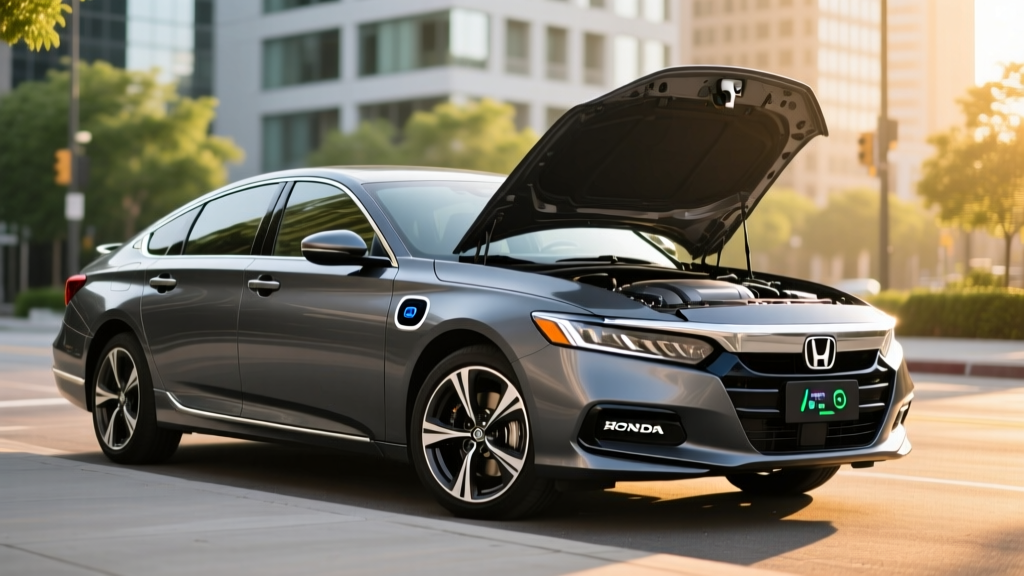
The 2023 Honda Accord Hybrid Sport sits in a tricky spot for electrified-car shoppers. It's not a plug-in hybrid, and it's certainly not a battery-electric vehicle. But for buyers who want meaningful fuel savings without ever plugging in, changing driving habits, or worrying about charging infrastructure, Honda's two-motor hybrid system in the Accord Sport delivers measurable, daily efficiency gains. This guide breaks down exactly what you get — EPA numbers, real-world fuel economy, powertrain specs, battery longevity, and how this conventional hybrid (HEV) stacks up against plug-in hybrids and full EVs in 2026.
HEV vs PHEV vs EV: Where the Accord Hybrid Sport Fits
Before we get into the numbers, let's clear up the most common confusion. The 2023 Accord Hybrid Sport is a conventional hybrid (HEV). It does not have a plug. It does not have a large battery you charge from a wall outlet. Instead, it uses a small lithium-ion battery pack that recharges through regenerative braking and the gasoline engine. You fuel it at a gas station like any other car.
| Feature | HEV (Accord Hybrid Sport) | PHEV (e.g., Toyota Prius Prime) | BEV (e.g., Tesla Model 3) |
|---|---|---|---|
| Plug-in charging? | No | Yes | Yes |
| Electric-only range | ~1 mile at low speed | 25-44 miles typical | 250-360+ miles |
| Battery size | ~1.06 kWh | 13.6-18.1 kWh | 57-82 kWh |
| Gas engine? | Yes (primary) | Yes (backup) | No |
| Home charging install needed? | No | Recommended (Level 2) | Required (Level 2) |
| Federal tax credit (§30D)? | No | Up to $7,500 (if eligible) | Up to $7,500 (if eligible) |
The Accord Hybrid Sport is the right call if you can't charge at home (apartment, street parking, no garage), drive long highway routes regularly, or simply want zero lifestyle change with better fuel economy. If you have a garage with a 240V outlet and a short commute, a PHEV or BEV will save you more money per mile.
2023 Honda Accord Hybrid Sport: EPA MPG and Fuel Economy
According to fueleconomy.gov, the 2023 Honda Accord Hybrid (all trims including Sport) carries these EPA estimates:
| Metric | EPA Estimate |
|---|---|
| City MPG | 46 MPG |
| Highway MPG | 41 MPG |
| Combined MPG | 44 MPG |
| Fuel tank capacity | 12.8 gallons |
| Total range (est.) | ~563 miles |
| Annual fuel cost (EPA est.) | ~$1,350 |
How many MPG does this hybrid get in the real world?
Here's where Honda's two-motor hybrid system shines: real-world city driving often exceeds the EPA city estimate. Because the Accord Hybrid runs primarily on its electric motors at low speeds — with the 2.0L engine acting as a generator rather than directly driving the wheels — stop-and-go traffic actually improves efficiency. Owners regularly report 47-50 MPG in urban and suburban driving.
Highway driving is a different story. At sustained speeds above 65 mph, the gasoline engine takes over direct drive, and aerodynamic drag works against you. Expect 38-41 MPG on the highway in real-world conditions. In cold weather (below 35°F), overall fuel economy typically drops 5-10% as the engine runs more frequently to provide cabin heat and maintain battery temperature.
For comparison, the gas-only 2023 Accord 1.5T Sport is rated at 29 city / 37 highway / 32 combined. The hybrid's 44 MPG combined represents a 37.5% improvement — roughly 180 fewer gallons per year for a driver covering 15,000 miles annually, saving approximately $540-$650 per year at 2026 fuel prices.
Powertrain Specs: Engine, Motors, and Horsepower
The 2023 Accord Hybrid Sport uses Honda's fourth-generation two-motor hybrid system. This is not a mild hybrid with a small assist motor bolted to a conventional drivetrain. It's a series-parallel full hybrid that can operate in three distinct modes:
- EV Drive: Battery powers the electric drive motor (short distances, low speeds)
- Hybrid Drive: Gasoline engine powers a generator, which feeds the electric drive motor
- Engine Drive: Gasoline engine directly drives the front wheels via a lock-up clutch (highway cruising)
| Specification | Value |
|---|---|
| Engine | 2.0L DOHC Atkinson-cycle 4-cylinder |
| Engine horsepower | 146 hp @ 6,100 rpm |
| Engine torque | 134 lb-ft @ 4,500 rpm |
| Electric drive motor | 181 hp / 247 lb-ft |
| Combined system output | 204 hp |
| Transmission | e-CVT (no physical gears) |
| Drivetrain | Front-wheel drive |
| 0-60 mph | ~7.3 seconds (est.) |
| Battery type | Lithium-ion |
| Battery capacity | ~1.06 kWh |
The combined 204 hp is competitive with the turbocharged 1.5T gas Accord (192 hp), but the hybrid's 247 lb-ft of instant electric torque gives it noticeably stronger off-the-line acceleration. The e-CVT avoids the rubber-band feel of older CVTs because, in Hybrid Drive mode, there's no direct mechanical connection between engine RPM and vehicle speed — the engine runs at its most efficient RPM while the electric motor modulates output.
Pricing, Trims, and Tax Credit Eligibility
The 2023 Honda Accord Hybrid was offered in three trims. Here's the original MSRP breakdown:
| Trim | 2023 MSRP |
|---|---|
| Accord Hybrid Sport | $32,990 |
| Accord Hybrid Sport-L | $34,635 |
| Accord Hybrid Touring | $38,985 |
As of 2026, used 2023 Accord Hybrid Sport models typically list between $24,000 and $29,000 depending on mileage and condition.
Does the Accord Hybrid Sport qualify for any tax credit?
No federal tax credit. The IRS §30D New Clean Vehicle Credit applies only to plug-in electric vehicles (BEVs and PHEVs) with a battery capacity of at least 7 kWh. The Accord Hybrid Sport's ~1.06 kWh battery doesn't come close. Conventional hybrids (HEVs) have not qualified for any federal purchase incentive since the original Hybrid Tax Credit expired in 2010.
Some states and municipalities offer small rebates or HOV lane access for hybrids, but these vary widely and change frequently. Check your state's energy office or the Alternative Fuels Data Center for current local incentives.
Battery Longevity, Warranty, and Replacement Cost
Honda Hybrid Battery Warranty: 8 years / 100,000 miles (10 years / 150,000 miles in CARB states including CA, CT, ME, MD, MA, NJ, NY, OR, RI, VT, WA, and others adopting California emissions standards).
Warranty coverage threshold: Honda covers the hybrid battery if it falls below approximately 60-70% of original capacity during the warranty period, though exact degradation thresholds are assessed case-by-case by Honda dealers.
Is this hybrid reliable and what is battery replacement cost?
Honda's hybrid system has a strong track record. The two-motor architecture is mechanically simpler than a traditional automatic transmission — no torque converter, no planetary gearsets, no multi-speed shifting. The electric motors have no brushes or wearable friction components.
The lithium-ion hybrid battery pack is small (~1.06 kWh) and operates within a narrow state-of-charge window (roughly 40-60% SoC), which dramatically reduces degradation compared to a BEV battery that cycles between 10-90% daily. Based on long-term data from Honda hybrid owners and fleet studies, the Accord Hybrid battery typically retains 85-90%+ capacity after 10 years and 150,000 miles.
If replacement is needed out of warranty, a new OEM hybrid battery for the Accord Hybrid costs approximately $2,000-$3,500 including parts and labor at a Honda dealer. Independent hybrid specialists often offer refurbished or aftermarket packs for $1,200-$2,000. This is dramatically less than a BEV battery replacement ($8,000-$20,000+).
For reliability data, the 2023 Accord earned a Top Safety Pick+ rating from IIHS and a 5-star overall safety rating from NHTSA. Honda Sensing (adaptive cruise, lane-keeping, automatic emergency braking, traffic sign recognition) is standard on all trims including the Hybrid Sport.
Who Should Choose the Accord Hybrid Sport vs a PHEV or EV?
Pros
- 44 MPG combined, often 47-50 MPG in city driving
- No plug-in charging required — zero infrastructure dependency
- 563-mile total range eliminates road-trip range anxiety
- Strong low-end torque (247 lb-ft from electric motor)
- Top Safety Pick+ with standard Honda Sensing ADAS suite
- Lower battery replacement cost vs BEV ($2,000-$3,500 vs $10,000+)
- Proven reliability from Honda's 4th-gen hybrid system
Cons
- No federal tax credit ($0 vs up to $7,500 for qualifying PHEVs/BEVs)
- Highway MPG (41) is lower than city (46) — unusual vs gas cars
- No electric-only commuting capability beyond ~1 mile at low speed
- FWD only — no AWD option (Toyota Camry Hybrid offers AWD)
- Higher upfront cost vs gas Accord (~$2,000-$3,000 premium)
- Cold-weather MPG drop of 5-10%
Choose the Accord Hybrid Sport if:
- You can't install a home charger (apartment, condo, street parking)
- Your commute is mixed city/highway and exceeds 40 miles round-trip
- You take road trips of 300+ miles regularly and don't want to plan charging stops
- You want 40+ MPG with zero behavioral change
- You live in a cold climate where BEV range loss is a concern
Choose a PHEV instead if:
- You have a garage with a 240V outlet or can install a Level 2 charger
- Your daily commute is under 40 miles round-trip (you could drive mostly electric)
- You want federal tax credit eligibility and your income/vehicle MSRP qualify
Choose a full BEV instead if:
- You have reliable home and workplace charging
- Your daily driving is under 200 miles and you rarely road-trip beyond 250 miles
- You want to eliminate gasoline entirely and minimize per-mile energy cost
Frequently Asked Questions
How many MPG does the 2023 Honda Accord Hybrid Sport get?
The EPA rates it at 46 city / 41 highway / 44 combined MPG. In real-world city driving, owners commonly see 47-50 MPG thanks to the electric-motor-dominant low-speed operation. Highway driving yields 38-41 MPG. Cold weather reduces combined economy by roughly 5-10%.
Does the Accord Hybrid need to be plugged in?
No. The Accord Hybrid Sport is a conventional hybrid (HEV). Its small lithium-ion battery recharges through regenerative braking and the gasoline engine. You fuel it exclusively at gas stations.
How far can the Accord Hybrid go on electric only?
Approximately 1 mile at very low speeds (under 25 mph) on a fully charged hybrid battery. This is not a plug-in hybrid — it is not designed for electric-only commuting. The electric motor assists the gasoline engine continuously but cannot sustain highway speeds on battery power alone.
Is the Honda Accord Hybrid reliable long-term?
Yes. Honda's fourth-generation two-motor hybrid system has been in production since 2017 across multiple models (Accord, CR-V, Civic Hybrid). The hybrid battery operates in a narrow 40-60% state-of-charge window, which minimizes degradation. Most Honda hybrid batteries retain 85-90%+ capacity at 150,000 miles. The hybrid battery carries an 8-year/100,000-mile warranty (10 years/150,000 miles in CARB states).
What does a replacement hybrid battery cost?
An OEM replacement hybrid battery for the Accord Hybrid costs approximately $2,000-$3,500 installed at a Honda dealer. Aftermarket or refurbished packs run $1,200-$2,000 through independent hybrid specialists. This is significantly less than a BEV battery replacement.
Does the 2023 Accord Hybrid qualify for a federal tax credit?
No. The IRS §30D New Clean Vehicle Credit requires a battery capacity of at least 7 kWh and plug-in charging capability. The Accord Hybrid's ~1.06 kWh battery does not qualify. Only plug-in hybrids (PHEVs) and battery-electric vehicles (BEVs) are eligible for federal purchase credits.
How does the Accord Hybrid Sport compare to the Toyota Camry Hybrid?
The 2023 Camry Hybrid LE is EPA-rated at 52 combined MPG (vs 44 for the Accord Hybrid) and offers available AWD. However, the Accord Hybrid produces 204 hp (vs 208 hp combined for the Camry) with a more refined e-CVT feel, a larger trunk (16.7 cu ft vs 15.1 cu ft), and earned IIHS Top Safety Pick+ status. If maximum MPG is your priority, the Camry Hybrid wins. If driving refinement, interior space, and safety ratings matter more, the Accord Hybrid is the stronger pick.