Quick Verdict: The Only Plug-In Hybrid Minivan in America
The 2023 Chrysler Pacifica Hybrid occupies a category of one. It remains the sole plug-in hybrid (PHEV) minivan sold in the United States, combining 32 miles of electric-only driving with the cargo space, sliding doors, and seven-seat layout that families need. For households that can charge at home and run most weekday errands on electricity — but still need 400+ miles of total range for road trips — the Pacifica Hybrid solves a problem no full EV minivan currently addresses.
But the PHEV premium is real. With a base MSRP around $51,095 (Touring trim) and climbing past $60,000 on the Limited and Pinnacle trims, buyers need to understand exactly what they're getting: the electric range, the real-world fuel economy, the charging logistics, and whether any federal tax credits still apply. Here's the data-driven breakdown.
HEV vs PHEV: What the Pacifica Hybrid Actually Is
Chrysler sells the Pacifica in two electrified-adjacent forms, and the distinction matters:
Conventional Gas Pacifica (Not a Hybrid)
The standard Pacifica uses a 3.6L V6 with no electric assist. It cannot drive on electric power alone and has no plug. EPA-rated at 19 city / 28 highway / 22 combined MPG.
Pacifica Hybrid (PHEV)
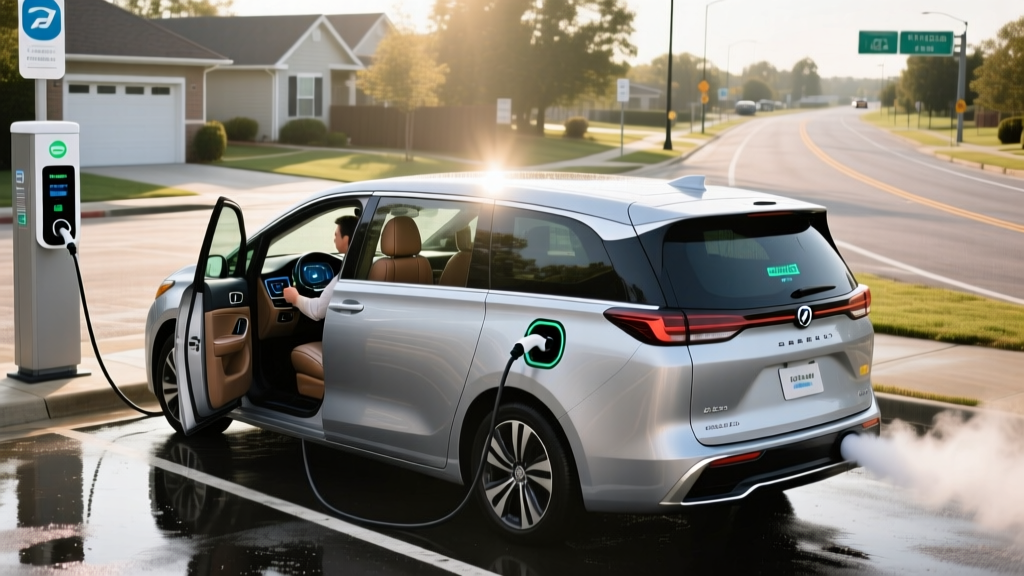
The Pacifica Hybrid is a plug-in hybrid. It pairs a 3.6L V6 with two electric motors and a 16-kWh lithium-ion battery. You plug it in to charge. It drives up to 32 miles on electricity alone before the gas engine engages. It never needs to be plugged in to function — the engine and regenerative braking recharge the battery — but plugging in is how you unlock its efficiency advantage.
Chrysler does not currently offer a conventional (non-plug-in) HEV version of the Pacifica. If you see "Pacifica Hybrid," it is always the PHEV.
Electric Range, MPGe, and Fuel Economy: The Numbers
| Metric | EPA Rating | Real-World Expectation |
|---|---|---|
| Electric-only range | 32 miles | 26–30 mi (highway/cold weather); up to 34 mi (city, mild temps) |
| MPGe (electric + gas) | 82 MPGe combined | Varies heavily by charge frequency |
| Gas-only MPG (after battery depletes) | 30 combined (29 city / 30 hwy) | 27–29 combined in mixed driving |
| Total combined range | 430 miles | ~390–420 mi real-world |
| Energy consumption (EV mode) | 37 kWh/100 mi | 38–42 kWh/100 mi highway |
The 32-mile EPA electric range is modest compared to PHEV SUVs like the Toyota RAV4 Prime (42 mi) or the Hyundai Tucson PHEV (33 mi). But in a 4,700-pound minivan, it's meaningful. Most families' daily driving — school drop-offs, grocery runs, commute — falls within 30 miles. If you charge nightly at home, you may use the gas engine only a few times per month.
Once the battery depletes, the Pacifica Hybrid operates as a conventional hybrid, returning a respectable 30 MPG combined. That's an 8-MPG improvement over the gas-only Pacifica's 22 combined, even without plug-in charging.
Real-World Range Reality Check
In cold weather (below 35°F), expect electric-only range to drop to roughly 22–26 miles due to battery chemistry limitations and cabin heating demands. Highway driving at 70+ mph also reduces EV range to approximately 24–27 miles. Plan conservatively if your commute is close to the 32-mile EPA figure.
Powertrain and Performance Specs
| Specification | Detail |
|---|---|
| Engine | 3.6L Atkinson-cycle V6 |
| Electric motors | Dual-motor eFlite electrically variable transmission (eVT) |
| Combined system horsepower | 260 hp |
| Battery capacity | 16 kWh (lithium-ion, NMC chemistry) |
| Usable battery capacity | ~13 kWh (buffer protects longevity) |
| 0–60 mph | ~7.1 seconds (est.) |
| Drivetrain | Front-wheel drive (AWD not available on Hybrid) |
| Towing capacity | Not rated for towing (gas Pacifica: 3,600 lb) |
| Cargo volume (behind 3rd row) | 32.3 cu ft |
| Cargo volume (max, seats folded) | 140.5 cu ft |
The Pacifica Hybrid's eFlite transmission uses two electric motors integrated into the transaxle. One motor primarily drives the wheels; the other acts as a generator or assists under hard acceleration. The system seamlessly blends electric and gas power — there's no jarring handoff when the engine kicks on, though you'll hear the V6 spool up under hard acceleration or when the battery is depleted.
One important limitation: the Pacifica Hybrid is front-wheel drive only. Chrysler offers AWD on the gas Pacifica but not the Hybrid. If you need all-wheel drive, this isn't your minivan.
Charging: Level 1, Level 2, and What You Need at Home
| Charging Level | Power (kW) | Time (0–100%) | Typical Setup |
|---|---|---|---|
| Level 1 (120V household outlet) | ~1.4 kW | ~14 hours | Included portable cordset; standard outlet |
| Level 2 (240V, 16A) | ~3.6 kW | ~4.5 hours | Home wall charger or public L2 station |
| Level 2 (240V, 32A) | ~7.2 kW | ~2 hours | Higher-amperage home charger (vehicle accepts up to 7.2 kW) |
| DC Fast Charging | Not supported | No CCS or CHAdeMO port | |
The Pacifica Hybrid's onboard charger accepts up to 7.2 kW on Level 2, which is competitive for a PHEV. A full charge in roughly 2 hours on a 32-amp Level 2 station means you can top off during a workday or while running errands if a charger is available.
The critical limitation: no DC fast charging. This is typical for PHEVs — the 16-kWh battery is small enough that Level 2 charging is adequate — but it means road-trip recharging relies on the gas engine, not highway fast chargers.
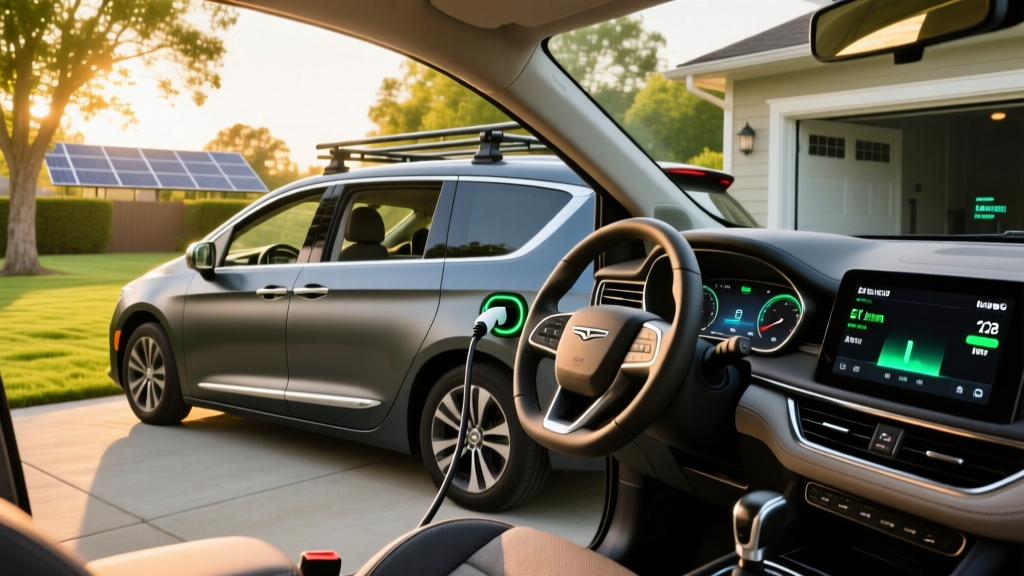
For home charging, a 240V / 32A Level 2 charger (such as a ChargePoint Home Flex or Emporia Vue) paired with a NEMA 14-50 outlet installation will deliver a full overnight charge in roughly 2 hours. Installation costs for a Level 2 home setup typically range from $500 to $2,000 depending on panel capacity and wiring distance — a licensed electrician should assess your panel before purchase.
Pricing, Trims, and Tax Credit Eligibility
The 2023 Chrysler Pacifica Hybrid was offered in three trims:
- Touring: ~$51,095 MSRP
- Limited: ~$54,095 MSRP
- Pinnacle: ~$59,400 MSRP
All trims include the 16-kWh battery, power sliding doors, power liftgate, and the Uconnect 5 infotainment system with an 8.4-inch (Touring) or 10.1-inch (Limited/Pinnacle) touchscreen.
Federal Tax Credit (§30D) — 2023 Rules vs. Now
When the 2023 Pacifica Hybrid was new, it qualified for a partial federal tax credit under IRS §30D — typically between $3,750 and $7,500 depending on battery component and critical-mineral sourcing requirements that phased in during 2023. However, as of 2024 and into 2026, the Pacifica Hybrid's credit eligibility has been reduced or eliminated for new purchases due to tightening battery-sourcing rules under the Inflation Reduction Act.
§30D Credit Requirements (Current Year — Verify with IRS)
- Vehicle must be new (not previously titled)
- MSRP cap: Vans/SUVs must be under $80,000 (Pacifica qualifies)
- Buyer income cap: $300,000 joint / $225,000 head of household / $150,000 single (modified AGI)
- Battery components must meet North American assembly thresholds (increasing yearly)
- Critical minerals must meet US/free-trade-agreement sourcing thresholds (increasing yearly)
- Credit can be transferred to dealer as point-of-sale discount (starting 2024)
Always check the latest eligibility list at IRS.gov before purchasing. Tax professionals can confirm your individual eligibility.
Battery Warranty, Reliability, and Replacement Cost
Pacifica Hybrid Battery Warranty
Federal emissions/battery warranty: 8 years / 100,000 miles (whichever comes first). This covers the 16-kWh traction battery against defects and excessive capacity loss.
Powertrain warranty: 5 years / 60,000 miles.
Bumper-to-bumper: 3 years / 36,000 miles.
The Pacifica Hybrid's battery warranty is federally mandated for PHEVs and aligns with industry standards. Chrysler warrants the battery to retain a minimum capacity threshold (typically 60–70% of original capacity) during the warranty period.
Regarding reliability: the Pacifica Hybrid has a mixed track record. Early model years (2017–2019) saw recalls related to the high-voltage battery, including a fire-risk recall that required dealers to inspect and, in some cases, replace battery packs. The 2023 model year benefited from several years of powertrain refinement, but the Pacifica Hybrid's overall reliability ratings from sources like Consumer Reports and J.D. Power have historically trailed competitors such as the Toyota Sienna Hybrid (which is a conventional HEV, not a PHEV).
Out-of-warranty battery replacement cost for the Pacifica Hybrid is estimated between $6,000 and $9,000 including parts and labor, based on dealer quotes and independent EV repair shops. This is a significant expense, though most owners will never face it — PHEV batteries in normal use typically retain 85–90%+ capacity after 100,000 miles.
For safety ratings, the 2023 Pacifica earned strong marks from NHTSA, and the Pacifica Hybrid shares the same structural platform. Check IIHS for the latest crash-test results and headlight ratings, which vary by trim.
Who Should Choose the Pacifica Hybrid vs. a Full EV or Gas Minivan?
Decision Framework
Choose the Pacifica Hybrid if:
- You have home charging access (garage or driveway with 240V capability)
- Your daily driving is under 30 miles and you want to minimize gas use
- You regularly take road trips exceeding 200 miles and don't want to plan around DC fast chargers
- You need minivan cargo space (Stow 'n Go seating is partially available — the Hybrid's 3rd row still folds flat, but the 2nd row does not stow into the floor due to the battery)
- You want to reduce fuel costs without committing to a full EV
Choose a full EV (like a Kia EV9 or future electric minivan) if:
- You have reliable home and/or workplace charging
- Your daily range needs are under 250 miles
- You want zero tailpipe emissions and lower per-mile energy cost (~$0.04–0.06/mi on home electricity vs. ~$0.12–0.15/mi on gas)
- You want minimal maintenance (no oil changes, no engine)
Choose the gas Pacifica or Toyota Sienna Hybrid (HEV) if:
- You cannot charge at home
- You need AWD (available on gas Pacifica, standard on Sienna)
- You want a lower purchase price (gas Pacifica starts ~$12,000 less)
- You need full Stow 'n Go seating (2nd-row floor stowage is gas-only on Pacifica)
- You want the Toyota Sienna's superior 36 MPG combined as a conventional hybrid
Pros and Cons at a Glance
Pros
- Only PHEV minivan on the market — no direct competitor
- 32-mile EV range covers most daily family driving
- 30 MPG combined on gas after battery depletion beats the gas Pacifica by 8 MPG
- Smooth, quiet electric driving in EV mode
- 7-passenger seating with usable cargo space
- 7.2 kW Level 2 charging is fast for a PHEV
- Federal battery warranty: 8 yr / 100,000 mi
Cons
- High starting price (~$51K) with limited tax credit availability in later years
- No AWD option
- No DC fast charging
- 2nd-row seats do not fold into the floor (battery occupies the well)
- Mixed reliability history; early-model recalls for HV battery
- Out-of-warranty battery replacement: $6,000–$9,000
- Towing not rated (gas Pacifica tows 3,600 lb)
Frequently Asked Questions
How many MPG does the 2023 Chrysler Pacifica Hybrid get?
The EPA rates the Pacifica Hybrid at 82 MPGe combined when operating in electric mode, and 30 MPG combined (29 city / 30 highway) once the battery is depleted and it runs as a conventional hybrid. Real-world gas-only MPG typically falls between 27 and 29 combined depending on driving style, terrain, and climate. In city driving with a charged battery, many owners report using little to no gasoline for weeks.
How far can the Pacifica Hybrid go on electric only?
The EPA rates it at 32 miles of electric-only range. In real-world conditions, expect 26–30 miles in mixed driving, dropping to approximately 22–26 miles in cold weather or sustained highway speeds above 65 mph. City driving in mild temperatures can stretch this to 34 miles with careful throttle use and regenerative braking.
Does the 2023 Pacifica Hybrid qualify for a federal tax credit?
When new in 2023, the Pacifica Hybrid qualified for a partial §30D federal tax credit (amount varied by delivery date and sourcing rules). As of 2024–2026, tightening battery-sourcing requirements under the Inflation Reduction Act have reduced or eliminated credit eligibility for new purchases of this model. Always verify current eligibility at fueleconomy.gov and consult a tax professional. The used-EV credit (§25E, up to $4,000) may apply if purchasing a pre-owned Pacifica Hybrid from a dealer, subject to income caps and the $25,000 maximum sale-price threshold.
Is the Pacifica Hybrid reliable, and what does a battery replacement cost?
The Pacifica Hybrid's reliability has improved over early model years but still trails the Toyota Sienna Hybrid in long-term dependability surveys. The HV battery is warrantied for 8 years / 100,000 miles. Out-of-warranty replacement costs approximately $6,000–$9,000. Most PHEV batteries retain 85%+ capacity well past 100,000 miles under normal use, so replacement is uncommon during typical ownership.
Can the Pacifica Hybrid charge at Tesla Superchargers or DC fast chargers?
No. The Pacifica Hybrid does not have a DC fast-charge port (no CCS, CHAdeMO, or NACS connector). It charges exclusively via Level 1 (120V) or Level 2 (240V, up to 7.2 kW). This is standard for PHEVs — the battery is small enough that Level 2 charging fully replenishes it in about 2 hours.
Hybrid vs PHEV vs EV — which is right for a family minivan buyer?
If you can charge at home and your daily driving is under 30 miles, the Pacifica PHEV offers the best of both worlds: electric commuting with gas-powered road-trip freedom. If you cannot charge at home, the Toyota Sienna Hybrid (HEV, 36 MPG combined, no plug needed) is a stronger choice. If you have charging access, mostly drive under 250 miles, and want the lowest operating cost, a full EV like the Kia EV9 (300+ mi range) eliminates gas entirely — though no full-EV minivan is currently available in the US market as of 2026.
Does the Pacifica Hybrid have Stow 'n Go seating?
Partially. The third-row seats fold flat into the floor, but the second-row seats do not — the space beneath the second row houses the 16-kWh battery pack. The second-row captain's chairs can be removed manually (they're heavy at ~60 lb each) but do not stow into the floor like the gas Pacifica. This is one of the most-cited compromises of the Hybrid model.