The Toyota Camry Hybrid has anchored the midsize hybrid sedan segment for over a decade, and the 2023 model year represents one of its most efficient iterations before Toyota shifted the nameplate to a hybrid-only lineup for 2025. If you're researching the 2023 Camry Hybrid MPG figures — whether evaluating a certified pre-owned example or comparing it against newer hybrid sedans — this guide covers every efficiency, powertrain, and ownership detail you need.
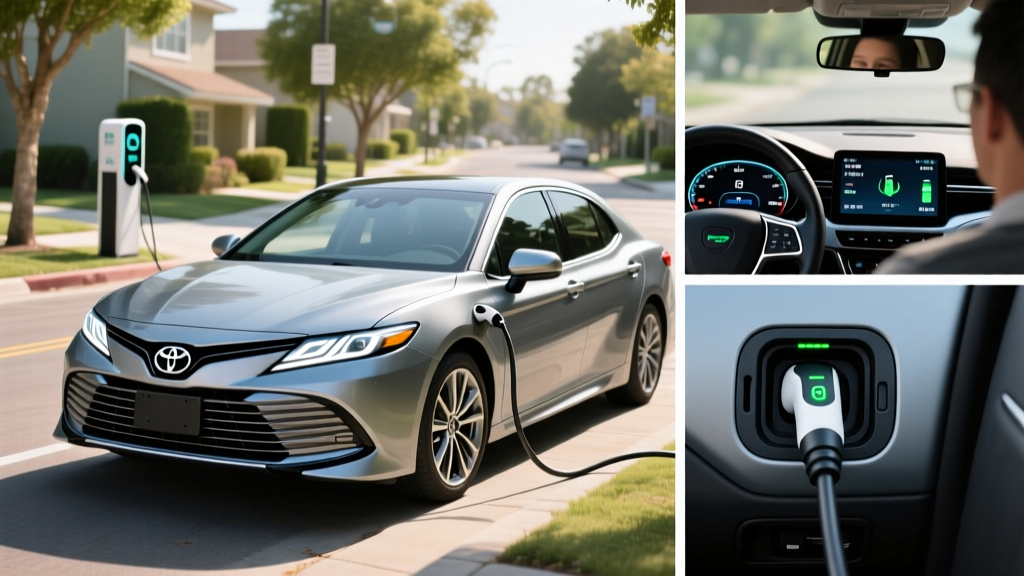
Unlike plug-in hybrids or full battery-electric vehicles, the 2023 Camry Hybrid is a conventional self-charging hybrid (HEV). It requires no plug, no charging station visits, and no behavior change from a standard gas car. You fuel it at any gas station and let Toyota's Hybrid Synergy Drive system manage the electric-gasoline balance automatically.
2023 Camry Hybrid MPG: EPA Ratings by Trim
Fuel economy varies by trim level because wheel size, weight, and tire compound all affect rolling resistance. The LE trim, equipped with 16-inch wheels and low-rolling-resistance tires, delivers the highest EPA numbers. The SE and XLE trims sacrifice a few MPG for sportier handling and larger 18-inch wheels.
| Trim | City MPG | Highway MPG | Combined MPG | Annual Fuel Cost* |
|---|---|---|---|---|
| LE | 51 | 53 | 52 | $1,150 |
| SE / SE Nightshade | 44 | 47 | 46 | $1,300 |
| XLE | 44 | 47 | 46 | $1,300 |
*Based on 15,000 miles/year, 55% city driving, and $3.30/gallon regular unleaded. Your costs will vary with local fuel prices and driving patterns.
HEV vs. PHEV: Where the Camry Hybrid Fits
A common source of confusion is the difference between a conventional hybrid (HEV) like the 2023 Camry Hybrid and a plug-in hybrid (PHEV) like the Toyota RAV4 Prime or Prius Prime. The distinction matters for your daily routine, fuel costs, and tax credit eligibility.
| Feature | HEV (Camry Hybrid) | PHEV (e.g., Prius Prime) | BEV (e.g., Tesla Model 3) |
|---|---|---|---|
| Plug-in required? | No | Yes (Level 1/2) | Yes (Level 2/DC) |
| Electric-only range | ~1 mile at low speed | 25–44 miles | 250–360 miles |
| Fuel/energy source | Gasoline only | Gasoline + electricity | Electricity only |
| Home charging needed? | No | Recommended | Essential |
| Federal tax credit (§30D) | Not eligible | Up to $7,500 (rules apply) | Up to $7,500 (rules apply) |
| Maintenance complexity | Low (no plug system) | Moderate | Low (no engine) |
The Camry Hybrid is an HEV. It uses a small 1.6 kWh nickel-metal hydride (NiMH) battery pack that charges itself through regenerative braking and engine-driven generation. You cannot plug it in, and it has no meaningful electric-only driving range. The electric motor assists the gasoline engine during acceleration and low-speed maneuvers, but the 2.5-liter four-cylinder engine remains the primary power source.
If you need electric-only commuting capability and have access to home charging, a PHEV like the 2023 Prius Prime (44 miles electric-only, EPA-estimated) or a full BEV may serve you better. But if you lack reliable charging access — apartment dwellers, street parkers, frequent road-trippers — the Camry Hybrid's no-plug-required simplicity is a major advantage.
Powertrain Specs: Engine, Motor, and Combined Output
The 2023 Camry Hybrid pairs Toyota's proven 2.5-liter Dynamic Force four-cylinder engine with an electric motor-generator through an electronically controlled continuously variable transmission (eCVT). This is not a belt-driven CVT — it uses a planetary gearset that seamlessly blends power from both sources, which contributes to its durability reputation.
| Component | Specification |
|---|---|
| Engine | 2.5L DOHC 4-cylinder (A25A-FXS) |
| Engine output | 176 hp / 163 lb-ft torque |
| Electric motor output | 118 hp / 149 lb-ft torque |
| Combined net horsepower | 208 hp |
| Transmission | eCVT (planetary gearset) |
| Hybrid battery | 1.6 kWh NiMH (244.8V nominal) |
| Drivetrain | FWD standard; AWD-e available (SE, XLE) |
| 0–60 mph | ~7.2 seconds (FWD) |
| Curb weight | 3,495–3,595 lbs (varies by trim/AWD) |
The AWD-e option (available on SE and XLE trims) adds a rear-mounted 40 hp electric motor that engages automatically during acceleration and low-traction conditions. It does not materially affect MPG — the EPA combined rating drops only 1–2 MPG with AWD-e — and it adds roughly $1,400 to the MSRP. For buyers in snow-belt states, this is a compelling alternative to a traditional AWD system's weight and drivetrain-loss penalties.
Pricing, Trims, and Tax Credit Eligibility
The 2023 Camry Hybrid was sold in four trims: LE, SE, SE Nightshade, and XLE. Original MSRP ranged from approximately $28,455 (LE, including destination) to $35,490 (XLE with AWD-e and packages). As of 2026, these vehicles are available only on the used and certified pre-owned market.
On the used market in early 2026, expect to pay $22,000–$28,000 for a 2023 Camry Hybrid depending on trim, mileage, and condition. Certified pre-owned (CPO) examples from Toyota dealers carry an extended warranty and typically command a $1,500–$2,500 premium over private-party sales.
Battery Warranty, Lifespan, and Replacement Cost
Hybrid battery longevity remains the top concern for used-hybrid buyers. Toyota addresses this with one of the strongest hybrid battery warranties in the industry, and the Camry Hybrid's NiMH pack has a well-documented track record of lasting well beyond the warranty period.
- Hybrid battery: 10 years / 150,000 miles (whichever comes first) — transferable to subsequent owners
- Hybrid system components (inverter, motor-generator, eCVT): 8 years / 100,000 miles
- Basic new-vehicle warranty: 3 years / 36,000 miles
- Powertrain warranty: 5 years / 60,000 miles
Real-world battery lifespan: Toyota's NiMH hybrid batteries in the Camry platform routinely last 150,000–200,000+ miles before significant degradation. Unlike the larger lithium-ion packs in PHEVs and BEVs, the Camry Hybrid's 1.6 kWh NiMH pack operates within a narrow state-of-charge window (roughly 40–80% SoC), which minimizes stress and extends cell life. The battery management system never allows a full charge or full discharge.
Replacement cost if out of warranty: A new OEM hybrid battery for the 2023 Camry Hybrid costs approximately $2,500–$3,500 installed at a Toyota dealer. Independent hybrid specialists may offer refurbished packs for $1,500–$2,200. Given the 10-year/150,000-mile warranty and the pack's proven longevity, battery replacement is statistically unlikely for most owners — but the cost is far lower than a BEV traction battery replacement ($8,000–$20,000+).
Reliability and Safety Ratings
Toyota's hybrid powertrain is among the most thoroughly proven in the automotive industry, with over 25 years of continuous production since the original Prius. The 2023 Camry Hybrid carries forward this reputation.
IIHS safety: The 2023 Camry (all trims, including Hybrid) earned the IIHS Top Safety Pick+ rating — the institute's highest honor — with Good ratings across all crashworthiness tests and Superior front crash prevention.
NHTSA safety: The NHTSA awarded the 2023 Camry a 5-Star Overall Safety Rating, with 5 stars in frontal crash, side crash, and rollover resistance.
Toyota Safety Sense 2.5+ (TSS 2.5+) comes standard on every 2023 Camry Hybrid trim. This Level 2 driver-assistance suite includes:
- Pre-Collision System with Pedestrian Detection
- Full-Speed Range Dynamic Radar Cruise Control
- Lane Departure Alert with Steering Assist
- Lane Tracing Assist
- Automatic High Beams
- Road Sign Assist
Long-term reliability data: Consumer Reports and J.D. Power consistently rate the Camry Hybrid above average for predicted reliability. The eCVT planetary gearset has no belts, clutches, or bands to wear out — a key reason Toyota's hybrid transmissions outlast conventional automatics. The regenerative braking system also reduces wear on the friction brakes, with many owners reporting original brake pads lasting 80,000–100,000+ miles.
Who Should Choose the 2023 Camry Hybrid?
✓ Choose the Camry Hybrid If:
- You want 46–52 MPG without changing any driving or fueling habits
- You lack access to home or workplace EV charging
- You take frequent long road trips and don't want to plan around chargers
- You want a proven, low-risk powertrain with a strong warranty
- You value a spacious midsize sedan trunk (15.1 cu ft) over a crossover
- You drive 15,000+ miles/year and want to minimize fuel costs
✗ Look Elsewhere If:
- You want electric-only commuting (consider a PHEV like the Prius Prime)
- You want to eliminate gasoline entirely (consider a BEV like the Ioniq 6 or Model 3)
- You need federal tax credits to offset purchase cost (HEVs don't qualify)
- You prefer SUV/crossover ride height and cargo flexibility
- You want the latest infotainment — the 2023 Camry's Toyota Audio Multimedia is functional but not class-leading
Bottom line on fuel cost savings: At 15,000 miles/year and $3.30/gallon, the Camry Hybrid LE (52 MPG combined) costs roughly $952/year in fuel. A comparable gas-only midsize sedan averaging 30 MPG combined would cost $1,650/year — a difference of nearly $700 annually. Over five years, that's $3,500 in fuel savings, which largely offsets the Camry Hybrid's modest price premium over its gas counterpart on the used market.
Frequently Asked Questions
How many MPG does the 2023 Camry Hybrid actually get in real driving?
The EPA rates the LE trim at 51 city / 53 highway / 52 combined. In real-world mixed driving, owners typically see 47–53 MPG in the LE and 41–46 MPG in the SE/XLE. City-heavy driving often exceeds the EPA city estimate because regenerative braking recaptures energy at every stop. Sustained highway driving at 75+ mph will fall slightly below the EPA highway number.
Does the 2023 Camry Hybrid need to be plugged in?
No. The Camry Hybrid is a conventional hybrid (HEV), not a plug-in hybrid (PHEV). Its small battery charges through regenerative braking and the gasoline engine. You fuel it exclusively at gas stations, exactly like a conventional car.
Does the 2023 Camry Hybrid qualify for any federal tax credit?
No. The IRS §30D Clean Vehicle Credit applies only to plug-in electric vehicles (PHEVs and BEVs) meeting specific battery sourcing, MSRP, and buyer income requirements. The Camry Hybrid, as a non-plug-in HEV, is ineligible for any federal EV tax credit. Check your state and local utility programs for possible high-efficiency vehicle rebates.
How long will the Camry Hybrid battery last, and what does replacement cost?
Toyota warranties the hybrid battery for 10 years / 150,000 miles, and real-world data shows these NiMH packs commonly last 150,000–200,000+ miles. If replacement is needed out of warranty, expect $2,500–$3,500 for a new OEM pack at a dealer, or $1,500–$2,200 for a refurbished unit from an independent hybrid specialist.
Is the AWD-e system worth it on the Camry Hybrid?
The AWD-e system adds a 40 hp rear electric motor for improved traction in rain and snow, with only a 1–2 MPG penalty. It costs roughly $1,400 extra. If you live in a region with frequent winter weather and don't want a crossover, AWD-e is a practical addition. For dry-climate drivers, FWD is sufficient and maximizes efficiency.
How does the 2023 Camry Hybrid compare to the 2023 Honda Accord Hybrid?
The Accord Hybrid (46 city / 41 highway / 44 combined on the Sport trim) trails the Camry Hybrid LE by about 8 MPG combined, primarily because the Honda's highway efficiency is lower. The Accord Hybrid offers a more engaging driving feel and a more modern interior, but the Camry Hybrid wins on pure fuel economy, AWD availability, and a slightly longer hybrid battery warranty (10 years vs. Honda's 8 years / 100,000 miles on the IMA battery).