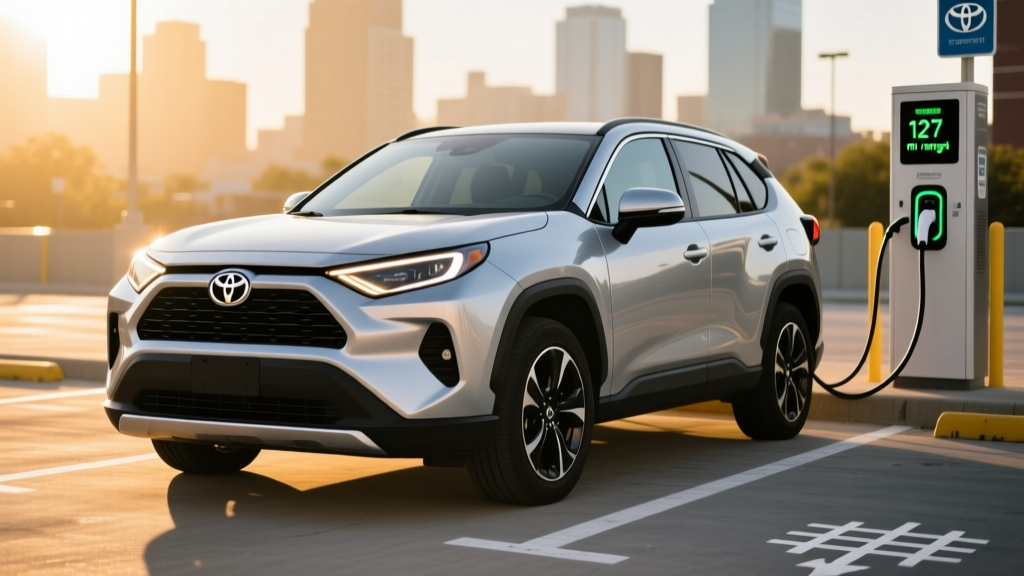
The 2022 Toyota RAV4 Hybrid remains one of the best-selling hybrid SUVs in America for good reason: it delivers genuine fuel savings without requiring any change in driving habits. No plugs, no charging apps, no range calculations — just fill up with gas and go farther on every tank. As we evaluate this model from a 2026 used-market perspective, the RAV4 Hybrid's proven powertrain, strong reliability record, and accessible pricing make it a compelling choice for buyers who want electrified efficiency without committing to a full battery-electric vehicle.
This guide covers every number that matters — EPA fuel economy, real-world MPG, powertrain specs, battery longevity, warranty coverage, and how the RAV4 Hybrid stacks up against its plug-in sibling (the RAV4 Prime PHEV) and full EVs. Whether you're shopping the used market or comparing it to newer hybrids, these are the data points that drive a smart purchase.
EPA Fuel Economy and Real-World MPG
The 2022 RAV4 Hybrid comes exclusively with all-wheel drive (AWD), which slightly impacts efficiency compared to a FWD-only setup but provides year-round traction. Here is the official EPA breakdown per fueleconomy.gov:
| Metric | Value |
|---|---|
| City MPG | 41 MPG |
| Highway MPG | 38 MPG |
| Combined MPG | 40 MPG |
| Annual Fuel Cost (est.) | ~$1,450 (15,000 mi/yr) |
| Fuel Tank Capacity | 14.5 gallons |
| Total Range (est.) | ~580 miles per tank |
Real-World MPG: What Owners Actually See
Hybrids tend to outperform their EPA city estimates in stop-and-go driving because regenerative braking recovers energy that a gas car wastes as heat. In real-world ownership, many RAV4 Hybrid drivers report 38–44 MPG combined depending on climate and driving style. City-heavy commuters frequently see 42–45 MPG, while sustained highway driving at 75+ MPH can drop efficiency to 34–36 MPG due to aerodynamic drag — a characteristic of all hybrids, since the electric motor provides less benefit at steady high speeds.
Cold weather reduces MPG by roughly 5–10% in winter months. The engine runs more frequently to provide cabin heat (the RAV4 Hybrid uses engine waste heat rather than a dedicated heat pump), and the battery is less efficient at low temperatures. Expect 36–38 MPG combined in freezing conditions.
HEV vs. PHEV: RAV4 Hybrid vs. RAV4 Prime
Toyota offered the RAV4 in two electrified variants for 2022: the conventional Hybrid (HEV) and the plug-in RAV4 Prime (PHEV). These are fundamentally different vehicles with different use cases.
HEV vs. PHEV — Key Distinction
Conventional Hybrid (HEV): The RAV4 Hybrid charges its small battery through regenerative braking and the gas engine. You never plug it in. It cannot drive on electric power alone for more than about a mile at low speed. The benefit is simplicity — no charging infrastructure needed.
Plug-in Hybrid (PHEV): The RAV4 Prime has a much larger 18.1 kWh battery that you plug in to charge. It delivers 42 miles of EPA-rated electric-only range before the gas engine activates. It qualifies for more incentives but costs significantly more upfront.
| Specification | RAV4 Hybrid (HEV) | RAV4 Prime (PHEV) |
|---|---|---|
| Combined Horsepower | 219 HP | 302 HP |
| EPA Combined MPG / MPGe | 40 MPG | 94 MPGe (electric) / 38 MPG (gas) |
| Electric-Only Range | ~1 mile (low speed) | 42 miles (EPA) |
| Battery Capacity | 1.6 kWh (NiMH) | 18.1 kWh (Li-ion) |
| Plug-In Charging | No | Yes — Level 1/2 (no DC fast charge) |
| Charge Time (Level 2, 240V) | N/A | ~2.5 hours (6.6 kW onboard charger) |
| DC Fast Charging | No | No |
| 0–60 MPH | 7.4 seconds | 5.7 seconds |
| AWD | Standard | Standard |
| 2022 Base MSRP (new) | $29,075 | $39,800 |
Powertrain and Performance Specs
The 2022 RAV4 Hybrid pairs a 2.5-liter inline-4 Atkinson-cycle engine with two electric motor-generators (one front, one rear) through Toyota's eCVT (electronically controlled continuously variable transmission). The rear motor provides the AWD system — there is no mechanical driveshaft connecting the front and rear axles. This "eAWD" system engages the rear wheels on demand during acceleration, low-traction conditions, and cornering.
| Component | Specification |
|---|---|
| Engine | 2.5L 4-cyl Atkinson cycle |
| Engine Output | 176 HP / 163 lb-ft torque |
| Front Electric Motor | 118 HP / 149 lb-ft |
| Rear Electric Motor | 54 HP / 89 lb-ft |
| Net Combined System HP | 219 HP |
| Transmission | eCVT |
| Drivetrain | Electronic AWD (eAWD) |
| 0–60 MPH | 7.4 seconds |
| Towing Capacity | 1,750 lbs |
| Cargo Volume (behind rear seats) | 37.6 cu ft |
| Cargo Volume (rear seats folded) | 69.8 cu ft |
The eCVT is not a traditional belt-and-pulley CVT — it uses a planetary gearset to blend engine and motor power seamlessly. The result is smooth, linear acceleration with none of the rubber-band effect that older CVTs exhibited. At 7.4 seconds to 60 MPH, the RAV4 Hybrid is quicker than most gas-powered compact SUV competitors and noticeably more responsive in city driving, where the electric motor's instant torque fills in the gaps between engine power bands.
Battery Warranty, Lifespan, and Replacement Cost
Hybrid battery longevity is the single most common concern among used-hybrid buyers. Here are the facts for the 2022 RAV4 Hybrid:
Battery Warranty Coverage
Hybrid Battery: 10 years / 150,000 miles (whichever comes first) — transferable to subsequent owners.
Hybrid System Components (inverter, motor-generators, ECU): 8 years / 100,000 miles.
Standard Powertrain Warranty: 5 years / 60,000 miles.
Note: California and states adopting CARB emissions rules (including NY, MA, NJ, CT, RI, VT, ME, WA, OR, CO, MD, NM) may mandate extended hybrid battery coverage up to 10 years/150,000 miles under emissions warranty provisions. Verify with your Toyota dealer based on your state of registration.
Real-World Battery Degradation
The RAV4 Hybrid uses a 1.6 kWh nickel-metal hydride (NiMH) battery pack. Toyota's hybrid system is designed to keep the battery within a narrow state-of-charge window (roughly 40–80%), which dramatically reduces stress and slows degradation. This is why Toyota hybrid batteries routinely last well beyond 150,000 miles without significant capacity loss.
Based on long-term fleet data and owner reports, most RAV4 Hybrid batteries show minimal degradation — typically 5–10% capacity loss over 100,000 miles. Because the battery is small and the system doesn't rely on it for long electric-only driving, even a degraded battery doesn't noticeably affect fuel economy or drivability the way it would in a full EV.
Battery Replacement Cost
If the hybrid battery does fail outside of warranty, replacement costs for a 2022 RAV4 Hybrid are typically:
- New OEM battery (Toyota dealer): $3,000–$4,500 installed
- Refurbished/remanufactured battery: $1,500–$2,500 installed
- Individual cell/module replacement (by a hybrid specialist): $500–$1,200
For context, the RAV4 Prime PHEV uses a much larger 18.1 kWh lithium-ion pack, and its out-of-warranty replacement would cost considerably more — estimated at $8,000–$12,000. This is a meaningful long-term cost advantage for the conventional Hybrid.
Pricing, Trim Levels, and Tax Credit Eligibility
The 2022 RAV4 Hybrid was offered in six trim levels. Here are the original MSRP figures (including destination charge):
| Trim | Original MSRP |
|---|---|
| LE | $29,075 |
| XLE | $30,675 |
| XLE Premium | $32,525 |
| SE | $32,525 |
| XSE | $34,275 |
| Limited | $37,400 |
On the used market in early 2026, expect to pay roughly $22,000–$32,000 depending on trim, mileage, and condition. The XLE and XLE Premium trims offer the best value proposition, adding features like a power-adjustable driver's seat, dual-zone climate, and blind-spot monitoring over the base LE.
Federal Tax Credit Eligibility
Used EV/Hybrid Tax Credit (§25E)
The 2022 RAV4 Hybrid (conventional HEV) does not qualify for the federal §30D new clean vehicle credit — that credit applies only to plug-in vehicles (PHEVs and BEVs) with sufficient battery capacity.
However, if you purchase a used RAV4 Hybrid from a licensed dealer in 2026, it may qualify for the §25E Previously-Owned Clean Vehicle Credit, which provides up to $4,000 (or 30% of the sale price, whichever is less) for eligible used hybrids and EVs. Key requirements:
- Sale price must be $25,000 or less
- Buyer income caps: $75,000 single / $112,500 head of household / $150,000 joint (modified AGI)
- Vehicle must be at least 2 model years old (2022 qualifies in 2026)
- Must purchase from a licensed dealer (private sales excluded)
- Credit is non-refundable but can be transferred to the dealer as a point-of-sale discount
Always verify current eligibility on IRS.gov or with a qualified tax professional before relying on this credit.
The RAV4 Prime (PHEV variant) is a different story: when purchased new, it previously qualified for up to $7,500 under §30D, but as of 2026, critical mineral and battery component sourcing rules have tightened substantially. Check the latest fueleconomy.gov tax credit pages for current PHEV eligibility.
Hybrid vs. PHEV vs. Full EV: Which Fits Your Life?
Choosing between the RAV4 Hybrid, the RAV4 Prime PHEV, and a full battery-electric SUV depends on your daily routine, charging access, and budget. Here's a practical decision framework:
Decision Framework
Choose the RAV4 Hybrid (HEV) if:
- You don't have access to home or workplace charging
- You want zero behavior change — no plugging in, no apps, no route planning
- Your budget is under $30,000 (used market)
- You drive 12,000–18,000 miles/year and want consistent 38–44 MPG
- You live in an area with limited public charging infrastructure
Choose the RAV4 Prime (PHEV) if:
- You can charge at home (Level 2, 240V) and your daily commute is under 40 miles
- You want electric-only weekday driving with gas flexibility for road trips
- You can absorb the higher purchase price ($35,000+ used) for long-term fuel savings
- You want 302 HP and significantly quicker acceleration
Choose a Full EV (e.g., Tesla Model Y, Hyundai Ioniq 5) if:
- You have reliable home Level 2 charging
- Your daily driving is under 250 miles and you're comfortable planning road-trip charging stops
- You want to eliminate gas entirely and minimize maintenance (no oil changes, fewer moving parts)
- You're eligible for the full $7,500 §30D federal credit on a new EV purchase
Reliability, Safety, and Long-Term Ownership
Toyota's hybrid powertrain is among the most proven in the industry, with over 25 years of continuous refinement since the original Prius. The 2022 RAV4 Hybrid benefits from this institutional knowledge:
- IIHS Rating: Top Safety Pick (2022) — earned "Good" in all crashworthiness tests per iihs.org
- NHTSA Rating: 5-Star Overall Safety Rating
- Toyota Safety Sense 2.0: Standard on all trims — includes pre-collision system with pedestrian detection, full-speed adaptive cruise control, lane departure alert with steering assist, lane tracing assist, and automatic high beams
- Predicted Reliability: The RAV4 Hybrid consistently ranks at or near the top of its segment in long-term reliability surveys. The eCVT has no belts, clutches, or torque converter to fail — it's one of the most durable transmissions in any vehicle, gas or hybrid
Maintenance Cost Advantage
Hybrids often cost less to maintain than their gas-only counterparts. Regenerative braking significantly reduces brake pad wear — many RAV4 Hybrid owners report original brake pads lasting 80,000–100,000 miles. There is no alternator, starter motor, or accessory belt to replace. Oil changes are still required (every 10,000 miles with synthetic), but the engine runs less frequently, keeping it cleaner internally.
Pros, Cons, and the Verdict
Pros
- 40 MPG combined EPA; real-world often higher in city driving
- Standard AWD on every trim
- Strong reliability record; 10yr/150k hybrid battery warranty
- No plug-in required — zero infrastructure dependency
- Spacious cargo area (37.6 cu ft)
- Toyota Safety Sense 2.0 standard on base LE
- May qualify for up to $4,000 used-vehicle tax credit (§25E)
Cons
- Highway MPG drops to 38 (city-favoring hybrid tuning)
- eCVT can drone under hard acceleration
- 1,750-lb towing capacity is low for the segment
- Infotainment (2022) lacks wireless CarPlay on lower trims
- No DC fast charging (irrelevant for HEV, but limits PHEV variant)
- Rear-seat legroom is average for the class (37.8 in)
Frequently Asked Questions
How many MPG does the 2022 Toyota RAV4 Hybrid get?
The EPA rates it at 41 city / 38 highway / 40 combined MPG. In real-world driving, city-heavy commuters often see 42–45 MPG, while sustained highway driving at higher speeds may yield 34–36 MPG. Cold weather typically reduces efficiency by 5–10%.
Does the RAV4 Hybrid need to be plugged in?
No. The RAV4 Hybrid is a conventional hybrid (HEV). Its 1.6 kWh battery charges exclusively through regenerative braking and the gasoline engine. You never plug it in. This is different from the RAV4 Prime, which is a plug-in hybrid (PHEV) that requires charging to access its 42-mile electric-only range.
How long will the RAV4 Hybrid battery last?
Toyota's hybrid batteries are designed to last the life of the vehicle. The 1.6 kWh NiMH pack is kept within a conservative charge window (roughly 40–80% SoC), which minimizes degradation. Most Toyota hybrid batteries last well beyond 150,000 miles. Toyota backs it with a 10-year/150,000-mile warranty that transfers to subsequent owners.
What does it cost to replace the hybrid battery?
Out of warranty, a new OEM replacement runs $3,000–$4,500 installed at a Toyota dealer. Refurbished batteries cost $1,500–$2,500, and individual module replacement by a hybrid specialist can be as low as $500–$1,200. Given the battery's proven longevity, most owners will never face this cost.
Does the 2022 RAV4 Hybrid qualify for a tax credit?
As a conventional hybrid (not plug-in), it does not qualify for the §30D new clean vehicle credit. However, when purchased used from a dealer in 2026 for $25,000 or less, it may qualify for the §25E used clean vehicle credit of up to $4,000, subject to buyer income limits. Confirm eligibility at IRS.gov or with a tax professional.
Is the RAV4 Hybrid better than a full EV for most people?
It depends on charging access. If you cannot install a Level 2 home charger or rely on street parking, the RAV4 Hybrid is the pragmatic choice — you get 40 MPG without any infrastructure requirements. If you have home charging and a predictable commute under 250 miles, a full EV will deliver lower per-mile energy costs and near-zero maintenance, but at a higher purchase price.
How does the RAV4 Hybrid handle in snow?
The electronic AWD system provides confident traction in snow and rain. The rear electric motor engages automatically when the front wheels slip, and because it's an independent motor (not a mechanical driveshaft), response is nearly instant. Pair it with dedicated winter tires and the RAV4 Hybrid is among the most capable compact SUVs in winter conditions.