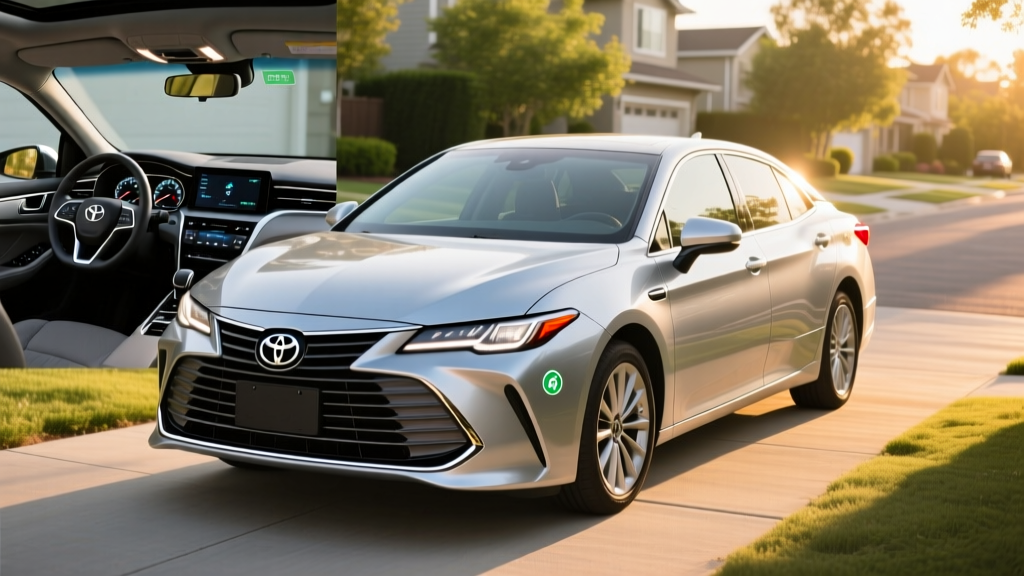
The Toyota Avalon Hybrid bowed out after the 2022 model year, ending a run as one of the most fuel-efficient full-size sedans on the market. If you are shopping the used market in 2026, this four-door hybrid still delivers an EPA-estimated 44 MPG combined while offering a spacious cabin, a proven powertrain, and Toyota's reputation for long-term hybrid reliability. This guide covers everything a used-car buyer needs to know: real-world fuel economy, battery longevity, replacement costs, and whether the Avalon Hybrid makes sense versus a plug-in hybrid or full EV.
2022 Toyota Avalon Hybrid: Key Specifications
| Specification | Detail |
|---|---|
| Powertrain | 2.5L inline-4 + electric motor (HEV, no plug) |
| Combined Horsepower | 215 hp |
| Transmission | eCVT (electronically controlled continuously variable) |
| EPA MPG (City / Hwy / Combined) | 43 / 44 / 44 (XLE); 43 / 43 / 43 (XSE, Limited, Touring) |
| Fuel Tank Capacity | 13.2 gallons |
| Total Driving Range | ~580 miles (XLE) |
| 0–60 mph | ~7.3 seconds (est.) |
| Drivetrain | Front-wheel drive |
| Hybrid Battery | ~1.6 kWh nickel-metal hydride (NiMH), sealed |
| Original MSRP (2022) | $37,350 (XLE) – $43,550 (Touring) |
| Federal EV Tax Credit (§30D) | Not eligible (conventional hybrid, not a PHEV or BEV) |
| Hybrid Battery Warranty (original) | 10 years / 150,000 miles (transferable to second owner in most states) |
HEV vs. PHEV: Understanding the Avalon's Hybrid System
The 2022 Avalon Hybrid is a conventional hybrid electric vehicle (HEV), not a plug-in hybrid (PHEV). This is a critical distinction that affects how you fuel it, what incentives you qualify for, and whether you need any home charging infrastructure.
| Feature | Conventional Hybrid (HEV) — Avalon Hybrid | Plug-In Hybrid (PHEV) |
|---|---|---|
| Plug-in Charging | No — refuels via regenerative braking and gasoline engine | Yes — plugs into Level 1 or Level 2 charger |
| Electric-Only Range | ~1 mile at very low speeds | Typically 20–50 miles |
| Battery Size | ~1.6 kWh (small, NiMH) | 10–20+ kWh (lithium-ion) |
| DC Fast Charging | Not applicable | Rare on PHEVs; most are Level 2 only |
| Federal Tax Credit (§30D) | Not eligible | Up to $7,500 (subject to MSRP, income, sourcing rules) |
| Best For | Drivers who want better MPG with zero behavior change | Drivers with home charging who want short EV commutes + gas road trips |
The Avalon Hybrid charges its own battery through regenerative braking and the gasoline engine. You never plug it in. You simply fill it with regular unleaded gasoline and drive. The hybrid system seamlessly switches between electric motor assist, engine power, and regenerative braking to optimize fuel consumption without any driver intervention.
Fuel Economy: EPA Ratings and Real-World MPG
| Trim Level | City MPG | Highway MPG | Combined MPG |
|---|---|---|---|
| XLE | 43 | 44 | 44 |
| XSE | 43 | 43 | 43 |
| Limited | 43 | 43 | 43 |
| Touring | 43 | 43 | 43 |
Source: EPA Fuel Economy
The XLE trim edges out the others by 1 MPG thanks to lighter 17-inch wheels and slightly lower curb weight. The XSE, Limited, and Touring trims ride on 18- or 19-inch wheels, adding unsprung mass and marginally increasing rolling resistance.
Real-World MPG: What Owners Actually See
Toyota's hybrid system excels in city driving where regenerative braking recaptures energy at every stop. Real-world results from owner forums and fuel-tracking data consistently show:
- City driving: 44–48 MPG — many owners report exceeding the EPA city estimate in stop-and-go traffic, especially in warm weather.
- Highway driving (70–80 mph): 38–42 MPG — sustained high speeds reduce the hybrid system's advantage because the gasoline engine does most of the work.
- Cold weather (below 32°F): Expect a 5–10% reduction, dropping combined MPG to roughly 38–40. The engine runs more often to heat the cabin and bring the catalytic converter to operating temperature.
- Mixed daily commute: 41–45 MPG is typical for most drivers combining city and highway miles.
At 44 MPG combined with a 13.2-gallon tank, the Avalon Hybrid can cover approximately 580 miles between fill-ups — enough for most drivers to go two weeks or more between gas station visits.
Powertrain and Driving Experience
The 2022 Avalon Hybrid pairs a 2.5-liter Dynamic Force inline-four engine (176 hp, 163 lb-ft of torque on its own) with a permanent-magnet electric motor integrated into the eCVT transaxle. Combined system output is 215 horsepower. The electric motor fills in torque at low RPMs where the four-cylinder is weakest, resulting in smooth, linear acceleration from a stop.
The eCVT is not a traditional belt-and-pulley CVT. It uses a planetary gearset to blend engine and motor power, so there is no rubber-band sensation or drone under acceleration. Toyota's Hybrid Synergy Demand system manages the power split automatically and transparently.
At 0–60 mph in roughly 7.3 seconds, the Avalon Hybrid is not a performance sedan, but it is adequate for highway merging and passing. The Touring trim adds adaptive variable suspension for slightly sharper handling, though all trims prioritize ride comfort over sportiness. Front-wheel drive is standard across the lineup — there is no all-wheel-drive option on the hybrid (AWD is available on the gas-only Avalon, but that variant was discontinued after 2021).
Hybrid Battery Longevity, Warranty, and Replacement Cost
Toyota Hybrid Battery Warranty: 10 years or 150,000 miles, whichever comes first. This warranty is transferable to subsequent owners in all states that follow federal emissions warranty guidelines (which is most of them). The warranty guarantees the hybrid battery will retain sufficient capacity to operate the hybrid system normally.
The Avalon Hybrid uses a nickel-metal hydride (NiMH) battery pack rated at approximately 1.6 kWh. This is a small, sealed battery designed for charge-assist duty, not sustained electric-only driving. NiMH chemistry is less energy-dense than lithium-ion but is exceptionally durable in this application. Toyota has been refining its NiMH hybrid batteries since the original 1997 Prius, and failures before 150,000 miles are uncommon.
How Long Does the Battery Actually Last?
Based on fleet data and owner reports across Toyota's hybrid lineup:
- Most Toyota hybrid batteries last 150,000–200,000+ miles before needing replacement.
- Capacity loss is gradual. You may notice slightly reduced fuel economy (1–3 MPG) as the battery ages, but the system continues to function.
- Heat is the primary enemy. Vehicles in hot climates (Arizona, Texas, Southern California) may see earlier degradation than those in temperate regions.
- The battery is managed conservatively by Toyota's battery management system — it never fully charges or fully discharges the pack, which extends cycle life significantly.
Battery Replacement Cost
If the hybrid battery does fail outside warranty, replacement options in 2026 include:
- New OEM battery from Toyota: Approximately $3,000–$4,000 (parts + labor at a dealership).
- Refurbished/reconditioned battery: $1,500–$2,500 from independent hybrid specialists.
- Individual module replacement: Some shops replace only the failed cells within the pack for $500–$1,000, though this is a shorter-term fix.
For context, the Avalon Hybrid has no other major wear items unique to hybrids. There is no alternator, no starter motor, and the regenerative braking system extends brake pad life significantly — many owners report original brake pads lasting 80,000+ miles.
Used Pricing and Tax Credit Eligibility
The 2022 Avalon Hybrid is no longer sold new. On the used market in early 2026, pricing typically falls in these ranges depending on mileage, condition, and trim:
- XLE (base hybrid): $24,000–$28,000
- XSE / Limited: $27,000–$32,000
- Touring (top trim): $30,000–$35,000
Does the 2022 Avalon Hybrid Qualify for Any Tax Credit?
No. The Avalon Hybrid is a conventional HEV, not a plug-in vehicle. Under IRS §30D rules, the federal clean vehicle credit applies only to battery electric vehicles (BEVs) and plug-in hybrids (PHEVs) that meet battery capacity, critical-mineral sourcing, MSRP, and buyer income requirements. Conventional hybrids like the Avalon Hybrid do not qualify for the federal credit.
However, if you purchase a used Avalon Hybrid from a dealer, you may qualify for the Used Clean Vehicle Credit (§25E) — but again, only if the vehicle is a PHEV or BEV. Since the Avalon Hybrid is an HEV, it does not qualify for this credit either. Some states or localities may offer small incentives for any hybrid purchase, but these vary by jurisdiction. Check your state's energy or DMV website for current programs.
Who Should Buy the 2022 Avalon Hybrid — and Who Shouldn't
Pros
- 44 MPG combined with zero lifestyle change — no plugging in, no range anxiety
- Proven, durable hybrid system with 10-year/150k-mile battery warranty
- Spacious full-size sedan with 16.1 cu ft trunk and generous rear legroom
- Low running costs: regular unleaded fuel, extended brake pad life, no charging equipment needed
- Strong resale value and Toyota reliability reputation
- ~580-mile total range between fill-ups
Cons
- Discontinued after 2022 — no new examples available; limited future dealer support as model ages
- No all-wheel-drive option on the hybrid
- Modest 215 hp — adequate but not quick
- No federal tax credit eligibility
- Infotainment system feels dated compared to newer competitors (no wireless Apple CarPlay on base trims)
- Highway MPG drops to ~38–42 at sustained 75+ mph speeds
Hybrid vs. PHEV vs. Full EV: Which Is Right for You?
Choose the Avalon Hybrid (HEV) if: You want maximum fuel savings with zero change to your routine. You live in an apartment or lack home charging access. You drive long highway stretches where PHEV electric range is irrelevant. You want a proven, low-risk powertrain with cheap maintenance.
Choose a PHEV (like the Toyota RAV4 Prime or Hyundai Tucson PHEV) if: You have access to Level 2 home charging and most of your daily driving is under 30–40 miles. You want electric-only commuting with the gas-engine safety net for road trips. You want to qualify for the federal tax credit (up to $7,500, subject to eligibility rules).
Choose a full EV (like the Tesla Model 3 or Hyundai Ioniq 6) if: You have reliable home or workplace charging. Your daily driving is predictable and within the vehicle's range. You want zero tailpipe emissions, minimal maintenance, and the lowest per-mile fuel cost. You are ready to plan around DC fast charging on road trips.
Reliability and Ownership Costs
Toyota's hybrid powertrain is among the most reliable in the automotive industry. The 2022 Avalon Hybrid carries strong reliability ratings from both Consumer Reports and J.D. Power. The 2.5L Dynamic Force engine has no turbocharger, no direct-injection carbon buildup issues, and a timing chain (not a belt), reducing long-term maintenance costs.
Estimated annual maintenance costs for the Avalon Hybrid run $400–$600 per year — lower than most non-hybrid sedans because the hybrid system eliminates the starter, alternator, and reduces brake wear. Insurance premiums are moderate, typically $1,200–$1,800 annually depending on your profile and state.
Frequently Asked Questions
How many MPG does the 2022 Toyota Avalon Hybrid get?
The EPA rates the XLE trim at 43 city / 44 highway / 44 combined MPG. The XSE, Limited, and Touring trims are rated at 43/43/43 MPG. In real-world city driving, many owners report 44–48 MPG. Highway driving at 75+ mph typically yields 38–42 MPG.
Does the Avalon Hybrid need to be plugged in?
No. The Avalon Hybrid is a conventional hybrid (HEV). It charges its own battery through regenerative braking and the gasoline engine. You fuel it exclusively with gasoline — there is no plug, no charging cable, and no electric-only driving range to manage.
How far can the Avalon Hybrid go on a full tank?
With a 13.2-gallon fuel tank and 44 MPG combined, the XLE trim delivers approximately 580 miles of total range. Real-world range varies from about 500 miles (aggressive highway driving) to 620+ miles (city-heavy commutes in warm weather).
Is the 2022 Avalon Hybrid reliable, and what does battery replacement cost?
Yes. Toyota's hybrid system has a decades-long track record for reliability. The hybrid battery is warranted for 10 years / 150,000 miles and typically lasts 150,000–200,000+ miles. If replacement is needed out of warranty, expect $3,000–$4,000 for a new OEM battery or $1,500–$2,500 for a refurbished unit.
Does the 2022 Avalon Hybrid qualify for a federal tax credit?
No. Under current IRS §30D and §25E rules, the federal clean vehicle credit applies only to plug-in vehicles (BEVs and PHEVs). The Avalon Hybrid is a conventional HEV and does not qualify for any federal tax credit, whether purchased new or used.
Should I buy a used Avalon Hybrid or a newer PHEV?
If you lack home charging or want a full-size sedan with minimal running costs and no plug-in hassle, the used Avalon Hybrid is a strong buy at current prices ($24,000–$35,000). If you have Level 2 charging at home and want electric-only commuting plus federal tax-credit eligibility, a newer PHEV like the RAV4 Prime or a plug-in sedan may serve you better — though you will pay more upfront and sacrifice trunk space in most PHEV options.
Is there an AWD version of the Avalon Hybrid?
No. The 2022 Avalon Hybrid is front-wheel drive only. Toyota offered an AWD version of the gas-only Avalon through 2021, but it was discontinued before the 2022 model year. If AWD is essential, consider the Toyota Camry Hybrid (available with AWD) or the Toyota RAV4 Hybrid.