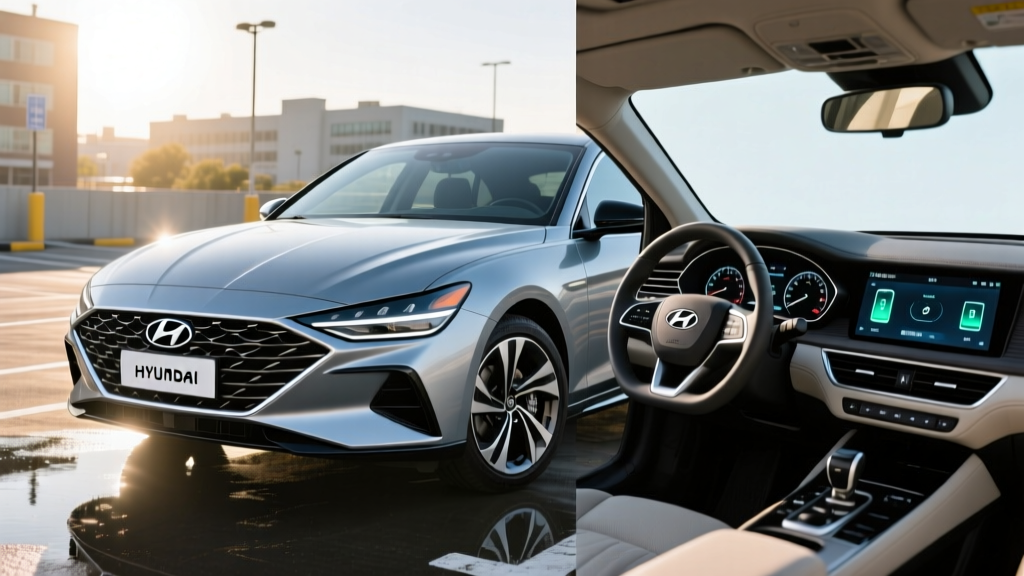
The 2022 Hyundai Sonata Hybrid occupies a specific niche in the midsize sedan market: it delivers class-leading fuel economy without requiring a plug, a charging routine, or any change to your driving habits. For buyers in 2026 evaluating the used market, this conventional hybrid (HEV) remains a compelling alternative to both full EVs and plug-in hybrids — particularly for those without reliable home charging access.
This guide breaks down the 2022 Sonata Hybrid's real-world efficiency, powertrain specs, battery longevity, ownership costs, and how it stacks up against PHEV and BEV alternatives.
2022 Sonata Hybrid Fuel Economy: EPA vs. Real World
The headline number for the 2022 Sonata Hybrid is its EPA-estimated fuel economy, which ranks among the best in the midsize sedan segment. Here is the official breakdown by trim, as published by fueleconomy.gov:
| Trim | City MPG | Highway MPG | Combined MPG |
|---|---|---|---|
| Blue | 50 | 54 | 52 |
| SEL / Limited | 45 | 51 | 47 |
The Blue trim's 52 MPG combined is exceptional. The SEL and Limited trims drop to 47 combined due to additional weight from features like the panoramic sunroof, larger wheels, and more equipment.
Hybrids typically exceed their EPA city estimates in stop-and-go traffic, where regenerative braking recaptures the most energy. In our experience and owner reports, the Sonata Hybrid Blue routinely returns 50–55 MPG in mixed city driving. Highway-only trips at 75+ mph tend to yield 44–48 MPG, as the electric motor provides less assist at sustained high speeds. In cold weather (below 30°F), expect a 5–10% drop due to engine warm-up cycles and reduced battery efficiency — still landing most drivers in the mid-to-high 40s.
Powertrain Specs: Engine, Motor, and Combined Output
The 2022 Sonata Hybrid pairs a 2.0-liter naturally aspirated four-cylinder engine with an electric motor integrated into the transmission housing. Unlike Toyota's planetary-gear hybrid system, Hyundai uses a conventional 6-speed automatic transmission with the motor sandwiched between the engine and gearbox. This gives the Sonata Hybrid a more traditional driving feel — no CVT drone under hard acceleration.
| Gas Engine | 2.0L I4, 150 HP / 139 lb-ft |
| Electric Motor | 39 kW (52 HP) / 151 lb-ft |
| Combined System Output | 192 HP / 271 lb-ft |
| Transmission | 6-speed automatic (no CVT) |
| Hybrid Battery | 1.56 kWh lithium-ion (HEV, not plug-in) |
| 0–60 mph | ~7.9 seconds |
| Drivetrain | Front-wheel drive |
The 1.56 kWh battery pack is small by PHEV or BEV standards, but it's precisely sized for a conventional hybrid: large enough to capture regenerative braking energy and assist during acceleration, small enough to add minimal weight and cost. This battery recharges itself through regen braking and the gas engine — you never plug it in.
HEV vs. PHEV vs. EV: Which Powertrain Fits You?
The Sonata was also offered as a plug-in hybrid in earlier model years (discontinued after 2019 in the U.S.), and Hyundai's lineup now includes full EVs like the Ioniq 6. Here's how the conventional hybrid compares to the alternatives:
| Factor | HEV (Sonata Hybrid) | PHEV (e.g., Tucson PHEV) | BEV (e.g., Ioniq 6) |
|---|---|---|---|
| Plug-in Required? | No | Yes (for EV range) | Yes (always) |
| Electric-Only Range | ~1 mile at low speed | 30–35 miles typical | 270–360 miles |
| Total Range | ~680 miles (14.8 gal tank) | ~400+ miles combined | 270–360 miles |
| Fuel/Energy Cost | Gas only | Gas + electricity | Electricity only |
| Home Charging Needed? | No | Recommended | Essential |
| Federal Tax Credit | None (§30D excludes HEVs) | Up to $7,500 if eligible | Up to $7,500 if eligible |
- You lack access to home or workplace charging
- You want maximum range without planning charging stops
- Your commute involves heavy stop-and-go traffic where hybrids shine
- You want lower upfront cost versus a PHEV or BEV
- You have Level 2 home charging and a commute under 30 miles
- You want some electric-only driving but need gas for road trips
- You have reliable home charging
- You want zero tailpipe emissions and the lowest per-mile energy cost
- Your daily driving is under 250 miles
Battery Warranty, Lifespan, and Replacement Cost
Hybrid battery longevity is consistently a top concern for used hybrid buyers. Hyundai provides one of the strongest hybrid battery warranties in the industry:
- Hybrid Battery: 10 years / 100,000 miles (original owner)
- Hybrid System Components: 10 years / 100,000 miles
- Powertrain Warranty: 10 years / 100,000 miles
- Second-Owner Note: Warranty transfers but may reduce to 5 years / 60,000 miles depending on state and transfer terms — verify with Hyundai or your dealer
The 1.56 kWh lithium-ion pack in the Sonata Hybrid is far less stressed than a BEV battery. It operates in a narrow state-of-charge window (roughly 40–60% SoC most of the time), which dramatically reduces degradation. Most Toyota and Hyundai hybrid batteries from the past decade have proven to last well beyond 150,000 miles without significant capacity loss.
If replacement is eventually needed, a new OEM hybrid battery for the Sonata Hybrid typically costs between $2,000 and $3,500 including labor. Refurbished or aftermarket options may reduce this to $1,200–$2,000. For context, this is a fraction of a BEV traction battery replacement, which can exceed $10,000–$15,000.
2022 Sonata Hybrid Pricing and Tax Credit Eligibility
The 2022 Sonata Hybrid was sold new in three trims. Here were the original MSRPs:
| Trim | MSRP (2022) | Key Features |
|---|---|---|
| Blue | $28,500 | 52 MPG combined, 16" wheels, cloth seats, wireless CarPlay/Android Auto |
| SEL | $30,550 | 47 MPG, heated seats, smart cruise control, 17" wheels |
| Limited | $35,450 | Leather, panoramic sunroof, head-up display, Highway Driving Assist |
Used market pricing (2026): Expect to find 2022 Sonata Hybrids on the used market between $18,000 and $27,000 depending on trim, mileage, and condition. Blue trims with low miles command a premium due to their superior fuel economy.
- The 2022 Sonata Hybrid is a conventional HEV — it does not qualify for the IRS §30D Clean Vehicle Credit, which applies only to plug-in hybrids (PHEVs) and battery-electric vehicles (BEVs)
- Some states offer modest hybrid incentives (typically $500–$1,500), but these vary widely and change frequently — check your state energy office or IRS.gov for current rules
- Used hybrid purchases may qualify for the §25E Previously-Owned Clean Vehicle Credit only if the vehicle is a PHEV or BEV — conventional HEVs are excluded
Reliability, Safety Ratings, and Ownership Costs
The 2022 Sonata Hybrid benefits from Hyundai's strong reliability track record with hybrid powertrains. The 2.0L engine is naturally aspirated (no turbo to fail), and the 6-speed automatic is a proven design with none of the complexity of a CVT. IIHS awarded the 2022 Sonata the Top Safety Pick designation when equipped with specific headlights.
Estimated annual fuel cost: At 52 MPG combined and $3.40/gallon gas, driving 15,000 miles per year costs approximately $980 in fuel. A comparable non-hybrid midsize sedan at 30 MPG combined would cost roughly $1,700 — a savings of about $720 per year with the hybrid.
Insurance: The Sonata Hybrid typically carries insurance rates similar to or slightly above the gas Sonata, depending on your insurer. Hybrid-specific coverage (including the hybrid battery) is standard with most major carriers.
Maintenance: Hybrids generally require less maintenance than gas-only vehicles. Regenerative braking reduces brake pad wear (60,000–100,000+ miles on original pads is common). There is no alternator or starter motor to replace — the hybrid motor handles those functions. Oil changes are still required but the engine runs less frequently, potentially extending intervals.
Pros, Cons, and the Final Verdict
- 52 MPG combined (Blue trim) — among the best of any midsize sedan
- No plug-in charging required — works with any gas station
- 680+ mile total range on a single tank
- 6-speed automatic avoids CVT drone
- 10-year/100,000-mile hybrid battery warranty (original owner)
- Spacious rear seat and 16.0 cu-ft trunk (battery doesn't intrude on cargo)
- Strong standard safety suite (forward collision, lane keeping, blind spot)
- No electric-only driving beyond very low-speed creeping
- No federal tax credit eligibility (HEV exclusion)
- SEL/Limited trims drop to 47 MPG combined
- Modest 192 HP — adequate but not quick (7.9 sec 0–60)
- Discontinued after 2022 in the U.S. — no new inventory available
- Road noise on coarse pavement is noticeable at highway speeds
Verdict: The 2022 Sonata Hybrid is an ideal used-car target for high-mileage commuters, rideshare drivers, and anyone who wants EV-like fuel savings without EV charging logistics. The Blue trim's 52 MPG combined is genuinely achievable in real-world mixed driving, and the 680-mile tank range eliminates range anxiety entirely. If you can charge at home and want electric-only commuting, a PHEV or BEV may serve you better — but for pure simplicity and proven reliability, this hybrid is hard to beat at its current used-market prices.
Frequently Asked Questions
How many MPG does the 2022 Sonata Hybrid get?
The Blue trim achieves an EPA-estimated 50 city / 54 highway / 52 combined MPG. The SEL and Limited trims are rated at 45 city / 51 highway / 47 combined. Real-world results often match or slightly exceed these figures in city driving, with highway-only trips returning a few MPG less.
Does the 2022 Sonata Hybrid need to be plugged in?
No. The Sonata Hybrid is a conventional hybrid (HEV). Its 1.56 kWh battery recharges through regenerative braking and the gas engine. You fuel it exclusively at gas stations, just like a regular car.
How far can the Sonata Hybrid drive on electric power alone?
Effectively less than one mile, and only at very low speeds (under 25 mph in ideal conditions). This is normal for conventional hybrids — the electric motor assists the gas engine rather than replacing it. If you want meaningful electric-only range (25–35 miles), you need a plug-in hybrid (PHEV).
Is the 2022 Sonata Hybrid reliable?
Yes. Hyundai's hybrid powertrain has a strong reliability record, and the naturally aspirated 2.0L engine is a simple, proven design. The hybrid battery is warrantied for 10 years/100,000 miles for the original owner, and real-world data suggests these batteries regularly exceed 150,000 miles without significant issues.
What does a Sonata Hybrid battery replacement cost?
A new OEM hybrid battery replacement runs approximately $2,000–$3,500 including labor. Refurbished options may cost $1,200–$2,000. Given the battery's narrow state-of-charge operating window and Hyundai's robust warranty, most owners will never need this repair.
Does the 2022 Sonata Hybrid qualify for a tax credit?
No. Under IRS §30D rules, the federal Clean Vehicle Credit applies only to plug-in hybrids (PHEVs) and battery-electric vehicles (BEVs) with sufficient battery capacity. Conventional hybrids like the Sonata Hybrid are excluded. Check IRS.gov for current credit eligibility details, as rules update periodically.
Is the Sonata Hybrid still sold new?
No. Hyundai discontinued the Sonata Hybrid in the U.S. market after the 2022 model year. The current Sonata lineup (2024–2026) is gas-only. However, 2022 Sonata Hybrids are readily available on the used market.