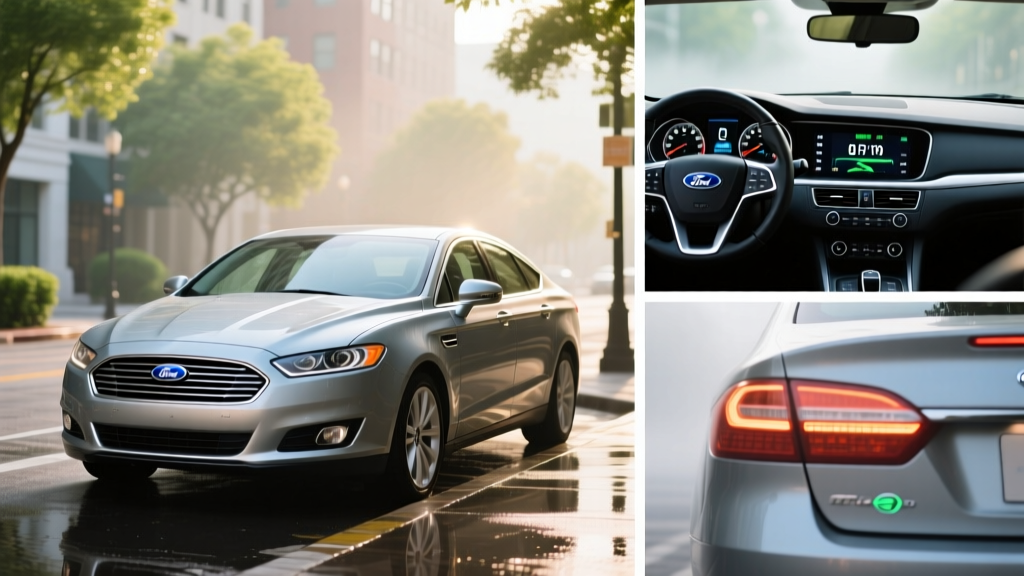
If you're searching for 2010 Ford Fusion Hybrid cars on the used market, you're looking at one of the earliest mainstream midsize sedans to pair a gasoline engine with an electric motor in a package that didn't scream "science experiment." Introduced for the 2010 model year, the Fusion Hybrid was Ford's answer to the Toyota Camry Hybrid, and it arrived with an EPA-estimated 39 MPG city — a figure that still impresses in stop-and-go traffic today. But a 16-year-old hybrid raises specific questions about battery health, replacement costs, and whether it still pencils out as a smart purchase in 2026.
This guide breaks down the real-world fuel economy, powertrain specs, battery longevity data, and ownership economics you need before signing the paperwork on a used 2010 Fusion Hybrid.
HEV vs. PHEV: What the 2010 Fusion Hybrid Actually Is
Before diving into specs, it's critical to understand what you're buying. The 2010 Ford Fusion Hybrid is a conventional hybrid electric vehicle (HEV), not a plug-in hybrid (PHEV).
- HEV (this car): The battery recharges through regenerative braking and the gasoline engine. You never plug it in. There is no electric-only driving range of any meaningful distance — the electric motor assists the gas engine and enables brief low-speed electric-only creep, but the gasoline engine is always the primary power source.
- PHEV (not this car): A plug-in hybrid has a larger battery (typically 8–20 kWh) that you charge from a wall outlet or charger, giving 20–50 miles of electric-only range before the gas engine kicks in. Ford did eventually offer a Fusion Energi PHEV, but not until the 2013 model year — the 2010 model is strictly an HEV.
This distinction matters because conventional hybrids do not qualify for the federal §30D clean vehicle tax credit, which applies only to plug-in vehicles with sufficient battery capacity. More on incentives below.
Fuel Economy: EPA Ratings and Real-World MPG
The headline number for the 2010 Fusion Hybrid was its class-leading city fuel economy. Here's the official EPA breakdown, sourced from fueleconomy.gov:
| Metric | EPA Estimate |
|---|---|
| City MPG | 41 MPG |
| Highway MPG | 36 MPG |
| Combined MPG | 39 MPG |
| Annual Fuel Cost (est.) | ~$1,450 (based on 15,000 mi/yr at $3.30/gal) |
| Fuel Tank Capacity | 16.5 gallons |
| Total Driving Range | ~643 miles (combined) |
Note: The EPA revised its testing methodology after 2007. Some older sources list the 2010 Fusion Hybrid at 41/36/39 MPG, while early pre-revision materials may show slightly different numbers. The figures above reflect the standardized EPA cycle.
Real-World MPG: What Owners Actually Report
Hybrids tend to outperform their EPA city estimates in actual stop-and-go driving because regenerative braking recovers energy that conventional cars waste as heat. Many 2010 Fusion Hybrid owners report 38–44 MPG in mixed city driving, with highway-only trips dropping to 33–36 MPG at sustained 70+ MPH speeds.
The combined real-world average across owner forums and Fuelly data clusters around 37–40 MPG, which aligns closely with the EPA combined estimate. In cold weather (below 30°F), expect a 5–10% reduction as the engine runs more frequently to provide cabin heat and the battery's charge-acceptance rate drops.
Powertrain Specs: Engine, Motor, and Combined Output
| Specification | 2010 Ford Fusion Hybrid |
|---|---|
| Engine | 2.5L Atkinson-cycle inline-4 |
| Engine Horsepower | 156 HP @ 6,000 RPM |
| Engine Torque | 136 lb-ft @ 2,250 RPM |
| Electric Motor | Permanent-magnet AC synchronous |
| Electric Motor Output | 106 HP (78 kW) |
| Combined Net System HP | 191 HP |
| Transmission | Electronically controlled CVT (eCVT) |
| Drivetrain | Front-wheel drive |
| 0–60 MPH | ~8.4 seconds |
| Hybrid Battery | 1.4 kWh (usable ~1.0 kWh), NiMH |
| Curb Weight | ~3,720 lbs |
The 2010 Fusion Hybrid uses Ford's second-generation hybrid system, co-developed with Aisin. The Atkinson-cycle 2.5L four-cylinder sacrifices low-end torque for thermal efficiency, and the electric motor fills in the gap during acceleration. The eCVT is not a belt-and-cone CVT like those in some Nissan products — it's a planetary gearset that seamlessly blends engine and motor power with no rubber-band effect and excellent long-term reliability.
Hybrid Battery: Lifespan, Degradation, and Replacement Cost
Original Battery Warranty: When new, the 2010 Fusion Hybrid's NiMH battery pack was covered for 8 years / 100,000 miles (10 years / 150,000 miles in California and states that adopted CARB emissions standards). As of 2026, that factory warranty has expired for every example on the road.
Expected Battery Lifespan: Nickel-metal hydride (NiMH) packs in this generation of Ford hybrids have proven remarkably durable. Data from owner surveys and taxi-fleet usage suggest these batteries commonly reach 150,000–200,000 miles before significant degradation forces replacement. Some units exceed 250,000 miles.
Battery Replacement Cost in 2026
If you're evaluating a high-mileage 2010 Fusion Hybrid, budget for eventual battery replacement:
- Remanufactured battery pack: $1,500–$2,500 (parts only, from suppliers like Green Bean Battery or Dorman)
- Installation labor: $300–$600 at an independent hybrid specialist
- Total out-of-pocket: $1,800–$3,100 for a remanufactured replacement
- OEM new battery (Ford dealer): $3,500–$5,000+ installed, though OEM new units are increasingly scarce for this model year
The good news: the 1.4 kWh NiMH pack is small and relatively inexpensive compared to the 60–100 kWh lithium-ion packs in modern EVs. A replacement is a manageable expense, not a total-loss event.
Signs of Battery Degradation to Watch For
- Reduced fuel economy: A drop of 5+ MPG below historical averages can indicate the battery isn't holding charge effectively
- More frequent engine cycling: If the gas engine starts and stops more aggressively than normal, the battery may be struggling
- SOC gauge behavior: The dashboard state-of-charge display shouldn't swing rapidly from full to empty during normal driving
- Check engine / hybrid system warning: Scan for codes P0A7F (hybrid battery pack deterioration) or similar
Pricing in 2026: What a Used 2010 Fusion Hybrid Costs
The 2010 Fusion Hybrid originally started at an MSRP of approximately $28,600. In the 2026 used-car market, pricing varies heavily with mileage, condition, and battery health:
- High-mileage examples (150,000+ mi): $3,500–$5,500
- Average condition (100,000–150,000 mi): $5,500–$8,000
- Low-mileage / excellent condition (under 80,000 mi): $8,000–$11,000
Tax Credit Eligibility
The 2010 Ford Fusion Hybrid is a conventional HEV with no plug. It does not qualify for the federal §30D New Clean Vehicle Credit (which requires a plug-in vehicle with at least 7 kWh of battery capacity and meets sourcing, MSRP, and income requirements per IRS guidelines). It also does not qualify for the §25E Used Clean Vehicle Credit, which similarly applies only to plug-in EVs and PHEVs.
Some states historically offered hybrid purchase incentives, but most have expired or shifted focus to plug-in vehicles. Check your state's current energy office or DMV for any remaining programs.
2010 Fusion Hybrid vs. Modern Alternatives: Which Fits You?
Is a 16-year-old hybrid still the right call, or should you look at newer options? Here's a decision framework:
Choose the 2010 Fusion Hybrid If:
- Your budget is under $8,000 and you need maximum MPG per dollar
- Your commute is city-heavy (the hybrid system shines below 45 MPH)
- You want a proven, simple hybrid with no plug-in requirements
- You're comfortable budgeting $2,000–$3,000 for a potential battery replacement
- You don't have access to home or workplace charging (rules out PHEV/EV)
Look at a Modern PHEV or EV Instead If:
- You want a federal tax credit ($3,750–$7,500 for qualifying plug-in vehicles)
- You need modern safety tech (automatic emergency braking, lane-keeping — not available on the 2010 Fusion)
- You want a warranty (the Fusion's factory coverage is long expired)
- Your commute is highway-dominant (the hybrid advantage shrinks above 60 MPH)
- You'd prefer zero tailpipe emissions for daily driving (a PHEV or BEV delivers this)
Quick Comparison: 2010 Fusion Hybrid vs. Current Alternatives
| Vehicle | Type | Combined MPG / MPGe | Approx. 2026 Price | Tax Credit |
|---|---|---|---|---|
| 2010 Ford Fusion Hybrid | HEV | 39 MPG | $4,000–$9,000 (used) | None |
| 2025 Toyota Prius | HEV | 57 MPG | ~$28,550 (new) | None |
| 2025 Toyota Prius Prime | PHEV | 52 MPG + 44 mi electric | ~$33,450 (new) | Up to $3,750 (§30D) |
| 2025 Hyundai Elantra Hybrid | HEV | 54 MPG | ~$26,250 (new) | None |
Reliability and Known Issues Beyond the Battery
The 2010 Fusion Hybrid earned a solid reputation for mechanical reliability. The eCVT planetary gearset is essentially bulletproof — there are no belts, clutches, or friction materials to wear out. However, some known issues to investigate before purchase:
- Electric power steering (EPS): Some 2010–2012 Fusion models experienced EPS failures. Check for any steering-assist warning lights and verify whether the EPS recall (NHTSA recall 14V-286) was completed
- ABS module: Intermittent ABS warnings can indicate a failing module — a $600–$1,200 repair
- Blend-door actuator: A common Ford HVAC issue that causes clicking behind the dash and temperature-control failures ($200–$400 fix)
- Brake feel: The regenerative-to-friction brake transition can feel slightly grabby — this is normal for the era, but warped rotors will amplify it
The NHTSA recall database lists 7 recalls for the 2010 Fusion (across all powertrains). Run the VIN through NHTSA's lookup tool to confirm all recalls were addressed.
Ownership Cost Breakdown: Does It Still Save Money?
Let's run the numbers for a typical buyer driving 15,000 miles per year with gas at $3.30/gallon:
| Annual Cost | 2010 Fusion Hybrid (39 MPG) | 2010 Fusion Gas 2.5L (26 MPG) |
|---|---|---|
| Fuel | $1,269 | $1,904 |
| Annual fuel savings | $635/year in favor of the Hybrid | |
| Insurance (est. avg) | ~$1,100–$1,400 | ~$1,100–$1,400 |
| Maintenance (est.) | ~$400–$600 | ~$450–$700 |
At a $3,000–$5,000 purchase premium over a comparable gas Fusion, the fuel savings pay back the hybrid premium in roughly 5–8 years. But at these used-car prices, the absolute dollar gap between a hybrid and gas example has narrowed to $500–$2,000, making the payback much faster — often under 3 years.
Pre-Purchase Checklist for a Used 2010 Fusion Hybrid
- Pull a battery health report: A Ford dealer or hybrid specialist can read the battery's State of Health (SoH) via OBD-II scan tool. Look for SoH above 70%.
- Check the maintenance records: Confirm regular oil changes (the Atkinson-cycle engine still needs them) and coolant service on both the engine and inverter cooling loops.
- Verify recall completion: Run the VIN at nhtsa.gov/recalls.
- Test the regenerative braking: On a safe downhill stretch, the car should slow noticeably when you lift off the accelerator — weak regen can signal battery issues.
- Scan for stored codes: Even if no warning lights are on, pending codes can reveal developing hybrid-system issues.
- Budget for a battery reserve: Set aside $2,000–$3,000 in your ownership budget for eventual battery replacement, especially if the car is over 130,000 miles.
Frequently Asked Questions
How many MPG does the 2010 Ford Fusion Hybrid get?
The EPA rates it at 41 MPG city, 36 MPG highway, and 39 MPG combined. Real-world owners typically see 37–42 MPG in mixed driving, with city-dominant commutes occasionally hitting 44 MPG.
Does the 2010 Fusion Hybrid need to be plugged in?
No. It is a conventional hybrid (HEV), not a plug-in. The battery recharges through regenerative braking and the gasoline engine. You fuel it like any other car — just less often.
How far can it drive on electric power alone?
Not far. Under ideal conditions (low speed, gentle acceleration, warm battery), the 2010 Fusion Hybrid can creep roughly 1–2 miles on electric power alone at speeds below 25 MPH. This is not a usable electric-only range — it's a low-speed assist function. If you want meaningful electric-only driving, you need a PHEV like the later Fusion Energi (2013+) or a modern PHEV with 25+ miles of electric range.
Is the 2010 Fusion Hybrid reliable, and what does a battery replacement cost?
Yes, it has proven reliable, particularly the eCVT transmission and hybrid powertrain. The NiMH battery typically lasts 150,000–200,000 miles. When replacement is needed, a remanufactured pack runs $1,800–$3,100 installed — far less than a modern EV battery swap.
Does the 2010 Fusion Hybrid qualify for any tax credit?
No. Federal §30D and §25E tax credits apply only to plug-in vehicles (BEVs and PHEVs) meeting specific battery-capacity, sourcing, and price requirements. As a conventional HEV, the Fusion Hybrid does not qualify. Some states offered hybrid incentives in 2010, but these have largely expired.
Should I buy a 2010 Fusion Hybrid or a newer Prius?
If your budget is under $8,000 and you need a roomy midsize sedan, the Fusion Hybrid is a solid choice. If you can stretch to $25,000+, a new Toyota Prius delivers 57 MPG combined, a full factory warranty, modern safety features, and better long-term reliability certainty. The right answer depends entirely on your budget and risk tolerance.
What's the biggest risk of buying a 16-year-old hybrid?
Battery failure is the headline concern, but at $2,000–$3,000 for replacement, it's manageable. The larger risks are typical used-car issues: deferred maintenance, accident history, and worn suspension components. A thorough pre-purchase inspection by a hybrid-aware mechanic is essential.
Sources: U.S. EPA fueleconomy.gov, NHTSA Recall Database, IRS Clean Vehicle Credits.