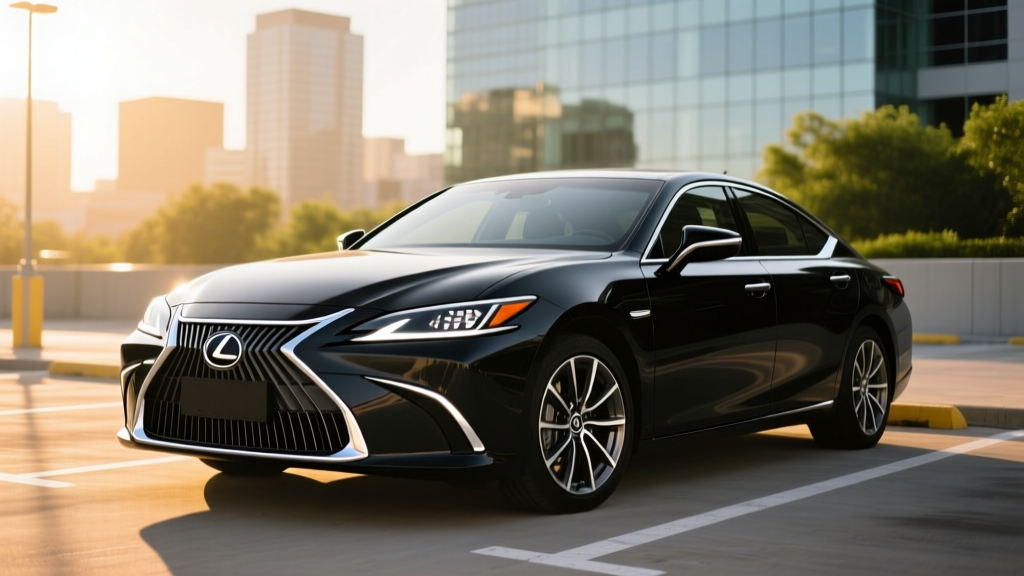
The 2022 Lexus ES Hybrid — badged as the ES 300h — occupies a specific niche in the electrified sedan market: a luxury conventional hybrid (HEV) that prioritizes fuel efficiency, ride comfort, and long-term reliability over plug-in capability or all-electric range. If you're researching this model on the used market in 2026 or comparing it against current hybrid and EV sedans, this guide breaks down every number that matters.
Before we get into the data, a critical clarification: the ES 300h is a conventional hybrid (HEV), not a plug-in hybrid (PHEV). It does not plug in, has no electric-only driving mode of meaningful distance, and cannot be charged from a wall outlet or public charger. Lexus does not offer a plug-in version of the ES sedan. If you need electric-only commuting capability, you'll need to look at a PHEV or a full battery-electric vehicle (BEV).
HEV vs PHEV: Where the 2022 Lexus ES Hybrid Fits
Understanding the distinction between hybrid types is essential before evaluating the ES 300h against competitors:
| Feature | Conventional Hybrid (HEV) — ES 300h | Plug-In Hybrid (PHEV) | Battery Electric (BEV) |
|---|---|---|---|
| Plugs in to charge? | No | Yes | Yes |
| Electric-only range | ~1 mile at low speed | 20–45 miles typical | 200–400+ miles |
| Battery capacity | 1.6 kWh (NiMH) | 10–20 kWh (Li-ion) | 60–100+ kWh (Li-ion) |
| Fuel required | Yes (gasoline) | Yes (gasoline) | No |
| Federal tax credit (§30D) | No | Up to $7,500 (if eligible) | Up to $7,500 (if eligible) |
| Home charging needed | No | Recommended (Level 2) | Essential (Level 2) |
The ES 300h uses its small battery pack and electric motor purely to assist the gasoline engine and recapture energy during braking. You fuel it like any other car — the hybrid system works invisibly in the background to reduce fuel consumption.
Fuel Economy: EPA Ratings and Real-World MPG
The headline number for the 2022 ES 300h is its EPA-estimated fuel economy, which remains competitive even against newer hybrid sedans in 2026.
| Driving Cycle | EPA Estimate | Real-World Expectation |
|---|---|---|
| City | 43 MPG | 44–48 MPG (hybrids excel in stop-and-go) |
| Highway | 44 MPG | 39–43 MPG (at 70–80 mph sustained) |
| Combined | 44 MPG | 41–45 MPG (mixed driving) |
Why real-world city MPG often beats the EPA sticker: Conventional hybrids like the ES 300h recapture kinetic energy through regenerative braking every time you slow down. In city driving with frequent stops, the electric motor handles more of the workload, and the gasoline engine shuts off at idle and low speeds. On the highway, the engine runs continuously, reducing the hybrid advantage.
According to fueleconomy.gov, the 2022 ES 300h achieves its 44 MPG combined with a 13.2-gallon fuel tank, yielding an EPA-estimated total range of approximately 580 miles per tank. In conservative real-world driving — accounting for colder temperatures, hilly terrain, and aggressive acceleration — expect 500–550 miles between fill-ups.
For comparison, the non-hybrid 2022 ES 250 (4-cylinder AWD) rates at 25 city / 34 highway / 28 combined. The hybrid's 44 MPG combined represents a 57% improvement in fuel economy over the base gasoline model.
Powertrain Specifications: Engine, Motor, and Combined Output
| Specification | 2022 Lexus ES 300h |
|---|---|
| Engine | 2.5L inline-4 (Atkinson cycle) |
| Engine horsepower | 176 hp @ 5,700 rpm |
| Engine torque | 163 lb-ft @ 3,600–5,200 rpm |
| Electric motor output | 88 kW (118 hp) |
| Combined net horsepower | 215 hp |
| Transmission | eCVT (electronically controlled) |
| Drivetrain | Front-wheel drive |
| 0–60 mph | 7.7 seconds (manufacturer est.) |
| Battery type | Nickel-metal hydride (NiMH) |
| Battery capacity | 1.6 kWh |
| Fuel tank | 13.2 gallons |
| Recommended fuel | Regular unleaded (87 octane) |
The ES 300h pairs Toyota/Lexus's proven 2.5-liter Atkinson-cycle four-cylinder with a front-mounted electric motor integrated into the transaxle. The eCVT is not a belt-driven continuously variable transmission like those found in some competitors — it's a planetary gearset that blends engine and motor power with no fixed gear ratios, resulting in smooth, stepless acceleration.
At 215 combined horsepower, the ES 300h isn't a performance sedan. The 7.7-second 0–60 time is adequate for highway merging and passing but noticeably relaxed compared to turbocharged rivals. The trade-off is deliberate: this powertrain is engineered for efficiency and refinement, not acceleration.
A notable detail: the ES 300h runs on regular 87-octane gasoline. Many luxury competitors require premium fuel, so the ES 300h's fuel cost advantage extends beyond MPG into per-gallon pricing at the pump.
Battery Longevity, Warranty, and Replacement Cost
Hybrid battery lifespan is the single most common concern for used hybrid buyers. Here's what the data shows for the ES 300h's NiMH pack:
2022 Lexus ES 300h Hybrid Battery Warranty
- Federal emissions/hybrid component warranty: 8 years / 100,000 miles
- California-emissions states (CARB): 10 years / 150,000 miles on hybrid battery
- Powertrain warranty: 6 years / 70,000 miles
- Basic vehicle warranty: 4 years / 50,000 miles
Lexus uses nickel-metal hydride (NiMH) chemistry in the ES 300h — the same proven technology Toyota has deployed in the Prius since 1997. NiMH packs are less energy-dense than lithium-ion but have an exceptional track record for longevity. Real-world data from Lexus and Toyota hybrids routinely shows these batteries lasting 150,000 to 200,000+ miles before significant capacity loss.
Battery replacement cost (2026 estimates):
- OEM Lexus hybrid battery pack: $3,500–$5,000 (parts and labor at dealership)
- Refurbished/remanufactured pack: $2,000–$3,000 (independent hybrid specialist)
- Individual cell/module replacement: $500–$1,500 (if only partial failure)
For a 2022 model year vehicle in 2026, most examples will still carry at least 2–4 years of hybrid battery warranty coverage, depending on mileage. Always verify the remaining warranty by having a Lexus dealer pull the vehicle's service history.
Pricing, Trims, and Tax Credit Eligibility
The 2022 Lexus ES 300h was offered in three trims when new:
| Trim | Original MSRP (2022) | Typical Used Price (2026) |
|---|---|---|
| Base ES 300h | $42,490 | $30,000–$34,000 |
| Luxury Package | $44,140 | $32,000–$36,000 |
| Ultra Luxury Package | $46,590 | $34,000–$39,000 |
Used prices vary by mileage, condition, region, and market conditions. Data reflects approximate 2026 market values for vehicles with 30,000–60,000 miles.
Federal tax credit eligibility: The 2022 Lexus ES 300h does not qualify for the IRS §30D Clean Vehicle Credit. That credit applies only to plug-in electric vehicles (PHEVs and BEVs) meeting specific battery capacity, critical mineral sourcing, MSRP cap, and buyer income requirements. Conventional hybrids like the ES 300h are excluded.
Some states offer their own incentives for hybrid purchases, but these vary by jurisdiction and change frequently. Check your state's energy or environmental agency website for current programs. There is no federal hybrid-specific tax credit as of 2026.
Ownership Economics: Fuel Cost vs Gasoline and EV Alternatives
To put the ES 300h's 44 MPG into financial perspective, here's a 5-year fuel cost comparison assuming 15,000 miles/year and $3.50/gallon regular gasoline:
| Vehicle | MPG Combined | Annual Fuel Cost | 5-Year Fuel Cost |
|---|---|---|---|
| 2022 Lexus ES 300h (HEV) | 44 | $1,193 | $5,966 |
| 2022 Lexus ES 250 (gas AWD) | 28 | $1,875 | $9,375 |
| 2022 BMW 530i (gas, premium) | 27 | $2,528* | $12,639* |
| Average new vehicle (2022) | 28 | $1,875 | $9,375 |
*BMW 530i requires premium fuel at ~$4.10/gallon.
The ES 300h saves approximately $3,400 in fuel costs over five years compared to the gasoline ES 250, and over $6,600 versus a premium-fuel competitor like the BMW 530i. These savings partially offset the hybrid's higher initial purchase price.
However, a full EV charged primarily at home on residential electricity ($0.14/kWh national average) can achieve fuel costs under $600/year — roughly half the ES 300h's expense. The trade-off is EV charging infrastructure access and higher upfront cost.
Who Should Choose the 2022 Lexus ES Hybrid?
Choose the ES 300h if:
- You want luxury sedan comfort with 40+ MPG without changing your fueling habits
- You lack access to home or workplace charging (apartment, street parking)
- You drive 15,000+ miles/year and want to minimize fuel costs
- You prioritize long-term reliability and low maintenance costs
- You prefer regular 87-octane fuel in a luxury vehicle
Look at a PHEV or full EV instead if:
- You have home Level 2 charging and a commute under 30 miles (PHEV covers this electrically)
- You want the $7,500 federal tax credit (requires a qualifying PHEV or BEV)
- You want zero tailpipe emissions for daily commuting
- You're interested in one-pedal driving and instant electric torque
Reliability Ratings and Safety
The Lexus ES lineup — including the 300h — carries a strong reliability reputation. Lexus consistently ranks at or near the top of J.D. Power Vehicle Dependability Studies, and the ES's Toyota-sourced hybrid powertrain is one of the most proven electrified systems on the road.
The Insurance Institute for Highway Safety (IIHS) rated the 2022 Lexus ES as a Top Safety Pick+ when equipped with specific headlights. Standard safety features include Lexus Safety System+ 2.0 with pre-collision braking, lane departure alert with steering assist, dynamic radar cruise control, and lane tracing assist — all functioning as SAE Level 2 driver-assistance systems that require continuous driver engagement.
Common owner-reported concerns are minor: some note that the eCVT produces a droning engine note under hard acceleration (a characteristic of the planetary gearset, not a defect), and the infotainment touchpad interface in the 2022 model year drew criticism before Lexus switched to a touchscreen for 2023.
Pros
- 44 MPG combined on regular gasoline — exceptional for a luxury sedan
- Proven NiMH hybrid battery with 150K+ mile track record
- Quiet, comfortable ride quality with excellent seat comfort
- Lower fuel cost vs all gasoline luxury competitors
- No charging infrastructure needed — fuel anywhere
- Strong resale value and Lexus reliability reputation
Cons
- No electric-only driving capability (not a PHEV)
- No federal tax credit eligibility
- Relaxed acceleration (7.7s 0–60) compared to turbocharged rivals
- FWD only — no all-wheel-drive option on the hybrid
- Touchpad infotainment interface (pre-2023 redesign)
- Hybrid battery replacement cost ($3,500–$5,000) if out of warranty
Frequently Asked Questions
How many MPG does the 2022 Lexus ES 300h hybrid get?
The EPA rates the 2022 Lexus ES 300h at 43 city / 44 highway / 44 combined MPG. In real-world driving, many owners report exceeding the city estimate (44–48 MPG in stop-and-go traffic) while highway driving at 75+ mph tends to return 39–43 MPG. The combined real-world average typically falls between 41–45 MPG depending on driving style and climate.
Does the 2022 Lexus ES Hybrid plug in or have electric-only range?
No. The ES 300h is a conventional hybrid (HEV), not a plug-in hybrid. It does not have a charging port, cannot be plugged in, and has no meaningful electric-only driving range. The small 1.6 kWh battery recharges solely through regenerative braking and the gasoline engine. If you need electric-only commuting, consider a PHEV like the Toyota Prius Prime or a full EV.
Is the 2022 Lexus ES 300h reliable, and what does a hybrid battery replacement cost?
The ES 300h uses Toyota/Lexus's fourth-generation hybrid system with a NiMH battery pack that has a proven track record of 150,000–200,000+ miles before significant degradation. The hybrid battery is warranted for 8 years/100,000 miles (10 years/150,000 miles in CARB states). If replacement is needed out of warranty, expect $3,500–$5,000 for an OEM pack or $2,000–$3,000 for a refurbished unit.
Does the 2022 Lexus ES 300h qualify for any federal tax credit?
No. The IRS §30D Clean Vehicle Credit applies only to plug-in electric vehicles (PHEVs and BEVs) that meet battery sourcing, MSRP cap, and buyer income requirements. Conventional hybrids like the ES 300h are not eligible for any federal purchase incentive. Some states may offer hybrid-specific rebates — check your state energy office for current programs.
Hybrid vs PHEV vs EV — which is right for me?
A conventional hybrid (HEV) like the ES 300h is best if you lack charging access and want maximum MPG without lifestyle changes. A plug-in hybrid (PHEV) suits drivers with home charging and short commutes (20–40 miles electric, then gasoline for longer trips). A full EV (BEV) is ideal if you have reliable home Level 2 charging, want the lowest operating costs, and your daily driving stays within the vehicle's range. The ES 300h eliminates range anxiety entirely — you refuel at any gas station in under 5 minutes.
How does the ES 300h compare to the 2022 Toyota Camry Hybrid?
The 2022 Camry Hybrid shares the same 2.5L hybrid powertrain architecture and achieves 52 MPG combined (LE trim) — 8 MPG better than the ES 300h. The trade-off: the Camry lacks the Lexus's premium interior materials, sound insulation, ride quality, and brand cachet. If fuel economy is the sole priority, the Camry Hybrid wins. If luxury comfort matters, the ES 300h's 44 MPG in a quieter, more refined package is the better choice.