Why the 2022 Camry Hybrid Still Matters in 2026
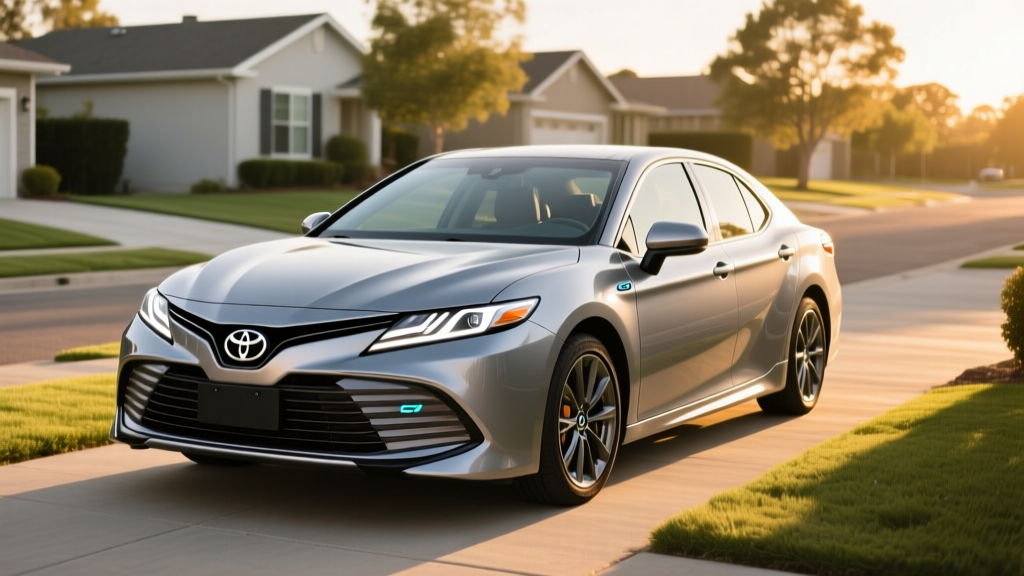
The midsize sedan segment has thinned out, but the 2022 Toyota Camry Hybrid remains a benchmark for drivers who want maximum fuel efficiency without plugging in. With EPA ratings reaching 52 MPG city and a combined range exceeding 600 miles, it occupies a practical middle ground between a conventional gas car and a full battery-electric vehicle (BEV). As of 2026, used examples are plentiful and affordable, making this model year a smart target for cost-conscious buyers evaluating electrified options.
This guide covers everything a research-heavy buyer needs: exact EPA fuel economy by trim, real-world MPG expectations, powertrain specs, battery longevity and warranty, ownership costs, and how the Camry Hybrid stacks up against plug-in hybrids and full EVs.
EPA Fuel Economy and Real-World MPG
The 2022 Camry Hybrid comes in three trims — LE, SE, and XLE — and fuel economy varies slightly depending on wheel size and drivetrain configuration. Here is the full EPA breakdown according to fueleconomy.gov:
| Trim | City MPG | Highway MPG | Combined MPG | Tank Size (gal) | Est. Total Range (mi) |
|---|---|---|---|---|---|
| LE (16" wheels) | 51 | 53 | 52 | 13.2 | ~686 |
| SE (18" wheels) | 44 | 47 | 46 | 13.2 | ~607 |
| XLE (18" wheels) | 44 | 47 | 46 | 13.2 | ~607 |
The LE trim's 52 MPG combined rating is exceptional — it benefits from lower-rolling-resistance 16-inch tires and a slightly lighter curb weight. The SE and XLE trims drop to 46 combined due to larger 18-inch alloy wheels and wider tires.
Real-World MPG: What Owners Actually See
Toyota's hybrid synergy drive system excels in stop-and-go city driving, where regenerative braking and electric-motor assist do the heavy lifting. Many owners report exceeding the EPA city estimate in moderate climates — 53–56 MPG in warm-weather urban commutes is common based on aggregated owner data from Fuelly and Edmunds long-term tests.
Highway driving tells a different story. At sustained 75–80 MPH speeds, expect the LE to return roughly 46–49 MPG and the SE/XLE closer to 40–43 MPG. Cold weather (below 30°F) reduces fuel economy by roughly 5–10% across all trims because the gasoline engine runs more frequently to provide cabin heat and maintain battery temperature.
Powertrain Specs: Engine, Motors, and Combined Output
The 2022 Camry Hybrid pairs a 2.5-liter four-cylinder Atkinson-cycle gasoline engine with an electric motor-generator system through Toyota's eCVT (electronically controlled continuously variable transmission). This is a conventional hybrid (HEV) — it charges its own battery through regenerative braking and engine power. You never plug it in.
| Specification | Value |
|---|---|
| Gasoline Engine | 2.5L 4-cyl Atkinson-cycle (A25A-FXS) |
| Engine Power | 176 hp @ 5,700 rpm / 163 lb-ft torque |
| Electric Motor Power | 88 kW (118 hp) / 149 lb-ft torque |
| Net Combined System Power | 208 hp |
| Transmission | eCVT (planetary gearset, not a belt CVT) |
| Drivetrain | FWD (LE, SE, XLE); AWD-e available on SE |
| Hybrid Battery | 1.6 kWh nickel-metal hydride (NiMH) |
| 0–60 MPH | ~7.2 seconds (FWD) |
The AWD-e option on the SE trim adds a rear-axle electric motor (40 hp) that engages automatically under acceleration or in low-traction conditions. This drops fuel economy slightly to 44 city / 43 highway / 44 combined MPG.
The 1.6 kWh NiMH battery pack is small by design. It doesn't provide meaningful electric-only driving — instead, it serves as a buffer for regenerative energy capture and brief electric assist during acceleration. This is fundamentally different from a plug-in hybrid, which carries a much larger battery for miles of electric-only range.
HEV vs PHEV vs EV: Which Powertrain Fits You?
Buyers cross-shopping the Camry Hybrid often wonder whether they should consider a plug-in hybrid like the Toyota RAV4 Prime or a full EV like the Tesla Model 3 or Hyundai Ioniq 6. The right choice depends on your charging access, driving patterns, and budget.
| Factor | HEV (Camry Hybrid) | PHEV (e.g., RAV4 Prime) | BEV (e.g., Model 3) |
|---|---|---|---|
| Plug-in Required? | No — self-charging | Yes — for electric range | Yes — always |
| Electric-Only Range | ~0.5 mi at low speed | 25–42 mi typical | 250–350+ mi |
| Fuel Cost per Mile | ~$0.09 (at $3.50/gal, 50 MPG) | ~$0.04 electric / $0.09 gas | ~$0.04–$0.06 |
| Home Charging Needed? | No | Recommended (Level 2) | Essential (Level 2) |
| Federal Tax Credit (§30D) | Not eligible | Up to $7,500 (if eligible)* | Up to $7,500 (if eligible)* |
| Upfront Price (new MSRP range) | $28,000–$35,000 | $40,000–$50,000 | $38,000–$55,000+ |
| Best For | No home charging; long highway trips | Home charging + short commutes | Home charging; lower running costs |
*Federal tax credit eligibility under IRS §30D depends on battery sourcing, critical mineral requirements, buyer income caps, and MSRP limits. Consult IRS.gov or a tax professional for current-year rules.
- You cannot install a home charger (apartment, street parking, no garage)
- You regularly drive 400+ miles in a single trip and don't want to plan charging stops
- You want the lowest possible upfront cost for an electrified vehicle
- You live in an area with sparse public charging infrastructure
- You have reliable Level 2 home charging and a commute under 35 miles
- You want to drive primarily on electricity and minimize gasoline use
- You qualify for the federal tax credit, which can offset a PHEV or EV's higher purchase price
- You want access to HOV lane stickers (available for PHEVs and EVs in many states, not for HEVs)
Battery Warranty, Longevity, and Replacement Cost
Hybrid battery longevity is consistently the top concern for buyers considering a used Camry Hybrid. Here's the data:
- Hybrid Battery: 10 years / 150,000 miles (whichever comes first) in all 50 states — Toyota extended this from the prior 8-year/100,000-mile standard starting with 2020 models
- Hybrid System Components: 8 years / 100,000 miles (inverter, transaxle, control module)
- Transferability: Warranty transfers to subsequent owners automatically
How Long Do Camry Hybrid Batteries Actually Last?
Toyota's NiMH hybrid batteries have an extensive track record. Data from fleet operators and long-term owners indicates that Camry Hybrid battery packs routinely last 150,000–200,000+ miles before significant capacity loss. Unlike full EV batteries, the hybrid system never deeply cycles the pack — it operates in a narrow state-of-charge window (roughly 40–80%), which dramatically reduces degradation.
The 2022 model's 1.6 kWh NiMH pack is proven technology. Toyota has used similar chemistry in the Prius and Camry Hybrid for over two decades with low failure rates.
Battery Replacement Cost
If the hybrid battery does fail outside warranty:
- New OEM replacement: $2,500–$4,000 (parts and labor at a Toyota dealer)
- Refurbished/remanufactured pack: $1,500–$2,500 from independent hybrid specialists
- Individual module replacement: Some shops can replace failed modules within the pack for $500–$1,200, though this is less common on newer models
Given the 10-year/150,000-mile warranty and the pack's proven durability, hybrid battery replacement is rarely a cost that 2022 Camry Hybrid owners face in practice.
Pricing and Tax Credit Eligibility
The 2022 Camry Hybrid is no longer sold new, so buyers are looking at the used and certified pre-owned (CPO) market. Here's what pricing looks like as of early 2026:
| Trim | Original MSRP (2022) | 2026 Used Range (est.) | 2026 CPO Range (est.) |
|---|---|---|---|
| LE | $28,430 | $21,000–$25,500 | $24,000–$27,000 |
| SE | $30,110 | $22,500–$27,000 | $25,500–$28,500 |
| XLE | $33,745 | $24,000–$29,000 | $27,000–$31,000 |
Does the Camry Hybrid Qualify for Any Tax Credit?
No. The Camry Hybrid is a conventional HEV — it does not have a plug and does not meet the definition of a "clean vehicle" under IRS §30D. Federal tax credits are available only for plug-in vehicles (PHEVs and BEVs) that meet battery-sourcing, critical-mineral, MSRP, and buyer-income requirements.
However, there is one potential incentive for used buyers: the Used Clean Vehicle Credit (IRC §25E) provides up to $4,000 (or 30% of the sale price, whichever is less) for qualifying used plug-in vehicles. Since the Camry Hybrid is not a plug-in, it does not qualify for this credit either.
Some states and utilities offer rebates for purchasing any hybrid vehicle, but these are typically modest ($250–$500) and vary by jurisdiction. Check your local utility and state energy office for current programs.
Reliability, Safety, and Ownership Costs
Toyota's hybrid powertrain is among the most reliable in the industry. The 2022 Camry earned top marks from both the NHTSA and IIHS:
- NHTSA: 5-Star Overall Safety Rating — nhtsa.gov
- IIHS: Top Safety Pick+ (when equipped with specific headlights)
- Toyota Safety Sense 2.5+: Standard on all trims — includes pre-collision system with pedestrian detection, full-speed adaptive cruise control, lane departure alert with steering assist, lane tracing assist, and automatic high beams
Five-Year Ownership Cost Estimate
| Cost Category | Estimated Cost | Notes |
|---|---|---|
| Purchase Price | $23,000 | Average used LE, ~35k miles |
| Fuel (75,000 mi @ 50 MPG avg, $3.50/gal) | $5,250 | 1,500 gal over 5 years |
| Insurance | $7,500–$9,000 | $1,500–$1,800/yr avg |
| Maintenance | $2,500–$3,500 | Oil changes, tires, brakes (regen extends brake life) |
| Depreciation | $6,000–$8,000 | Camry Hybrids hold value well |
| Total 5-Year Cost | $44,250–$47,250 | ~$0.59–$0.63 per mile all-in |
For comparison, a similarly equipped 2022 Camry gas model (2.5L, 30 MPG combined) would spend roughly $8,750 on fuel over the same distance — a $3,500 fuel-cost penalty versus the hybrid. The hybrid's premium at purchase (typically $1,500–$2,500 more used) pays for itself within 2–3 years of average driving.
Pros and Cons
Pros
- Class-leading 52 MPG combined (LE trim)
- No plug-in charging required — works anywhere with gas stations
- 686-mile EPA total range eliminates range anxiety entirely
- 10-year / 150,000-mile hybrid battery warranty
- Strong reliability record and low maintenance costs
- Standard Toyota Safety Sense 2.5+ suite
- Smooth, quiet hybrid powertrain with adequate 208 hp
Cons
- No electric-only driving capability — always uses gasoline
- Not eligible for federal EV/PHEV tax credits
- SE and XLE trims drop to 46 MPG combined with 18" wheels
- eCVT engine drone under hard acceleration (common hybrid trait)
- No DC fast charging (not applicable — no plug)
- Smaller trunk than gas Camry due to hybrid battery placement (15.1 vs 15.9 cu ft)
- No HOV lane access in most states
Frequently Asked Questions
How many MPG does the 2022 Camry Hybrid get?
The LE trim achieves 51 city / 53 highway / 52 combined MPG. The SE and XLE trims with 18-inch wheels are rated at 44 city / 47 highway / 46 combined. Real-world city driving often exceeds EPA estimates by 2–4 MPG in warm weather; highway driving at 75+ MPH typically returns 3–5 MPG below the sticker.
Is the 2022 Camry Hybrid a plug-in?
No. The Camry Hybrid is a conventional hybrid (HEV). It charges its own 1.6 kWh battery through regenerative braking and the gasoline engine. You never plug it in. If you want plug-in capability with electric-only range, look at the Toyota RAV4 Prime or Prius Prime.
How far can the Camry Hybrid drive on electric only?
Effectively zero miles in any practical sense. The hybrid system can propel the car at very low speeds (under ~25 MPH) for roughly half a mile on battery alone in ideal conditions, but the gasoline engine engages almost immediately under any meaningful acceleration or speed. This is by design — the HEV system uses the battery for assist and efficiency, not for standalone driving.
Is the hybrid battery reliable, and what does replacement cost?
Toyota's NiMH hybrid batteries are among the most proven in the industry, routinely lasting 150,000–200,000+ miles. The 2022 model carries a 10-year / 150,000-mile hybrid battery warranty that transfers to subsequent owners. Out-of-warranty replacement costs $2,500–$4,000 for a new OEM pack, or $1,500–$2,500 for a refurbished unit.
Does the 2022 Camry Hybrid qualify for a federal tax credit?
No. Federal clean vehicle tax credits under IRC §30D and §25E are available only for plug-in vehicles (PHEVs and BEVs). The Camry Hybrid, as a conventional HEV, does not qualify for any federal purchase incentive. Check your state and local utility for possible hybrid-specific rebates, though these are uncommon and typically small.
Should I buy the Camry Hybrid or a full EV?
If you have reliable Level 2 home charging, a commute under 40 miles, and want the lowest per-mile fuel cost (~$0.04–$0.06/mi on electricity vs ~$0.09/mi on gasoline at 50 MPG), a full EV like the Tesla Model 3 or Hyundai Ioniq 6 will save more on running costs and may qualify for tax credits. If you lack home charging, frequently drive long distances, or want the lowest upfront cost, the Camry Hybrid is the more practical choice with zero charging logistics.