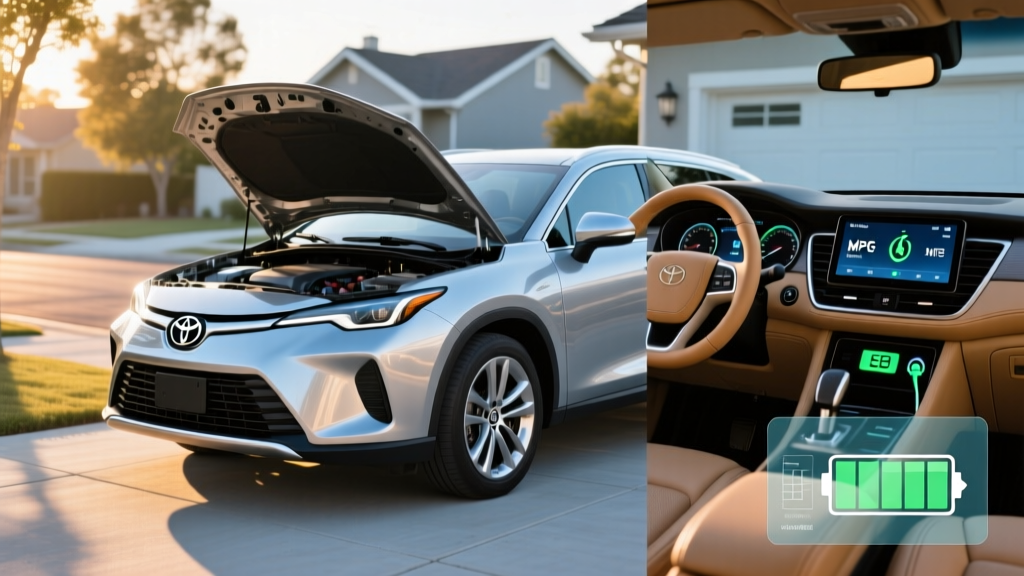
The 2021 Toyota Venza hybrid returned to the U.S. market after a multi-year hiatus, repositioned as a stylish, all-hybrid midsize crossover that slots between the RAV4 Hybrid and the Highlander Hybrid in Toyota's lineup. Unlike the RAV4 Prime plug-in hybrid, the Venza is exclusively a conventional hybrid (HEV) — no plug, no electric-only driving mode, just a proven Toyota Hybrid System that delivers strong real-world fuel economy without any change to your daily routine.
Now that we're several model years into this generation (2021–2024, before the Crown Signia effectively replaced it), we have enough owner data and long-term testing to give a thorough verdict. Here's everything you need to know about the 2021 Venza hybrid's fuel economy, powertrain, battery longevity, and where it fits in the electrified-vehicle landscape.
HEV vs. PHEV: Why the Venza Is a Conventional Hybrid
A common source of confusion among shoppers is the difference between a conventional hybrid (HEV) and a plug-in hybrid (PHEV). The 2021 Venza is firmly in the HEV camp, and that distinction matters for your ownership experience.
Conventional Hybrid (HEV) vs. Plug-In Hybrid (PHEV)
| Feature | HEV (2021 Venza) | PHEV (e.g., RAV4 Prime) |
|---|---|---|
| Plugs in? | No — gas only | Yes — Level 1/Level 2 |
| Electric-only range | ~1 mile at very low speed | 25–42 miles typical |
| Battery size | ~1.6 kWh (small) | 13–18 kWh (larger) |
| Fuel economy | 40 MPG combined | 38 MPG (gas) / 94 MPGe (elec) |
| Federal tax credit | Not eligible (§30D) | Up to $7,500 (eligibility varies) |
| Home charging needed? | No | Recommended for full benefit |
The Venza's HEV system recovers energy through regenerative braking and the gasoline engine — you never need to plug it in. A PHEV like the RAV4 Prime offers meaningful electric-only commuting but requires home charging infrastructure to justify its higher price.
If you don't have access to home or workplace charging, the Venza's HEV setup is arguably the better choice — you get meaningful fuel savings over a gas-only vehicle with zero behavioral change.
2021 Venza Hybrid Fuel Economy: EPA and Real-World MPG
The EPA rates the 2021 Toyota Venza hybrid at 40 MPG city / 37 MPG highway / 40 MPG combined for all trims (LE, XLE, Limited), since all share the same AWD hybrid powertrain. These figures come from fueleconomy.gov and apply across the entire Venza lineup.
| Metric | EPA Rating | Real-World Expectation |
|---|---|---|
| City MPG | 40 | 40–44 (hybrids excel in stop-and-go) |
| Highway MPG | 37 | 34–37 (less regen benefit at steady speed) |
| Combined MPG | 40 | 38–42 |
| Fuel tank | 14.5 gal | ~550–580 miles per tank |
Powertrain: Engine, Motors, and Combined Output
The 2021 Venza uses Toyota's fourth-generation Hybrid System (THS IV), the same architecture found in the RAV4 Hybrid and Camry Hybrid, adapted for the Venza's platform. Here's the full breakdown:
| Specification | Detail |
|---|---|
| Engine | 2.5L inline-4 (Atkinson cycle) |
| Engine output | 176 hp / 163 lb-ft torque |
| Front electric motor | 118 hp / 149 lb-ft |
| Rear electric motor (AWD) | 54 hp / 89 lb-ft |
| Net combined system output | 219 hp |
| Drivetrain | Electronic on-demand AWD (standard all trims) |
| Transmission | eCVT (planetary gearset, no fixed gears) |
| 0–60 mph | ~7.6 seconds (Car and Driver tested) |
| Hybrid battery | ~1.6 kWh, nickel-metal hydride (NiMH) |
| Curb weight | ~3,900 lbs |
| Towing capacity | Not rated for towing |
The rear motor provides electronic AWD by engaging only when the front wheels slip or under hard acceleration — it's not a mechanical driveshaft system. This keeps weight and drivetrain losses low, contributing to the Venza's strong efficiency. The 219 hp combined output is adequate for highway merging and passing, though it's noticeably less punchy than the RAV4 Prime's 302 hp PHEV system.
Battery Warranty, Lifespan, and Replacement Cost
Battery longevity is the single most common concern among hybrid buyers, and it's worth addressing directly. The 2021 Venza's hybrid battery is a relatively small ~1.6 kWh NiMH pack — far less stressed than a full EV battery because it operates in a narrow state-of-charge window (roughly 40–80% SoC), which dramatically reduces degradation.
2021 Venza Hybrid Battery Warranty
- Hybrid battery: 10 years / 150,000 miles (whichever comes first) in all 50 states for 2020+ model-year Toyota hybrids
- Hybrid system components (inverter, motors, control module): 8 years / 100,000 miles
- Basic new-vehicle warranty: 3 years / 36,000 miles
- Powertrain warranty: 5 years / 60,000 miles
Toyota extended hybrid battery coverage to 10 years/150,000 miles starting with the 2020 model year, up from the previous 8 years/100,000 miles. This applies to all 2021 Venza models regardless of state.
Real-world battery lifespan: Toyota's NiMH hybrid batteries have an excellent track record. The Prius, which uses similar chemistry and management, routinely sees original batteries lasting 150,000–200,000+ miles before needing replacement. Given the Venza's less aggressive charge/discharge cycles, there's no reason to expect different longevity.
Replacement cost: If the hybrid battery does eventually need replacement out of warranty, expect to pay between $2,000 and $4,000 for a refurbished or new OEM pack including labor at a Toyota dealer. Third-party hybrid battery specialists often offer refurbished units for $1,500–$2,500 installed. This is dramatically cheaper than a full EV battery replacement ($8,000–$20,000+), reflecting the Venza's much smaller pack.
Pricing, Trims, and Tax Credit Eligibility
The 2021 Venza launched with three trims, all sharing the same powertrain and AWD:
| Trim | Original MSRP | Key Features |
|---|---|---|
| LE | $32,470 | Toyota Safety Sense 2.0, 8" touchscreen, LED headlights |
| XLE | $36,000 | SofTex seats, wireless charging, 9" display, power liftgate |
| Limited | $39,800 | Fixed panoramic glass roof, JBL audio, HUD, 12.3" display |
Prices include destination charge. Source: Toyota USA pressroom.
Does the 2021 Venza Hybrid Qualify for a Federal Tax Credit?
No. The 2021 Venza is a conventional hybrid (HEV), and the IRS §30D federal tax credit applies only to plug-in electric vehicles (BEVs and PHEVs) with sufficient battery capacity and qualifying battery-sourcing criteria. The Venza's ~1.6 kWh NiMH pack does not meet the minimum 4 kWh threshold that previously existed under older rules, and under current IRS clean vehicle credit rules, only plug-in vehicles with ≥7 kWh of battery capacity are eligible.
Some states may offer small rebates or HOV lane access for hybrids, but these vary widely by jurisdiction. Check your state's energy or DMV website for current programs. There is no federal incentive for purchasing a conventional hybrid in 2026.
On the used market, the Venza also does not qualify for the up-to-$4,000 used clean vehicle credit (§25E), which similarly requires a plug-in vehicle with ≥7 kWh battery capacity.
Reliability, Safety, and Ownership Costs
Toyota's hybrid powertrain is among the most proven in the industry, with over 25 years of continuous refinement since the original Prius. The 2021 Venza benefits from this institutional knowledge, and early reliability data has been strong.
Safety ratings: The 2021 Venza earned the IIHS Top Safety Pick award with Good ratings in all crashworthiness tests. It comes standard with Toyota Safety Sense 2.0, which includes pre-collision braking with pedestrian detection, full-speed adaptive cruise control, lane departure alert with steering assist, lane tracing assist, and automatic high beams. Note: this is an SAE Level 1–2 driver-assistance suite — the driver must remain fully engaged at all times.
Insurance costs: The Venza hybrid typically costs slightly more to insure than its gas-only midsize crossover competitors, but less than full EVs. Expect annual premiums in the $1,400–$1,900 range depending on your profile and state — get quotes before purchasing.
Maintenance: Hybrid maintenance costs are generally lower than gas-only vehicles because regenerative braking extends brake pad life (often 80,000+ miles before replacement), the Atkinson-cycle engine runs cooler and under less stress, and there's no conventional starter motor or alternator to fail. Toyota recommends standard oil changes every 10,000 miles.
Who Should Choose the 2021 Venza Hybrid?
Decision Framework
Choose the 2021 Venza hybrid if:
- You want 40 MPG without changing your refueling habits (no plug-in needed)
- You lack access to home or workplace Level 2 charging
- You value a quiet, refined ride with premium touches (especially the Limited's glass roof)
- You want standard AWD for snow/rain climates without a fuel-economy penalty
- You prioritize proven reliability and low long-term maintenance costs
Look elsewhere if:
- You want electric-only commuting — consider the RAV4 Prime (42 miles EV range) or a full BEV like the Ioniq 5
- You need towing capacity — the Venza isn't rated to tow; consider the Highlander Hybrid (3,500 lbs) or a PHEV truck
- You want maximum cargo space — the Venza's 28.8 cu ft behind the rear seats is tight for the segment
- You're chasing federal tax credits — only plug-in vehicles qualify under current §30D rules
Pros
- 40 MPG combined with standard AWD — outstanding for the segment
- No plug-in required; zero behavior change from a gas car
- 10-year/150,000-mile hybrid battery warranty
- Refined, quiet cabin; Limited trim feels premium
- Strong IIHS safety ratings; TSS 2.0 standard
- Real-world MPG often matches or beats EPA estimates in city driving
Cons
- Modest cargo space (28.8 cu ft) vs. RAV4 Hybrid (37.5 cu ft)
- No plug-in option; ineligible for federal tax credits
- Not rated for towing
- CVT drone under hard acceleration
- Infotainment feels dated vs. competitors (no wireless CarPlay on LE/XLE in 2021)
- Discontinued after 2024 — limited new inventory
Frequently Asked Questions
How many MPG does the 2021 Venza hybrid get?
The EPA rates it at 40 MPG city / 37 MPG highway / 40 MPG combined. Real-world driving typically yields 38–44 MPG depending on conditions — city driving with frequent stops tends to produce higher numbers thanks to regenerative braking, while sustained highway driving at 75+ MPH may drop to 34–37 MPG.
Can the 2021 Venza drive on electric power only?
Only at very low speeds (under ~25 MPH) for brief distances (roughly 1 mile or less) on a full charge. This is not a meaningful electric-only mode like a PHEV offers — the Venza is a conventional hybrid designed to optimize fuel economy, not to replace gasoline with electricity for commuting.
Is the 2021 Venza hybrid reliable?
Yes. Toyota's hybrid system is among the most reliable powertrains in the automotive industry, with decades of real-world validation across millions of vehicles. The hybrid battery carries a 10-year/150,000-mile warranty, and NiMH packs in similar Toyota hybrids routinely last 150,000–200,000+ miles.
How much does it cost to replace the Venza hybrid battery?
Out of warranty, expect $2,000–$4,000 at a Toyota dealer for a new OEM battery pack, or $1,500–$2,500 for a refurbished unit from a hybrid specialist. Given the battery's small size and conservative management, most owners will never need a replacement.
Does the 2021 Venza hybrid qualify for any tax credit?
No. The federal §30D clean vehicle credit applies only to plug-in vehicles (BEVs and PHEVs) with ≥7 kWh of battery capacity. The Venza's ~1.6 kWh NiMH pack doesn't qualify. It's also ineligible for the used EV credit (§25E). Check your state's energy office for any local hybrid incentives, which vary by jurisdiction.
Hybrid vs. PHEV vs. EV — which is right for me?
If you have no home charging access and want maximum simplicity, an HEV like the Venza is the best fit. If you can charge at home and have a short commute (<30 miles each way), a PHEV like the RAV4 Prime lets you commute on electricity while keeping a gas engine for road trips. If you have reliable charging access and want the lowest operating cost and zero tailpipe emissions, a full BEV (like the Hyundai Ioniq 5 or Tesla Model Y) eliminates gasoline entirely — but requires commitment to charging infrastructure.
Is the Venza being discontinued?
Toyota discontinued the Venza after the 2024 model year in the U.S., effectively replacing it with the Crown Signia (a lifted wagon/crossover also offered exclusively as a hybrid). The 2021–2024 Venza remains widely available on the used market, and all hybrid warranty coverage continues to be honored by Toyota dealers.