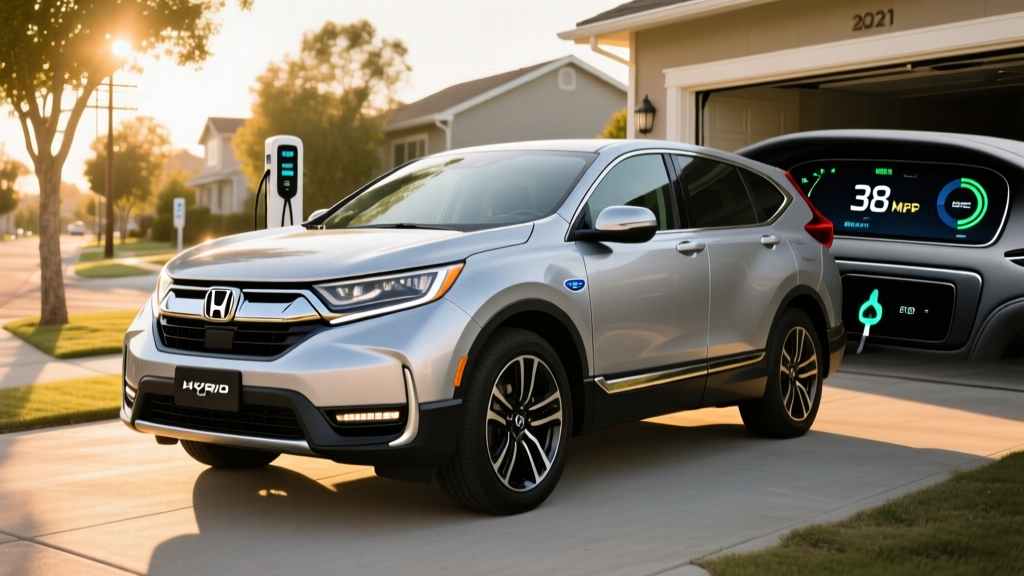
The 2021 Honda CR-V Hybrid remains one of the most sought-after compact hybrid SUVs on the used market in 2026. With the discontinuation of Honda's two-motor hybrid system in the CR-V after the 2022 model year — replaced by a turbocharged hybrid setup for 2023 and later — the 2021 model occupies a specific niche: a naturally aspirated, Atkinson-cycle hybrid that prioritizes fuel efficiency and proven reliability over outright power. For buyers who want hybrid fuel savings without plugging in, this generation still delivers.
This guide covers the complete spec profile, real-world fuel economy expectations, battery longevity data, and whether the 2021 CR-V Hybrid still makes financial sense against newer PHEVs and full EVs in today's market.
HEV vs PHEV: What the 2021 CR-V Hybrid Actually Is
Before diving into specs, it's critical to understand exactly what you're buying. The 2021 Honda CR-V Hybrid is a conventional hybrid electric vehicle (HEV). It is not a plug-in hybrid (PHEV) and not a battery electric vehicle (BEV).
HEV vs PHEV vs BEV — Quick Reference
| Feature | HEV (CR-V Hybrid) | PHEV (e.g., Toyota RAV4 Prime) | BEV (e.g., Tesla Model Y) |
|---|---|---|---|
| Plugs in? | No | Yes | Yes |
| Electric-only range | ~1-2 mi at low speed | 25-42 mi typical | 250-330 mi |
| Battery size | ~1.3 kWh (buffer) | 13-18 kWh | 60-82 kWh |
| Federal tax credit | None (new or used) | Up to $7,500 (new, if eligible) | Up to $7,500 new / $4,000 used |
| Fuel required | Gasoline | Gasoline + electricity | Electricity only |
The CR-V Hybrid's small battery recharges through regenerative braking and the gasoline engine. You never plug it in. You simply fill it with gas and drive. The hybrid system handles the energy management automatically, using the electric motor to assist the engine, enable engine-off coasting, and recapture energy during braking.
EPA Fuel Economy: How Many MPG Does the 2021 CR-V Hybrid Get?
The EPA rates the 2021 Honda CR-V Hybrid with all-wheel drive (the only drivetrain offered on hybrid trims) at the following:
| Metric | EPA Rating |
|---|---|
| City | 40 MPG |
| Highway | 35 MPG |
| Combined | 38 MPG |
| Annual fuel cost (est.) | ~$1,550 (15,000 mi/yr at $3.30/gal) |
Real-World MPG: What Owners Actually See
Honda's two-motor hybrid system excels in city driving, where regenerative braking and electric-only low-speed operation maximize efficiency. In real-world ownership, the pattern is consistent:
- City/suburban driving: 38-43 MPG. Many owners report exceeding the 40 MPG city sticker in stop-and-go traffic, especially in mild weather. The hybrid system frequently shuts off the engine at stops and below ~25 mph.
- Highway cruising (70-75 mph): 31-34 MPG. The CR-V Hybrid's boxy aerodynamics and AWD drivetrain losses hurt highway efficiency. Expect 4-5 MPG below the EPA highway figure at sustained interstate speeds.
- Cold weather (below 30°F): 30-34 MPG combined. The engine runs more often to provide cabin heat (no heat pump on this generation), and the battery's charge/discharge efficiency drops in cold temperatures.
- Mixed driving (realistic average): 35-39 MPG combined for most owners across seasons.
The gap between EPA and real-world is narrower than with most EVs' range estimates, but highway-heavy commuters should budget for ~33 MPG rather than the 38 combined sticker.
Powertrain Specs: Engine, Motors, and Total Output
| Specification | 2021 CR-V Hybrid |
|---|---|
| Engine | 2.0L Atkinson-cycle 4-cylinder |
| Engine output | 143 hp / 129 lb-ft torque |
| Electric motors | Two-motor system (propulsion + generator) |
| Propulsion motor output | 181 hp / 232 lb-ft torque |
| Combined system output | 212 hp |
| Drivetrain | AWD (rear motor-driven, no mechanical driveshaft) |
| Transmission | e-CVT (no traditional gears — direct drive with lock-up clutch) |
| 0-60 mph | ~7.5 seconds |
| Hybrid battery capacity | ~1.3 kWh (lithium-ion, usable buffer only) |
| Towing capacity | 1,000 lbs (not rated for heavy towing) |
Honda's two-motor hybrid system operates primarily in series-hybrid mode at lower speeds — the engine spins the generator motor, which feeds electricity to the propulsion motor that drives the front wheels. At highway speeds (roughly above 50 mph under light load), a lock-up clutch mechanically connects the engine directly to the wheels for improved efficiency. This is why highway MPG drops: the engine is now doing the work directly rather than through the more flexible electric motor path.
The AWD system is worth noting: there is no mechanical driveshaft connecting the front and rear axles. Instead, a dedicated rear electric motor provides rear-wheel traction when needed. This means AWD engagement is instantaneous and doesn't add the parasitic drivetrain losses of a traditional mechanical AWD system.
Battery Warranty, Lifespan, and Replacement Cost
For used hybrid buyers in 2026, battery health is the top concern. A 2021 CR-V Hybrid is now 5 years old, which puts it squarely in the territory where buyers want hard data.
Hybrid Battery Warranty — 2021 CR-V
- Federal emissions/hybrid battery warranty: 8 years / 80,000 miles (mandatory for all hybrids sold in the US)
- CARB states (CA, NY, MA, and ~12 others): 10 years / 150,000 miles on hybrid battery components
- Warranty trigger: Battery capacity drops below a defined threshold (typically ~70% of original capacity) or a cell/module failure
- Remaining coverage (2026): A 2021 model still has ~3 years of federal warranty remaining (through 2029), or ~5 years in CARB states (through 2031), assuming under 80K/150K miles
Real-World Battery Degradation
Honda's hybrid battery in this generation is small (~1.3 kWh) and operates within a narrow state-of-charge window — typically between 20% and 80% SoC. The system never fully charges or fully depletes the battery, which dramatically reduces degradation stress. This is fundamentally different from a BEV or PHEV battery that cycles through a wider range.
Based on fleet data and owner reports for Honda's two-motor hybrid system:
- At 100,000 miles: Most CR-V Hybrids show minimal measurable capacity loss. MPG may drop 1-2 MPG from new — often within normal variation.
- At 150,000-200,000 miles: Some gradual capacity loss is expected, but complete failures are uncommon for this generation.
- Failure rate: Honda's hybrid battery failure rate in the CR-V Hybrid has been notably lower than early-generation hybrid systems from other manufacturers.
Battery Replacement Cost
If the hybrid battery does fail outside of warranty:
- Dealer replacement (new OEM battery): $2,500–$4,000 including labor
- Independent hybrid specialist (reconditioned/remanufactured): $1,500–$2,500
- Individual cell/module replacement: $500–$1,200 if only specific modules have degraded (requires a specialist with cell-balancing equipment)
Compared to a BEV battery replacement ($8,000–$20,000+), hybrid battery replacement costs are modest — and the likelihood of needing one within the vehicle's useful life is lower due to the conservative charge management.
Trims, Pricing, and Tax Credit Eligibility in 2026
The 2021 CR-V Hybrid was offered in three trims, all with AWD standard:
| Trim | Original MSRP | Est. Used Price (2026) |
|---|---|---|
| EX Hybrid | $31,710 | $19,000–$22,500 |
| EX-L Hybrid | $34,310 | $21,500–$25,000 |
| Touring Hybrid | $37,410 | $24,000–$28,500 |
Used pricing varies by mileage, condition, and region. Source: market averages from major listing platforms, early 2026.
Does the 2021 CR-V Hybrid Qualify for Any Tax Credit?
No. The 2021 Honda CR-V Hybrid does not qualify for the federal §30D clean vehicle tax credit — neither the new-vehicle credit (which it never qualified for, as it's an HEV, not a PHEV or BEV) nor the used-vehicle credit (which applies only to BEVs and PHEVs under $25,000 purchased from a dealer).
Conventional hybrids (HEVs) have not qualified for federal purchase incentives since the early Toyota Prius credits expired. Some states may offer minimal incentives or HOV lane access for hybrids, but these are increasingly targeted at PHEVs and BEVs. Check your state's energy office for current programs.
2021 CR-V Hybrid vs Alternatives: HEV, PHEV, or EV?
The used compact SUV market in 2026 offers three distinct electrification paths. Here's how the CR-V Hybrid compares to the alternatives buyers cross-shop:
Pros — 2021 CR-V Hybrid
- Proven reliability with low battery failure rates
- 40 MPG city without any lifestyle change (no plugging in)
- AWD standard on all hybrid trims
- Still under federal hybrid battery warranty (through 2029)
- Spacious cargo area (33.2 cu ft behind rear seats)
- Strong resale value relative to gas-only trims
Cons — 2021 CR-V Hybrid
- No electric-only driving range (it's an HEV, not a PHEV)
- Highway MPG disappoints vs city (35 EPA, ~31-34 real)
- No federal or state purchase incentives
- Only 1,000 lb towing capacity
- Honda Sensing suite is basic vs 2026 ADAS standards
- CVT drone under hard acceleration
Who Should Choose the 2021 CR-V Hybrid?
Choose the CR-V Hybrid if: You want a reliable, fuel-efficient compact SUV without changing your fueling habits. You don't have access to home charging (apartment, street parking). Your driving is predominantly city and suburban. You want AWD for snow/rain without the cost premium of a PHEV or EV.
Choose a PHEV (e.g., used RAV4 Prime or CR-V's successor PHEV) if: You have home Level 2 charging and a commute under 35 miles. You want electric-only daily driving with gas-engine backup for road trips. You want to access HOV lanes or state EV incentives.
Choose a full EV (e.g., used Tesla Model Y, Hyundai Ioniq 5) if: You have reliable home charging. You drive under 250 miles daily. You want to eliminate gas entirely and minimize maintenance. You can benefit from the $4,000 used-EV federal tax credit on qualifying models.
Ownership Costs: 5-Year Fuel Savings vs Gas CR-V
The primary financial argument for the CR-V Hybrid is fuel savings over the gas-only 2021 CR-V (rated at 30 MPG combined with AWD). At 15,000 miles per year and $3.30/gallon average fuel cost:
| Cost Factor | Gas CR-V AWD (30 MPG) | CR-V Hybrid (38 MPG) |
|---|---|---|
| Annual fuel cost | $1,650 | $1,303 |
| 5-year fuel cost | $8,250 | $6,513 |
| 5-year fuel savings | — | $1,737 |
That ~$1,700 savings over five years partially offsets the used-market premium the Hybrid commands over the gas CR-V (typically $1,500–$3,000 more for equivalent mileage/condition). The break-even point depends on your local fuel prices and annual mileage — higher mileage and higher gas prices accelerate the payback.
Maintenance costs are comparable between the two. The hybrid system has no additional scheduled maintenance items. Brake pad life is often longer on the hybrid due to regenerative braking reducing mechanical brake wear.
Frequently Asked Questions
How many MPG does the 2021 Honda CR-V Hybrid actually get?
The EPA rates it at 40 city / 35 highway / 38 combined. In real-world driving, most owners see 35-39 MPG combined. City-heavy drivers can exceed 40 MPG, while highway-dominant commutes at 75+ mph typically yield 31-34 MPG. Cold weather reduces efficiency to roughly 30-34 MPG combined.
Does the 2021 CR-V Hybrid need to be plugged in?
No. The CR-V Hybrid is a conventional HEV. Its small battery recharges through regenerative braking and the gasoline engine. You never plug it in — you simply refuel with gasoline like any other car.
How far can it drive on electric power alone?
Effectively zero miles in any practical sense. At very low speeds (under ~25 mph, light load), the system can operate in EV mode for roughly 1 mile or less before the engine restarts. This is not comparable to a PHEV's 25-40 miles of electric range. Think of the electric motor as an efficiency assist, not a primary power source.
Is the 2021 CR-V Hybrid reliable?
Honda's two-motor hybrid system has demonstrated strong reliability since its introduction. The 2021 CR-V Hybrid benefits from years of iterative refinement. IIHS rated it a Top Safety Pick with good crash-test scores across the board. The hybrid-specific components (battery, power electronics, motors) have lower failure rates than traditional automatic transmissions. Consumer surveys consistently place Honda hybrids in the above-average reliability tier.
What does a replacement hybrid battery cost?
A new OEM hybrid battery from a Honda dealer costs approximately $2,500–$4,000 installed. Remanufactured options from independent hybrid specialists run $1,500–$2,500. However, most 2021 CR-V Hybrids are still under the 8-year/80,000-mile federal hybrid battery warranty (valid through 2029), and CARB-state vehicles have 10-year/150,000-mile coverage.
Does the 2021 CR-V Hybrid qualify for a federal tax credit?
No. The IRS §30D clean vehicle credit applies only to plug-in vehicles (PHEVs and BEVs) that meet battery sourcing, MSRP, and buyer income requirements. Conventional hybrids like the CR-V Hybrid do not qualify for federal purchase incentives, new or used.
Should I buy the 2021 CR-V Hybrid or wait for a newer model?
The 2023+ CR-V Hybrid uses a different powertrain (turbocharged 2.0L + updated two-motor system, ~204 hp) with slightly improved efficiency and a refreshed interior. However, used 2023+ models command $28,000–$35,000+. If your budget is $20,000–$26,000, the 2021 model offers strong value with proven reliability and remaining battery warranty. If you want PHEV capability, you'll need to look outside the CR-V lineup for this generation — Honda did not offer a CR-V PHEV in the US market until later model years.