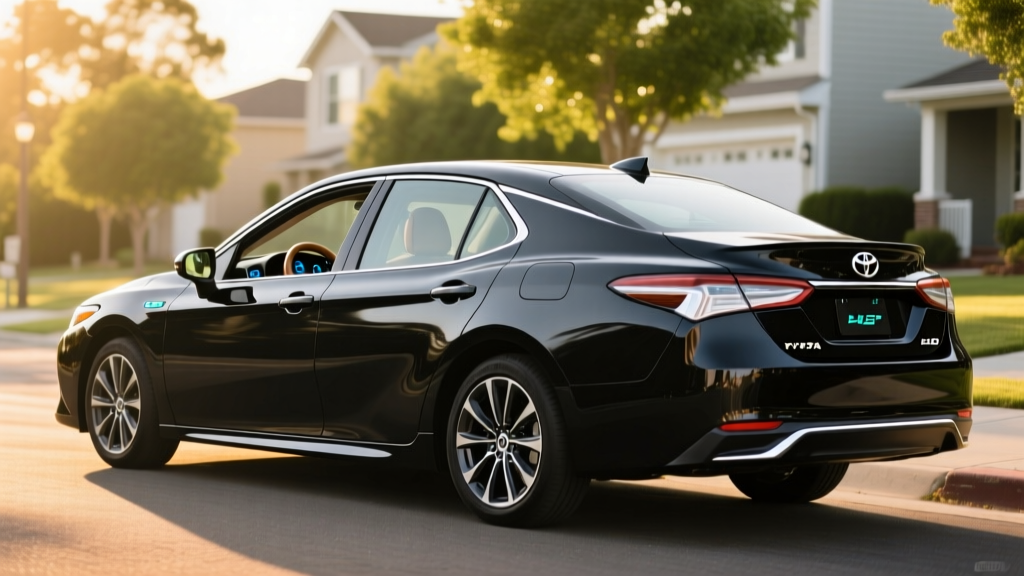
The 2020 Toyota Camry Hybrid LE occupies a specific niche in the electrified-vehicle landscape: a conventional hybrid (HEV) that requires zero behavioral change from its owner. No plugs, no charging apps, no range calculations. You fuel it at any gas station and let Toyota's Hybrid Synergy Drive system handle the rest. With an EPA-estimated 52 MPG combined, it remains one of the most efficient midsize sedans ever sold in the United States — and on the used market in 2026, it represents a compelling value proposition for buyers who want electrified efficiency without the infrastructure dependencies of a full EV or plug-in hybrid.
This guide covers everything a prospective buyer or current owner needs to know: exact EPA and real-world fuel economy, the hybrid powertrain architecture, battery longevity and replacement economics, and how the Camry Hybrid LE stacks up against PHEVs and BEVs for different driving lifestyles.
HEV vs PHEV vs EV: Where the Camry Hybrid LE Fits
Before examining specifications, it is essential to distinguish between the three main electrified powertrain types, because confusion here leads to costly purchasing mistakes.
Conventional Hybrid (HEV) — Camry Hybrid LE
A small battery (1.6 kWh in the Camry Hybrid) is charged exclusively through regenerative braking and the gasoline engine. No plug, no external charging. The electric motor assists the engine and enables brief low-speed electric-only driving. Fuel economy gains come from engine optimization, regenerative braking, and electric assist — not from grid electricity.
Plug-In Hybrid (PHEV) — e.g., Toyota RAV4 Prime
A larger battery (typically 13–18 kWh) that can be plugged in to charge from the grid. Provides 25–42 miles of electric-only range before the gasoline engine engages. Once the battery is depleted, it operates as a conventional hybrid. Qualifies for partial or full federal tax credits under certain conditions.
Battery Electric Vehicle (BEV) — e.g., Tesla Model 3, Hyundai Ioniq 6
No gasoline engine. Runs entirely on a large battery pack (50–100+ kWh). Requires home or public charging infrastructure. Zero tailpipe emissions but dependent on charging access and grid electricity source.
The 2020 Camry Hybrid LE is firmly in the HEV category. It cannot be plugged in, has no meaningful electric-only range beyond a few blocks at low speed, and does not qualify for the federal §30D new clean vehicle tax credit (which applies only to PHEVs and BEVs meeting battery-sourcing and MSRP requirements). This is a feature, not a limitation — it means zero charging dependency and maximum simplicity.
Fuel Economy: EPA Ratings and Real-World MPG
The headline number for the 2020 Camry Hybrid LE is its EPA-estimated fuel economy, which ranks among the best of any midsize sedan. The LE trim specifically benefits from lighter weight and lower-rolling-resistance tires compared to the SE and XLE hybrid trims.
| Metric | EPA Estimate | Real-World Expectation |
|---|---|---|
| City MPG | 51 MPG | 48–55 MPG (hybrids often exceed EPA in city due to regen braking) |
| Highway MPG | 53 MPG | 45–50 MPG (hybrids lose advantage at sustained high speed) |
| Combined MPG | 52 MPG | 47–52 MPG depending on driving mix |
| Fuel Tank Capacity | 13.2 gallons | — |
| Total Range | ~686 miles | ~600–700 miles per tank |
Why real-world city MPG can exceed the EPA sticker: Conventional hybrids recapture kinetic energy during stop-and-go driving through regenerative braking, which recharges the small battery and reduces engine load. In heavy urban traffic with frequent stops, the Camry Hybrid LE can achieve 55 MPG or higher. Conversely, sustained highway driving at 75+ MPH reduces the hybrid system's advantage because the gasoline engine runs continuously and aerodynamic drag dominates.
Cold-weather impact: Expect a 5–12% fuel economy reduction in freezing temperatures. The engine runs more frequently to maintain cabin heat and reach optimal operating temperature, reducing electric-motor assist time. In our experience, a Camry Hybrid LE that averages 52 MPG in moderate climates may drop to 46–48 MPG during sustained sub-30°F winter driving. This is modest compared to the 20–35% range loss a BEV experiences in the same conditions.
Source: EPA Fuel Economy Guide — 2020 Toyota Camry Hybrid
Powertrain Specifications and Driving Performance
The 2020 Camry Hybrid LE uses Toyota's fourth-generation Hybrid Synergy Drive, pairing a 2.5-liter four-cylinder Atkinson-cycle gasoline engine with an electric motor and a compact nickel-metal hydride (NiMH) battery pack. This is not a performance-oriented powertrain — it prioritizes efficiency and smoothness over acceleration.
| Specification | Value |
|---|---|
| Gasoline Engine | 2.5L 4-cylinder Atkinson-cycle (A25A-FXS) |
| Engine Horsepower | 176 HP @ 5,700 RPM |
| Engine Torque | 163 lb-ft @ 3,600–5,200 RPM |
| Electric Motor Output | 118 HP / 149 lb-ft |
| Net Combined System HP | 208 HP |
| Hybrid Battery | 1.6 kWh Nickel-Metal Hydride (NiMH), 244.8V nominal |
| Transmission | Electronically controlled CVT (eCVT) |
| 0–60 MPH | ~7.5 seconds |
| Drivetrain | Front-wheel drive |
| Curb Weight | ~3,472 lbs |
| EV Mode | Yes — limited to ~1 mile at speeds under 25 MPH |
The 208 combined horsepower figure is competitive with turbocharged four-cylinder rivals. The eCVT provides seamless, shift-free acceleration that feels linear rather than sporty. For highway merging and passing, the powertrain is adequate but not thrilling — the Camry Hybrid prioritizes quiet, efficient cruising over engagement.
NiMH vs Lithium-Ion note: The 2020 Camry Hybrid LE uses a nickel-metal hydride battery rather than the lithium-ion pack found in some competing hybrids and all PHEVs/BEVs. NiMH is a mature, well-understood chemistry with excellent longevity and thermal stability. It is heavier and less energy-dense than lithium-ion, but for a 1.6 kWh hybrid buffer battery, the weight penalty is negligible (approximately 100 lbs for the battery module).
Hybrid Battery Warranty, Longevity, and Replacement Cost
Hybrid battery lifespan is the single most common concern among used-hybrid buyers. The 2020 Camry Hybrid benefits from one of the strongest hybrid battery warranties in the industry, and real-world longevity data is now extensive enough to provide confidence.
Toyota Hybrid Battery Warranty Coverage
- Original warranty: 8 years / 100,000 miles (whichever comes first), transferable to subsequent owners
- California and states adopting CARB emissions standards: 10 years / 150,000 miles
- Coverage threshold: Battery must retain sufficient capacity to function within diagnostic parameters — Toyota replaces or reconditions batteries that fail diagnostic testing
- Hybrid system components: Inverter, control module, and associated electronics covered under same warranty terms
Real-world longevity data: Toyota's hybrid battery packs in the Camry and Prius lines have demonstrated exceptional durability. Taxi fleet data and owner reports indicate that many first-generation and second-generation Camry Hybrid batteries (2007–2017 models) exceed 200,000 miles before requiring replacement. The NiMH chemistry in the 2020 model is less prone to the degradation modes that affect lithium-ion cells (such as lithium plating and electrolyte decomposition). The primary failure mode for NiMH hybrid batteries is individual cell imbalance over many years, which can often be addressed through cell-level reconditioning rather than full pack replacement.
Replacement cost if out of warranty:
- Toyota dealer new OEM battery: $3,000–$4,500 (parts and labor)
- Reconditioned/remanufactured battery: $1,500–$2,500
- Individual cell module replacement (specialist shops): $500–$1,200
Given that a 2020 Camry Hybrid LE in 2026 is at most six years old, most examples remain under the original 8-year/100,000-mile hybrid battery warranty. Buyers should verify warranty status through a Toyota dealer using the VIN before purchase.
Pricing, Value, and Tax Credit Eligibility
As a used vehicle in 2026, the 2020 Camry Hybrid LE does not qualify for the federal §30D new clean vehicle tax credit (up to $7,500), which applies exclusively to new PHEVs and BEVs meeting specific battery-sourcing, critical-mineral, MSRP, and buyer-income requirements under current IRS rules. It also does not qualify for the used clean vehicle credit (§25E, up to $4,000), because that credit requires the vehicle to be a PHEV or BEV — conventional hybrids are excluded.
| Cost Factor | Detail |
|---|---|
| Original MSRP (2020 LE Hybrid) | $28,430 (base, including destination) |
| Typical used price (2026 market) | $18,000–$24,000 depending on mileage and condition |
| Federal tax credit (new §30D) | Not eligible — conventional HEV excluded |
| Federal used EV credit (§25E) | Not eligible — applies only to PHEVs and BEVs |
| State incentives | Varies by jurisdiction; most state incentives target PHEVs/BEVs. Check AFDC state incentive database for local programs. |
| Insurance (annual avg.) | $1,400–$1,900 depending on profile and state |
| Annual fuel cost (15,000 mi/yr @ $3.40/gal) | ~$980 |
Total cost of ownership context: Compared to a 2020 Camry gasoline LE (EPA 32 MPG combined), the Hybrid LE saves approximately $540 per year in fuel costs at 15,000 miles annually and $3.40/gallon. Over five years of ownership, that equates to roughly $2,700 in fuel savings — enough to offset the typical used-market price premium of the hybrid over the gasoline model. For high-mileage drivers (20,000+ miles/year), the payback period shortens further.
Reliability Ratings and Ownership Costs
The 2020 Camry Hybrid benefits from Toyota's long-standing reliability reputation and the inherent simplicity of the hybrid powertrain. The eCVT transmission has no traditional gears, clutch packs, or torque converter — reducing the mechanical failure points found in conventional automatic transmissions. The regenerative braking system also reduces wear on the friction brake pads, with many owners reporting original brake pads lasting 80,000–100,000 miles.
Safety and reliability benchmarks:
- IIHS rating: Top Safety Pick+ (highest honor) when equipped with specific headlight configurations. Standard Toyota Safety Sense 2.0 includes pre-collision braking, lane departure alert, dynamic radar cruise control, and automatic high beams. (IIHS 2020 Camry ratings)
- NHTSA rating: 5-Star Overall Safety Rating. (NHTSA 2020 Camry)
- Consumer Reports: The Camry Hybrid has consistently received above-average reliability scores across multiple model years.
Maintenance cost advantage: The Camry Hybrid requires no maintenance items beyond a standard gasoline vehicle — same oil change intervals (10,000 miles with synthetic), same tire rotations, same cabin air filter. There is no hybrid-specific scheduled maintenance. The hybrid battery cooling system air filter should be inspected and cleaned periodically (a $0–$20 DIY task), as a clogged filter can reduce battery cooling efficiency and accelerate degradation.
Who Should Choose the Camry Hybrid LE vs a PHEV or Full EV?
The decision between a conventional hybrid, a plug-in hybrid, and a full battery-electric vehicle depends on your charging access, driving patterns, and willingness to adapt your fueling behavior.
Choose the Camry Hybrid LE (HEV) if:
- You lack access to home or workplace charging (apartment, street parking, no garage)
- You want maximum fuel efficiency with zero behavioral change — no plugs, no apps, no planning
- You frequently drive long road trips and don't want to plan around charging stops
- You want a lower purchase price and proven long-term reliability
- Your daily commute is under 40 miles and you don't need electric-only driving
Choose a PHEV (e.g., Toyota RAV4 Prime, Hyundai Tucson PHEV) if:
- You have reliable home Level 2 charging and a commute under 30–40 miles
- You want to drive on electricity most days but need gasoline flexibility for road trips
- You want to reduce fuel consumption dramatically without range anxiety
- You can benefit from federal or state PHEV tax incentives
Choose a full BEV (e.g., Tesla Model 3, Chevrolet Equinox EV) if:
- You have reliable home charging and your daily driving is under 250 miles
- You want the lowest per-mile energy cost (electricity is typically $0.03–$0.06/mile vs $0.10–$0.15/mile for gasoline)
- You want zero tailpipe emissions and minimal drivetrain maintenance
- You qualify for the federal §30D tax credit (up to $7,500) and/or state incentives
Pros and Cons: 2020 Camry Hybrid LE at a Glance
Pros
- 52 MPG combined EPA — among the highest of any midsize sedan
- No plug required — zero charging infrastructure dependency
- Strong hybrid battery warranty (8yr/100k mi; 10yr/150k mi in CARB states)
- Proven reliability with extensive long-term ownership data
- Standard Toyota Safety Sense 2.0 with IIHS Top Safety Pick+ rating
- Regenerative braking extends brake pad life significantly
- Competitive 208 HP combined output for confident highway merging
Cons
- No federal or state EV/PHEV tax credit eligibility
- eCVT feels unengaging compared to geared transmissions
- NiMH battery is heavier and less energy-dense than lithium-ion (though inconsequential at 1.6 kWh)
- EV mode limited to ~1 mile at very low speeds — essentially negligible
- LE trim interior materials are functional but not premium
- Highway MPG advantage narrows at sustained 75+ MPH speeds
Frequently Asked Questions
How many MPG does the 2020 Toyota Camry Hybrid LE get?
The EPA rates it at 51 city / 53 highway / 52 combined MPG. In real-world driving, expect 48–55 MPG in city conditions and 45–50 MPG on the highway. Cold weather reduces fuel economy by approximately 5–12%.
Can I plug in the 2020 Camry Hybrid LE to charge it?
No. The Camry Hybrid LE is a conventional hybrid (HEV), not a plug-in hybrid (PHEV). It has no charging port. The 1.6 kWh hybrid battery charges exclusively through regenerative braking and the gasoline engine. You fuel it at a gas station like any conventional car.
How long will the hybrid battery last, and what does replacement cost?
Toyota's NiMH hybrid batteries have demonstrated longevity of 150,000–250,000+ miles in real-world use. The battery is covered by an 8-year/100,000-mile warranty (10 years/150,000 miles in CARB states). Out-of-warranty replacement costs range from $1,500 (reconditioned) to $4,500 (new OEM from a dealer). Most 2020 models in 2026 are still within the original warranty window.
Does the 2020 Camry Hybrid LE qualify for any tax credits?
No. Federal tax credits under §30D (new vehicle, up to $7,500) and §25E (used vehicle, up to $4,000) apply only to plug-in hybrids and battery-electric vehicles. Conventional hybrids like the Camry Hybrid LE are not eligible for federal clean vehicle credits. Some states may offer minor incentives for hybrids — check your state's energy office or the AFDC state incentive database.
Is the Camry Hybrid LE better than a full EV for my situation?
If you cannot charge at home, drive more than 300 miles regularly, or want zero behavioral change, the Camry Hybrid LE is likely the better choice. If you have reliable home charging, a commute under 200 miles, and want the lowest per-mile energy cost, a full EV will save more money over time and may qualify for $7,500 in federal tax credits. The Camry Hybrid is the pragmatic choice when charging access is uncertain or when you want a proven, simple ownership experience.
What is the difference between the Camry Hybrid LE, SE, and XLE trims?
All three trims share the same 208 HP hybrid powertrain and 2.5L engine. The LE achieves the highest fuel economy (52 MPG combined) due to lighter weight, smaller wheels (16-inch), and low-rolling-resistance tires. The SE and XLE use 18-inch wheels and sport-tuned or comfort-tuned suspensions, which reduce fuel economy to 46 MPG combined. The XLE adds premium interior features including leather-trimmed seats and a larger infotainment display.
How does regenerative braking work in the Camry Hybrid?
When you lift off the accelerator or apply the brakes, the electric motor reverses its function and acts as a generator, converting kinetic energy into electricity that recharges the hybrid battery. This slows the vehicle without relying solely on the friction brakes, which is why Camry Hybrid brake pads often last 80,000–100,000 miles. The transition between regenerative and friction braking is managed automatically and is generally seamless.
The 2020 Toyota Camry Hybrid LE remains a benchmark for no-compromise hybrid efficiency. It asks nothing of its owner beyond filling up at any gas station, and in return it delivers over 50 MPG, strong reliability, and a total cost of ownership that undercuts most competitors in the midsize sedan segment. For buyers in 2026 who want electrified efficiency without the complexity of plug-in charging, it is one of the most rational choices on the used market.