Quick Verdict: The Last Full-Size Hybrid Sedan Worth Buying Used
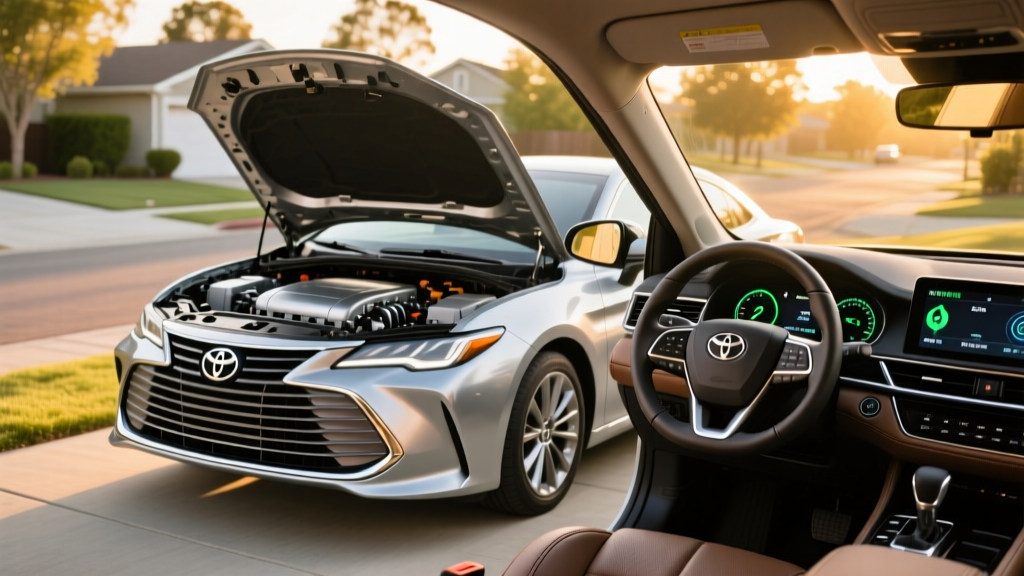
Toyota discontinued the Avalon after the 2022 model year, but the 2020 Toyota Avalon Hybrid remains one of the most compelling used hybrid sedans on the market. With an EPA-rated 44 MPG combined, a proven 2.5-liter Dynamic Force hybrid powertrain, and Toyota's 10-year/150,000-mile hybrid battery warranty, it occupies a sweet spot for buyers who want full-size comfort without the fuel bill of a traditional V6 sedan — and without the charging dependency of a plug-in hybrid or full EV.
This guide covers everything a used-car shopper or current owner needs to know: exact fuel economy data, real-world MPG expectations, powertrain specs, battery longevity, replacement costs, and whether the Avalon Hybrid still makes sense in 2026 versus a modern PHEV or BEV alternative.
EPA Fuel Economy and Real-World MPG
| Trim | City MPG | Highway MPG | Combined MPG |
|---|---|---|---|
| XLE (Hybrid) | 43 | 44 | 44 |
| Limited (Hybrid) | 43 | 43 | 43 |
Source: fueleconomy.gov
The XLE trim rides on smaller 17-inch wheels and lighter equipment, which is why it edges out the Limited by 1 MPG on the highway cycle. Both trims share the same hybrid powertrain, so the difference is purely weight and rolling resistance.
Real-World MPG: What Owners Actually See
EPA Combined: 44 MPG (XLE) / 43 MPG (Limited)
Real-World Expectation: 40–48 MPG depending on driving style and conditions
- City-dominant driving: Hybrids shine here. Expect 44–48 MPG in stop-and-go traffic where regenerative braking and electric-only low-speed operation do the heavy lifting.
- Highway cruising (70–80 mph): 38–42 MPG. Aerodynamic drag and the engine running continuously at higher speeds reduce the hybrid advantage.
- Cold weather (below 30°F): Expect a 5–10% drop (roughly 38–42 MPG combined). The engine runs more frequently to heat the cabin and bring the catalytic converter to operating temperature.
- Mountainous terrain: Highly variable. Regenerative braking on descents can partially offset the uphill consumption penalty.
The Avalon Hybrid's real-world advantage over its EPA sticker is typical of Toyota's fourth-generation hybrid system: conservative EPA testing doesn't fully capture how efficiently the system operates in urban conditions. Many owners on Fuelly report lifetime averages between 42 and 46 MPG — right around or slightly above the EPA combined figure.
Powertrain: Engine, Motor, and Combined Output
| Specification | Detail |
|---|---|
| Engine | 2.5L inline-4 Dynamic Force (A25A-FXS) |
| Engine Output | 176 hp @ 5,700 rpm / 163 lb-ft torque |
| Electric Motor | Permanent-magnet synchronous (front axle) |
| Motor Output | 118 hp / 149 lb-ft torque |
| Combined Net Horsepower | 215 hp |
| Transmission | eCVT (planetary gearset, not belt-driven) |
| Drivetrain | Front-wheel drive |
| 0–60 mph | ~7.6 seconds |
| Hybrid Battery | Nickel-metal hydride (NiMH), ~1.6 kWh gross |
The A25A-FXS engine uses Toyota's Dynamic Force architecture with both port and direct injection (D-4S), a high 14:1 compression ratio, and a long-stroke design optimized for thermal efficiency (Toyota claims 41%). This isn't a detuned economy engine — it's purpose-built for hybrid duty where the electric motor fills in the torque gaps.
The eCVT is Toyota's planetary power-split device, not a traditional belt-and-cone CVT. It has no belts, no pulleys, and no fixed gear ratios. This design is a major reason for the Avalon Hybrid's long-term reliability — there are no friction surfaces to wear in the transmission.
HEV vs. PHEV: Why the Avalon Hybrid Is a Conventional Hybrid
| Feature | HEV (Avalon Hybrid) | PHEV (e.g., Toyota RAV4 Prime) |
|---|---|---|
| Plugs in to charge? | No — charges via regenerative braking and engine | Yes — Level 1 or Level 2 AC charging |
| Electric-only range | ~1 mile at low speeds | 25–42 miles (typical) |
| Battery size | ~1.6 kWh (NiMH) | 13–18 kWh (lithium-ion) |
| DC fast charging | Not applicable | Rare (most PHEVs lack DCFC) |
| Federal tax credit (§30D) | Not eligible | Up to $7,500 (if eligible) |
| Driving after battery depletes | Operates as a hybrid indefinitely | Operates as a conventional hybrid |
The Avalon Hybrid is a self-charging conventional hybrid. You never plug it in. The 1.6 kWh NiMH battery is small by design — it buffers energy recovered from braking and coasting, then deploys it to assist acceleration or enable brief electric-only movement at low speeds. There is no electric-only range to speak of in practical terms (roughly 0.5–1 mile at under 25 mph under ideal conditions).
Battery Longevity, Warranty, and Replacement Cost
Hybrid Battery Warranty (Original)
California-emissions states (CARB states): 10 years / 150,000 miles
Federal-emissions states: 8 years / 100,000 miles
Coverage: Defects and capacity loss below a defined threshold
Since the 2020 model year, Toyota extended the hybrid battery warranty to 10 years/150,000 miles for all states — a significant upgrade from the prior 8-year/100,000-mile federal standard. This means a 2020 Avalon Hybrid purchased new has battery coverage through 2030 or 150,000 miles, whichever comes first.
How Long Do Toyota Hybrid Batteries Actually Last?
Toyota's NiMH hybrid batteries have an exceptionally well-documented track record. Data from taxi fleets, owner surveys, and repair shops consistently shows:
- Typical lifespan: 150,000–250,000+ miles before significant degradation
- Failure rate: Well under 5% within the warranty period
- Common failure mode: Individual cell imbalance rather than total pack failure
NiMH chemistry is less energy-dense than lithium-ion but is remarkably tolerant of the shallow charge/discharge cycles that hybrid systems use. The Avalon Hybrid's battery management system keeps the state of charge between roughly 40% and 80%, never fully charging or fully depleting the pack. This shallow cycling is the primary reason Toyota hybrid batteries outlast their warranty periods by wide margins.
Battery Replacement Cost
If the hybrid battery does eventually need replacement outside warranty:
- New OEM battery (Toyota dealer): $3,000–$4,000 installed
- Refurbished/reconditioned battery: $1,500–$2,500 installed
- Individual cell replacement (specialty shop): $500–$1,200 if only specific cells have failed
For a 2020 model year vehicle now entering its sixth year on the road, the hybrid battery is still well within its warranty window for most original owners. Used buyers should verify the remaining warranty by checking the in-service date with a Toyota dealer using the VIN.
Pricing, Tax Credits, and Used Market Value
The 2020 Toyota Avalon Hybrid was offered in two trims when new:
| Trim | Original MSRP (2020) | Estimated Used Price (2026) |
|---|---|---|
| XLE Hybrid | $37,050 | $22,000–$27,000 |
| Limited Hybrid | $43,050 | $26,000–$32,000 |
Used prices vary significantly based on mileage, condition, and regional demand. Hybrid sedans have held value well as buyers seek fuel-efficient alternatives without committing to EV charging infrastructure.
Federal Tax Credit Eligibility
The 2020 Toyota Avalon Hybrid does not qualify for the federal §30D clean vehicle tax credit. This credit applies only to plug-in electric vehicles (BEVs and PHEVs) that meet battery capacity, critical-mineral sourcing, MSRP caps, and buyer income limits as defined by the IRS. Conventional hybrids like the Avalon Hybrid are excluded.
However, if you purchase this vehicle used from a dealer, you may be eligible for the used clean vehicle credit (§25E) — but only if the vehicle qualifies as a plug-in electric vehicle. Since the Avalon Hybrid is a conventional HEV, it does not qualify for this credit either. The used EV credit is reserved for BEVs and PHEVs with a sale price under $25,000.
Some states offer their own incentives for hybrid purchases or for registering efficient vehicles. Check your state's energy or DMV website for current programs.
Who Should Buy the 2020 Avalon Hybrid vs. a PHEV or Full EV?
Choose the 2020 Avalon Hybrid If:
- You want a full-size, comfortable sedan with excellent fuel economy and zero lifestyle changes
- You lack access to home or workplace charging (apartment, street parking, no garage outlet)
- Your annual mileage is high (15,000+ miles/year), making the 44 MPG savings significant
- You prefer proven, low-complexity technology with a long reliability track record
- You want a used vehicle under $30,000 with predictable maintenance costs
Choose a PHEV Instead If:
- You have home charging access and a commute under 30 miles (electric-only covers daily driving)
- You want to reduce gasoline consumption dramatically while retaining a gas engine for road trips
- You qualify for the §30D tax credit and can absorb a higher purchase price (e.g., Toyota RAV4 Prime, Hyundai Tucson PHEV)
Choose a Full EV Instead If:
- You have reliable Level 2 home charging and your daily driving is under 250 miles
- You want the lowest per-mile fuel cost (electricity at $0.13/kWh ≈ $0.04/mile vs. gas at $3.50/gal ≈ $0.08/mile at 44 MPG)
- You want to eliminate oil changes and reduce brake wear (regen braking extends pad life)
- You qualify for federal and state EV incentives that narrow the price gap
The Fuel-Cost Math
At 15,000 miles per year and $3.50/gallon regular unleaded:
- Avalon Hybrid (44 MPG): ~$1,193/year in fuel
- Gas-only Avalon V6 (25 MPG combined): ~$2,100/year in fuel
- Annual savings vs. gas Avalon: ~$907/year
- 5-year savings: ~$4,535
That fuel savings helps offset the used-market premium the Hybrid commands over the gas-only Avalon, which typically sells for $2,000–$4,000 less at equivalent mileage.
Pros and Cons at a Glance
Pros
- 44 MPG combined EPA — real-world often matches or exceeds in city driving
- Toyota's proven hybrid system with exceptional long-term reliability data
- 10-year/150,000-mile hybrid battery warranty (still active on 2020 models)
- Spacious, quiet cabin with genuine full-size sedan comfort
- Smooth eCVT with no belt-driven CVT reliability concerns
- No plug-in required — zero lifestyle adaptation
- Standard Toyota Safety Sense P (pre-collision, lane departure, auto high beams, dynamic radar cruise)
Cons
- Discontinued after 2022 — no new models available, used-only market
- Only two hybrid trims (XLE, Limited) — no sport hybrid option
- FWD only — no AWD hybrid variant unlike the Camry Hybrid
- No federal tax credit eligibility (conventional hybrid)
- Infotainment system feels dated by 2026 standards (no wireless CarPlay on 2020 model)
- NiMH battery (not lithium-ion) — heavier and less energy-dense, though more durable
- Highway MPG drops to 38–42 in real-world 75+ mph driving
Frequently Asked Questions
How many MPG does the 2020 Toyota Avalon Hybrid get?
The EPA rates the 2020 Avalon Hybrid XLE at 43 city / 44 highway / 44 combined MPG. The Limited trim is rated at 43/43/43. In real-world driving, city-dominant commuters often see 44–48 MPG, while highway-heavy drivers at 75+ mph should expect 38–42 MPG.
Does the 2020 Avalon Hybrid need to be plugged in?
No. The Avalon Hybrid is a conventional hybrid (HEV), not a plug-in hybrid (PHEV). The battery charges through regenerative braking and the gasoline engine. You never plug it in — you simply drive it and refuel with gasoline like any other car.
How far can the Avalon Hybrid go on electric only?
Effectively less than 1 mile at very low speeds (under 25 mph). The 1.6 kWh NiMH battery is far too small for meaningful electric-only driving. This is by design — the hybrid system uses the battery to assist the engine and recover braking energy, not to replace the engine.
Is the 2020 Avalon Hybrid reliable?
Yes. Toyota's fourth-generation hybrid system (used in the Camry, RAV4, Highlander, and Avalon) has over two decades of field-proven reliability. The eCVT transmission has no belts or friction components to wear. The NiMH battery typically lasts 150,000–250,000+ miles. Toyota's hybrid vehicles consistently rank at or near the top of J.D. Power and Consumer Reports reliability surveys.
What does a replacement hybrid battery cost?
A new OEM replacement battery from a Toyota dealer runs approximately $3,000–$4,000 installed. Refurbished packs are available for $1,500–$2,500, and individual cell repairs can cost as little as $500–$1,200. However, most 2020 Avalon Hybrids are still within their 10-year/150,000-mile battery warranty as of 2026.
Does the 2020 Avalon Hybrid qualify for any tax credit?
No. The federal §30D clean vehicle credit applies only to plug-in electric vehicles (BEVs and PHEVs) meeting specific battery sourcing, MSRP, and buyer income requirements. Conventional hybrids are not eligible. The §25E used clean vehicle credit also requires a plug-in vehicle. Check your state for any local efficiency incentives.
How does the Avalon Hybrid compare to the Camry Hybrid?
Both use the same 2.5L Dynamic Force hybrid powertrain rated at 215 combined hp. The Camry Hybrid LE achieves a slightly higher EPA 52 MPG combined (vs. the Avalon's 44) due to lighter weight and a smaller footprint. The trade-off is interior space: the Avalon offers 16.1 cubic feet of trunk volume and significantly more rear legroom. If you prioritize fuel economy above all else, the Camry Hybrid wins. If you need full-size sedan comfort, the Avalon Hybrid is the better fit.
Is the Avalon Hybrid good for road trips?
Yes. With a 13.2-gallon fuel tank and 44 MPG combined, the Avalon Hybrid can travel approximately 580 miles between fill-ups — one of the longest ranges of any sedan sold in the US. Highway comfort is excellent, and the hybrid system seamlessly manages engine and motor operation without any driver intervention. The only caveat is that sustained 75–80 mph driving will reduce fuel economy to roughly 38–42 MPG, still yielding 500+ miles per tank.