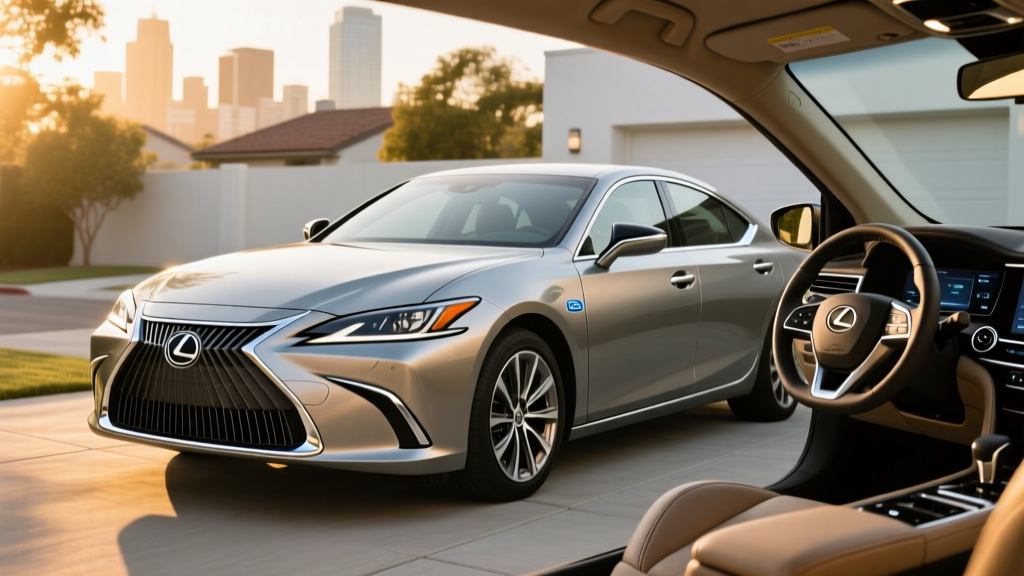
The 2020 Lexus ES 300h occupies a specific niche: a midsize luxury sedan that sips fuel without asking its owner to plug in, change driving habits, or sacrifice the cushioned ride Lexus is known for. As a conventional hybrid (HEV), it requires zero lifestyle adjustment — you fuel it like any other car and let the powertrain sort out the rest. For used-car shoppers in 2026 evaluating whether a four-to-six-year-old luxury hybrid still makes financial sense, the ES 300h demands a close look at its real-world efficiency, battery longevity, and ownership costs.
This guide breaks down the 2020 Lexus ES hybrid's powertrain, fuel economy, battery warranty, and how it stacks up against plug-in hybrids and full battery-electric vehicles for different driving profiles.
HEV vs PHEV: Where the 2020 Lexus ES 300h Fits
Before examining the numbers, it's critical to understand what the ES 300h is — and what it isn't. Lexus offered the 2020 ES in two powertrains: the gas-only ES 350 (3.5L V6) and the hybrid ES 300h (2.5L four-cylinder plus electric motor). There is no plug-in hybrid (PHEV) variant of this generation ES, and Lexus has not offered one as of the current model year.
| Feature | HEV (ES 300h) | PHEV (e.g., Toyota Prius Prime) | BEV (e.g., Tesla Model 3) |
|---|---|---|---|
| Plug-in charging required? | No | Yes (for EV range) | Yes (sole energy source) |
| Electric-only range | ~1 mile at low speed | 25–44 miles typical | 250–360+ miles |
| Battery size | 1.6 kWh (NiMH) | 13.6–18.1 kWh (Li-ion) | 60–82+ kWh (Li-ion) |
| Federal tax credit (§30D) | Not eligible | Up to $7,500 (if eligible) | Up to $7,500 (if eligible) |
| Home charger needed? | No | Recommended (Level 2) | Essential (Level 2) |
| Gas engine? | Yes (primary) | Yes (backup) | No |
The ES 300h's 1.6 kWh nickel-metal hydride (NiMH) battery is small by design. It captures energy from regenerative braking and the gas engine, then deploys it in short bursts to assist acceleration, enable low-speed electric creeping, and allow the engine to shut off at stops. You never plug it in. The trade-off versus a PHEV is clear: you get no meaningful electric-only commuting range, but you also get no charging hassle, no range anxiety, and a lower purchase price.
Powertrain and Performance Specs
The 2020 ES 300h pairs a 2.5-liter Atkinson-cycle four-cylinder engine with a permanent-magnet electric motor through Lexus's fourth-generation hybrid transaxle. Here are the key figures:
| Specification | 2020 Lexus ES 300h |
|---|---|
| Engine | 2.5L inline-4 (Atkinson cycle) |
| Engine output | 176 hp / 163 lb-ft torque |
| Electric motor output | 118 hp / 149 lb-ft torque |
| Net combined system horsepower | 215 hp |
| Hybrid battery | 1.6 kWh NiMH (244.8V) |
| Transmission | ECVT (electronically controlled CVT) |
| Drivetrain | Front-wheel drive |
| 0–60 mph | ~7.7 seconds |
| Curb weight | ~3,680 lbs |
The 215 combined horsepower is adequate rather than thrilling. The ES 300h prioritizes seamless, quiet acceleration over sportiness. The eCVT eliminates shift shock entirely — there are no fixed gears to shift through. Around town, the electric motor fills in torque instantly while the gas engine spools up, giving the sedan a responsive feel despite its modest power figures. Highway passing requires a deeper pedal press and a noticeable engine drone as the CVT holds high RPM, but it gets the job done.
Fuel Economy: EPA Ratings and Real-World MPG
The headline number for the 2020 Lexus ES hybrid is its EPA-estimated fuel economy, which remains competitive even against newer hybrid sedans:
| Driving Cycle | EPA Estimate | Real-World Expectation |
|---|---|---|
| City | 43 MPG | 44–48 MPG (hybrids excel in stop-and-go) |
| Highway | 44 MPG | 39–43 MPG (aerodynamic drag, higher speeds) |
| Combined | 44 MPG | 41–45 MPG (mixed driving) |
Source: EPA Fuel Economy Guide
Several factors explain why real-world results can deviate from the sticker:
- City driving favors hybrids. The ES 300h recaptures energy during braking and runs on electric power at low speeds. Owners with heavy urban commutes frequently report 45–48 MPG in warm weather.
- Highway driving reduces the advantage. At 70–80 mph, the gas engine does nearly all the work, and the hybrid system adds weight without proportional benefit. Expect 39–42 MPG on sustained interstate trips.
- Cold weather reduces efficiency by 5–10%. The engine runs longer to heat the cabin and warm the catalytic converter, and battery performance drops in freezing temperatures.
- Driving style matters more than in a gas car. Aggressive acceleration defeats the hybrid system's ability to keep the engine off. Smooth, anticipatory driving maximizes electric-mode usage.
With a 13.2-gallon fuel tank and 44 MPG combined, the ES 300h delivers roughly 580 miles of total range between fill-ups — a genuine advantage for road-trip-heavy owners who don't want to plan around charging stops.
Battery Longevity, Warranty, and Replacement Cost
Hybrid battery anxiety is the single most common concern for used-hybrid buyers. Here's what the data shows for the ES 300h's NiMH pack:
2020 Lexus ES 300h Hybrid Battery Warranty
- Original warranty: 8 years / 100,000 miles (hybrid battery and hybrid system components)
- California-emissions states: 10 years / 150,000 miles (CA, CT, ME, MA, NJ, NY, OR, RI, VT, WA, and states adopting CARB standards)
- Warranty trigger: Battery capacity loss causing measurable fuel-economy degradation or a hybrid-system diagnostic trouble code
- Transferable to second owner? Yes — the hybrid warranty follows the vehicle, not the original buyer
For a 2020 model in 2026, the federal 8-year/100,000-mile warranty is still active on most examples, and the 10-year/150,000-mile coverage applies in CARB states through the end of 2029 or 150,000 miles — whichever comes first. This is a significant safety net for used buyers.
Real-world battery lifespan: Toyota/Lexus NiMH hybrid batteries have an exceptionally strong track record. Data from fleet operators and long-term owner surveys (including Consumer Reports analysis) indicates that these packs routinely last 150,000–200,000+ miles before needing replacement. The NiMH chemistry degrades more gracefully than early lithium-ion packs, losing capacity slowly rather than failing catastrophically.
Replacement cost if out of warranty: A new OEM hybrid battery for the ES 300h runs approximately $3,000–$4,500 installed at a Lexus dealer. Independent hybrid specialists and refurbished battery options can reduce this to $1,500–$2,500. Given the vehicle's fuel savings versus the gas ES 350 (roughly $600–$900/year at 15,000 miles and $3.50/gallon), the battery replacement cost is typically recovered within 3–5 years of continued driving.
Does the 2020 ES 300h Qualify for Tax Credits?
No. The 2020 Lexus ES 300h is a conventional hybrid (HEV), not a plug-in vehicle. Under current IRS §30D rules, only plug-in electric vehicles (PHEVs and BEVs) with sufficient battery capacity and qualifying battery-mineral sourcing are eligible for the federal clean vehicle credit of up to $7,500. The ES 300h's 1.6 kWh battery is far below the 7 kWh minimum threshold, and the vehicle has no plug.
For used buyers, the §25E used clean vehicle credit (up to $4,000 or 30% of sale price, whichever is less) also requires a plug-in vehicle. The ES 300h does not qualify.
Some states offer their own hybrid incentives — check your state's energy office or DMV for current programs, as these change frequently and vary widely.
Pricing and Value in 2026
The 2020 ES 300h originally started at an MSRP of approximately $42,490 (base), with well-equipped Luxury and Ultra Luxury trims reaching $50,000+. In the 2026 used market, expect the following approximate ranges depending on mileage, condition, and trim:
| Trim Level | Original MSRP (2020) | Estimated Used Price (2026) |
|---|---|---|
| Base ES 300h | $42,490 | $27,000–$31,000 |
| Luxury | $46,860 | $30,000–$35,000 |
| Ultra Luxury | $51,410 | $33,000–$38,000 |
Lexus vehicles hold value well, and the ES 300h's combination of reliability reputation, low fuel cost, and luxury features keeps resale strong. Compare this to a similarly aged German luxury sedan, which typically depreciates faster and costs more to maintain.
Who Should Choose the ES 300h vs. a PHEV or Full EV?
Choose the 2020 Lexus ES 300h (HEV) if:
- You lack access to home or workplace charging (apartment, street parking)
- You drive 15,000+ miles per year, mostly highway, where PHEV EV-range is quickly exhausted
- You want a luxury sedan with minimal maintenance and proven reliability
- You take frequent long road trips and don't want to plan charging stops
- You prefer not to think about your car's powertrain — just drive and refuel
Choose a PHEV (e.g., Toyota Prius Prime, BMW 330e) if:
- You have home Level 2 charging and a short commute (under 30–40 miles round-trip)
- You want to drive mostly on electricity weekdays but take gas-powered road trips on weekends
- You qualify for the §30D federal tax credit on a new PHEV purchase
Choose a full EV (e.g., Tesla Model 3, Hyundai Ioniq 6) if:
- You have reliable home charging and want the lowest per-mile energy cost
- Your daily driving is under 250 miles and you can plan road-trip charging
- You want instant torque, zero tailpipe emissions, and minimal drivetrain maintenance
Pros and Cons at a Glance
Pros
- 44 MPG combined — genuine fuel savings with zero lifestyle change
- Outstanding reliability record; Lexus/Toyota hybrid system is industry-proven
- Quiet, refined ride quality; excellent cabin insulation
- Hybrid battery warranty still active on most 2020 examples in 2026
- Strong resale value compared to European luxury competitors
- No charging infrastructure needed
- ~580-mile total range per tank
Cons
- No plug-in option; no electric-only commuting capability
- No federal or most state tax credits for conventional hybrids
- Modest 215 hp — not a performance sedan
- eCVT engine drone under hard acceleration
- Infotainment touchpad controller (2020 model year) is frustrating versus a touchscreen
- All-wheel drive was not offered on the 2020 ES 300h
Frequently Asked Questions
How many MPG does the 2020 Lexus ES 300h hybrid get?
The EPA rates the 2020 ES 300h at 43 MPG city, 44 MPG highway, and 44 MPG combined. In real-world driving, owners typically see 41–45 MPG in mixed conditions, with city-heavy driving sometimes pushing past 46 MPG and sustained highway driving dropping to 39–42 MPG.
Can the 2020 Lexus ES 300h drive on electric power only?
Only for very short distances (roughly half a mile to one mile) at low speeds under 25 mph. This is a conventional hybrid, not a plug-in. The small 1.6 kWh battery is designed to assist the gas engine and capture braking energy, not to provide meaningful electric-only range.
Is the 2020 Lexus ES hybrid reliable?
Yes. The Lexus ES 300h uses the same Toyota Hybrid System II architecture found in millions of Prius, Camry Hybrid, and RAV4 Hybrid vehicles. It consistently earns top reliability scores from Consumer Reports and J.D. Power. The hybrid battery and system components carry an 8-year/100,000-mile warranty (10 years/150,000 miles in CARB states), which still covers most 2020 examples in 2026.
What does a hybrid battery replacement cost for the ES 300h?
An OEM replacement hybrid battery installed at a Lexus dealer costs approximately $3,000–$4,500. Refurbished or aftermarket options from independent hybrid specialists range from $1,500–$2,500. Most ES 300h batteries last 150,000–200,000+ miles based on long-term fleet and owner data.
Does the 2020 Lexus ES 300h qualify for any tax credit?
No. As a conventional hybrid (HEV) with no plug and a 1.6 kWh battery, the ES 300h does not qualify for the federal §30D new clean vehicle credit or the §25E used clean vehicle credit. Both programs require plug-in vehicles (PHEVs or BEVs) meeting battery-capacity, sourcing, and price thresholds. Check your state energy office for any local hybrid incentives.
How does the ES 300h compare to the gas-only ES 350?
The ES 350 (3.5L V6, 302 hp) is quicker (0–60 in ~6.1 seconds) and smoother under hard acceleration but gets only 25 MPG combined versus the ES 300h's 44 MPG. Over 15,000 miles per year at $3.50/gallon, the ES 300h saves roughly $800–$900 annually in fuel costs. The ES 350 costs about $2,000 less at purchase, meaning the hybrid's fuel savings typically pay back the price premium within 2–3 years.
What should I check when buying a used 2020 ES 300h?
Verify the hybrid battery health through a dealer diagnostic scan (ask for a State of Health reading). Check maintenance records for regular oil changes (the Atkinson-cycle engine is sensitive to neglected oil). Confirm the hybrid system warranty is still active (8 years/100,000 miles from original in-service date). Inspect for any outstanding recalls via NHTSA's recall lookup.
The 2020 Lexus ES 300h remains one of the most rational luxury-sedan choices on the used market in 2026. It won't win drag races or qualify for tax credits, but it delivers exactly what it promises: a quiet, comfortable, remarkably efficient daily driver with the reliability backing that makes Lexus the default choice for buyers who plan to keep their cars well past the 100,000-mile mark.