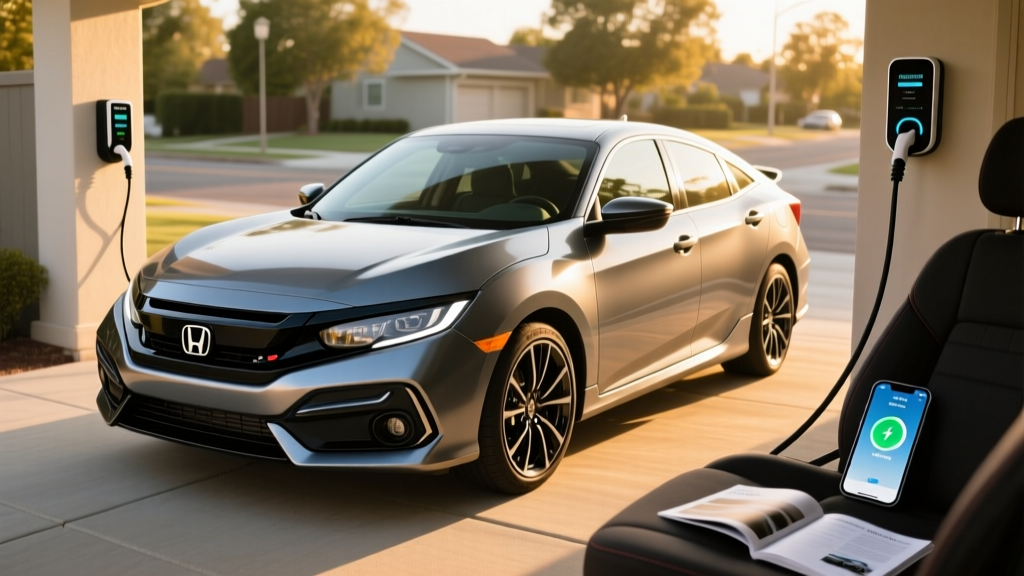
The 2025 Honda Civic Hybrid Sport occupies a specific niche that a growing number of buyers are hunting for: a compact sedan with genuine fuel economy credentials that doesn't require you to plug in, rethink your road-trip habits, or stretch your budget into luxury territory. After Honda discontinued the Civic Hybrid in the U.S. after the 2015 model year, the nameplate returned for 2025 with Honda's fourth-generation two-motor hybrid system — and the Sport trim specifically gives you the sport-tuned suspension, darker exterior accents, and a slightly more aggressive stance over the base Hybrid.
But is it the right electrified choice for you, or should you be looking at a plug-in hybrid (PHEV) or a full battery-electric vehicle (BEV) instead? This guide breaks down every number that matters — EPA MPG, real-world efficiency, powertrain output, battery warranty, pricing, and tax credit eligibility — so you can decide with data, not marketing.
HEV vs PHEV vs EV: Where the Civic Hybrid Sport Fits
Before diving into the Civic Hybrid Sport's specs, it's essential to understand the three types of electrified vehicles on the market and why Honda chose a conventional hybrid (HEV) architecture for this model.
Conventional Hybrid (HEV)
How it works: A gasoline engine paired with one or more electric motors and a small battery (typically 1–2 kWh). The battery recharges through regenerative braking and the engine — you never plug it in. The electric motor assists during acceleration and enables brief low-speed electric-only driving, but the engine does the heavy lifting.
Best for: Drivers who want better fuel economy with zero lifestyle changes. No charging infrastructure needed. Ideal for apartment dwellers, street parkers, and anyone who doesn't have reliable access to a plug.
Plug-In Hybrid (PHEV)
How it works: A larger battery (typically 10–25 kWh) that you can charge from a wall outlet or charging station, giving 20–50 miles of pure electric driving before the gasoline engine kicks in. Once the battery depletes, it operates like a conventional hybrid.
Best for: Drivers with home charging access who have short commutes (under 40 miles) but still want gas-engine flexibility for road trips. PHEVs qualify for the federal §30D tax credit (up to $7,500) if they meet battery sourcing, MSRP, and income requirements.
Battery Electric Vehicle (BEV)
How it works: No gasoline engine at all. A large battery pack (50–100+ kWh) powers electric motors exclusively. Range typically 200–400+ miles per charge. Requires home Level 2 charging or reliance on public DC fast-charging networks.
Best for: Drivers with reliable home charging who want the lowest operating costs, zero tailpipe emissions, and are comfortable planning longer road trips around charging stops.
The 2025 Honda Civic Hybrid Sport is an HEV. It does not plug in. It does not have a large battery you can charge overnight. What it does offer is a meaningful MPG improvement over the gas-only Civic, seamless operation, and the simplicity of filling up at any gas station.
Powertrain and Performance Specs
Honda's fourth-generation two-motor hybrid system is the heart of the Civic Hybrid Sport. Unlike simpler belt-driven mild-hybrid setups used by some competitors, this is a full series-parallel hybrid — meaning the electric motors can drive the wheels independently of the engine, and the engine can also drive the wheels directly at highway cruising speeds for efficiency.
| Specification | 2025 Honda Civic Hybrid Sport |
|---|---|
| Powertrain Type | Series-parallel HEV (two-motor) |
| Engine | 2.0L Atkinson-cycle 4-cylinder |
| Combined System Horsepower | 200 hp |
| Combined System Torque | 232 lb-ft |
| Electric Motors | Two (one propulsion, one generator) |
| Transmission | Direct-drive (no traditional CVT/gears) |
| Drivetrain | Front-wheel drive |
| 0–60 mph (est.) | ~7.2 seconds |
| Battery Type | Lithium-ion |
| Battery Capacity | ~1.0 kWh (gross, HEV buffer) |
| Plug-In Charging | No — self-charging via regen & engine |
| Regenerative Braking | Yes, with selectable decel paddles |
The 200 hp combined output is significant — it's 42 hp more than the gas-only Civic Sport's 158-hp 2.0L engine, and the 232 lb-ft of electric torque is available immediately from low RPMs. In practice, the Hybrid Sport feels noticeably quicker off the line than its gas counterpart, particularly in city driving where electric motor torque fills in before the engine reaches its power band. Honda's direct-drive system eliminates the rubber-band effect that older CVTs suffered from, and the engine engagement is smoother than in the previous-generation Insight that this powertrain effectively replaces.
Fuel Economy: EPA Ratings vs Real-World MPG
The headline number for any hybrid buyer is fuel economy, and the Civic Hybrid Sport delivers one of the best combined ratings in the compact sedan segment.
| Driving Cycle | EPA Rating | Real-World Expectation |
|---|---|---|
| City | 50 MPG | 48–55 MPG (hybrids often exceed EPA in stop-and-go) |
| Highway | 47 MPG | 42–47 MPG (aerodynamic drag and sustained speed reduce electric assist) |
| Combined | 49 MPG | 45–52 MPG depending on driving mix |
Real-world context: Honda's two-motor system excels in city and suburban driving, where the propulsion motor handles most acceleration and the engine acts primarily as a generator. In heavy stop-and-go traffic, it's realistic to see 50–55 MPG because regenerative braking recaptures energy that a gas car would waste as heat. On the highway, however, the engine takes over direct drive at sustained speeds (above ~45 mph), and efficiency drops slightly — expect 42–45 MPG at 75 mph on flat terrain, and somewhat less in mountainous routes or headwinds.
Compared to the gas-only 2025 Civic Sport (30 city / 37 highway / 33 combined per fueleconomy.gov), the Hybrid Sport saves approximately 16 MPG combined. For a driver covering 15,000 miles annually at $3.40/gallon, that translates to roughly $500–$600 per year in fuel savings, with a payback period on the hybrid premium of roughly 2–3 years depending on trim pricing.
Total Range on a Tank: With a 12.4-gallon fuel tank and 49 MPG combined, the Civic Hybrid Sport delivers an estimated ~607 miles of total range. In real-world mixed driving, expect 550–620 miles between fill-ups. No range anxiety, no charging stops — just fewer visits to the gas station.
Pricing, Trims, and Tax Credit Eligibility
The 2025 Honda Civic Hybrid is available in two trims: the base Hybrid Sport and the Hybrid Sport Touring. Here's the pricing breakdown:
| Trim | MSRP (incl. destination) | Key Features |
|---|---|---|
| Hybrid Sport | ~$29,845 | 18" black alloy wheels, sport-tuned suspension, Honda Sensing suite, 7" touchscreen, wireless Apple CarPlay/Android Auto, heated front seats |
| Hybrid Sport Touring | ~$32,845 | All Sport features plus: Bose 12-speaker audio, 9" touchscreen, wireless phone charger, leather-trimmed seats, moonroof, low-speed braking control, traffic jam assist |
Does the Civic Hybrid Sport Qualify for a Federal Tax Credit?
No. The 2025 Honda Civic Hybrid Sport is a conventional hybrid (HEV), not a plug-in hybrid (PHEV) or battery electric vehicle (BEV). Under current IRS §30D rules, the federal Clean Vehicle Credit (up to $7,500) is available only for plug-in electric vehicles and fuel cell vehicles that meet battery component sourcing, critical mineral, MSRP cap, and buyer income requirements.
Because the Civic Hybrid Sport cannot be plugged in and has a battery capacity far below the 7 kWh minimum threshold for §30D eligibility, it does not qualify for any federal purchase incentive. Some states may offer modest rebates or HOV lane access for hybrids, but these vary widely by jurisdiction — check your state's energy office or DMV for current programs.
If you want a federal tax credit, you need a PHEV or BEV that meets ALL of these §30D requirements (2025 rules):
- Vehicle must be a PHEV (≥7 kWh battery) or BEV or fuel cell vehicle
- MSRP must not exceed $55,000 (sedans) or $80,000 (SUVs/pickups/vans)
- Buyer AGI must not exceed $150,000 (single) / $300,000 (joint)
- Battery components must meet North American manufacturing thresholds
- Critical minerals must meet U.S./FTA-country sourcing thresholds
- Credit can be transferred to the dealer at point of sale for an immediate price reduction
Battery Warranty, Reliability, and Replacement Cost
Hybrid battery longevity is consistently the top concern among first-time hybrid buyers. Here's the data:
Honda Hybrid Battery Warranty
Duration: 8 years / 100,000 miles (10 years / 150,000 miles in CARB states including California, New York, Massachusetts, and others)
Coverage: Defects in materials and workmanship, plus capacity loss below a defined threshold (typically 60–70% of original capacity)
Additional Coverage: The hybrid system components — including the electric motors, inverter, and control unit — are covered under the same warranty period
Real-world reliability data: Honda's hybrid systems have proven durable over multiple generations. The previous-generation Insight (2019–2022), which used the third-generation version of this same two-motor system, has shown minimal hybrid battery failure reports in owner forums and NHTSA complaint databases. Honda's lithium-ion hybrid batteries are significantly more robust than the nickel-metal hydride (NiMH) packs used in early 2000s hybrids, and the small capacity (~1 kWh) means the battery undergoes shallower charge-discharge cycles than a PHEV or BEV battery, reducing degradation stress.
Replacement cost if out of warranty: Based on parts pricing for Honda's current hybrid battery modules, a full hybrid battery replacement (if needed after the warranty period) is estimated at $2,000–$3,500 including labor at a dealership. Independent hybrid specialists may offer refurbished battery options for $1,200–$2,000. This is dramatically less than BEV battery replacements ($8,000–$20,000+), and the likelihood of needing replacement within the first 15 years of ownership is low based on current field data.
Who Should Choose the Civic Hybrid Sport vs a PHEV or Full EV?
The decision between an HEV, PHEV, and BEV comes down to your daily driving pattern, charging access, and budget. Here's a practical framework:
Choose the 2025 Honda Civic Hybrid Sport (HEV) if:
- You don't have access to home or workplace charging (apartment, street parking, no garage)
- You want better fuel economy with zero behavioral change — just fill up at any gas station
- Your budget is under $33,000 and you want a well-equipped compact sedan
- You drive a mix of city and highway miles and want strong real-world MPG in both
- You want the simplicity of a conventional car ownership experience with lower fuel costs
- You frequently take road trips and don't want to plan around charging infrastructure
Choose a PHEV (e.g., Toyota Prius Prime, Hyundai Ioniq PHEV) if:
- You have home charging (even a standard 120V outlet works for overnight PHEV charging)
- Your daily commute is under 40 miles round-trip — you can drive mostly on electricity
- You want to reduce gasoline consumption by 70–90% on typical days while keeping gas flexibility for road trips
- You want to qualify for the federal §30D tax credit (up to $7,500 depending on eligibility)
Choose a Full EV (e.g., Chevy Equinox EV, Tesla Model 3, Hyundai Ioniq 5) if:
- You have reliable Level 2 home charging (240V, ~$500–$1,500 installation)
- You want the lowest per-mile operating cost (electricity is typically $0.03–$0.05/mile vs $0.10–$0.14/mile for gas)
- You want zero tailpipe emissions and minimal maintenance (no oil changes, no engine)
- You're comfortable planning road trips around DC fast-charging stops
- You want the strongest federal and state incentives (up to $7,500 federal + state rebates)
Driving Impressions and Daily Ownership
The Civic Hybrid Sport's driving character is defined by its two-motor system's seamless torque delivery. In normal driving, the propulsion motor handles acceleration from a stop, and the engine remains off until higher speeds or heavier throttle demand. Honda's selectable regenerative braking paddles behind the steering wheel let you adjust deceleration intensity across four levels — the strongest setting approaches one-pedal driving in city traffic, though it won't bring the car to a complete hold like some EVs.
The Sport trim's retuned suspension with firmer damping and a slightly lower ride height gives it more composure through corners than the standard Civic, without being harsh over rough pavement. Road noise remains the Civic's most common complaint — Honda added acoustic glass and additional sound deadening for the hybrid variants, but highway drone is still more noticeable than in competitors like the Toyota Corolla Hybrid or Mazda3.
The Honda Sensing ADAS suite is standard across all Hybrid trims and includes adaptive cruise control with low-speed follow, lane-keeping assist, road departure mitigation, and traffic sign recognition. This is an SAE Level 2 driver-assist system — it supports steering and speed control but requires the driver to remain fully engaged with hands on the wheel and eyes on the road at all times. It is not a self-driving system.
Pros and Cons
Pros
- 49 MPG combined EPA — among the best in the compact sedan segment
- 200 hp combined output — noticeably quicker than the gas-only Civic
- No plug-in charging required — zero lifestyle change from a gas car
- ~607 miles of total range on a single tank
- Strong 8 yr / 100,000 mi hybrid battery warranty (10/150k in CARB states)
- Honda Sensing ADAS standard on all trims
- Proven Honda reliability and strong resale value
Cons
- No federal tax credit eligibility (HEV, not PHEV/BEV)
- Highway MPG drops to low 40s at sustained 75+ mph speeds
- Road noise still noticeable at highway speeds
- No all-wheel-drive option (FWD only)
- Hybrid premium over gas Civic Sport adds ~$2,500 to the price
- Regenerative braking doesn't achieve full one-pedal stop-and-hold
Frequently Asked Questions
How many MPG does the 2025 Honda Civic Hybrid Sport get?
The EPA rates the Civic Hybrid Sport at 50 MPG city, 47 MPG highway, and 49 MPG combined. In real-world driving, expect to see 48–55 MPG in city traffic (hybrids excel in stop-and-go) and 42–47 MPG on the highway at sustained speeds. Your actual results depend on driving style, terrain, and climate.
Does the Civic Hybrid Sport need to be plugged in?
No. The Civic Hybrid Sport is a conventional hybrid (HEV). Its small lithium-ion battery recharges through regenerative braking and the gasoline engine. You never plug it in — you simply refuel at any gas station like a conventional car.
How far can the Civic Hybrid Sport drive on electric power alone?
Unlike a PHEV, the Civic Hybrid Sport does not have a meaningful electric-only range. The electric motor can propel the car at low speeds (typically under 25 mph) for very short distances — roughly 0.5 to 1 mile in ideal conditions — but the engine engages frequently. This is normal HEV behavior; the electric motor's primary role is to assist the engine and recapture braking energy, not to provide standalone electric driving.
Is the Honda hybrid system reliable, and what does battery replacement cost?
Honda's two-motor hybrid system has demonstrated strong reliability across multiple model generations. The hybrid battery is covered by an 8-year/100,000-mile warranty (10 years/150,000 miles in CARB states). Out-of-warranty replacement is estimated at $2,000–$3,500 at a dealership, though the likelihood of needing replacement within 15 years is low based on current field data. See Honda's official specifications for full warranty details.
Does the 2025 Civic Hybrid Sport qualify for any tax credits?
The Civic Hybrid Sport does not qualify for the federal §30D Clean Vehicle Credit, which is limited to plug-in electric vehicles (PHEVs and BEVs) and fuel cell vehicles. Some states may offer small hybrid-specific incentives, HOV lane access, or reduced registration fees — check your state's energy or DMV website for current programs. Consult a tax professional for personalized eligibility guidance.
How does the Civic Hybrid Sport compare to the Toyota Corolla Hybrid?
The Corolla Hybrid (LE AWD) is rated at 50/43/47 MPG city/highway/combined and starts around $24,000, making it the more affordable option. However, the Civic Hybrid Sport offers 200 hp vs the Corolla's 138 hp, a more engaging driving experience with its sport-tuned suspension, and a more premium interior on the Sport Touring trim. The trade-off is roughly $5,000–$6,000 more in starting price for the Honda.
Is the Civic Hybrid Sport good for road trips?
Yes — this is one of the HEV's strongest advantages. With approximately 607 miles of total range, you can drive from Los Angeles to San Francisco, or New York to Washington D.C., without stopping for fuel. There's no need to plan around charging stations, and the gasoline engine provides consistent power at highway speeds without the range degradation that EVs experience in cold weather or at high speeds.
Sources: U.S. EPA fueleconomy.gov, Honda Automobiles Official Specifications, IRS Clean Vehicle Credit (§30D).