Quick Verdict: The 2020 CR-V Hybrid in 2026
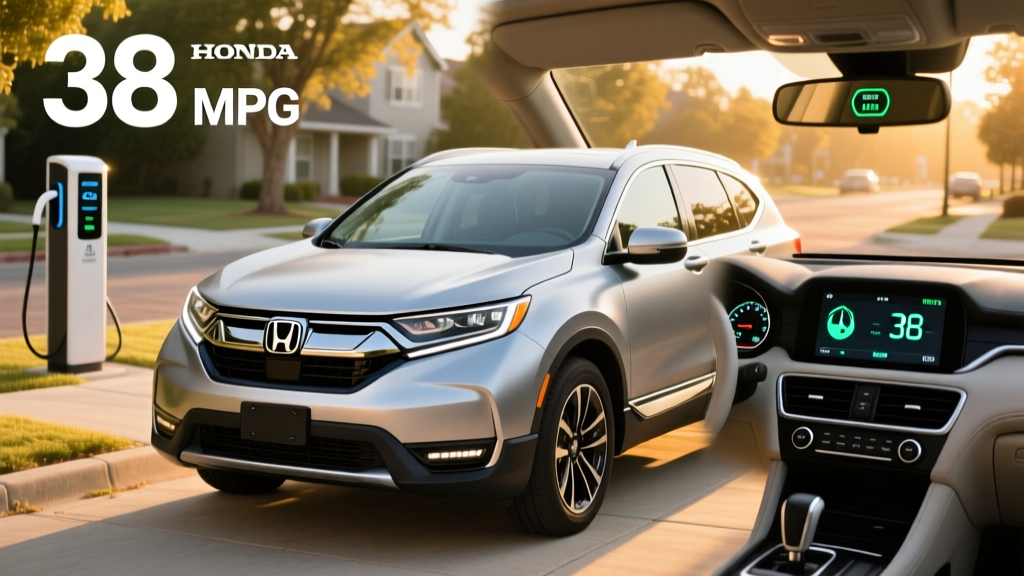
The 2020 Honda CR-V Hybrid remains one of the most sensible compact hybrid SUVs on the used market in 2026. With an EPA-rated 40 MPG combined, a proven two-motor hybrid system producing 212 horsepower, and Honda's 8-year/100,000-mile hybrid battery warranty, it offers a low-risk entry into electrified driving without any plug-in requirement. If you're shopping the used market and want SUV practicality with fuel costs closer to a compact sedan, this powertrain holds up well six years after its debut.
| Specification | 2020 Honda CR-V Hybrid |
|---|---|
| Powertrain | 2.0L Atkinson-cycle 4-cyl + 2 electric motors |
| Combined Horsepower | 212 hp |
| EPA MPG (City / Hwy / Combined) | 40 / 35 / 38 |
| Fuel Tank | 14.0 gallons |
| Total Range | ~532 miles |
| Drivetrain | AWD (standard on all hybrid trims) |
| 0-60 mph | ~7.8 seconds |
| Cargo Volume (behind rear seats) | 33.2 cu ft |
| Hybrid Battery Warranty | 8 years / 100,000 miles |
| Original MSRP (base Hybrid) | $30,560 |
| Typical Used Price (2026) | $19,000–$26,000 |
HEV vs PHEV: What the CR-V Hybrid Actually Is
The 2020 Honda CR-V Hybrid is a conventional hybrid electric vehicle (HEV) — not a plug-in hybrid. This distinction matters because it changes everything about how you own and fuel the vehicle.
| Feature | HEV (CR-V Hybrid) | PHEV (e.g., Toyota RAV4 Prime) |
|---|---|---|
| Plug-in charging? | No — charges via regenerative braking and engine | Yes — plug in for electric-only miles |
| Electric-only range | ~1-2 miles at low speed | 25-42 miles typically |
| Battery size | ~1.3 kWh (small buffer) | 13-18 kWh |
| Federal tax credit | Not eligible (§30D requires plug-in) | Up to $7,500 if criteria met (new purchase) |
| Driving experience | Seamless gas/electric blending | EV mode for commutes, gas for road trips |
Honda never produced a plug-in hybrid version of the CR-V for the US market. If you need electric-only commuting, you'd need to look at the Toyota RAV4 Prime (42 miles EV), Hyundai Tucson PHEV (33 miles EV), or a full battery-electric vehicle. The CR-V Hybrid's advantage is simplicity: you just fill it with gas and the hybrid system handles the rest, recovering energy during braking and coasting to reduce fuel consumption.
Fuel Economy: EPA Ratings vs Real-World MPG
| Driving Condition | EPA Estimate | Real-World Expectation |
|---|---|---|
| City | 40 MPG | 38–43 MPG (hybrids excel in stop-and-go) |
| Highway | 35 MPG | 32–36 MPG (less regen benefit at steady speed) |
| Combined | 38 MPG | 35–40 MPG depending on driving mix |
| Cold Weather (below 30°F) | — | 30–34 MPG (engine runs more for cabin heat) |
The 2020 CR-V Hybrid actually achieves better fuel economy in the city than on the highway — a hallmark of Honda's two-motor hybrid system. In city driving, the electric motor does most of the work at low speeds, with the gasoline engine primarily acting as a generator to keep the small battery charged. This means frequent stops and starts actually help your MPG through regenerative braking.
On the highway, the system switches to a direct-drive mode where the gasoline engine mechanically drives the front wheels through a single fixed gear ratio. Efficiency here is good for an AWD compact SUV but not exceptional — you'll see 32-36 MPG at 70-75 mph, which is still a meaningful improvement over the non-hybrid CR-V's 30 MPG combined rating.
In cold weather, expect a noticeable dip. The Atkinson-cycle 2.0L engine must run more frequently to provide cabin heat (there's no electric heater in this generation), and the battery's charge acceptance decreases in low temperatures. Owners in northern climates commonly report 30-34 MPG during winter months, rebounding to 38+ MPG in warmer weather.
For context, the non-hybrid 2020 CR-V AWD is rated at 30 MPG combined by the EPA. The hybrid's 38 MPG combined saves roughly $400-$500 per year in fuel costs at 15,000 miles driven and $3.50/gallon gas (2026 national average).
Powertrain Deep Dive: Honda's Two-Motor Hybrid System
The 2020 CR-V Hybrid uses Honda's Intelligent Multi-Mode Drive (i-MMD) system, which is fundamentally different from Toyota's planetary-gear hybrid approach. Here's how it works:
- EV Drive: At low speeds and light loads, the propulsion motor (181 hp, 232 lb-ft) drives the wheels using battery power alone. The gasoline engine is off.
- Hybrid Drive: Under moderate acceleration, the gasoline engine starts but only drives a generator motor. That generator feeds electricity to the propulsion motor, which drives the wheels. The engine speed is decoupled from vehicle speed, allowing it to run at its most efficient RPM.
- Engine Drive: At highway cruising speeds, a lock-up clutch connects the engine directly to the front wheels through a single fixed ratio. This avoids the efficiency losses of the electrical conversion path.
The result is a combined system output of 212 horsepower — 28 hp more than the non-hybrid CR-V's 1.5L turbo (184 hp). The electric motor's instant torque gives the hybrid a noticeably quicker feel in city driving, and the 0-60 mph time of approximately 7.8 seconds is competitive for the class.
Standard AWD on all hybrid trims is another advantage. Honda uses a mechanical rear driveshaft connected to the front powertrain (not a separate rear electric motor), so the rear wheels receive power when the front wheels slip. This is a conventional AWD system, not the torque-vectoring electric AWD you'd find on some competitors.
Battery Longevity, Warranty & Replacement Costs
Honda Hybrid Battery Warranty
Coverage: 8 years or 100,000 miles (whichever comes first)
In CARB states: 10 years or 150,000 miles
What's covered: Battery capacity loss below a defined threshold, defects
Transferable: Yes, warranty transfers to subsequent owners
The 2020 CR-V Hybrid's lithium-ion battery pack is relatively small — approximately 1.3 kWh total capacity — and Honda's hybrid system is conservative with how it uses the battery. The system maintains a narrow state-of-charge window (roughly 40-60% SoC during normal driving), which is one of the most effective strategies for maximizing lithium-ion battery longevity. Deep discharges and full charges are the primary drivers of battery degradation, and the i-MMD system avoids both.
Real-world data from Honda hybrid owners (including Accord Hybrid and earlier CR-V Hybrid models) suggests the battery pack commonly lasts 150,000-200,000+ miles before any noticeable capacity loss. Failures within the warranty period are uncommon based on owner forum reports and repair databases.
Replacement cost if out of warranty: A new OEM hybrid battery pack for the CR-V Hybrid typically runs $2,000-$3,500 for the part, plus $500-$1,000 in labor, for a total of approximately $2,500-$4,500. Independent hybrid battery specialists can sometimes refurbish or replace individual cells for $1,000-$2,000. For a vehicle that's now six years old on the used market, many examples will still carry some remaining factory warranty coverage — a 2020 model purchased in 2026 with under 100,000 miles would still be within the 8-year/100,000-mile window (warranty expires in 2028).
Pricing, Trims & Tax Credit Eligibility
The 2020 CR-V Hybrid was offered in three trims, all with standard AWD:
| Trim | Original MSRP | Key Features |
|---|---|---|
| EX | $30,560 | Honda Sensing suite, 7" touchscreen, Apple CarPlay/Android Auto, heated front seats |
| EX-L | $33,150 | Leather seats, power liftgate, heated steering wheel, auto-dimming mirror |
| Touring | $36,190 | Navigation, premium audio, hands-free liftgate, wireless phone charging, LED fog lights |
Federal tax credit: The 2020 CR-V Hybrid does not qualify for the IRS §30D Clean Vehicle Credit. This credit is only available for plug-in electric vehicles (PHEVs and BEVs) that meet battery capacity, critical mineral sourcing, MSRP caps, and buyer income requirements. Conventional hybrids like the CR-V Hybrid have never been eligible for the federal purchase credit.
Used EV credit (IRC §25E): Similarly, the used hybrid does not qualify for the up-to-$4,000 used clean vehicle credit, which also requires a plug-in vehicle with at least 7 kWh of battery capacity.
State incentives: A handful of states offer rebates or HOV lane access for hybrids, but these programs have largely wound down or shifted focus to plug-in vehicles. Check your state's energy or environmental agency for current availability.
Used market pricing (2026): Expect to pay $19,000-$26,000 for a 2020 CR-V Hybrid depending on trim, mileage, and condition. The EX trim with 60,000-80,000 miles typically lists around $20,000-$22,000, while low-mileage Touring models can command $24,000-$26,000. These prices reflect the broader used-SUV market softening in 2025-2026 as new EV and hybrid inventory has normalized.
Reliability & Safety Record
The 2020 CR-V Hybrid carries strong reliability marks. Honda's i-MMD system has fewer mechanical complexity points than a traditional automatic transmission (there's no multi-gear transmission — just a single fixed ratio and the electric motor), and the hybrid components have been proven across millions of Honda hybrid vehicles globally.
Common issues reported by owners and tracked by NHTSA include:
- 12V battery drain: If the vehicle sits for extended periods (2+ weeks), the 12V accessory battery can discharge. This is not the hybrid traction battery — it's the standard small battery that powers electronics. A trickle charger solves this for infrequent drivers.
- Infotainment lag: The 7-inch touchscreen in EX and EX-L trims can be slow to respond. This is a software limitation, not a failure.
- Brake feel: The transition between regenerative braking and friction braking can feel slightly abrupt when coming to a stop. This is normal for the system and not indicative of a problem.
The 2020 CR-V earned a Top Safety Pick award from IIHS when equipped with specific headlights (Touring trim), and the Honda Sensing suite (standard on all trims) includes automatic emergency braking, lane-keeping assist, adaptive cruise control, and road departure mitigation.
Who Should Buy the 2020 CR-V Hybrid vs Alternatives
Choose the 2020 CR-V Hybrid if:
- You want a compact SUV with 35-40 MPG without changing your fueling habits
- You don't have access to home or workplace charging (no plug needed)
- You want standard AWD for snow or rain without a fuel penalty
- You prefer a proven, simple hybrid system with low maintenance needs
- Your budget is $20,000-$26,000 on the used market
Consider a PHEV instead if:
- You have home charging and a commute under 30 miles (RAV4 Prime: 42 mi EV range)
- You want electric-only driving for daily errands with gas backup for road trips
- You're buying new and can access the $7,500 federal tax credit
Consider a full EV instead if:
- You have reliable home Level 2 charging
- Your daily driving is under 200 miles
- You want near-zero maintenance (no oil changes, no engine) and lower per-mile fuel cost
- You're eligible for the full $7,500 federal credit on a new BEV
Pros
- 40 MPG city EPA — excellent for an AWD compact SUV
- 212 hp feels quicker than the non-hybrid CR-V
- Standard AWD on every hybrid trim
- No plug-in charging required — fuel like a normal gas car
- 8-year/100,000-mile hybrid battery warranty (10yr/150k in CARB states)
- Honda Sensing ADAS suite standard on all trims
- 33.2 cu ft cargo space — competitive for the class
Cons
- Highway MPG (35) is less impressive than city (40)
- No PHEV variant available — no electric-only commuting
- No federal tax credit eligibility
- Infotainment system dated by 2026 standards
- Rear seats don't recline as much as some competitors
- CVT-like drone under hard acceleration (engine RPM decoupled from speed)
Frequently Asked Questions
How many MPG does the 2020 Honda CR-V Hybrid get?
The EPA rates it at 40 MPG city, 35 MPG highway, and 38 MPG combined. In real-world driving, expect 35-40 MPG combined depending on your driving mix. City-heavy drivers often exceed the EPA estimate, while highway-heavy drivers and cold-weather conditions bring it down to 30-35 MPG.
Does the 2020 CR-V Hybrid need to be plugged in?
No. The CR-V Hybrid is a conventional hybrid (HEV). It charges its own small battery through regenerative braking and the gasoline engine. You never plug it in — you simply fill it with gasoline like any other car.
Is there a plug-in hybrid Honda CR-V?
Honda has not offered a plug-in hybrid CR-V in the United States as of 2026. If you want a Honda PHEV, the Clarity Plug-In Hybrid was discontinued after 2021. For a compact SUV PHEV in this class, the Toyota RAV4 Prime, Hyundai Tucson PHEV, and Kia Sportage PHEV are the closest alternatives.
How long will the CR-V Hybrid battery last?
Honda's hybrid battery is designed to last the life of the vehicle under normal use. The warranty covers 8 years/100,000 miles (10 years/150,000 miles in CARB states). Real-world data from Honda hybrids suggests 150,000-200,000+ miles before any meaningful capacity loss. The conservative charge window (never fully charging or fully depleting) is key to this longevity.
What does it cost to replace the hybrid battery?
An OEM replacement hybrid battery pack runs approximately $2,500-$4,500 installed at a Honda dealer. Independent hybrid specialists can sometimes repair or refurbish the pack for $1,000-$2,000. For context, this is significantly less than a full EV battery replacement ($8,000-$20,000+), and the CR-V Hybrid's small 1.3 kWh pack is a fraction of the size.
Does the 2020 CR-V Hybrid qualify for any tax credit?
No. The federal §30D Clean Vehicle Credit and the §25E Used Clean Vehicle Credit both require a plug-in vehicle with minimum battery capacity. The CR-V Hybrid is a conventional hybrid and does not qualify for any federal purchase incentive. Some states may offer minor incentives for hybrids — check your state's energy office.
Is the 2020 CR-V Hybrid good in snow?
Yes. All hybrid trims come with standard AWD, and the hybrid system's instant electric torque provides good low-speed traction. Combined with the Honda Sensing suite and available winter tires, the CR-V Hybrid performs well in moderate snow and ice. Ground clearance is 8.2 inches, which is competitive for the compact SUV segment.
Hybrid vs PHEV vs EV — which is right for me?
If you can't charge at home, a conventional hybrid like the CR-V Hybrid is the practical choice — you get 35-40 MPG with zero behavior change. If you have home charging and a short commute, a PHEV gives you 25-42 miles of electric-only driving for daily use plus gas-engine range for road trips. If you have home charging and mostly drive under 200 miles per day, a full EV (BEV) offers the lowest operating cost and maintenance burden, with 250-350 miles of range in most 2026 models.