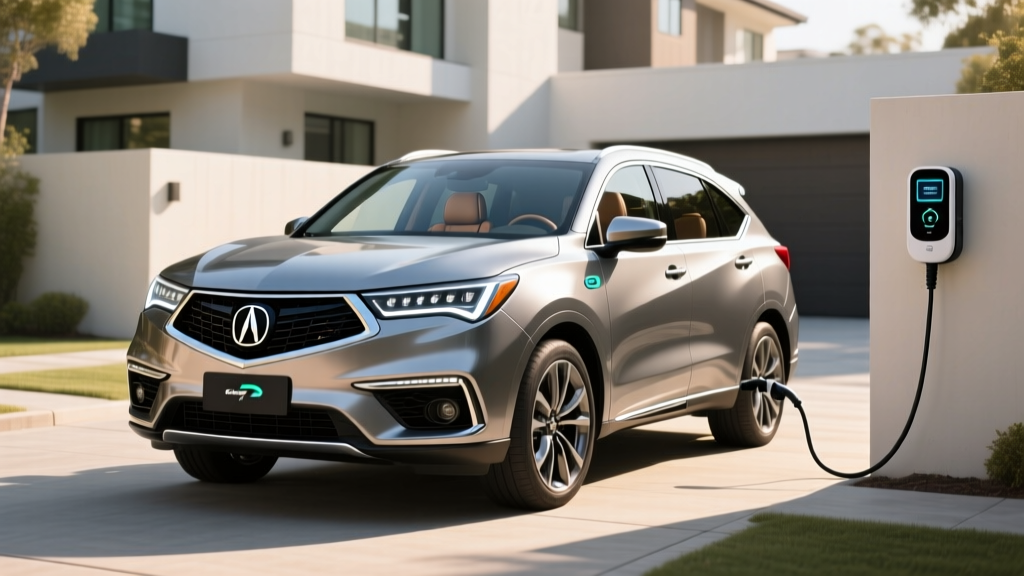
The 2020 Acura MDX Sport Hybrid occupies a specific niche in the luxury midsize SUV segment: a three-row, seven-passenger vehicle that pairs a 3.0-liter V6 with a three-motor hybrid system and Super Handling All-Wheel Drive (SH-AWD). Discontinued after the 2020 model year when Acura redesigned the MDX for 2022 without a hybrid variant, this model now lives exclusively on the used market — which makes understanding its real-world fuel economy, battery longevity, and ownership costs essential before signing on the dotted line.
This guide covers everything a used-car buyer needs to know about the 2020 MDX Sport Hybrid, from EPA fuel-economy figures to hybrid battery replacement costs, and explains where this conventional hybrid (HEV) fits relative to plug-in hybrids (PHEVs) and full battery-electric vehicles (BEVs).
HEV vs. PHEV: Where the MDX Sport Hybrid Fits
Before examining the numbers, it is critical to understand what the 2020 Acura MDX Sport Hybrid is — and what it is not. This is a conventional hybrid (HEV), meaning it generates all its electricity internally through regenerative braking and the gasoline engine. There is no plug, no charging port, and no electric-only driving range of any meaningful distance.
| Attribute | Conventional Hybrid (HEV) | Plug-In Hybrid (PHEV) | Battery Electric (BEV) |
|---|---|---|---|
| Plug-in charging? | No — self-charging | Yes — Level 1/2 | Yes — Level 1/2/DC |
| Electric-only range | ~1 mi (low-speed assist) | 20–50 mi typical | 200–400+ mi |
| Battery size | 1.3 kWh (MDX Sport Hybrid) | 10–25 kWh typical | 60–120 kWh typical |
| Gasoline required? | Yes — primary fuel | Yes — backup + highway | No |
| Federal tax credit | None (expired) | Up to $7,500 (§30D, if eligible) | Up to $7,500 (§30D, if eligible) |
The MDX Sport Hybrid's 1.3 kWh lithium-ion battery pack is far too small to provide meaningful electric-only propulsion. Instead, the electric motors supplement the V6 during acceleration, enable engine stop-start at traffic lights, and recover energy during braking. The result is improved fuel economy over the gas-only MDX — particularly in city driving — without any change to refueling habits.
Fuel Economy: EPA Ratings vs. Real-World MPG
The EPA rates the 2020 Acura MDX Sport Hybrid at 26 MPG city, 27 MPG highway, and 26 MPG combined. For comparison, the non-hybrid 2020 MDX with the 3.5-liter V6 and SH-AWD achieves 19/26/22 MPG (city/highway/combined).
| Model | City MPG | Highway MPG | Combined MPG |
|---|---|---|---|
| 2020 MDX Sport Hybrid (SH-AWD) | 26 | 27 | 26 |
| 2020 MDX 3.5L V6 (SH-AWD) | 19 | 26 | 22 |
| Improvement with hybrid | +7 MPG | +1 MPG | +4 MPG |
The hybrid system's advantage is overwhelmingly in city driving, where the electric motors handle low-speed acceleration and the engine shuts off at stops. On the highway, the V6 does most of the work and the hybrid advantage narrows to just 1 MPG.
Real-World MPG Expectations
Owner-reported data on Fuelly and similar platforms cluster around 24–27 MPG combined, with city-heavy commuters sometimes seeing 28 MPG and highway-dominant drivers dropping to 23–24 MPG. Cold weather reduces fuel economy by roughly 5–8% due to increased engine warm-up time and cabin heating demands. These figures are consistent with the EPA sticker — the MDX Sport Hybrid does not dramatically overperform or underperform its ratings the way some Toyota hybrids do in city driving.
With a 18.5-gallon fuel tank, expect a real-world range of approximately 440–500 miles between fill-ups depending on driving conditions.
Powertrain Specs: 321 HP and Three Electric Motors
The 2020 MDX Sport Hybrid uses Acura's Sport Hybrid SH-AWD powertrain, the same system found in the contemporary NSX supercar (albeit in a very different configuration). Here is the full breakdown:
| Specification | Detail |
|---|---|
| Engine | 3.0L SOHC V6, i-VTEC |
| Engine output | 257 hp @ 6,300 rpm / 218 lb-ft @ 5,000 rpm |
| Front electric motor | 47 hp / 109 lb-ft (integrated with 7-speed DCT) |
| Rear electric motors (twin) | 36 hp each / 54 lb-ft each (one per rear wheel) |
| Combined system output | 321 hp / 289 lb-ft |
| Transmission | 7-speed dual-clutch automatic (DCT) |
| Drivetrain | SH-AWD with torque vectoring rear axle |
| 0–60 mph | 6.1 seconds (Car and Driver tested) |
| Towing capacity | 3,500 lbs |
| Battery type / capacity | Lithium-ion / 1.3 kWh (approx.) |
| Curb weight | 4,593 lbs |
The twin rear motors are the engineering highlight. They independently torque-vector the rear axle, sending up to 100% of available rear torque to either the left or right wheel. This provides genuine handling benefits beyond simple all-wheel-drive traction — the MDX Sport Hybrid corners with noticeably more composure than the gas-only model, especially on wet or twisty roads.
The 7-speed dual-clutch transmission is a point of contention among owners. At low speeds, it can exhibit slight hesitation or jerkiness — a common DCT characteristic — though Acura's programming smooths this out better than most. It is not as seamless as the 9-speed automatic in the non-hybrid MDX, particularly in stop-and-go traffic.
Pricing and Tax Credit Eligibility
When new, the 2020 MDX Sport Hybrid started at $53,795 (including destination) in the base Technology trim, with the Advance trim at approximately $58,395. These prices represented a $6,000–$7,000 premium over the equivalently equipped gas-only MDX.
On the used market in early 2026, expect to pay roughly $28,000–$38,000 depending on mileage, condition, and trim level. Low-mileage Advance models command the upper end of that range.
Federal and State Tax Credits
The 2020 Acura MDX Sport Hybrid does not qualify for any federal tax credit, whether purchased new or used. Here is why:
- New-vehicle §30D credit: The federal hybrid tax credit for conventional HEVs expired years ago. Even when active, Acura/Honda had exhausted their manufacturer allocation. The current IRS §30D credit applies only to plug-in electric vehicles (PHEVs and BEVs) meeting battery-sourcing and critical-mineral requirements — not conventional hybrids.
- Used EV credit (§25E): The up-to-$4,000 used clean vehicle credit applies only to used PHEVs and BEVs, not conventional hybrids like the MDX Sport Hybrid.
- State incentives: A handful of states previously offered rebates for hybrids, but most have redirected funds toward plug-in vehicles. Check your state's energy office for any remaining programs.
If tax incentives are a priority, a used PHEV like the Chrysler Pacifica Hybrid or a used BEV may offer more financial benefit through the §25E used-vehicle credit (up to $4,000, subject to income limits and vehicle price caps).
Battery Warranty, Lifespan, and Replacement Cost
| Item | Coverage |
|---|---|
| Hybrid battery warranty (original) | 8 years / 100,000 miles (10 yr / 150,000 mi in CARB states) |
| Powertrain warranty (original) | 6 years / 70,000 miles |
| Battery replacement cost (estimated) | $3,000–$5,000 (dealer) / $2,000–$3,500 (independent hybrid specialist) |
| 12V auxiliary battery | Standard AGM, ~$200–$300 replacement |
For a 2020 model, the original 8-year/100,000-mile hybrid battery warranty is expiring or has already expired in 2028 at the latest — and many examples have already exceeded the mileage threshold. Buyers should verify remaining warranty coverage by checking the vehicle's in-service date with an Acura dealer using the VIN.
The 1.3 kWh hybrid battery in the MDX Sport Hybrid is small and relatively lightly stressed compared to larger PHEV or BEV packs. Honda/Acura's hybrid battery track record is strong: the Insight, Accord Hybrid, and CR-Z have demonstrated battery lifespans of 150,000–200,000+ miles with minimal degradation. The MDX Sport Hybrid's pack should follow a similar pattern, though the vehicle's discontinuation means long-term data specific to this model is still accumulating.
If the hybrid battery does require replacement outside warranty, the cost is substantially lower than a full EV battery swap. Independent hybrid battery shops can often refurbish or replace individual cells for $2,000–$3,500, while a new dealer-installed pack runs $3,000–$5,000. This is a manageable expense relative to the vehicle's value.
Reliability Track Record
The 2020 MDX Sport Hybrid carries generally favorable reliability ratings. Consumer Reports gives the 2020 MDX (across trims) an average to above-average reliability score, with the hybrid system itself proving trouble-free in most owner surveys. The primary complaints cluster around the dual-clutch transmission's low-speed behavior, infotainment system responsiveness (Acura's dual-screen setup from this era is widely criticized), and occasional brake feel inconsistency — a common hybrid characteristic as the system blends regenerative and friction braking.
The NHTSA awarded the 2020 MDX a 5-star overall safety rating, and the IIHS named it a Top Safety Pick+ when equipped with the optional front crash prevention system.
Who Should Buy the MDX Sport Hybrid — and Who Should Look Elsewhere
Choose the 2020 MDX Sport Hybrid if:
- You want three rows and all-wheel drive without plugging in
- Your driving is city-heavy, where the hybrid system delivers its biggest MPG gains
- You value the SH-AWD torque vectoring for all-weather confidence and handling
- You want a luxury SUV in the $30,000–$38,000 used range with reasonable fuel costs
- You do not have access to home or workplace charging (making a PHEV or BEV impractical)
Look elsewhere if:
- You want electric-only driving for short commutes (consider a PHEV like the Toyota RAV4 Prime or Volvo XC60 Recharge)
- You want federal tax credits (only PHEVs and BEVs qualify under current IRS §30D and §25E rules)
- Highway fuel economy is your top priority (the hybrid advantage over the gas MDX is minimal on the highway)
- You want the latest infotainment and driver-assist tech (the 2020 model's dual-screen system is dated)
- You plan to tow more than 3,500 lbs
MDX Sport Hybrid vs. the Electrified Alternatives
For buyers cross-shopping the used 2020 MDX Sport Hybrid, here is how it compares to nearby alternatives on fuel economy, seating, and electrification level:
| Vehicle | Type | Combined MPG / MPGe | Rows / Seats | Used Price Range (2026 est.) |
|---|---|---|---|---|
| 2020 Acura MDX Sport Hybrid | HEV | 26 MPG | 3 / 7 | $28K–$38K |
| 2020 Toyota Highlander Hybrid | HEV | 35 MPG | 3 / 7–8 | $27K–$36K |
| 2020 Lexus RX 450hL | HEV | 30 MPG | 3 / 7 | $32K–$42K |
| 2021 Toyota RAV4 Prime | PHEV | 94 MPGe / 38 MPG gas | 2 / 5 | $33K–$42K |
| 2020 Tesla Model X Long Range | BEV | 100 MPGe (325 mi range) | 2–3 / 5–7 | $38K–$52K |
The Toyota Highlander Hybrid delivers significantly better fuel economy (35 vs. 26 MPG combined) and offers similar three-row practicality, but lacks the MDX's luxury positioning and SH-AWD handling sophistication. The Lexus RX 450hL is a closer luxury peer but commands higher used prices. The RAV4 Prime offers 42 miles of electric-only range but only seats five. The Model X provides true zero-emission driving with optional third-row seating, but at a higher used price and with charging-infrastructure dependence.
Pros
- 321 hp with smooth, linear hybrid torque delivery
- SH-AWD torque vectoring provides genuine handling and traction benefits
- +4 MPG combined over gas MDX; +7 MPG in city driving
- Small hybrid battery means low eventual replacement cost
- 5-star NHTSA safety rating; IIHS Top Safety Pick+
- No plug-in charging required — works with existing gas-station habits
Cons
- No federal or state tax credit eligibility
- Dual-clutch transmission can be hesitant at low speeds
- Dated dual-screen infotainment system
- Highway MPG advantage over gas model is minimal (+1 MPG)
- Discontinued — no direct successor; long-term parts availability uncertain for hybrid-specific components
- Hybrid battery warranty expiring on most examples by 2028
Frequently Asked Questions
How many MPG does the 2020 Acura MDX Sport Hybrid get?
The EPA rates it at 26 MPG city, 27 MPG highway, and 26 MPG combined. Real-world owner reports cluster between 24–27 MPG combined, with city-heavy drivers occasionally seeing 28 MPG. Cold weather and aggressive driving can drop these figures by 5–10%.
Does the MDX Sport Hybrid need to be plugged in?
No. This is a conventional hybrid (HEV), not a plug-in hybrid (PHEV). The battery recharges through regenerative braking and the gasoline engine. You refuel exclusively at gas stations, exactly like a conventional vehicle.
Can it drive on electric power alone?
Only at very low speeds (under ~15 mph) for extremely short distances, such as creeping through a parking lot. The 1.3 kWh battery is far too small for meaningful electric-only driving. If you want 20–40 miles of electric-only range, you need a PHEV.
Is the hybrid battery reliable, and what does replacement cost?
Honda/Acura hybrid batteries have a strong longevity record, often lasting 150,000–200,000+ miles. If replacement is needed, expect $3,000–$5,000 at a dealer or $2,000–$3,500 at an independent hybrid specialist — far less than a full EV battery replacement. The original 8-year/100,000-mile warranty is nearing expiration on 2020 models.
Does the 2020 MDX Sport Hybrid qualify for any tax credit?
No. Conventional hybrids do not qualify for the federal §30D new-vehicle credit or the §25E used-vehicle credit. These credits are reserved for plug-in vehicles (PHEVs and BEVs) that meet battery-sourcing, MSRP, and buyer-income requirements. Check the IRS clean vehicle credit page for current rules.
How does it compare to the gas-only 2020 MDX?
The Sport Hybrid gains 4 MPG combined (26 vs. 22), 321 hp (vs. 290 hp), and the torque-vectoring SH-AWD system. The trade-offs are a higher original price, a dual-clutch transmission that is less smooth at low speeds, and approximately 200 lbs of additional curb weight. If your driving is mostly highway, the fuel-economy benefit is marginal (+1 MPG), and the gas-only V6 MDX may be the better used buy.
Should I buy this or a full EV?
If you have reliable home charging, drive under 300 miles per day, and want to eliminate gasoline costs, a used BEV like the Tesla Model X or a newer electric SUV will deliver far lower running costs and qualify for the up-to-$4,000 used-vehicle tax credit. If you lack charging access, frequently drive long distances in areas with sparse charging infrastructure, or need the simplicity of gas-station refueling, the MDX Sport Hybrid is a practical compromise.