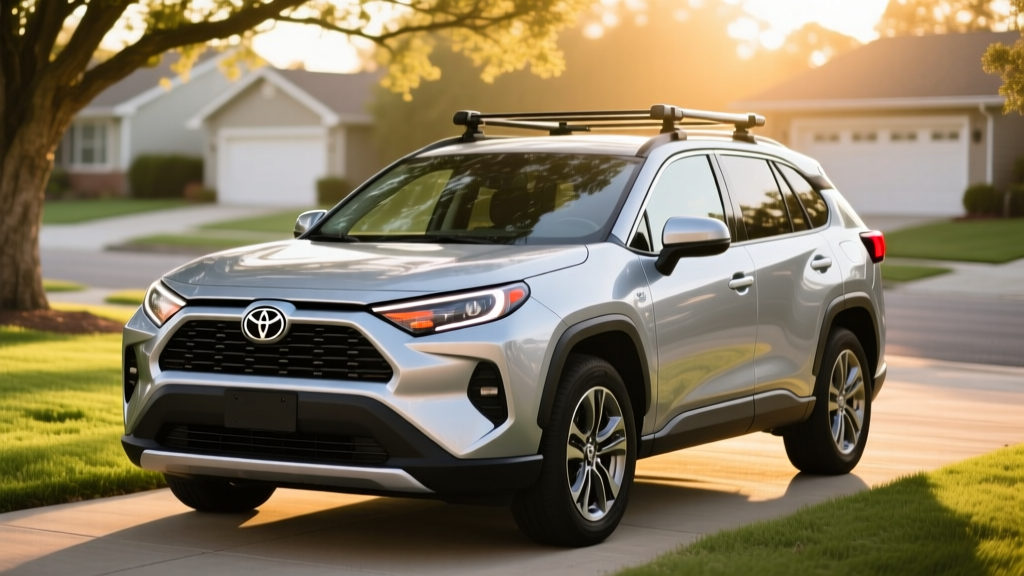
The 2019 Toyota RAV4 Hybrid LE was the launch trim of the fifth-generation RAV4 Hybrid, built on Toyota's TNGA-K platform. In 2026, it remains one of the most sought-after used compact hybrid SUVs — and for good reason. With an EPA-estimated 41 MPG combined, standard all-wheel drive, and Toyota's proven hybrid synergy drive, the LE trim delivers maximum efficiency at the lowest price point in the lineup. If you're shopping the used market, here's every number you need.
2019 RAV4 Hybrid LE Fuel Economy: EPA vs Real World
The EPA rates the 2019 RAV4 Hybrid LE at 41 MPG city / 38 MPG highway / 41 MPG combined. Unlike most gas cars, hybrids often match or exceed their city rating because regenerative braking recovers energy in stop-and-go traffic. Highway driving at sustained speeds above 70 mph leans more on the 2.5-liter gas engine, which slightly drops efficiency.
| Driving Cycle | EPA MPG | Real-World Expectation |
|---|---|---|
| City | 41 MPG | 39–43 MPG (regen-heavy routes can exceed EPA) |
| Highway | 38 MPG | 34–37 MPG (75+ mph, cold weather reduces further) |
| Combined | 41 MPG | 37–40 MPG (mixed driving, seasonal variation) |
In real-world ownership, drivers in mild climates with city-heavy commutes consistently report 40–43 MPG on forums and fueleconomy.gov user data. Winter driving in sub-freezing temperatures can drop combined economy to 35–37 MPG due to increased engine idling for cabin heat and reduced battery efficiency. This is normal for all hybrids — the nickel-metal hydride (NiMH) traction battery operates less efficiently when cold.
Hybrid (HEV) vs Plug-In Hybrid (PHEV): Which RAV4 Is This?
The 2019 RAV4 Hybrid LE is a conventional hybrid (HEV), not a plug-in hybrid. This distinction matters because the two operate fundamentally differently:
| Feature | RAV4 Hybrid LE (HEV) | RAV4 Prime (PHEV, 2021+) |
|---|---|---|
| Plug-in charging required? | No — self-charging via engine + regen | Yes — plug in for electric-only driving |
| Electric-only range | ~0.5–1 mile at low speed | 42 miles (EPA) |
| Traction battery | 1.6 kWh (NiMH) | 18.1 kWh (lithium-ion) |
| Combined horsepower | 219 hp | 302 hp |
| Combined MPG / MPGe | 41 MPG | 94 MPGe (electric) / 38 MPG (gas) |
| Federal tax credit (new) | None | $7,500 (was available at launch) |
| Model year availability | 2019–present | 2021–present |
The RAV4 Prime (PHEV) didn't arrive until the 2021 model year, so if you're specifically looking at a 2019, you're looking at the conventional hybrid. No plug, no charging cable, no range anxiety — just fill up with gas and drive. The 1.6 kWh NiMH battery is small by design: it buffers energy from regenerative braking and assists the gas engine during acceleration, but it cannot power the vehicle for meaningful distances on electricity alone.
Powertrain Specs: Engine, Motors, and Horsepower
| Engine | 2.5L Dynamic Force 4-cylinder (A25A-FXS) |
| Engine output | 176 hp @ 5,700 rpm / 163 lb-ft @ 3,600–5,200 rpm |
| Front electric motor | 88 kW (118 hp) / 149 lb-ft |
| Rear electric motor (AWD) | 40 kW (54 hp) / 89 lb-ft |
| Net combined system horsepower | 219 hp |
| Transmission | eCVT (planetary gearset, no belts) |
| Drivetrain | Electronic On-Demand AWD (standard) |
| 0–60 mph | 7.8 seconds (Motor Trend tested) |
| Towing capacity | 1,750 lbs |
| Fuel tank | 14.5 gallons |
| Total driving range | ~595 miles (EPA combined) |
The eCVT in the RAV4 Hybrid is not a belt-driven continuously variable transmission like those found in some competitors. Toyota uses a planetary gearset that seamlessly blends power from the gas engine and electric motors. This design has no belts or pulleys to wear out, contributing to the powertrain's long-term durability.
The rear electric motor provides electronic all-wheel drive without a mechanical driveshaft. It engages automatically during acceleration, slippery conditions, or when the front wheels lose traction. This system adds minimal weight and doesn't meaningfully reduce fuel economy compared to a FWD-only configuration.
Battery Warranty, Lifespan, and Replacement Cost
Toyota Hybrid Battery Warranty
Original coverage: 8 years / 100,000 miles (10 years / 150,000 miles in California and states adopting CARB emissions standards).
For a 2019 model in 2026: The 8-year/100k federal warranty has expired by time for most vehicles (7 years old). The 10-year/150k CARB warranty may still apply in applicable states if mileage is under 150,000.
Capacity retention threshold: Toyota warrants the hybrid battery against failure or significant capacity loss that triggers a check-engine light or reduces drivability. There is no published minimum State of Health percentage — coverage applies when the battery fails to function within normal parameters.
The 1.6 kWh NiMH battery in the 2019 RAV4 Hybrid is a mature, well-proven technology. Toyota has used NiMH chemistry in its hybrids since the original 1997 Prius. Real-world data from fleet operators and long-term owners shows these batteries commonly last 150,000–200,000+ miles before needing replacement. The battery is never fully charged or fully depleted in normal operation — Toyota's battery management system keeps State of Charge between roughly 40% and 80%, which dramatically extends cycle life.
If replacement becomes necessary:
- New OEM battery (Toyota dealer): $2,500–$3,500 installed
- Refurbished/remanufactured battery: $1,200–$2,000 installed
- Individual module replacement: $500–$900 (only failed modules replaced — requires a qualified hybrid technician)
For context, most 2019 RAV4 Hybrids on the used market have 50,000–90,000 miles. Battery failure at this mileage is uncommon. When shopping used, ask for a Toyota dealer hybrid battery health check, which reads the battery's internal resistance and voltage delta across modules.
Used Pricing in 2026 and Tax Credit Eligibility
The 2019 RAV4 Hybrid LE launched with an MSRP of approximately $28,350 (including destination). In the 2026 used market, expect to pay:
- 50,000–70,000 miles, clean title: $22,000–$26,000
- 70,000–100,000 miles, clean title: $18,500–$22,000
- 100,000+ miles: $15,000–$18,000
Prices vary by region, condition, and color. The Hybrid LE remains one of the best-retaining vehicles in its class due to strong demand and limited new-vehicle supply in recent years.
Federal Tax Credit Status
Under IRS §30D rules, conventional hybrids (HEVs) like the RAV4 Hybrid do not qualify for the federal plug-in electric vehicle tax credit. The credit applies only to plug-in vehicles (BEVs and PHEVs) with battery capacity of at least 7 kWh. The RAV4 Hybrid's 1.6 kWh NiMH battery falls well below this threshold.
If you purchase this vehicle used, it also does not qualify for the Used Clean Vehicle Credit (§25E), which similarly requires a plug-in vehicle with at least 7 kWh of battery capacity. No federal incentive applies to this purchase. Some states and utilities offer rebates for used hybrids — check your local programs, but these vary widely by jurisdiction.
Who Should Choose the 2019 RAV4 Hybrid LE?
Pros
- 41 MPG combined — no charging, no plug, no behavior change needed
- Standard AWD with no fuel-economy penalty vs FWD
- Proven NiMH battery with 150k–200k+ mile track record
- Spacious cargo area (37.6 cu ft behind rear seats, 69.8 cu ft folded)
- Toyota Safety Sense 2.0 standard (AEB, lane-keeping, adaptive cruise, auto high beams)
- Low cost of ownership — no timing belt, eCVT has no wear items, regenerative braking extends pad life
Cons
- No electric-only driving capability — always burns gas
- No federal tax credit eligibility (new or used)
- LE trim lacks premium features (cloth seats, no power liftgate, basic 7-inch screen)
- 1,750-lb towing capacity limits utility vs truck-based SUVs
- Road noise and engine drone under hard acceleration (eCVT characteristic)
- Used prices remain elevated due to high demand
Decision Framework: HEV vs PHEV vs BEV
Choose the 2019 RAV4 Hybrid (HEV) if: You want maximum MPG with zero lifestyle change. No home charging setup needed. You drive 12,000–18,000 miles/year in mixed city/highway conditions and want to spend ~$1,100/year on gas (at $3.20/gal, 15,000 mi/yr, 41 MPG).
Choose a RAV4 Prime (PHEV) if: You can install a Level 2 home charger, your daily commute is under 42 miles, and you want electric-only weekday driving with gas flexibility for road trips. You'll pay more upfront but save significantly on fuel if electricity is cheap in your area.
Choose a full EV (BEV) like a Tesla Model Y or Hyundai Ioniq 5 if: You have reliable home charging access, your typical trips fall within 250–300 miles, and you want zero tailpipe emissions plus lower per-mile fuel cost (~$0.04–$0.06/mi on home electricity vs $0.08–$0.10/mi for this hybrid).
Common Questions About the 2019 RAV4 Hybrid LE
How many MPG does the 2019 RAV4 Hybrid LE actually get?
The EPA rates it at 41 city / 38 highway / 41 combined. Real-world owners report 37–43 MPG combined depending on climate, driving style, and city-vs-highway mix. City-heavy commutes often exceed the EPA number thanks to regenerative braking.
Do I need to plug in the 2019 RAV4 Hybrid?
No. The 2019 RAV4 Hybrid is a conventional hybrid (HEV). It charges its own small battery through regenerative braking and the gas engine. There is no plug, no charging cable, and no electric-only driving mode of any meaningful distance. You fuel it like any other gas car.
How long will the hybrid battery last?
Toyota's NiMH hybrid batteries commonly last 150,000–200,000+ miles. The battery management system keeps the State of Charge in a narrow band (roughly 40–80%) to maximize cycle life. Battery failure before 100,000 miles is rare. Original warranty was 8 years/100,000 miles (10/150,000 in CARB states).
What does it cost to replace the hybrid battery?
A new OEM replacement runs $2,500–$3,500 installed at a Toyota dealer. Refurbished batteries cost $1,200–$2,000 installed. Individual module replacement (the most common failure mode) costs $500–$900 at a hybrid-specialist shop.
Does the 2019 RAV4 Hybrid qualify for any tax credit?
No. Conventional hybrids do not qualify for the federal §30D plug-in EV credit or the §25E used EV credit. These incentives require a plug-in vehicle with at least 7 kWh of battery capacity. Some state or utility programs may offer small rebates for used hybrids — check local resources.
Is the 2019 RAV4 Hybrid LE reliable?
Yes. The RAV4 Hybrid consistently earns above-average reliability ratings from Consumer Reports and J.D. Power. The eCVT planetary gearset has no belts or friction bands to wear out, the NiMH battery is proven over two decades of Toyota hybrid production, and the 2.5L Dynamic Force engine has shown no widespread issues. NHTSA gave the 2019 RAV4 a 5-star overall safety rating.
What's the difference between the LE and higher trims?
The LE is the base hybrid trim. It includes Toyota Safety Sense 2.0, a 7-inch touchscreen, cloth seats, and 17-inch steel wheels. The XLE adds alloy wheels, dual-zone climate, blind-spot monitoring, and a power-adjustable driver seat. The XSE adds sport-tuned suspension and 18-inch wheels. All trims share the identical 219-hp hybrid powertrain and 41 MPG combined rating — the LE is the lightest and therefore the most efficient.