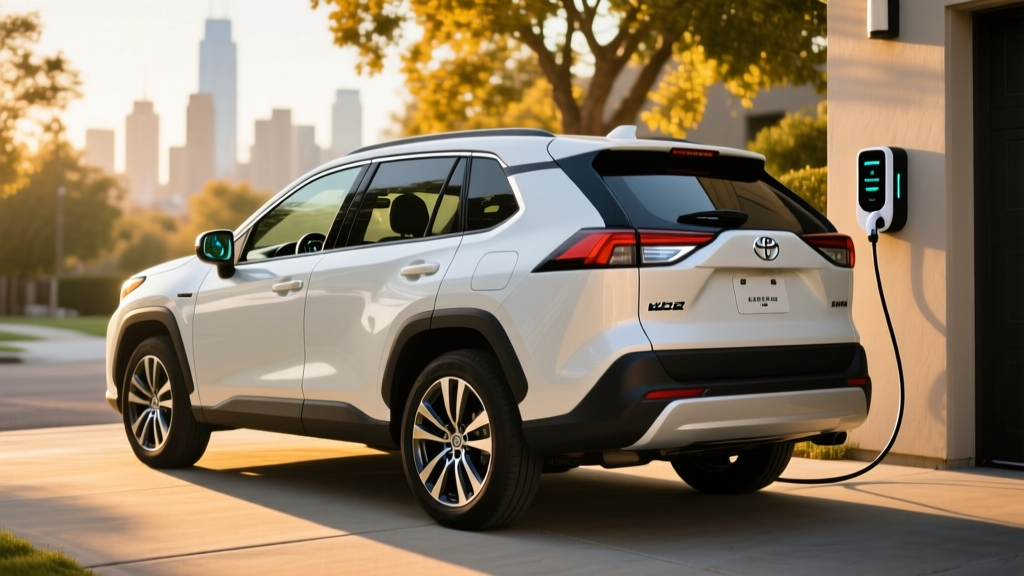
If you are shopping the used hybrid SUV market in 2026, the 2019 Toyota RAV4 Hybrid Limited remains one of the most data-backed, low-risk choices available. This was the first model year of the fifth-generation RAV4, built on Toyota's TNGA-K platform with a redesigned hybrid powertrain that bumped combined output to 219 horsepower and delivered EPA-estimated fuel economy that still holds up against brand-new competitors. With nearly seven years of real-world ownership data now accumulated, we can evaluate this SUV not on marketing promises but on actual fuel savings, battery longevity, and total cost of ownership.
HEV vs PHEV: What the 2019 RAV4 Hybrid Actually Is
Before examining the numbers, it is essential to understand what this vehicle is — and what it is not. The 2019 RAV4 Hybrid is a conventional hybrid electric vehicle (HEV). It generates its own electricity through a gasoline engine and regenerative braking. You never plug it in. There is no electric-only driving range to manage, no charging cable to deal with, and no home charger installation required.
Toyota did introduce a plug-in variant later — the RAV4 Prime (a PHEV) — starting with the 2021 model year. That vehicle offers 42 miles of electric-only range and a much larger 18.1 kWh battery. But the 2019 model year only offered the HEV. If you see a 2019 RAV4 Hybrid listed for sale, it is the self-charging conventional hybrid.
| Attribute | 2019 RAV4 Hybrid (HEV) | RAV4 Prime (PHEV, 2021+) |
|---|---|---|
| Plug-in required? | No — self-charging | Yes — plug in for EV range |
| Battery capacity | 1.6 kWh (NiMH) | 18.1 kWh (Li-ion) |
| Electric-only range | None (EV assist only) | 42 miles EPA |
| Combined horsepower | 219 hp | 302 hp |
| EPA combined MPG / MPGe | 40 MPG | 94 MPGe (EV mode) / 38 MPG (gas) |
| Federal tax credit (new) | None | Up to $7,500 (when available) |
| DC fast charging | N/A | No DC fast charge (Level 2 only) |
Fuel Economy: EPA Ratings and Real-World MPG
The 2019 RAV4 Hybrid Limited carries EPA ratings of 41 MPG city / 38 MPG highway / 40 MPG combined, per fueleconomy.gov. These figures apply across all 2019 RAV4 Hybrid trims, including the Limited, as they share the same powertrain and AWD system.
| Driving Cycle | EPA Rating | Real-World Expectation |
|---|---|---|
| City | 41 MPG | 42–45 MPG (hybrids excel in stop-and-go) |
| Highway | 38 MPG | 35–38 MPG (sustained 70+ mph reduces regen benefit) |
| Combined | 40 MPG | 38–42 MPG depending on driving mix |
| Cold weather (below 32°F) | — | 34–37 MPG (engine runs more for cabin heat) |
Real-world note: Toyota hybrids consistently outperform their EPA city ratings because regenerative braking recaptures more energy in traffic. Many owners on Fuelly and similar tracking platforms report lifetime averages between 38 and 43 MPG. However, sustained highway driving at higher speeds and cold-weather operation reduce the hybrid advantage. In winter conditions below freezing, expect a 5–10% fuel economy drop as the gasoline engine runs more frequently to provide cabin heat and maintain battery temperature.
Powertrain and Performance Specs
The 2019 RAV4 Hybrid pairs a 2.5-liter Atkinson-cycle four-cylinder gasoline engine with two electric motor-generators and an electronically controlled continuously variable transmission (eCVT). All-wheel drive comes standard on every 2019 RAV4 Hybrid — Toyota added a dedicated rear electric motor that provides torque to the rear axle when needed, without a mechanical driveshaft.
| Specification | Value |
|---|---|
| Engine | 2.5L Atkinson-cycle inline-4 |
| Engine output | 176 hp / 163 lb-ft torque |
| Front electric motor | 118 hp / 149 lb-ft |
| Rear electric motor (AWD) | 54 hp / 89 lb-ft |
| Net combined system output | 219 hp |
| Transmission | eCVT |
| Drivetrain | Electronic AWD (standard) |
| 0–60 mph | 7.8 seconds (Toyota est.) |
| Towing capacity | 1,750 lbs |
| Hybrid battery | 1.6 kWh, Nickel-Metal Hydride (NiMH) |
| Fuel tank | 14.5 gallons |
| Total driving range | ~580 miles |
The 219 combined horsepower represented a significant jump over the prior-generation RAV4 Hybrid's 194 hp. The result is confident merging and passing performance that eliminated the "underpowered hybrid" stereotype. The eCVT delivers smooth, linear acceleration without the rubber-band feel of older CVTs.
Limited Trim: What You Get at the Top of the Lineup
The Limited was the most expensive 2019 RAV4 Hybrid trim, originally stickered at $38,350 MSRP (before destination). For 2026 used-car shoppers, expect to find well-maintained examples between $22,000 and $28,000 depending on mileage, condition, and region.
Standard Limited equipment included:
- SofTex-trimmed heated and ventilated front seats
- 8-inch touchscreen with Entune Audio Plus and JBL 11-speaker system
- Wireless smartphone charging pad
- Toyota Safety Sense 2.0 (pre-collision, lane departure, dynamic radar cruise, auto high beams, lane tracing assist, road sign assist)
- Blind Spot Monitor with Rear Cross-Traffic Alert
- 18-inch alloy wheels
- Power liftgate
- LED projector headlights with auto-leveling
The Safety Sense 2.0 suite is notable because it includes lane tracing assist — a feature that provides gentle steering centering on marked highways. This is an SAE Level 1 driver-assist system, meaning it supports the driver but requires full attention and hands-on-wheel engagement at all times.
Hybrid Battery Lifespan, Warranty, and Replacement Cost
2019 RAV4 Hybrid Battery Warranty (Original):
- Duration: 8 years / 100,000 miles (10 years / 150,000 miles in California and states adopting CARB emissions standards)
- Coverage: Defects and capacity loss below a defined threshold
- Chemistry: Nickel-Metal Hydride (NiMH) — proven, durable, less energy-dense than lithium-ion
- Replacement cost (out of warranty): $3,000–$5,000 installed at a Toyota dealer; $2,000–$3,500 at independent hybrid specialists
The NiMH battery in the 2019 RAV4 Hybrid is one of the most thoroughly proven hybrid batteries on the road. Toyota has used NiMH chemistry in its hybrids since the original 1997 Prius, and real-world failure data is extensive. Most RAV4 Hybrid batteries from this generation are lasting well beyond 150,000 miles with minimal degradation. The 1.6 kWh pack is small by modern standards, but because the hybrid system never deeply cycles it (the battery management system keeps State of Charge between roughly 40% and 80%), stress on the cells is minimal.
If you are buying a used 2019 RAV4 Hybrid in 2026, the original 8-year/100,000-mile warranty has expired for most vehicles. However, the hybrid system components (inverter, motor-generators) may still carry residual coverage depending on the vehicle's in-service date and mileage. Always request a CarFax or AutoCheck report and have a hybrid-qualified mechanic perform a battery health scan using Toyota's Techstream diagnostic tool, which can report individual module voltages and internal resistance.
Battery replacement reality: Full NiMH pack replacement at a dealer typically costs $3,000–$5,000. Independent hybrid shops and refurbished pack options can reduce this to $2,000–$3,500. Individual module replacement (if only a few cells have degraded) is sometimes possible for $500–$1,500. Given the proven longevity of this pack, battery replacement should not be a deal-breaker for a well-maintained example.
Tax Credits and Incentives: The Used-Buyer Reality
When new, the 2019 RAV4 Hybrid did not qualify for the federal EV tax credit (§30D), because it is a conventional hybrid — not a plug-in electric vehicle. That has not changed. Under current IRS rules, the §30D credit applies only to battery electric vehicles (BEVs) and plug-in hybrids (PHEVs) meeting battery capacity, critical-mineral sourcing, MSRP, and buyer income requirements. The RAV4 Hybrid's 1.6 kWh NiMH battery does not meet the minimum 7 kWh threshold.
For used buyers in 2026, the Used Clean Vehicle Credit (§25E) — up to $4,000 or 30% of the sale price, whichever is less — also does not apply to this vehicle, as it requires a plug-in capable powertrain. Conventional hybrids are ineligible for both new and used federal EV credits.
Some states and local utilities offer their own incentives for hybrid purchases, but these vary widely by jurisdiction and change frequently. Check your state's energy office or utility provider for current programs. A tax professional can confirm eligibility for any credits you may find.
Who Should Choose the 2019 RAV4 Hybrid — And Who Shouldn't
Pros
- 40 MPG combined — genuine 40%+ fuel savings vs gas RAV4
- Standard AWD with no fuel economy penalty vs FWD
- Proven NiMH battery with extensive longevity data
- Toyota Safety Sense 2.0 standard on every trim
- Strong resale value and low depreciation curve
- No plug-in infrastructure needed — works everywhere
Cons
- No electric-only driving range
- No federal tax credit eligibility (new or used)
- 1,750-lb towing limit is modest for the class
- Limited trim MSRP was steep at $38,350; used prices still elevated
- Entune infotainment feels dated vs 2024+ systems
- Cargo space slightly reduced vs gas model (due to hybrid battery)
Choose the 2019 RAV4 Hybrid Limited if:
- You want maximum fuel savings without changing your driving or charging habits
- You lack access to home or workplace EV charging
- You drive a city-heavy commute where regenerative braking shines
- You want AWD for weather without the fuel penalty of a gas AWD SUV
- You plan to keep the vehicle 5+ years and value proven reliability data
Look at a full EV or PHEV instead if:
- You have reliable home Level 2 charging and want $0 gasoline commuting
- You want to access HOV lane privileges (state-dependent, usually requires PHEV or BEV)
- You want federal tax credit eligibility — consider a used RAV4 Prime (PHEV) or a BEV like the Ioniq 5 or Model Y
- Your daily driving is under 40 miles and you want electric-only operation
Ownership Economics: 5-Year Cost Snapshot
To put the fuel savings in context, here is a comparison assuming 15,000 miles/year, $3.40/gallon regular unleaded, and the EPA combined MPG for each variant:
| Vehicle | EPA Combined MPG | Gallons/Year | Annual Fuel Cost |
|---|---|---|---|
| 2019 RAV4 Hybrid (AWD) | 40 MPG | 375 | $1,275 |
| 2019 RAV4 Gas (AWD) | 28 MPG | 536 | $1,822 |
| Annual savings (Hybrid vs Gas) | — | 161 fewer gallons | ~$547/year |
Over five years, the hybrid saves roughly $2,700 in fuel compared to the gas AWD RAV4. This does not include potential savings from reduced brake wear (regenerative braking extends pad life significantly) or the higher upfront purchase price of the hybrid. On balance, the hybrid premium typically pays for itself within 3–5 years of typical driving.
Frequently Asked Questions
How many MPG does the 2019 Toyota RAV4 Hybrid Limited get?
The EPA rates it at 41 MPG city, 38 MPG highway, and 40 MPG combined. Real-world owners commonly report 38–43 MPG depending on driving conditions. City driving with frequent stops tends to yield higher numbers due to regenerative braking, while sustained highway speeds above 70 mph and cold weather reduce efficiency.
Do I need to plug in the 2019 RAV4 Hybrid?
No. The 2019 RAV4 Hybrid is a conventional hybrid (HEV). It charges its own 1.6 kWh battery through the gasoline engine and regenerative braking. There is no plug, no charging cable, and no electric-only driving range. If you want plug-in capability with electric-only miles, look at the 2021+ RAV4 Prime (PHEV).
Is the hybrid battery reliable and what does replacement cost?
Toyota's NiMH hybrid batteries are among the most proven in the industry, with many lasting 150,000–200,000+ miles. Original warranty was 8 years/100,000 miles (10/150,000 in CARB states). Out-of-warranty replacement costs $3,000–$5,000 at a dealer or $2,000–$3,500 at independent hybrid specialists. Refurbished packs and individual module repairs can cost even less.
Does the 2019 RAV4 Hybrid qualify for any tax credit?
No. Federal clean vehicle credits (§30D for new, §25E for used) require a plug-in vehicle with a battery of at least 7 kWh. The RAV4 Hybrid's 1.6 kWh NiMH pack does not qualify. Some state or utility incentives may apply to hybrids — check local programs and consult a tax professional.
Hybrid vs PHEV vs EV — which should I choose?
A conventional hybrid like this RAV4 is ideal if you want fuel savings without changing your habits or needing charging infrastructure. A PHEV (like the RAV4 Prime) suits drivers who can charge at home and want 30–40 miles of electric-only commuting with gas-engine backup. A full EV (like the Tesla Model Y or Hyundai Ioniq 5) makes sense if you have reliable home charging, want zero tailpipe emissions, and your daily driving fits within the vehicle's range. The decision often comes down to charging access and daily mileage.
How does the 2019 RAV4 Hybrid compare to newer models?
The fifth-generation RAV4 Hybrid powertrain has remained largely unchanged from 2019 through 2025, still rated at 219 hp with similar MPG figures. Newer model years added updated infotainment (Toyota Audio Multimedia with wireless CarPlay/Android Auto from 2023+), additional safety features, and minor styling updates. The core hybrid system, battery, and fuel economy are essentially identical, making the 2019 a strong value proposition on the used market.