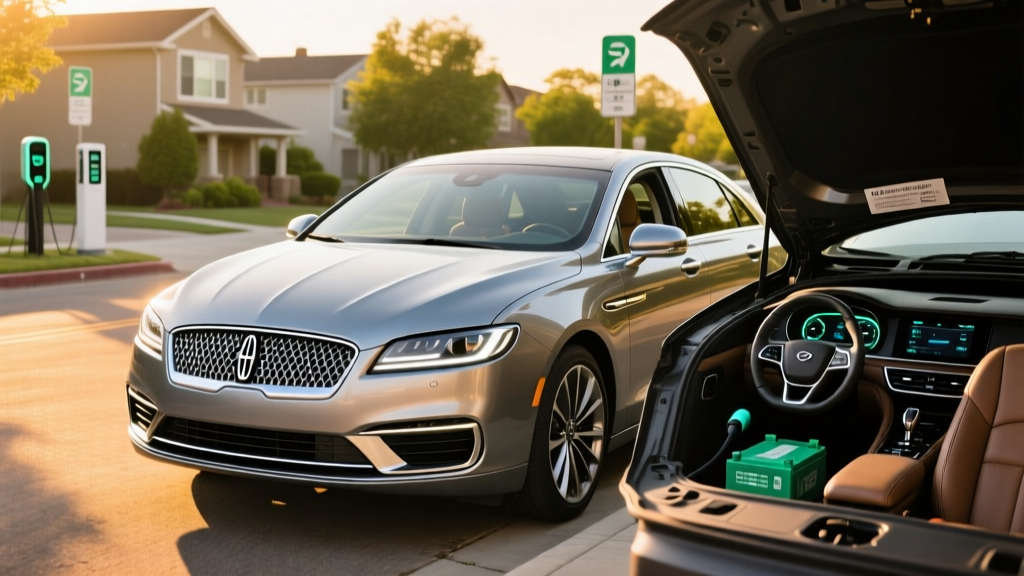
The 2019 Lincoln MKZ Hybrid occupies a specific niche: a midsize luxury sedan that sips fuel without requiring a plug, a charging station, or any change in driving habits. Lincoln discontinued the MKZ after the 2020 model year, making the 2019 model one of the last and most refined examples of this nameplate. For used-car shoppers in 2026 weighing a fuel-efficient luxury sedan against newer EVs and PHEVs, the MKZ Hybrid's 41 MPG EPA combined rating and modest used pricing demand a closer look.
This guide covers the exact specifications, real-world efficiency expectations, battery longevity data, and ownership economics you need to decide whether a used 2019 MKZ Hybrid fits your commute — or whether a plug-in hybrid or full EV makes more sense for your situation.
2019 Lincoln MKZ Hybrid Powertrain and Specifications
The 2019 MKZ Hybrid pairs a 2.0-liter Atkinson-cycle inline-four engine with an electric motor integrated into Ford's eCVT transaxle. Unlike turbocharged competitors, this powertrain prioritizes smoothness and efficiency over raw acceleration. The combined system output is 188 horsepower — adequate for merging and highway cruising, but not sporty by luxury-sedan standards.
| Specification | Value |
|---|---|
| Powertrain | 2.0L I-4 Atkinson + electric motor (eCVT) |
| Combined Horsepower | 188 hp |
| Engine Output | 141 hp @ 6,000 rpm / 129 lb-ft torque |
| Electric Motor Output | 120 hp / 166 lb-ft torque |
| Battery Chemistry | Lithium-ion (1.4 kWh usable) |
| Drivetrain | Front-wheel drive |
| EPA Fuel Economy (City / Hwy / Combined) | 42 / 39 / 41 MPG |
| Fuel Tank Capacity | 13.5 gallons |
| Total Driving Range | ~553 miles (EPA estimate) |
| 0-60 mph (estimated) | ~8.1 seconds |
| Cargo Volume | 11.1 cu ft (trunk) |
| Original Base MSRP (Hybrid Reserve) | $42,760 |
| Hybrid Battery Warranty (original) | 8 years / 100,000 miles |
A critical distinction for buyers: the 2019 MKZ Hybrid is a conventional hybrid (HEV), not a plug-in hybrid. Lincoln offered a plug-in variant called the MKZ Hybrid in earlier years, but for 2019, only the self-charging HEV was available in the U.S. market. You never plug it in — regenerative braking and the gasoline engine keep the small 1.4 kWh battery charged automatically.
Fuel Economy: EPA Ratings vs. Real-World MPG
The EPA rates the 2019 MKZ Hybrid at 42 MPG city, 39 MPG highway, and 41 MPG combined, per fueleconomy.gov. The city-highway split is typical of conventional hybrids: electric-motor assistance at low speeds and in stop-and-go traffic pushes city efficiency higher than highway numbers, where the gasoline engine does most of the work.
EPA figures are laboratory estimates. In practice, owners report:
- City / suburban driving: 40–45 MPG (many owners exceed EPA city estimates in warm weather with moderate speeds)
- Highway (70+ mph sustained): 35–39 MPG (aerodynamic drag and engine-only propulsion reduce efficiency)
- Cold weather (below 35°F): 33–38 MPG combined (engine runs more often for cabin heat, battery chemistry less efficient)
- Observed long-term average (owner forums): ~39–42 MPG combined across mixed driving
For a 15,000-mile annual commute, the MKZ Hybrid at 40 MPG real-world consumes roughly 375 gallons per year. At $3.40/gallon (2026 national average), that's approximately $1,275 in annual fuel costs — roughly half what a comparable 22 MPG gasoline luxury sedan would require.
| Vehicle Type | MPG Combined | Gallons/Year | Annual Cost |
|---|---|---|---|
| 2019 Lincoln MKZ Hybrid | 41 (EPA) / ~40 (real) | 375 | $1,275 |
| 2019 BMW 330i (gas) | 28 | 536 | $1,822 |
| 2019 Lexus ES 300h (hybrid) | 44 | 341 | $1,159 |
| 2026 Tesla Model 3 RWD (EV) | 132 MPGe | — | ~$540* |
*EV cost based on $0.14/kWh national average electricity rate. Actual costs vary significantly by utility and charging setup.
HEV vs. PHEV vs. EV: Which Powertrain Fits You?
Since the 2019 MKZ is a conventional hybrid, it's worth understanding how it compares to the other electrified options on the used and new market in 2026.
Conventional Hybrid (HEV) — Like the MKZ Hybrid
- No plug required. Gas up like any car; the hybrid system is invisible in daily use.
- Battery: Small (1–2 kWh), charged by regenerative braking and the engine.
- Best for: Drivers without home charging access, those in apartments, or anyone who wants efficiency without behavioral change.
- Trade-off: Can't drive on electric-only power for meaningful distances. Still burns gasoline for every trip.
Plug-In Hybrid (PHEV) — e.g., Toyota RAV4 Prime, Chrysler Pacifica Hybrid
- Plugs in to a standard outlet or Level 2 charger for 20–45 miles of electric-only range.
- Battery: Medium (10–20 kWh). Once depleted, operates as a conventional hybrid.
- Best for: Short-commute drivers who can charge at home but need gas-engine range for road trips.
- Trade-off: Higher purchase price; requires charging access to realize the EV benefit.
Battery Electric Vehicle (BEV) — e.g., Tesla Model 3, Hyundai Ioniq 6
- No gasoline. Runs entirely on a large battery pack (50–100+ kWh).
- Best for: Home-charging owners with predictable commutes and access to DC fast charging for road trips.
- Trade-off: Higher upfront cost (though falling); requires charging infrastructure planning; cold-weather range loss of 20–30%.
- Choose the MKZ Hybrid (HEV) if: You lack home charging, want luxury comfort, drive 12,000–20,000 miles/year, and want to spend under $25,000 on a used car.
- Choose a PHEV if: You have a garage or driveway for a Level 2 charger, commute under 35 miles round-trip, and want some electric-only driving without range anxiety.
- Choose a BEV if: You have reliable home charging, want the lowest per-mile energy cost, are eligible for federal/state EV incentives, and can absorb a higher purchase price.
Battery Longevity, Warranty, and Replacement Cost
The 2019 MKZ Hybrid uses a 1.4 kWh lithium-ion traction battery located behind the rear seats (it slightly reduces trunk pass-through but does not significantly compromise cargo space). Lincoln's original hybrid battery warranty covers 8 years or 100,000 miles from the vehicle's original in-service date, whichever comes first. In California and states that adopted CARB emissions standards (including NY, MA, NJ, and others), the hybrid battery warranty extends to 10 years or 150,000 miles.
For a 2019 model purchased new in early 2019, the standard 8-year/100,000-mile warranty expires in early 2027. If you're buying used in 2026, verify the in-service date on the Carfax and confirm remaining warranty coverage with a Lincoln dealer. CARB-state vehicles retain coverage through 2029 or 150,000 miles.
Real-world battery degradation: Ford/Lincoln hybrid batteries have a strong longevity track record. The Fusion Hybrid and MKZ Hybrid share the same powertrain architecture, and fleet data from taxis and rideshare drivers (who routinely exceed 200,000 miles) shows hybrid battery failures are uncommon before 150,000 miles. Capacity loss of 10–15% over 100,000 miles is normal and barely noticeable because the battery is so small to begin with — it's used for assist, not primary propulsion.
Replacement cost if out of warranty: A new OEM hybrid battery pack for the MKZ Hybrid runs approximately $2,500–$4,000 including parts and labor at a Lincoln dealer. Independent hybrid specialists may offer refurbished packs for $1,500–$2,500. This is dramatically less than a full EV battery replacement (which can exceed $10,000–$18,000), and the likelihood of needing one on a 2019 model with under 100,000 miles is low.
Used Pricing in 2026 and Tax Credit Eligibility
The 2019 Lincoln MKZ Hybrid was originally sold in two trims: the Hybrid Reserve (starting at $42,760) and the Hybrid Reserve II (approximately $46,610 with additional packages). A fully loaded Black Label variant could push past $52,000.
As of early 2026, used-market pricing for the 2019 MKZ Hybrid typically falls in these ranges:
- 60,000–90,000 miles, good condition: $18,000–$23,000
- 30,000–60,000 miles, excellent condition: $22,000–$27,000
- Under 30,000 miles, certified pre-owned: $26,000–$31,000 (rare finds)
Federal Tax Credit: Does the MKZ Hybrid Qualify?
No. The 2019 Lincoln MKZ Hybrid does not qualify for the federal §30D Clean Vehicle Credit. Under current IRS rules, the §30D credit applies only to new plug-in electric vehicles (BEVs and PHEVs) that meet battery-capacity, critical-mineral sourcing, MSRP cap, and buyer income requirements. Conventional hybrids like the MKZ have never qualified for this credit.
The federal Used Clean Vehicle Credit (§25E) — up to $4,000 for qualifying pre-owned plug-in vehicles — also does not apply to conventional hybrids. Some states may offer modest incentives for hybrid purchases, but these vary by jurisdiction. Check your state's environmental or energy agency for current programs.
Reliability, Safety, and Ownership Experience
The MKZ Hybrid shares its CD4 platform and powertrain with the Ford Fusion Hybrid, which has accumulated years of fleet and consumer reliability data. The hybrid system itself (eCVT, motor, battery) is among the most proven in the industry — Ford has been refining this architecture since the 2010 Fusion Hybrid.
NHTSA safety: The 2019 MKZ received a 5-Star Overall Safety Rating from NHTSA, with 5 stars in frontal crash, 5 stars in side crash, and 4 stars in rollover resistance.
IIHS ratings: The related Ford Fusion earned Top Safety Pick status. The MKZ, sharing the same structure, performs comparably, though Lincoln-specific headlight ratings varied by trim.
Common issues to inspect on a used 2019 MKZ Hybrid:
- Infotainment system (SYNC 3) responsiveness — software updates may be needed
- Suspension bushings and strut wear above 70,000 miles
- Standard brake wear (regenerative braking extends pad life significantly — many owners report 80,000+ miles on original pads)
- 12V auxiliary battery replacement (typical lifespan: 3–5 years, unrelated to the hybrid traction battery)
Maintenance costs are lower than a conventional gasoline luxury sedan: no transmission fluid changes (the eCVT is sealed), reduced brake wear from regen, and no timing belt (the Atkinson-cycle I-4 uses a chain). Expect annual maintenance of $400–$700 after the warranty period.
Pros and Cons of the 2019 MKZ Hybrid as a Used Buy
Pros
- 41 MPG EPA combined — among the best for any luxury sedan
- No plug-in required; zero behavioral change vs. a gas car
- Quiet, comfortable ride with Lincoln's signature luxury isolation
- Strong hybrid battery reliability record from Ford/Lincoln
- Low maintenance costs (no traditional transmission, reduced brake wear)
- Used pricing well below original MSRP — strong value at $18K–$27K
- 5-Star NHTSA safety rating
Cons
- 188 hp is modest — not a performance luxury sedan
- Discontinued after 2020 — Lincoln no longer supports with new parts updates
- Trunk space compromised slightly by hybrid battery (11.1 cu ft vs. gas MKZ's 15.4 cu ft)
- SYNC 3 infotainment feels dated vs. 2026 systems
- No all-wheel-drive option (FWD only)
- No federal tax credit eligibility (HEV, not PHEV/BEV)
- eCVT drone under hard acceleration (common to all hybrid transaxles)
Who Should Buy the 2019 Lincoln MKZ Hybrid?
The 2019 MKZ Hybrid makes the most sense for a specific buyer profile in 2026:
- Apartment dwellers and street-parkers who can't install a home charger but want luxury-sedan comfort with low fuel costs.
- High-mileage commuters (15,000–25,000 miles/year) where the MPG advantage saves $500–$800 annually over a gas competitor.
- Used-car budget buyers seeking a sub-$25,000 luxury sedan with low running costs and strong reliability data.
- Drivers in extreme climates (very cold or very hot) where EV range loss is a concern and a hybrid's gasoline range provides peace of mind.
It's not the right choice if you want electric-only driving for short commutes (look at a PHEV like the Toyota RAV4 Prime or a used BMW 330e), if you want the lowest possible per-mile energy cost (a used Tesla Model 3 or Chevy Bolt wins there), or if you need AWD for snow-belt driving (the Lexus ES 300h is FWD as well, but the Toyota Camry Hybrid offers AWD).
Frequently Asked Questions
How many MPG does the 2019 Lincoln MKZ Hybrid get?
The EPA rates it at 42 MPG city, 39 MPG highway, and 41 MPG combined. Real-world owners typically see 38–44 MPG depending on driving conditions, with city driving often exceeding the EPA estimate and sustained highway driving falling slightly below it.
Is the 2019 MKZ Hybrid a plug-in hybrid?
No. The 2019 MKZ Hybrid is a conventional hybrid (HEV). You never plug it in. The battery charges through regenerative braking and the gasoline engine. Lincoln offered a plug-in MKZ in earlier model years (2017–2018) with about 21 miles of electric-only range, but that variant was discontinued before the 2019 model year.
How long will the hybrid battery last?
Ford/Lincoln hybrid batteries routinely last 150,000+ miles with minimal degradation. The original warranty covers 8 years/100,000 miles (10 years/150,000 miles in CARB states). For a 2019 model, standard warranty coverage extends into 2027. Replacement cost, if needed out of warranty, is $2,500–$4,000 at a dealer.
Does the 2019 MKZ Hybrid qualify for any tax credit?
No. Federal tax credits (§30D for new vehicles, §25E for used) apply only to plug-in electric vehicles — BEVs and PHEVs. Conventional hybrids like the MKZ are not eligible. Some states may have separate hybrid incentives; check your state energy office.
Is the MKZ Hybrid reliable?
Yes. The Ford/Lincoln hybrid powertrain (shared with the Fusion Hybrid) has one of the strongest reliability records in the industry, backed by extensive fleet and taxi use. The eCVT has no traditional transmission components to fail, and regenerative braking dramatically extends brake-pad life. Major concerns are typical wear items (suspension, 12V battery, infotainment) rather than hybrid-specific failures.
How does the MKZ Hybrid compare to the Lexus ES 300h?
The 2019 Lexus ES 300h is rated at 44 MPG combined — 3 MPG better than the MKZ. The Lexus also holds resale value more strongly. However, used MKZ Hybrids are typically $3,000–$6,000 cheaper than comparable ES 300h models, making the Lincoln a better value play if you prioritize purchase price over long-term depreciation.