If you're researching the 2019 Hyundai Sonata Plug-In Hybrid on the used market in 2026, you're likely weighing whether a midsize PHEV sedan from this generation still makes financial sense against newer EVs and hybrids. This guide covers every spec that matters — EPA efficiency, real-world range, battery health expectations, charging logistics, and whether any tax incentives still apply to a used purchase.
The 2019 Sonata PHEV occupies a specific niche: a plug-in hybrid that bridges the gap between conventional hybrids (no plug, no electric-only driving) and full battery-electric vehicles (no gas engine, higher upfront cost). Understanding exactly what it can — and can't — do is essential before you sign on the dotted line.
HEV vs PHEV vs EV: Where the 2019 Sonata Plug-In Hybrid Fits
Before diving into specs, let's clarify the three electrified powertrain types, because the 2019 Sonata was sold in both conventional hybrid and plug-in hybrid forms — and they are fundamentally different vehicles.
| Feature | Conventional Hybrid (HEV) | Plug-In Hybrid (PHEV) | Battery Electric (BEV) |
|---|---|---|---|
| Plug-in charging | No — regenerative braking only | Yes — Level 1 & Level 2 | Yes — Level 1, 2, & DC fast |
| Electric-only range | None (motor assists engine) | Typically 20-40 miles | 200-400+ miles |
| Gas engine | Yes — primary power source | Yes — kicks in after battery depletes | None |
| Battery size | ~1-2 kWh | ~9-20 kWh | ~60-100+ kWh |
| Example (2019 Sonata) | Sonata Hybrid: 39 MPG combined | Sonata PHEV: 99 MPGe / 40 MPG hybrid | N/A |
The 2019 Sonata Plug-In Hybrid can be plugged in to charge its 9.8 kWh battery pack, giving it an EPA-rated 27 miles of electric-only driving. Once that battery is depleted, it operates as a conventional hybrid, using its gasoline engine and regenerative braking to achieve 40 MPG combined. This dual-mode operation is the defining characteristic of a PHEV.
Powertrain Specs: Engine, Motor, and Combined Output
| Specification | 2019 Hyundai Sonata Plug-In Hybrid |
|---|---|
| Engine | 2.0L inline-4 GDI (154 hp, 140 lb-ft) |
| Electric Motor | 50 kW permanent-magnet synchronous (67 hp, 151 lb-ft) |
| Combined System Output | 193 hp |
| Transmission | 6-speed automatic |
| Drivetrain | Front-wheel drive |
| 0-60 mph | ~7.8 seconds (est.) |
| Battery Pack | 9.8 kWh lithium-polymer |
| Onboard Charger | 3.3 kW (Level 2 AC) |
| DC Fast Charging | Not supported |
| EPA Electric-Only Range | 27 miles |
| EPA Combined Range (EV + Gas) | ~590 miles |
| Fuel Tank Capacity | 18.5 gallons |
The 2.0-liter four-cylinder is a naturally aspirated Atkinson-cycle engine tuned for efficiency rather than punch. The 50 kW electric motor fills in low-end torque, making the Sonata PHEV feel responsive around town in EV mode. The 6-speed automatic — rather than the CVT or DCT found in some competitors — delivers smooth, predictable shifts but sacrifices a small amount of efficiency.
One critical note: the 2019 Sonata PHEV does not support DC fast charging. You're limited to Level 1 (120V household outlet) and Level 2 (240V) charging. At 3.3 kW, a full charge from empty takes roughly 3 hours on Level 2, or about 9-10 hours on a standard 120V outlet.
Fuel Economy: EPA Ratings and Real-World MPG
| Mode | City | Highway | Combined |
|---|---|---|---|
| Charge-Depleting (EV Mode) | 99 MPGe (EPA) | ||
| Charge-Sustaining (Hybrid Mode) | 40 MPG | 40 MPG | 40 MPG |
| EPA Electric-Only Range | 27 miles | ||
According to fueleconomy.gov, the 2019 Sonata PHEV delivers 99 MPGe when operating on battery power and 40 MPG combined in hybrid mode. The flat city/highway split in hybrid mode (40/40) is somewhat unusual — most hybrids favor city driving where regenerative braking recovers more energy.
- EV range: Expect 22-25 miles in mixed driving in moderate temperatures. Highway speeds above 65 mph and cold weather (below 40°F) can reduce EV range to 17-20 miles.
- Hybrid MPG: Owners commonly report 38-42 MPG in hybrid mode, closely tracking the EPA estimate. City driving with frequent stops can push toward 43-45 MPG thanks to regenerative braking.
- Total range: With a full charge and full tank, ~550-600 miles is achievable.
How many MPG does the 2019 Sonata PHEV get? The short answer: 40 MPG combined in hybrid mode, plus up to 27 miles of gas-free electric driving when charged. For a midsize sedan, that's competitive with the Toyota Prius Prime (25-mile EV range in its 2019 generation) and well ahead of the conventional Sonata Hybrid's 39 MPG combined — provided you plug in regularly.
Charging Logistics: Level 1, Level 2, and Times
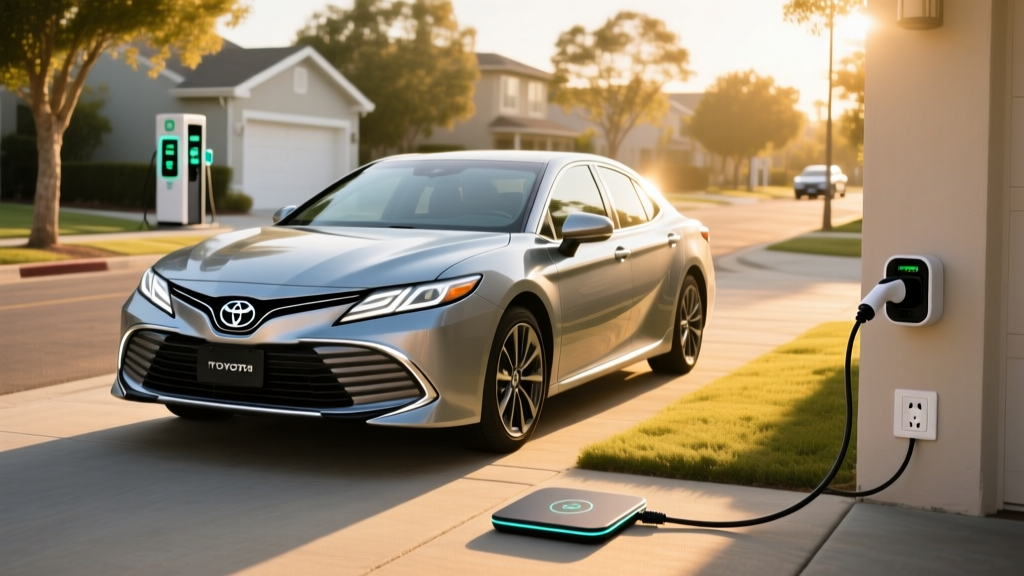
Charging the 2019 Sonata PHEV is straightforward but slow by modern standards. The 9.8 kWh battery is small, which means you don't need fast charging — but it also means the 3.3 kW onboard charger is adequate for overnight replenishment.
| Charging Level | Voltage | Power (kW) | Time (Empty to Full) | Miles of EV Range per Hour |
|---|---|---|---|---|
| Level 1 (Standard Outlet) | 120V | ~1.2 kW | ~9-10 hours | ~3 miles/hr |
| Level 2 (Home/Public AC) | 240V | 3.3 kW | ~2.5-3 hours | ~9 miles/hr |
| DC Fast Charge | N/A | Not supported | N/A | N/A |
For most PHEV owners, a standard 120V outlet in the garage is sufficient — plug in when you get home and the car is fully charged by morning. If your commute exceeds 20 miles round-trip and you want a midday top-up, a Level 2 home charger (typically $500-$800 installed) cuts charge time to under 3 hours.
The charging connector is a standard J1772 (Level 2 AC), which is compatible with virtually every public Level 2 charging station in the US. No adapter is needed for ChargePoint, EVgo Level 2, or workplace chargers.
Battery Health, Warranty, and Replacement Cost
- Coverage: 10 years / 100,000 miles (whichever comes first)
- Capacity threshold: Hyundai warrants the battery against defects and excessive capacity loss — typically defined as dropping below ~70% of original capacity
- Transferability: The 10-year/100,000-mile powertrain and battery warranty is not transferable to second owners — it drops to 5 years/60,000 miles upon resale
This is a critical point for used buyers in 2026: a 2019 Sonata PHEV purchased new had 10-year/100,000-mile battery coverage through 2029. But if you're buying it used, the remaining warranty drops to the 5-year/60,000-mile transferable portion — meaning for most 2019 models, the transferable warranty has likely expired by 2026 unless the original owner drove very few miles.
Is this hybrid reliable, and what does battery replacement cost?
The 2019 Sonata PHEV uses a lithium-polymer battery pack, which is Hyundai's preferred chemistry for its thermal stability and packaging flexibility. Real-world degradation data for Hyundai's PHEV packs is encouraging — most owners report minimal capacity loss (under 10%) in the first 5-6 years of normal use. The battery management system maintains a buffer (you never truly use 100% or 0% of the pack), which extends cell life.
If a replacement is needed out of warranty, expect to pay $3,500 to $5,500 for a refurbished or new battery pack including labor. Independent hybrid battery shops may offer reconditioned packs for $2,000-$3,000. Compare this to full EV battery replacements, which can exceed $10,000-$15,000 — the Sonata PHEV's smaller pack is significantly cheaper to replace.
For reliability context, the 2019 Sonata PHEV earned average to above-average marks from major reliability trackers. The conventional 6-speed automatic transmission is a known, proven unit without the complexity of a CVT. Common complaints center on infotainment glitches and minor electrical gremlins rather than powertrain failures.
Tax Credits and Incentives: What Applies in 2026?
When new, the 2019 Sonata Plug-In Hybrid qualified for a $4,543 federal tax credit under the pre-2023 IRS §30D rules (the credit was based on battery capacity and was less than the $7,500 maximum). That credit is no longer available for new purchases of this model year.
For used buyers in 2026, the Used Clean Vehicle Credit (IRS §25E) may apply:
- Credit amount: Up to $4,000 or 30% of the sale price, whichever is less
- Vehicle price cap: Sale price must be $25,000 or less
- Vehicle age: Must be at least 2 model years old (2019 qualifies)
- Buyer income caps: AGI ≤ $75,000 (single), $112,500 (head of household), $150,000 (joint)
- Dealer requirement: Must be purchased from a licensed dealer (private sales excluded)
- Claim frequency: Buyer cannot have claimed a used EV credit in the prior 3 years
- Point-of-sale transfer: Credit can be applied at purchase to reduce the sale price directly
At typical 2026 used pricing of $14,000-$19,000 for a 2019 Sonata PHEV, the $4,000 used credit could bring the effective cost down significantly — but only if you meet the income thresholds and purchase from a qualifying dealer. Consult IRS guidance on the Used Clean Vehicle Credit and verify eligibility with a tax professional before committing.
State incentives vary widely. Some states (California, Colorado, Massachusetts) offer additional rebates for used PHEVs, while others provide none. Check your state energy office or DMV for current programs.
Who Should Buy the 2019 Sonata PHEV (and Who Shouldn't)
- Your daily commute is under 25 miles round-trip and you can charge at home
- You want electric driving for errands but need gas flexibility for road trips
- You don't have reliable access to DC fast charging infrastructure
- You want a comfortable midsize sedan with a large trunk (13.3 cu ft) — not a crossover
- Your budget is $15,000-$20,000 and you qualify for the used EV credit
- Your commute exceeds 30 miles one-way — the EV range won't cover it, and you'll run mostly on gas
- You want modern ADAS features — the 2019 Sonata PHEV lacks the advanced driver-assistance suite of newer models
- You need DC fast charging for road-trip convenience — this car doesn't support it
- You want 35+ miles of EV range — consider a newer Prius Prime (44 miles) or RAV4 Prime (42 miles)
- You need all-wheel drive — the Sonata PHEV is front-wheel drive only
- Comfortable ride quality and spacious rear seats
- 40 MPG hybrid mode is excellent for a midsize sedan
- 27-mile EV range covers most daily errands
- Low battery replacement cost vs full EVs
- Strong value on the used market in 2026
- Potential $4,000 used federal tax credit
- No DC fast charging capability
- 3.3 kW onboard charger is slow for public Level 2 top-ups
- EV range drops significantly in cold weather and at highway speeds
- Outdated infotainment (no wireless CarPlay/Android Auto on base trim)
- ADAS features lag behind 2022+ competitors
- Transferable battery warranty likely expired by 2026
Hybrid vs PHEV vs EV: Which Fits Your Driving Pattern?
The decision between a conventional hybrid, plug-in hybrid, and full EV comes down to three variables: your daily mileage, your charging access, and your road-trip frequency.
Conventional hybrid (HEV) — Choose this if you can't plug in at home or work. The 2019 Sonata Hybrid gets 39 MPG combined without ever needing a plug. You sacrifice the 27 miles of free electric driving but gain simplicity. Best for apartment dwellers without charging access.
Plug-in hybrid (PHEV) — The 2019 Sonata PHEV is ideal if you have a garage or dedicated parking spot with a 120V outlet, your daily driving is under 25-30 miles, and you take occasional long road trips. You get near-EV running costs on weekdays and gas-car flexibility on weekends. The economics only work if you actually plug it in — a PHEV driven without charging is just a heavier, slightly less efficient hybrid.
Full EV (BEV) — Choose a BEV if your daily driving exceeds 30 miles, you have Level 2 home charging, and you're comfortable planning DC fast-charging stops on road trips. A used 2019-2021 EV like the Chevrolet Bolt (259-mile range) or Hyundai Kona Electric (258-mile range) offers far more electric range but eliminates the gas safety net entirely.
Frequently Asked Questions
How many MPG does the 2019 Hyundai Sonata Plug-In Hybrid get?
The EPA rates the 2019 Sonata PHEV at 40 MPG combined (40 city / 40 highway) in hybrid mode and 99 MPGe in electric mode. Real-world owners typically report 38-42 MPG in hybrid driving, with city routes sometimes yielding 43-45 MPG due to regenerative braking.
How far can the 2019 Sonata PHEV go on electric only?
The EPA rates it at 27 miles of electric-only range. In real-world driving, expect 22-25 miles in moderate conditions, dropping to 17-20 miles in cold weather or at sustained highway speeds above 70 mph.
Does the 2019 Sonata PHEV qualify for any tax credit in 2026?
It no longer qualifies for the new-vehicle §30D credit. However, it may qualify for the Used Clean Vehicle Credit (§25E) — up to $4,000 — if the sale price is $25,000 or less, you meet income requirements (AGI ≤ $75K single / $150K joint), and you purchase from a licensed dealer. Verify details at irs.gov.
Is the 2019 Sonata Plug-In Hybrid reliable?
Yes, generally. The powertrain uses proven components — a naturally aspirated 2.0L engine and 6-speed automatic — with no turbocharger or CVT to fail. The lithium-polymer battery pack has shown minimal degradation in real-world use. The main reliability concerns are minor infotainment and electrical issues rather than drivetrain problems.
What does a battery replacement cost for the 2019 Sonata PHEV?
Out-of-warranty replacement runs $3,500-$5,500 for a new or OEM-refurbished pack. Independent hybrid shops may offer reconditioned batteries for $2,000-$3,000. The original 10-year/100,000-mile battery warranty drops to 5 years/60,000 miles for second owners, meaning most 2019 models will have expired transferable coverage by 2026.
Can I DC fast charge the 2019 Sonata PHEV?
No. The 2019 Sonata Plug-In Hybrid only supports Level 1 (120V) and Level 2 (240V) AC charging via a J1772 connector, at a maximum rate of 3.3 kW. There is no DC fast-charging port. A full Level 2 charge takes approximately 2.5-3 hours.
Should I buy the PHEV or the regular Sonata Hybrid?
Buy the PHEV if you can charge at home and your daily driving is under 25 miles — you'll run mostly on electricity and save significantly on fuel. Buy the conventional Sonata Hybrid (39 MPG combined) if you lack charging access or regularly drive more than 40 miles daily, where the PHEV's advantage diminishes.