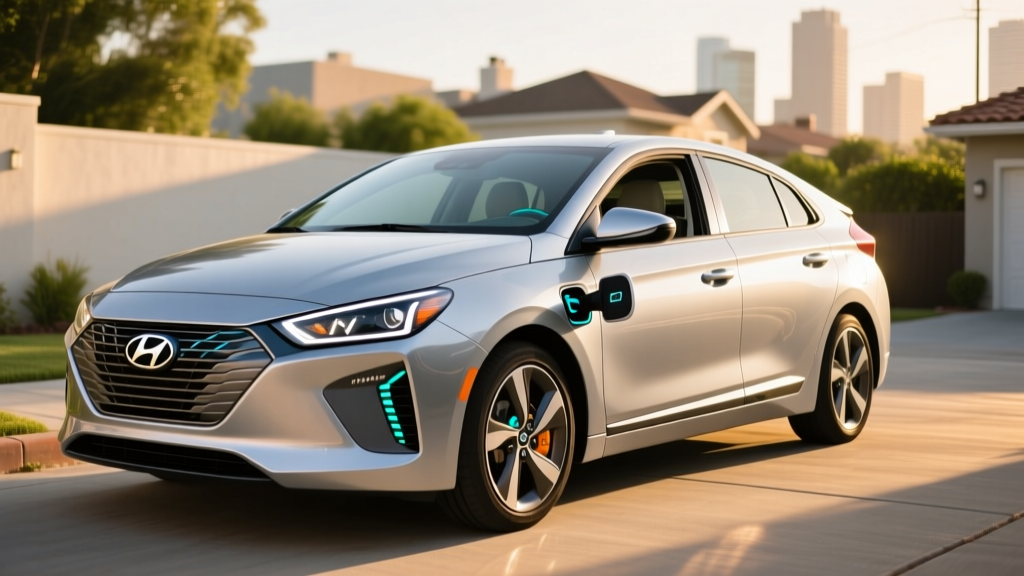
The 2019 Hyundai Ioniq Plug-In Hybrid occupies a narrow but compelling lane in the used electrified-vehicle market. It pairs a modest 8.9 kWh battery with a 1.6-liter four-cylinder engine and six-speed dual-clutch transmission to deliver up to 29 miles of electric-only driving and an EPA-rated 52 MPG combined once the battery depletes. For buyers in 2026 who want meaningful electric commuting without range anxiety, this PHEV remains a practical, budget-friendly option on the used market.
This guide breaks down exactly what the 2019 Ioniq PHEV delivers — EPA numbers versus real-world expectations, charging logistics, battery longevity, and how it stacks up against both the conventional Ioniq Hybrid and full battery-electric alternatives.
HEV vs PHEV: Understanding the Ioniq Lineup
Hyundai sold the Ioniq in three electrified flavors for 2019, and confusing them is the most common mistake shoppers make:
| Attribute | Ioniq Hybrid (HEV) | Ioniq Plug-In Hybrid (PHEV) | Ioniq Electric (BEV) |
|---|---|---|---|
| Battery Capacity | 1.56 kWh | 8.9 kWh | 28 kWh |
| Plug-In Charging? | No — self-charging | Yes — Level 1 & Level 2 | Yes — L1, L2, DCFC |
| Electric-Only Range | ~1 mi at low speed | 29 mi (EPA) | 124 mi (EPA) |
| EPA Combined MPG / MPGe | 55 MPG | 52 MPG (gas) / 119 MPGe (electric) | 136 MPGe |
| DC Fast Charging? | No | No | Yes (CCS, ~50 kW peak) |
| Federal Tax Credit (when new) | $0 | Up to $4,543 | $7,500 |
The conventional Ioniq HEV never plugs in — it recovers energy through regenerative braking and the engine to charge its small battery. The Ioniq PHEV (our focus here) has a much larger battery you charge by plugging in, giving it genuine electric-only commuting capability. The Ioniq Electric is a full battery-electric vehicle with no gasoline engine at all.
Fuel Economy & Electric-Only Range: The Numbers
| Metric | EPA Rating | Real-World Expectation |
|---|---|---|
| Combined MPG (charge-depleted, gas mode) | 52 MPG | 48–54 MPG (varies by driving style & temperature) |
| City MPG (gas mode) | N/A blended — see combined | Hybrids often exceed combined in city due to regen |
| Highway MPG (gas mode) | N/A blended — see combined | ~46–50 MPG at 70+ mph (less regen benefit) |
| Electric-Only Range | 29 miles | 22–27 miles (summer); 17–22 miles (winter) |
| MPGe (electric mode) | 119 MPGe | ~100–115 MPGe depending on climate & speed |
| Total Combined Range (full tank + full battery) | ~630 miles | ~550–620 miles real-world |
| Fuel Tank Capacity | 11.4 gallons | — |
The PHEV's 8.9 kWh battery has approximately 7.4 kWh of usable capacity (the rest is buffer to protect longevity). That usable energy is what powers the 29 miles of electric range. For comparison, the conventional Ioniq HEV's 1.56 kWh battery provides only brief electric assist at low speeds — it cannot sustain electric-only driving beyond a block or two.
How Many MPG Does the 2019 Ioniq PHEV Get?
The EPA rates it at 52 MPG combined in hybrid (charge-depleted) mode and 119 MPGe in electric mode. Real-world owners typically see 48–54 MPG on gas and 22–27 miles of electric range in moderate conditions. City-heavy routes favor the hybrid system's regenerative braking, sometimes pushing real-world MPG slightly above the EPA figure.
Charging: Level 1, Level 2, and What You Cannot Do
The 2019 Ioniq PHEV uses a standard J1772 connector for AC charging. It does not support DC fast charging — there is no CCS or CHAdeMO port. This is typical for PHEVs of this era, whose smaller batteries don't justify the cost and weight of DCFC hardware.
| Charging Level | Power (kW) | Time to Full (0–100%) | Where You'll Use It |
|---|---|---|---|
| Level 1 (120V household outlet) | ~1.4 kW | ~5.5 hours | Overnight at any standard outlet |
| Level 2 (240V home or public) | ~3.3 kW (onboard charger limit) | ~2 hours 15 min | Home wallbox, workplace, public AC stations |
The onboard charger maxes out at 3.3 kW, meaning even a 7.2 kW or 11.5 kW Level 2 station will only deliver 3.3 kW to the car. A full charge in roughly 2 hours and 15 minutes on Level 2 is practical for workplace top-ups — plug in when you arrive and the battery is full by lunch.
Level 1 charging from a standard 120V outlet is viable for this car. At 1.4 kW, you'll add roughly 5–6 miles of range per hour of charging, which covers a 29-mile commute with an overnight charge of about 5–6 hours. If your daily driving stays within the electric range, Level 1 alone may suffice.
Powertrain, Performance & Driving Impressions
| Specification | Figure |
|---|---|
| Engine | 1.6L Atkinson-cycle 4-cylinder |
| Engine Output | 104 hp / 109 lb-ft torque |
| Electric Motor Output | 60 hp / 125 lb-ft torque |
| Combined System Output | 164 hp / 195 lb-ft torque |
| Transmission | 6-speed dual-clutch automatic (DCT) |
| Drivetrain | Front-wheel drive |
| 0–60 mph | ~9.7 seconds |
| Battery Capacity (gross / usable) | 8.9 kWh / ~7.4 kWh |
| Battery Chemistry | Lithium-ion polymer (NMC) |
| Curb Weight | ~3,360 lbs |
| Cargo Volume | 23.0 cu ft (rear seats up) |
The six-speed dual-clutch transmission is a deliberate choice that sets the Ioniq apart from the Toyota Prius Prime, which uses a continuously variable transmission (CVT). The DCT delivers crisper, more natural gear changes and a more connected driving feel — you feel actual gear shifts rather than the rubber-band sensation of a CVT. The trade-off is occasional low-speed hesitation when the transmission juggles clutch engagement from a stop, though Hyundai refined this behavior through software updates.
With 164 combined horsepower, the Ioniq PHEV is adequate rather than quick. The 9.7-second 0–60 time is competitive within the PHEV segment but won't win any stoplight races. Where the electric motor shines is in low-speed responsiveness — the instant 125 lb-ft of torque from the motor makes city driving feel peppier than the 0–60 number suggests.
Battery Warranty, Reliability & Replacement Costs
10 years / 100,000 miles — whichever comes first. Covers battery capacity loss below a specified threshold (typically ~70% state of health) and defects in the hybrid/EV system components. This warranty applied to the original owner and transfers to subsequent owners, though some sources note the transfer reduces coverage to 5 years/60,000 miles for the second owner on certain model years — verify with a Hyundai dealer using your specific VIN.
Is the 2019 Ioniq PHEV Reliable?
The Ioniq line has a strong reliability track record. The 1.6L Kappa engine is a proven Hyundai-Kia workhorse, and the DCT, while occasionally criticized for low-speed behavior, has not shown widespread failure patterns. The lithium-ion polymer battery pack has demonstrated good longevity — early Ioniq owners (2017–2018 models now at 100,000+ miles) have reported minimal degradation, typically losing 5–10% of original capacity after 6–8 years of use.
For a 2019 model in 2026, you're looking at a 7-year-old vehicle. If the original in-service date was mid-2019, the 10-year battery warranty may still have ~3 years of coverage remaining (or until 100,000 miles, whichever hits first). Always verify warranty status with a Hyundai dealer before purchasing.
What Does Battery Replacement Cost?
If the 8.9 kWh battery pack fails outside of warranty, replacement cost at a Hyundai dealership typically runs $3,500–$5,500 including parts and labor. Independent hybrid-battery specialists may offer refurbished packs for $2,000–$3,500. Given the modest battery size, this is considerably less than a full EV battery replacement ($10,000–$20,000+). The battery is also modular — individual cells or modules can sometimes be replaced rather than the entire pack, reducing costs further.
For context, the conventional Ioniq HEV's 1.56 kWh battery is even cheaper to replace ($1,500–$2,500) but carries the same 10-year/100,000-mile warranty.
2019 Ioniq PHEV Trims, Pricing & Tax Credit Status
Hyundai offered the 2019 Ioniq Plug-In Hybrid in two trims:
| Trim | Original MSRP (2019) | Estimated Used Price (2026) |
|---|---|---|
| SEL (base) | $25,900 + $920 destination | $12,000–$16,500 |
| Limited | $29,500 + $920 destination | $14,500–$19,000 |
The SEL trim includes standard features like Apple CarPlay/Android Auto, a 7-inch touchscreen, adaptive cruise control, lane-keep assist, and forward-collision warning. The Limited adds leather seats, an 8-inch navigation screen, Harman Kardon audio, LED headlights, and a power driver seat.
Does It Qualify for Any Tax Credit in 2026?
No federal tax credit applies to used 2019 Ioniq PHEV purchases in 2026. Here's why:
- New vehicle credit (§30D): No longer available — the car is not being sold new, and Hyundai had already exceeded the 200,000-vehicle manufacturer cap long before 2019.
- Used EV credit (§25E): This credit (up to $4,000 or 30% of sale price) applies to used BEVs and PHEVs, but the vehicle must have a battery of at least 7 kWh (the Ioniq PHEV qualifies at 8.9 kWh). However, the 2019 model year is likely too old — the credit requires the vehicle to be at least 2 model years old (which it is), but income caps ($75,000 single / $150,000 joint) and the $25,000 maximum sale price apply. A used 2019 Ioniq PHEV selling for under $25,000 could qualify if the buyer meets income requirements and purchases through a registered dealer. Verify current IRS §25E rules before relying on this.
- State incentives: Vary widely by jurisdiction. Some states offer rebates for used PHEVs; most do not. Check your state energy office or DMV.
Who Should Buy the 2019 Ioniq PHEV (and Who Shouldn't)
- 29-mile electric range covers most commutes
- 52 MPG in gas mode — among the best PHEVs
- Level 1 charging sufficient for daily use
- Strong remaining battery warranty on low-mile examples
- Dual-clutch transmission feels more engaging than CVT
- Competitive used pricing ($12K–$19K)
- Comprehensive ADAS suite standard
- No DC fast charging capability
- 3.3 kW onboard charger limits Level 2 speed
- Modest 164 hp — not a performance car
- Cargo space reduced vs. HEV (battery placement)
- Electric range drops significantly in cold weather
- Limited all-electric highway range (~20 mi at 75 mph)
- Federal new-vehicle tax credit long gone
Hybrid vs PHEV vs EV — Which Fits You?
- Your daily round-trip commute is under 25 miles and you can charge at home overnight
- You take occasional road trips and don't want to plan around charging infrastructure
- You live in an apartment or area with unreliable public charging
- Your budget is $12K–$19K and you want electrified efficiency
- You cannot charge at home or work (no plug access at all)
- You want maximum simplicity — no charging cables, no plug management
- Your budget is even tighter ($9K–$14K used)
- You want zero tailpipe emissions and the lowest per-mile fuel cost
- You have reliable home Level 2 charging and your daily driving is under 200 miles
- You want to eliminate oil changes and engine maintenance entirely
- Your budget allows $18K+ for a used BEV (e.g., Chevy Bolt, used Model 3, Nissan Leaf)
Frequently Asked Questions
How far can the 2019 Hyundai Ioniq Plug-In Hybrid go on electric only?
The EPA rates it at 29 miles of electric-only range. Real-world results vary: expect 25–27 miles in mild weather at city speeds, 20–22 miles on the highway, and 17–22 miles in freezing temperatures when the cabin heater draws significant power from the battery.
Can I DC fast charge the Ioniq PHEV?
No. The 2019 Ioniq Plug-In Hybrid only supports AC charging via a J1772 connector — Level 1 (120V) and Level 2 (240V) up to 3.3 kW. There is no DC fast-charge port. This is standard for PHEVs of this era, as the 8.9 kWh battery charges fully in ~2.25 hours on Level 2, making DCFC hardware unnecessary.
What happens when the battery depletes — does the car stop?
No. When the battery reaches its minimum state of charge, the gasoline engine seamlessly takes over and the car operates as a conventional hybrid, achieving 52 MPG combined. You'll never be stranded — the 11.4-gallon fuel tank provides an additional ~590 miles of range.
Is the 2019 Ioniq PHEV reliable, and what does a battery replacement cost?
The Ioniq PHEV has a strong reliability record with no widespread failure patterns for the powertrain or battery. The 8.9 kWh battery is covered by a 10-year/100,000-mile warranty (original), and replacement costs $3,500–$5,500 at a dealer if needed outside warranty. Early degradation reports suggest 5–10% capacity loss over 6–8 years — well within acceptable limits.
Does the 2019 Ioniq PHEV qualify for a tax credit if I buy it used in 2026?
Possibly, under the IRS §25E used clean vehicle credit. If the sale price is $25,000 or less, you meet income caps ($75K single / $150K joint), and you purchase through a registered dealer, you may qualify for up to $4,000 or 30% of the sale price (whichever is less). Confirm eligibility with a tax professional and verify the dealer is registered with the IRS before purchase.
How does the Ioniq PHEV compare to the Toyota Prius Prime?
The 2019 Prius Prime offers 25 miles of electric range (vs. 29 for the Ioniq) and 54 MPG combined in hybrid mode (vs. 52). The Prius Prime uses a CVT, which some drivers find less engaging than the Ioniq's dual-clutch transmission. Both are strong choices — the Ioniq edges ahead on electric range and driving feel, while the Prius Prime has a slight MPG advantage and Toyota's reputation for bulletproof reliability. According to EPA data on fueleconomy.gov, the gap between them is small enough that test-driving both is the best tiebreaker.
What is the total cost of ownership advantage over a gas car?
If you charge nightly and commute within the 29-mile electric range, you'll use almost no gasoline on weekdays. At $3.50/gallon and 30 MPG for a comparable gas sedan, a 250-mile weekly commute costs ~$29 in gas. The Ioniq PHEV on electricity costs ~$3–$5 for the same distance (at $0.13–$0.16/kWh). Over a year of weekday commuting, that's roughly $1,000–$1,200 in fuel savings, plus reduced brake wear from regenerative braking.
The 2019 Hyundai Ioniq Plug-In Hybrid remains one of the most efficient and practical used PHEVs available in 2026. Its combination of genuine electric-only commuting range, class-leading hybrid MPG, and affordable used pricing makes it an excellent bridge vehicle for buyers not yet ready to commit to a full EV — or for those who simply need the flexibility of a gas engine for longer trips.