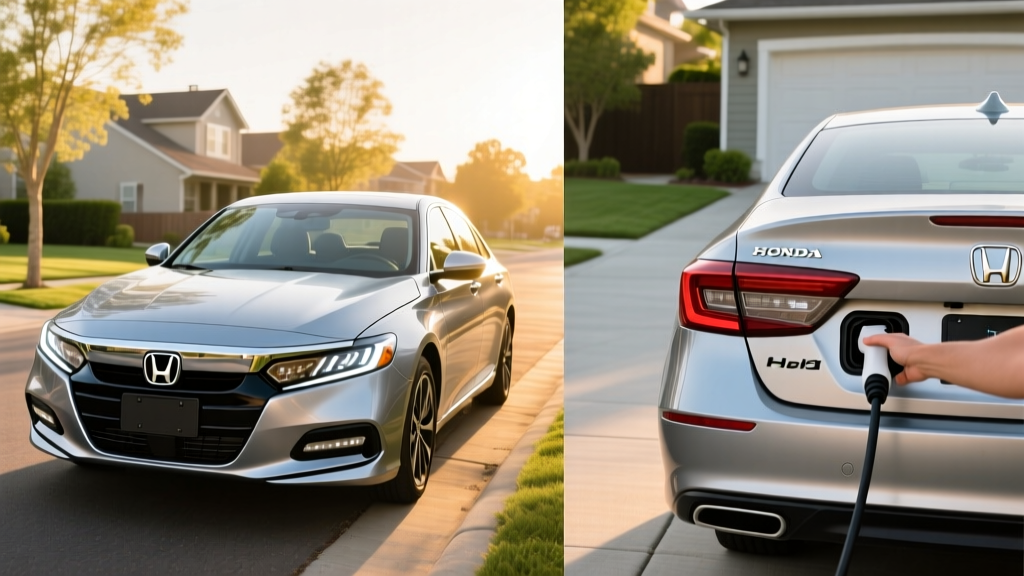
The 2019 Honda Accord Hybrid remains one of the most compelling used midsize sedans on the market in 2026. With an EPA-estimated 48 MPG combined, a refined two-motor hybrid system, and Honda's reputation for long-term durability, it sits at the intersection of efficiency and practicality for buyers who aren't ready to plug in. This guide breaks down the exact numbers you need — real-world fuel economy, powertrain specs, battery longevity, and whether this HEV still makes sense against today's newer hybrids, PHEVs, and full EVs.
What Is the 2019 Honda Accord Hybrid? (HEV vs PHEV Clarified)
Important distinction: The 2019 Honda Accord Hybrid is a conventional hybrid electric vehicle (HEV). It does not plug in. It generates all its electricity internally through regenerative braking and its gasoline engine. Honda did not offer a plug-in hybrid (PHEV) version of the 10th-generation Accord. If you're looking for electric-only driving range and a charge port, you'll need to look at vehicles like the Toyota Prius Prime or Hyundai Tucson PHEV instead.
As an HEV, the Accord Hybrid requires zero changes to your fueling routine — you fill it at any gas station. The hybrid system simply makes every gallon go significantly farther than the standard 1.5L turbo Accord, particularly in stop-and-go city driving where electric motor assist does the heavy lifting.
Fuel Economy: EPA Ratings and Real-World MPG
| Driving Condition | EPA Estimate | Real-World Expectation |
|---|---|---|
| City | 48 MPG | 46–52 MPG (hybrids often exceed EPA in city) |
| Highway | 47 MPG | 42–46 MPG (sustained high speeds reduce electric assist benefit) |
| Combined | 48 MPG | 44–49 MPG |
According to fueleconomy.gov, the 2019 Accord Hybrid achieves 48/47/48 MPG city/highway/combined across all trims (LX, EX, EX-L, Touring). These figures are identical regardless of trim because Honda uses the same powertrain calibration throughout the lineup.
Real-world context: Conventional hybrids like the Accord tend to beat their EPA city estimates because frequent braking recharges the small battery and maximizes electric-motor usage. In our experience and owner-reported data on Fuelly, many drivers see 50+ MPG in urban commuting. Highway driving is where the gap narrows — at 75+ MPH sustained, the 2.0L Atkinson-cycle engine carries most of the load, and real-world figures dip to the low-to-mid 40s. Cold weather (below 30°F) typically knocks 2–4 MPG off combined figures due to increased engine runtime for cabin heat and reduced battery efficiency.
For comparison, the non-hybrid 2019 Accord 1.5T achieves 30/38/33 MPG — meaning the hybrid delivers roughly 45% better combined fuel economy for a modest weight and price premium.
Powertrain Specs: How Honda's Two-Motor System Works
| Specification | 2019 Honda Accord Hybrid |
|---|---|
| Combined System Output | 212 HP |
| Gasoline Engine | 2.0L 4-cylinder Atkinson-cycle, 143 HP / 129 lb-ft |
| Drive Motor | AC synchronous permanent-magnet, 181 HP / 232 lb-ft |
| Generator Motor | Integrated starter-generator (charges battery, starts engine) |
| Transmission | e-CVT (no traditional gears — motor-driven with engine clutch for highway cruise) |
| Hybrid Battery | 1.3 kWh lithium-ion (gross) |
| Drivetrain | Front-wheel drive |
| 0–60 MPH | ~6.7 seconds |
| Fuel Tank | 12.8 gallons |
| Total Driving Range | ~614 miles (EPA combined) |
Honda's Intelligent Multi-Mode Drive (i-MMD) system is fundamentally different from Toyota's planetary-gear hybrid setup. In most driving scenarios, the gasoline engine acts as a generator — it never directly turns the wheels. Instead, the 181 HP drive motor propels the car using electricity produced on demand or drawn from the 1.3 kWh battery. Only at steady highway speeds does a lockup clutch engage, mechanically linking the engine to the wheels for maximum efficiency.
The result is a driving experience that feels more like an EV than a traditional hybrid: smooth, linear torque delivery from a stop, no gear hunting, and a quiet cabin at low speeds. The 212 combined horsepower makes the Accord Hybrid genuinely quick — the 6.7-second 0–60 time beats many turbocharged gas-only midsize sedans.
Hybrid Battery Warranty, Lifespan, and Replacement Cost
Honda Hybrid Battery Warranty: The 2019 Accord Hybrid's lithium-ion battery pack is covered under Honda's hybrid component warranty for 8 years / 100,000 miles (extended to 10 years / 150,000 miles in California Air Resources Board (CARB) states: CA, CT, ME, MD, MA, NJ, NY, OR, RI, VT, WA, and others adopting CARB standards).
Replacement cost (2026 estimate): A new OEM hybrid battery pack from Honda runs approximately $2,000–$3,500 including labor at a dealership. Independent hybrid specialists may offer refurbished packs for $1,200–$2,000. Module-level repair (replacing individual cells rather than the entire pack) is available for $500–$1,200.
For a 2019 model in 2026, the original 8-year/100,000-mile warranty is nearing expiration or has already expired depending on mileage — unless you're in a CARB state with the 10-year/150,000-mile coverage. When buying used, verify the battery's state of health through a Honda dealer diagnostic scan. The Accord Hybrid's 1.3 kWh pack is small and under relatively low stress compared to full EV batteries, and widespread reports of premature failure are rare. Most Accord Hybrid batteries outlast 150,000+ miles with minimal capacity loss, since the system's software keeps the battery operating in a narrow, longevity-friendly state of charge window (roughly 20–80% SoC).
The broader hybrid system — including the drive motor, generator motor, power control unit, and e-CVT — shares the same warranty coverage and has proven highly reliable. These components have fewer wear points than a conventional automatic transmission.
Is the 2019 Accord Hybrid Reliable?
The 10th-generation Accord Hybrid has earned strong reliability marks. The IIHS named it a Top Safety Pick+ when equipped with specific headlights, and the powertrain's simplicity — no traditional transmission, no starter motor, no alternator — eliminates several common failure points found in gas-only cars.
Common issues reported by owners and tracked by NHTSA include:
- Infotainment software glitches — occasional screen freezes or Apple CarPlay/Android Auto disconnects (resolved with firmware updates at most dealers)
- Road noise — not a defect, but the Accord's cabin insulation is noticeably less refined than the Toyota Camry Hybrid at highway speeds
- 12V auxiliary battery drain — if the car sits unused for extended periods, the 12V battery (separate from the hybrid pack) can discharge. This is common across all modern vehicles, not unique to the hybrid system
There are no widespread reports of hybrid battery failure, drive motor issues, or power electronics problems for this model year. Consumer reliability surveys consistently place the Accord Hybrid above average for the midsize sedan segment.
Pricing, Trims, and Tax Credit Eligibility in 2026
The 2019 Honda Accord Hybrid was offered in four trims. Original MSRP and current estimated used-market pricing (2026):
| Trim | Original MSRP (2019) | Estimated Used Price (2026) |
|---|---|---|
| LX (base) | $26,240 | $16,000–$19,500 |
| EX | $29,100 | $18,500–$22,000 |
| EX-L | $31,600 | $20,000–$24,000 |
| Touring | $34,990 | $22,000–$26,500 |
Tax credit reality check: The 2019 Honda Accord Hybrid does not qualify for the federal §30D new clean vehicle tax credit (up to $7,500), which applies only to new plug-in vehicles — BEVs and PHEVs with sufficient battery capacity. As a conventional HEV with a 1.3 kWh battery and no plug, it is ineligible.
However, buyers should check two alternative savings avenues:
- Used Clean Vehicle Credit (§25E): This credit offers up to $4,000 (30% of sale price, capped) for qualifying used EVs and plug-in hybrids purchased from a dealer for $25,000 or less. The Accord Hybrid, as a conventional HEV, does not qualify for §25E either. Only plug-in vehicles are eligible under current IRS rules.
- State and local incentives: Some states offer rebates or HOV lane access for any hybrid vehicle, though these have largely shifted toward PHEVs and BEVs. Check your state's energy office or DMV for current programs.
The bottom line: there are no federal tax incentives for buying a used 2019 Accord Hybrid. The value proposition rests entirely on its low fuel cost, strong reliability, and competitive used pricing.
Accord Hybrid vs. PHEV vs. Full EV: Which Is Right for You?
Choose the 2019 Accord Hybrid (HEV) if:
- You cannot install a home charger (apartment, street parking, no garage)
- You want maximum simplicity — no charging cables, no range planning, no plug-in learning curve
- Your budget is under $25,000 and you want a spacious, reliable midsize sedan
- You drive a mix of city and highway and want strong MPG in both without behavior changes
- You take frequent long road trips where charging infrastructure is sparse
Consider a PHEV or full EV instead if:
- You can charge at home (Level 2) and want to eliminate or drastically reduce gasoline use
- Your daily commute is under 30–40 miles round-trip (a PHEV like the Prius Prime covers this on electric alone)
- You want to qualify for federal tax credits (up to $7,500 for new qualifying BEVs/PHEVs, or up to $4,000 for used qualifying plug-in vehicles)
- You want the lowest per-mile energy cost — home electricity at $0.13/kWh beats gasoline at $3.20/gallon by a wide margin
- You want access to HOV/carpool lanes (available in many states for PHEVs and BEVs, not for conventional hybrids)
The Accord Hybrid occupies a specific niche: maximum efficiency with zero lifestyle change. If your situation supports plug-in charging, a PHEV like the 2026 Toyota Prius Prime (44 miles electric-only, 52 MPG combined after depletion) or a full EV like the Hyundai Ioniq 6 (360 miles EPA range) will deliver lower operating costs and tax incentives. But if plugging in isn't feasible, the Accord Hybrid's 48 MPG combined and ~614-mile total range are remarkably hard to beat.
Frequently Asked Questions
How many MPG does the 2019 Honda Accord Hybrid get?
The EPA rates the 2019 Accord Hybrid at 48 MPG city, 47 MPG highway, and 48 MPG combined. In real-world driving, city commuters often see 50+ MPG thanks to frequent regenerative braking, while sustained highway driving at 75+ MPH typically yields 42–46 MPG. Cold weather reduces combined MPG by roughly 2–4 MPG.
Does the 2019 Accord Hybrid need to be plugged in?
No. The Accord Hybrid is a conventional hybrid (HEV), not a plug-in hybrid (PHEV). It charges its 1.3 kWh battery entirely through regenerative braking and the onboard gasoline engine. You fuel it exclusively at gas stations, just like any other car.
How far can the 2019 Accord Hybrid drive on electric only?
Only about 1–2 miles at very low speeds (under 25 MPH) in EV mode. The 1.3 kWh battery is too small for meaningful electric-only driving. This is by design — the system uses the battery for assist and efficiency optimization, not for plug-in-style electric range. If electric-only commuting is your goal, you need a PHEV or BEV.
Is the hybrid battery expensive to replace?
A new OEM replacement battery from Honda costs approximately $2,000–$3,500 installed at a dealership. Refurbished packs from independent hybrid specialists run $1,200–$2,000, and module-level repair can be as low as $500–$1,200. Fortunately, widespread premature battery failures on the 10th-gen Accord Hybrid are uncommon. Most packs last well beyond 150,000 miles.
Does the 2019 Accord Hybrid qualify for any tax credit?
No. Federal tax credits under §30D (new vehicles) and §25E (used vehicles) require the vehicle to be a plug-in electric vehicle — a BEV or PHEV. The Accord Hybrid is a conventional HEV with no plug and no qualifying battery capacity. Some state or local programs may offer minor incentives for hybrids, but these vary by jurisdiction. Always verify current rules on irs.gov and your state energy office.
How does the Accord Hybrid compare to the Toyota Camry Hybrid?
The 2019 Camry Hybrid LE achieves 52/53/52 MPG EPA — slightly better than the Accord's 48 combined. However, the Accord Hybrid offers more rear legroom (40.8 vs 38.0 inches), a larger trunk (16.7 vs 15.1 cu ft), more combined horsepower (212 vs 208), and a more engaging driving experience. If maximum MPG is your top priority, the Camry Hybrid wins on paper. If space, power, and driving dynamics matter, the Accord Hybrid has the edge.
What's the total range on a full tank?
With a 12.8-gallon fuel tank and 48 MPG combined, the EPA-estimated total range is approximately 614 miles. Real-world range typically falls between 560 and 630 miles depending on driving conditions, with city-heavy driving pushing range higher and aggressive highway driving pulling it lower.