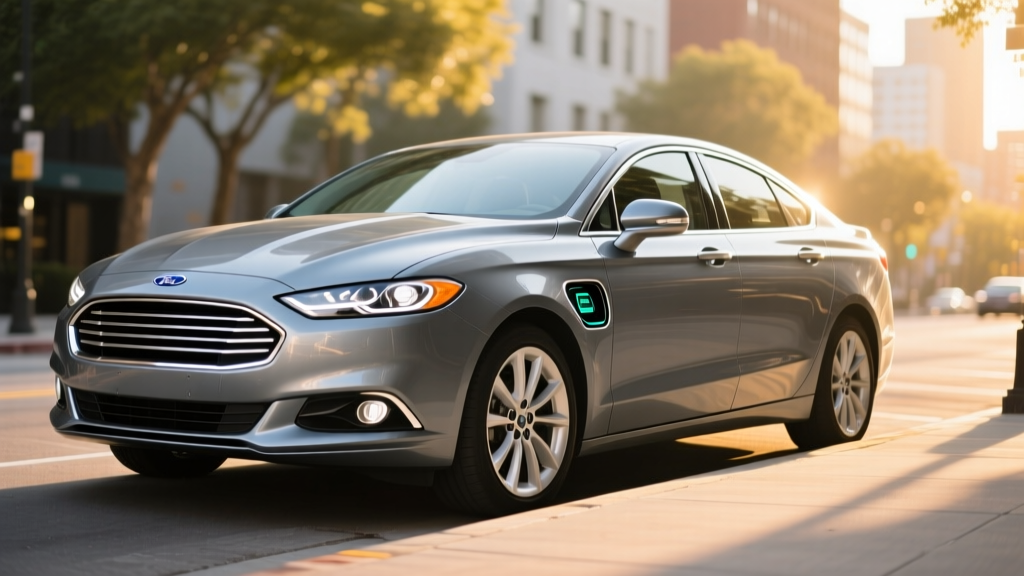
The Ford Fusion Hybrid was discontinued after the 2020 model year, but the 2019 Ford Fusion SE Hybrid remains one of the most sought-after used midsize hybrids on the market. With an EPA-estimated 42 MPG combined, a proven naturally aspirated powertrain, and Ford's hybrid battery warranty still potentially in effect for some owners, it represents a compelling entry point into hybrid ownership without the plug-in commitment or full-EV charging logistics.
This guide covers everything a used-car buyer or current owner needs to know: exact EPA fuel economy, real-world MPG expectations, the hybrid battery's lifespan and replacement cost, how the Fusion SE Hybrid stacks up against PHEVs and full EVs, and whether any tax incentives still apply to a 2019 model in 2026.
2019 Ford Fusion SE Hybrid: EPA Fuel Economy & Real-World MPG
| Metric | Value |
|---|---|
| EPA City | 43 MPG |
| EPA Highway | 41 MPG |
| EPA Combined | 42 MPG |
| Fuel Tank Capacity | 13.5 gallons |
| Total Driving Range (EPA est.) | ~567 miles |
| Fuel Type | Regular unleaded (87 octane) |
Source: fueleconomy.gov — 2019 Ford Fusion Hybrid
Real-World MPG: What Owners Actually See
The Fusion Hybrid's Atkinson-cycle 2.0L engine paired with its electric motor is particularly efficient in stop-and-go city driving, where regenerative braking recaptures energy and the electric motor handles low-speed propulsion. This is why the EPA city rating (43 MPG) actually exceeds the highway rating (41 MPG) — a hallmark of conventional hybrids.
In real-world ownership, expect the following:
- City / suburban driving: 40–46 MPG. Many owners report exceeding the EPA city figure in warm weather with moderate use of climate control.
- Highway cruising (70–80 mph): 36–40 MPG. Aerodynamic drag and sustained engine load reduce the hybrid advantage at higher speeds.
- Cold weather (below 35°F): 34–38 MPG combined. The engine runs more frequently to provide cabin heat and maintain battery temperature, reducing electric-only operation.
- Combined mixed driving (annual average): 38–43 MPG is typical based on owner-reported data.
The key takeaway: if your commute is primarily urban or suburban with frequent stops, the 2019 Fusion SE Hybrid will likely meet or exceed its EPA rating. If you drive mostly highway miles at high speed, plan for roughly 38 MPG.
HEV vs PHEV: The Fusion Hybrid Is a Conventional Hybrid — Not a Plug-In
A critical distinction for shoppers: the 2019 Ford Fusion SE Hybrid is a conventional hybrid electric vehicle (HEV). It does not have a charge port, cannot be plugged in, and has no meaningful electric-only driving range. Ford did sell a plug-in variant called the Fusion Energi, which is a separate model with different specs entirely.
| Specification | Fusion SE Hybrid (HEV) | Fusion Energi (PHEV) |
|---|---|---|
| Powertrain Type | Conventional Hybrid | Plug-in Hybrid |
| Plug-in Charging | No — self-charging via regen & engine | Yes — Level 1 (120V) and Level 2 (240V) |
| Battery Capacity | 1.4 kWh (lithium-ion) | 7.6 kWh (lithium-ion) |
| Electric-Only Range | N/A (brief EV mode at low speed) | 26 miles (EPA) |
| EPA Combined MPG / MPGe | 42 MPG | 103 MPGe (EV mode) / 42 MPG (gas-only) |
| Total Range | ~567 miles | ~610 miles (EV + gas) |
| DC Fast Charging | No | No |
| Federal Tax Credit (original) | None | Expired — was up to $4,007 when new |
The Fusion SE Hybrid captures all its energy through regenerative braking and the gasoline engine. You never plug it in. This is an advantage for buyers who lack access to home or workplace charging — the car manages its own energy seamlessly.
Powertrain Specs: Engine, Motor, and Combined Output
| Component | Specification |
|---|---|
| Gasoline Engine | 2.0L Atkinson-cycle inline-4 |
| Engine Power | 141 hp @ 6,000 rpm |
| Engine Torque | 129 lb-ft @ 4,000 rpm |
| Electric Motor | Permanent-magnet synchronous AC motor |
| Motor Power | 88 kW (118 hp) |
| Combined System Output | 195 hp (145 kW) |
| Transmission | eCVT (electronic continuously variable) |
| Drivetrain | Front-wheel drive |
| 0–60 mph (est.) | ~8.1 seconds |
| Battery Type | Lithium-ion, 1.4 kWh |
The eCVT in the Fusion Hybrid is not a belt-driven CVT like those found in some competitors. Ford uses a planetary gearset that blends engine and motor power seamlessly — there is no belt to slip or wear, which contributes to the powertrain's long-term durability reputation.
The 195 combined horsepower is adequate for daily driving and highway merging. The electric motor's instant torque (available from 0 rpm) gives the car responsive off-the-line acceleration in city traffic, even though the 0–60 time won't impress performance enthusiasts.
Battery Longevity, Warranty & Replacement Cost
- Hybrid battery warranty: 8 years / 100,000 miles (whichever comes first)
- Hybrid battery warranty (CARB states): 10 years / 150,000 miles in states that follow California Air Resources Board emissions rules (CA, CO, CT, DE, ME, MD, MA, NJ, NY, OR, RI, VT, WA, and others)
- Capacity retention threshold: Ford warrants the battery against failure or capacity loss below a defined threshold that triggers a diagnostic fault
How Long Does the Fusion Hybrid Battery Actually Last?
The 1.4 kWh lithium-ion battery in the 2019 Fusion SE Hybrid is relatively small and operates within a conservative state-of-charge window — typically between 40% and 80% SoC. Ford's battery management system never allows the pack to fully charge or fully deplete, which dramatically reduces degradation stress on the cells.
Based on fleet data, owner reports, and the track record of Ford's hybrid system (shared with the Escape Hybrid and C-Max Hybrid), these batteries routinely last 150,000–200,000+ miles before requiring replacement. Many first-generation Fusion Hybrids (2013–2016) are still running on their original batteries past 180,000 miles.
Battery Replacement Cost (2026 Estimates)
If the hybrid battery does fail outside of warranty coverage:
- New OEM replacement battery: $2,500–$4,000 (parts) + $500–$800 (labor) = approximately $3,000–$4,800 total
- Remanufactured / refurbished battery: $1,500–$2,500 installed
- Individual cell/module replacement: Some independent hybrid specialists can replace failed modules within the pack for $800–$1,500, though this is less common for the lithium-ion pack versus older NiMH designs
For a 2019 model purchased in 2026, the factory 8-year/100,000-mile warranty may still be partially in effect depending on the vehicle's in-service date and odometer reading. Verify warranty status with a Ford dealer using the VIN before purchasing.
Does the 2019 Fusion SE Hybrid Qualify for Any Tax Credits?
No federal tax credit is available for the 2019 Ford Fusion SE Hybrid in 2026. Here's why:
- IRS §30D Clean Vehicle Credit: This credit applies only to new plug-in electric vehicles (BEVs and PHEVs) with battery capacities of at least 7 kWh. The Fusion SE Hybrid is a conventional HEV with a 1.4 kWh battery and no plug — it never qualified for §30D, even when new.
- Used EV Credit (§25E): The up-to-$4,000 used clean vehicle credit requires the vehicle to be a qualifying plug-in EV or fuel cell vehicle. Conventional hybrids are excluded.
- The Fusion Energi (PHEV variant): Even the plug-in Fusion Energi no longer qualifies for federal credits. The §30D credit for the Energi expired years ago, and used-credit eligibility requires meeting current battery sourcing and MSRP caps that this discontinued model cannot satisfy on the used market in a straightforward way.
- State incentives: Some states offer modest rebates or HOV lane access for hybrids, but these vary widely and change frequently. Check your state's energy office or DMV for current programs. States like California have largely shifted incentive funding toward zero-emission vehicles (BEVs and FCEVs).
Source: IRS.gov — Clean Vehicle Credits
Pricing in 2026: What Does a Used 2019 Fusion SE Hybrid Cost?
Since the Fusion Hybrid was discontinued after the 2020 model year, all examples on the market in 2026 are used. Pricing varies significantly by mileage, condition, and region:
| Condition / Mileage | Estimated Price Range |
|---|---|
| Low mileage (<40,000 mi), excellent condition | $18,000–$22,000 |
| Average mileage (50,000–80,000 mi), good condition | $14,000–$18,000 |
| Higher mileage (80,000–120,000 mi), fair condition | $10,000–$14,000 |
| High mileage (120,000+ mi) / fleet history | $8,000–$11,000 |
Original MSRP (2019): The Fusion SE Hybrid started at approximately $27,560 including destination. Well-equipped examples with the SE Hybrid Technology Package and other options reached $32,000–$34,000.
The Fusion Hybrid's depreciation has been relatively favorable for used buyers — these cars hold value well because demand for proven, no-plug-needed hybrids consistently exceeds supply in the used market.
Who Should Buy the 2019 Fusion SE Hybrid — And Who Should Look Elsewhere
- You want 40+ MPG without plugging in
- You lack access to home or workplace charging
- Your commute is mostly city/suburban stop-and-go
- You want a proven, low-risk hybrid with strong reliability data
- You prefer a traditional sedan with a large trunk (12.1 cu ft — the hybrid battery doesn't intrude on cargo space as much as the Energi)
- You want lower purchase cost than a new hybrid or EV
- You want electric-only driving for short commutes (consider a PHEV like the Toyota RAV4 Prime or a used Chevy Volt)
- You want zero tailpipe emissions (consider a full BEV like the Chevy Bolt or Tesla Model 3)
- You need all-wheel drive (the Fusion Hybrid is FWD only — consider the Toyota Camry Hybrid AWD or Ford Escape Hybrid AWD)
- You want the latest infotainment and ADAS tech (the 2019 SYNC 3 system is functional but dated versus 2025+ vehicles)
- You drive mostly highway miles at 80+ mph (the hybrid advantage diminishes significantly at sustained high speed)
Hybrid vs PHEV vs Full EV — Quick Decision Framework
| Factor | HEV (Fusion Hybrid) | PHEV | Full EV (BEV) |
|---|---|---|---|
| Plug-in Required? | No | Optional (but recommended) | Yes — mandatory |
| Home Charging Needed? | No | Strongly recommended for benefit | Yes (Level 2 ideal) |
| Fuel Cost (per mile) | ~$0.09–$0.11 | ~$0.04 electric / $0.10 gas | ~$0.03–$0.06 |
| Maintenance Cost | Low (standard + hybrid system) | Low–Moderate (two full powertrains) | Very Low (no oil, fewer moving parts) |
| Federal Tax Credit (new) | None | Up to $7,500 (if eligible) | Up to $7,500 (if eligible) |
| Best For | No-charging-access drivers, budget buyers | Home chargers with short commutes + road-trip flexibility | Home chargers committed to zero tailpipe emissions |
Frequently Asked Questions
How many MPG does the 2019 Ford Fusion SE Hybrid get?
The EPA rates it at 43 city / 41 highway / 42 combined MPG. Real-world results typically range from 38–46 MPG depending on driving style, terrain, and temperature. City driving tends to produce the highest numbers thanks to regenerative braking.
Can I plug in the 2019 Ford Fusion SE Hybrid to charge?
No. The Fusion SE Hybrid is a conventional hybrid (HEV) with no charge port. It charges its 1.4 kWh battery internally through regenerative braking and the gasoline engine. If you want plug-in capability, look at the Fusion Energi (PHEV) instead — but note it was also discontinued after 2020.
Is the 2019 Ford Fusion Hybrid reliable?
Yes. Ford's hybrid powertrain has a strong reliability track record. The eCVT planetary gearset is mechanically simple and robust, the 2.0L Atkinson-cycle engine is naturally aspirated and lightly stressed, and the lithium-ion battery is managed conservatively. Major third-party reliability surveys consistently rate the Fusion Hybrid as average to above-average for the midsize sedan segment. The most common complaints relate to infotainment (SYNC 3) glitches and standard wear items, not the hybrid system itself.
What is the hybrid battery replacement cost for the 2019 Fusion?
A new OEM hybrid battery replacement costs approximately $3,000–$4,800 including labor at a dealership. Remanufactured options run $1,500–$2,500 installed. However, based on historical data, these batteries typically last 150,000–200,000+ miles, and many may never need replacement during the vehicle's useful life.
Does the 2019 Ford Fusion SE Hybrid qualify for any tax credit in 2026?
No. The Fusion SE Hybrid is a conventional hybrid, not a plug-in vehicle. It never qualified for the federal §30D tax credit when new, and it does not qualify for the §25E used clean vehicle credit. No state-level hybrid-specific incentives are widely available as of 2026 — most incentive programs have shifted to plug-in and zero-emission vehicles.
How does the Fusion Hybrid compare to the Toyota Camry Hybrid?
The 2019 Camry Hybrid LE is rated at 52 MPG combined (EPA) versus the Fusion's 42 MPG — a significant 10 MPG advantage for Toyota. The Camry also offers an available AWD configuration. However, the Fusion Hybrid provides a slightly more engaging driving feel, a more intuitive infotainment interface (SYNC 3 vs. Toyota's older Entune system in 2019), and often lower used-market pricing for comparable mileage. If maximum fuel economy is your priority, the Camry Hybrid wins. If value and driving dynamics matter more, the Fusion remains competitive.
Is the Ford Fusion Hybrid being replaced by another model?
Ford discontinued the Fusion sedan entirely after the 2020 model year as part of its shift toward SUVs and trucks. There is no direct sedan replacement. The closest current Ford hybrid alternatives are the Ford Escape Hybrid (compact SUV, 37–41 MPG combined) and the Ford Maverick Hybrid (compact pickup, 37–42 MPG combined). Both use more advanced versions of Ford's hybrid powertrain.