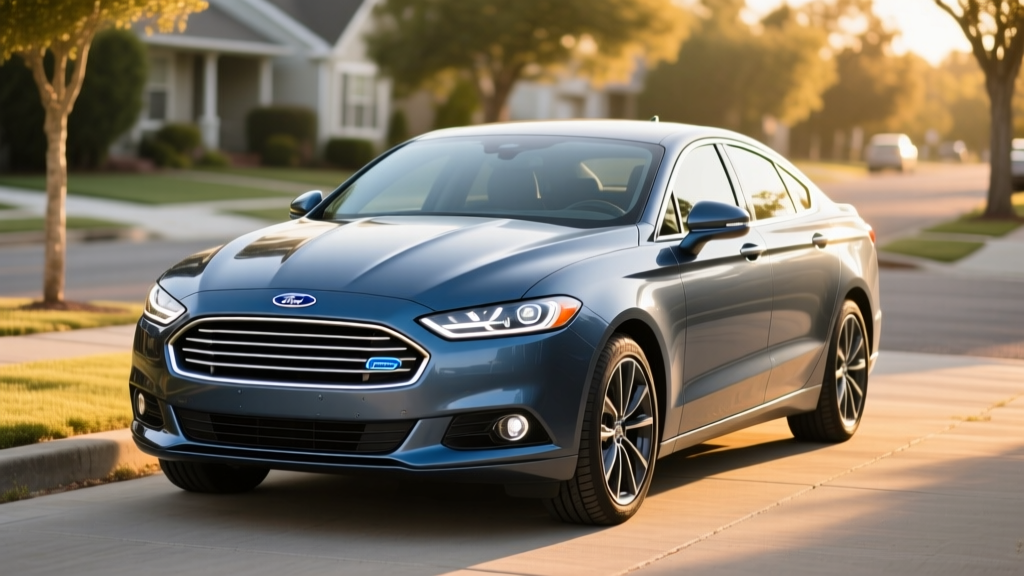
The 2019 Ford Fusion Hybrid: A Used Midsize Sedan Worth Considering in 2026
The Ford Fusion Hybrid was discontinued after the 2020 model year when Ford exited the North American sedan market. But the 2019 model year represents the final, most refined version of Ford's midsize hybrid sedan — and on the used market in 2026, it's attracting buyers who want proven hybrid efficiency without the premium of a newer model. With an EPA-rated 42 MPG combined and a conventional hybrid powertrain that requires no plug-in charging, the 2019 Fusion Hybrid occupies a practical sweet spot: better fuel economy than a gas-only Camry, no range anxiety, and lower used prices than a comparable RAV4 Hybrid.
This guide breaks down everything you need to evaluate a used 2019 Fusion Hybrid — from real-world MPG and powertrain specs to battery longevity, tax credit eligibility on a used purchase, and how it stacks up against going full EV or sticking with a conventional hybrid competitor.
HEV vs. PHEV: Understanding What the Fusion Hybrid Is (and Isn't)
Before diving into specs, it's critical to distinguish the two electrified Fusion variants Ford sold in 2019, because confusing them leads to wrong expectations at the dealership:
| Feature | Fusion Hybrid (HEV) | Fusion Energi (PHEV) |
|---|---|---|
| Powertrain Type | Conventional Hybrid | Plug-in Hybrid |
| Needs to Plug In? | No — charges via regenerative braking and engine | Yes — plug in for electric-only driving |
| Electric-Only Range | None (EV mode limited to ~1 mile at low speed) | 26 miles (EPA) |
| Battery Capacity | 1.4 kWh (usable) | 9.0 kWh (usable) |
| EPA Combined MPG | 42 MPG | 42 MPG (hybrid mode) / 103 MPGe (electric) |
| Total Range | ~620 miles | ~610 miles (electric + gas) |
| DC Fast Charging | N/A | No — Level 2 (240V) only |
This article focuses on the conventional Fusion Hybrid (HEV). If you're looking at a Fusion Energi with a charge port and EV-mode button that actually drives on electricity, that's the PHEV variant — a different vehicle with different trade-offs. We'll note Energi specifics where they matter for comparison.
Fuel Economy: EPA Ratings and Real-World MPG
The headline number for the 2019 Ford Fusion Hybrid is strong, especially for a midsize sedan with this level of interior space and highway comfort.
| Driving Condition | EPA Rating | Real-World Expectation |
|---|---|---|
| City | 43 MPG | 44–48 MPG (hybrids excel in stop-and-go) |
| Highway | 41 MPG | 37–40 MPG (aerodynamic drag, less regen benefit) |
| Combined | 42 MPG | 40–44 MPG depending on driving mix |
How many MPG does the 2019 Fusion Hybrid actually get? In mixed driving, owners and long-term tests consistently report 40–44 MPG combined. The hybrid system's regenerative braking recovers energy during deceleration, which means city driving often exceeds the EPA estimate — the opposite of a conventional gas car. Highway driving at 75+ MPH will drop efficiency to the mid-to-high 30s, which is typical for hybrid sedans.
Real-World Range Note: With a 14.0-gallon fuel tank and observed 40–44 MPG combined, expect 560–615 miles between fill-ups in normal conditions. In extreme cold (below 20°F), fuel economy can drop 10–15% due to engine running more frequently for cabin heat, bringing real-world range to roughly 490–540 miles.
For context, the 2019 Toyota Camry Hybrid LE achieves 52 MPG combined (EPA), outperforming the Fusion on paper. But the Fusion's highway manners, ride quality, and interior materials were competitive advantages that many buyers preferred even at a slight MPG deficit.
Powertrain, Performance, and Driving Dynamics
| Specification | 2019 Ford Fusion Hybrid |
|---|---|
| Engine | 2.0L Atkinson-cycle inline-4 |
| Engine Output | 141 HP @ 6,000 RPM / 129 lb-ft torque |
| Electric Motor | Permanent-magnet synchronous (integrated into transaxle) |
| Motor Output | 120 HP / 177 lb-ft torque |
| Combined System Output | 188 HP |
| Transmission | Electronic Continuously Variable (eCVT) |
| Drivetrain | Front-wheel drive |
| 0–60 MPH | ~7.8 seconds (tested) |
| Hybrid Battery | 1.4 kWh usable, lithium-ion |
| Curb Weight | ~3,650 lbs |
The 2019 Fusion Hybrid uses Ford's third-generation hybrid system paired with a 2.0-liter Atkinson-cycle four-cylinder engine. The eCVT is not a traditional belt-and-pulley CVT — it's a planetary gearset that blends engine and motor power seamlessly, avoiding the rubber-band drone associated with some CVTs. Acceleration is adequate for merging and passing, though the Fusion Hybrid is tuned for efficiency, not sportiness. The brake feel is notably linear for a hybrid, with a smooth transition between regenerative and friction braking — a common complaint with earlier-generation hybrids that Ford addressed well here.
The 1.4 kWh lithium-ion battery is small by PHEV or EV standards, but that's intentional: a conventional hybrid battery only needs to buffer energy captured from braking and deceleration, then redeploy it for acceleration assist or low-speed EV-mode crawling. It charges and discharges constantly in small increments — it never needs to be plugged in.
Reliability, Battery Lifespan, and Replacement Costs
Hybrid battery longevity is the number-one concern for used hybrid buyers, and it deserves a thorough answer.
Original Warranty (When New):
- Hybrid Battery: 8 years / 100,000 miles (10 years / 150,000 miles in California Air Resources Board states: CA, CT, ME, MD, MA, NJ, NY, OR, RI, VT, WA)
- Hybrid System Components: 8 years / 100,000 miles
- Powertrain (engine, transaxle): 5 years / 60,000 miles
For a 2019 model in 2026: The 8-year/100,000-mile hybrid battery warranty may still have residual coverage depending on the vehicle's original in-service date and current mileage. A 2019 model sold in January 2019 would see its federal hybrid battery warranty expire in January 2027. CARB-state vehicles retain coverage through January 2029 or 150,000 miles. Always verify with a Ford dealer using the VIN.
Is the 2019 Fusion Hybrid reliable? Ford's third-generation hybrid system proved durable in fleet and taxi service, where Fusion Hybrids accumulated 200,000+ miles with minimal hybrid-specific issues. The 2019 model year benefits from late-cycle refinement — most early-production kinks in the hybrid control software and battery thermal management were resolved years prior. Consumer Reports rates the 2019 Fusion Hybrid's predicted reliability as average to above average, with no systemic hybrid battery failure pattern.
Battery replacement cost: If the hybrid battery does fail outside warranty, expect to pay between $2,000 and $3,500 for a refurbished or new replacement battery pack plus labor at an independent hybrid specialist. A Ford dealer OEM replacement may run $3,500–$5,000. Individual cell module replacement (only the degraded cells) can reduce costs to $800–$1,500 at specialized shops. For context, hybrid battery failure rates on the Fusion remain low — most batteries retain 85–90%+ capacity at 150,000 miles based on fleet data.
Used Pricing and Tax Credit Eligibility in 2026
The 2019 Fusion Hybrid was sold in three trims: S, SE, and Titanium. Original MSRPs ranged from approximately $28,000 (S) to $34,600 (Titanium). In 2026, used pricing reflects typical 7-year-old midsize sedan depreciation:
| Trim | Original MSRP (2019) | Estimated Used Price (2026) |
|---|---|---|
| S (base) | ~$28,000 | $12,000–$15,000 |
| SE (mid) | ~$30,500 | $14,000–$18,000 |
| Titanium (top) | ~$34,600 | $16,000–$21,000 |
Does a used 2019 Fusion Hybrid qualify for any tax credit? Under IRS §25E (the used clean vehicle credit), a used Fusion Hybrid may qualify for up to $4,000 or 30% of the sale price (whichever is less) if all conditions are met. Key requirements for 2026:
- Sale price must be $25,000 or less — most 2019 Fusion Hybrids meet this threshold at current used prices
- Buyer income caps: AGI must not exceed $75,000 (single), $112,500 (head of household), or $150,000 (married filing jointly)
- Vehicle requirements: Must be a qualified clean vehicle (hybrid qualifies), model year at least 2 years older than current year (2019 meets this in 2026), purchased from a licensed dealer
- First used transfer: The credit applies only to the first qualified sale of the vehicle as a used vehicle after August 16, 2022 — verify with the dealer that the credit hasn't already been claimed on this specific VIN
- Point-of-sale transfer: The credit can be applied at the dealership at the time of purchase, reducing your out-of-pocket cost directly
Consult IRS.gov's used clean vehicle credit page and a tax professional to confirm your eligibility. Rules are subject to legislative changes, and prior claims on the vehicle's VIN can disqualify it.
Hybrid vs. PHEV vs. Full EV: Which Powertrain Fits You?
The 2019 Fusion Hybrid competes not just against other used hybrids, but against the growing used EV market and newer PHEVs. Here's a practical decision framework:
Choose the 2019 Fusion Hybrid (HEV) if:
- You cannot install a home charger (apartment, street parking, no garage access)
- You want zero behavior change — just fill up at gas stations as before, but less often
- Your budget is $12,000–$20,000 for a reliable, efficient midsize sedan
- You take frequent long road trips and don't want to plan around charging stations
Choose a used PHEV (e.g., Toyota Prius Prime, Hyundai Ioniq PHEV) if:
- You can charge at home and want 25–40 miles of daily electric-only commuting
- Your round-trip commute is under 40 miles, meaning you'd rarely burn gas on weekdays
- You still want a gas engine for weekend road trips
Choose a used full EV (e.g., Chevrolet Bolt EV, Nissan Leaf Plus) if:
- You have reliable home Level 2 charging and want the lowest per-mile fuel cost (~$0.04–$0.06/mile vs. ~$0.08–$0.10/mile for the Fusion Hybrid at 42 MPG and $3.50/gal)
- Your daily driving is under 200 miles and you're comfortable with public DC fast charging for longer trips
- You want near-zero routine maintenance (no oil changes, fewer brake replacements due to regen)
The Fusion Hybrid's core advantage over a full EV is simplicity: no charging infrastructure required, no range planning, and familiar ownership. Its advantage over a PHEV is lower purchase price on the used market and no need for any electrical work at home. Its trade-off is that it still burns gasoline — you'll spend roughly $1,200–$1,500/year on fuel at 12,000 miles driven, versus $500–$700/year on electricity in a comparable EV.
Ownership Costs: 5-Year Projection
| Cost Category | 2019 Fusion Hybrid (HEV) | Comparable Used Gas Sedan | Comparable Used EV |
|---|---|---|---|
| Purchase Price (avg) | $16,000 | $13,000 | $18,000 |
| Fuel/Energy (5 yr, 60K mi) | $6,500 | $10,000 | $3,000 |
| Maintenance (5 yr) | $2,800 | $3,500 | $1,500 |
| Insurance (5 yr avg) | $7,500 | $6,500 | $8,000 |
| Estimated Depreciation | $5,000 | $4,500 | $7,000 |
| 5-Year Total | ~$37,800 | ~$37,500 | ~$37,500 |
The Fusion Hybrid's total cost of ownership lands remarkably close to both a cheaper gas sedan (which costs more to fuel) and a pricier used EV (which depreciates faster but costs less to run). The hybrid's sweet spot is buyers who want low running costs without the upfront premium or charging logistics of an EV. See fueleconomy.gov to model your personal fuel costs based on local gas prices and driving patterns.
Pros, Cons, and Final Verdict
Pros
- 42 MPG combined EPA; real-world city driving often exceeds 44 MPG
- No plug-in charging required — zero infrastructure dependency
- Smooth, linear brake feel uncommon for hybrids of this era
- Spacious trunk (12.0 cu ft) — battery packaging doesn't compromise cargo
- Available advanced features: adaptive cruise, lane-keeping, blind-spot monitoring
- Potential $4,000 used EV tax credit under §25E
- Strong highway ride quality and cabin quietness
Cons
- Discontinued — no new models, limited dealer support long-term
- eCVT drone under hard acceleration (common to most hybrids)
- Infotainment (SYNC 3) feels dated compared to 2026 systems
- FWD only — no AWD option unlike RAV4 Hybrid or Camry Hybrid AWD
- Trunk-mounted battery limits spare tire to an inflator kit
- Highway MPG (41 EPA) trails Camry Hybrid LE (51 highway EPA)
Verdict: The 2019 Ford Fusion Hybrid is a rational, well-executed used hybrid for buyers who prioritize comfort and simplicity over maximum MPG or the latest technology. At $12,000–$21,000 depending on trim and mileage, it offers genuine 40+ MPG daily driving with no charging hassle. The potential §25E used vehicle credit can bring effective cost down to $12,000–$17,000 for qualifying buyers — exceptional value for a vehicle this capable. If you need AWD or maximum efficiency, look at a used Camry Hybrid or RAV4 Hybrid. If you can charge at home and want lower running costs, a used Bolt EV or Leaf Plus may serve you better. But for straightforward, proven hybrid ownership, the Fusion Hybrid earns its place on your shortlist.
Frequently Asked Questions
How far can the 2019 Ford Fusion Hybrid go on a full tank?
With its 14.0-gallon tank and EPA-rated 42 MPG combined, the Fusion Hybrid can travel approximately 588 miles between fill-ups under EPA test conditions. Real-world range typically falls between 560 and 615 miles depending on driving mix, dropping to around 490–540 miles in extreme cold when the engine runs more frequently for cabin heating.
Does the 2019 Fusion Hybrid need to be plugged in?
No. The Fusion Hybrid is a conventional hybrid (HEV). Its small 1.4 kWh battery charges entirely through regenerative braking and the gasoline engine. There is no plug, no charge port, and no electric-only driving range beyond brief low-speed EV-mode creep. If you see a Fusion with a charge port, that's the Fusion Energi (PHEV), a different model.
How long does the hybrid battery last in a 2019 Fusion?
Ford's hybrid batteries in this generation have demonstrated strong longevity, with fleet data showing 85–90%+ capacity retention at 150,000 miles. Systemic battery failures are uncommon. The original warranty covers 8 years/100,000 miles (10 years/150,000 miles in CARB states). For a 2019 model in 2026, some residual warranty coverage may still apply — verify with a Ford dealer using the VIN.
What does it cost to replace the hybrid battery?
A full OEM replacement at a Ford dealer typically costs $3,500–$5,000. Independent hybrid specialists offer refurbished packs for $2,000–$3,500, and individual cell module replacement (addressing only the degraded cells) can cost $800–$1,500. Given the low failure rate, most owners never face this expense.
Does the 2019 Fusion Hybrid qualify for any tax credit in 2026?
It may qualify for the IRS §25E used clean vehicle credit of up to $4,000 (or 30% of the sale price, whichever is less). Requirements include a sale price of $25,000 or less, buyer income below IRS thresholds ($75K single / $150K joint), purchase from a licensed dealer, and the vehicle must not have previously had the §25E credit claimed on it. Consult IRS.gov and a tax professional for your specific situation.
Is the 2019 Fusion Hybrid better than a Camry Hybrid?
It depends on priorities. The 2019 Camry Hybrid LE achieves 52 MPG combined versus the Fusion's 42 MPG — a meaningful 10 MPG advantage that saves roughly $300–$400/year in fuel. But the Fusion Hybrid offers a quieter highway ride, more premium interior materials in Titanium trim, and generally lower used pricing at equivalent trim levels. If maximum MPG is your top criterion, the Camry wins. If ride comfort and value matter more, the Fusion is compelling.
Can the 2019 Fusion Hybrid run on electric power alone?
Only in very limited circumstances. The hybrid system can propel the car on electric power alone at speeds below approximately 25 MPH for roughly one mile — useful for creeping through a parking lot or a residential driveway. This is not comparable to a PHEV or EV's electric-only capability. The engine engages automatically and frequently for normal driving.