The Hyundai Palisade has been a staple of the three-row family SUV segment since its introduction, but for 2026, Hyundai adds what many buyers have been waiting for: a conventional hybrid powertrain. The Palisade Hybrid pairs a turbocharged four-cylinder with an electric motor to deliver meaningful fuel-economy gains over the gas-only model — without requiring a plug, a garage charger, or any change to daily driving habits. For families shopping large SUVs who want lower fuel bills but aren't ready for a full EV or a plug-in hybrid, this is one of the most compelling new options on the market.
This guide covers everything you need to know about the 2026 Hyundai Palisade Hybrid, from its interior layout and cargo dimensions to EPA MPG ratings, powertrain specs, battery warranty, and how it stacks up against the EV and PHEV alternatives.
HEV vs. PHEV: What Kind of Hybrid Is the Palisade?
Before we dig into the numbers, it's essential to understand what the Palisade Hybrid is — and what it isn't. The 2026 Palisade Hybrid is a conventional hybrid electric vehicle (HEV). That means it uses a gasoline engine combined with a small electric motor and a compact battery pack to improve fuel economy. You never plug it in. The battery charges through regenerative braking and the engine itself.
This is different from a plug-in hybrid (PHEV) like the Toyota RAV4 Prime or Hyundai's own Tucson PHEV, which features a larger battery you charge from an outlet or charger and can drive 30-40 miles on electricity alone before the gas engine kicks in.
| Feature | Palisade Hybrid (HEV) | Typical 3-Row PHEV |
|---|---|---|
| Plug-in charging required? | No | Yes (for electric-only range) |
| Battery capacity | ~1.5 kWh (small) | 15–25 kWh (large) |
| Electric-only driving | Limited (low-speed assist only) | 30–40+ miles |
| Federal tax credit (§30D) | Not eligible | Up to $7,500 (if qualified) |
| Home charger needed? | No | Recommended (Level 2) |
| Best for | Drivers wanting simple MPG gains | Drivers with short commutes + home charging |
Hyundai has not announced a Palisade PHEV variant for the 2026 model year. If you need plug-in electric range in a three-row SUV, you'd currently need to look at competitors like the Mazda CX-90 PHEV or the Volvo XC90 Recharge.
2026 Palisade Hybrid Interior: Space, Tech, and Comfort
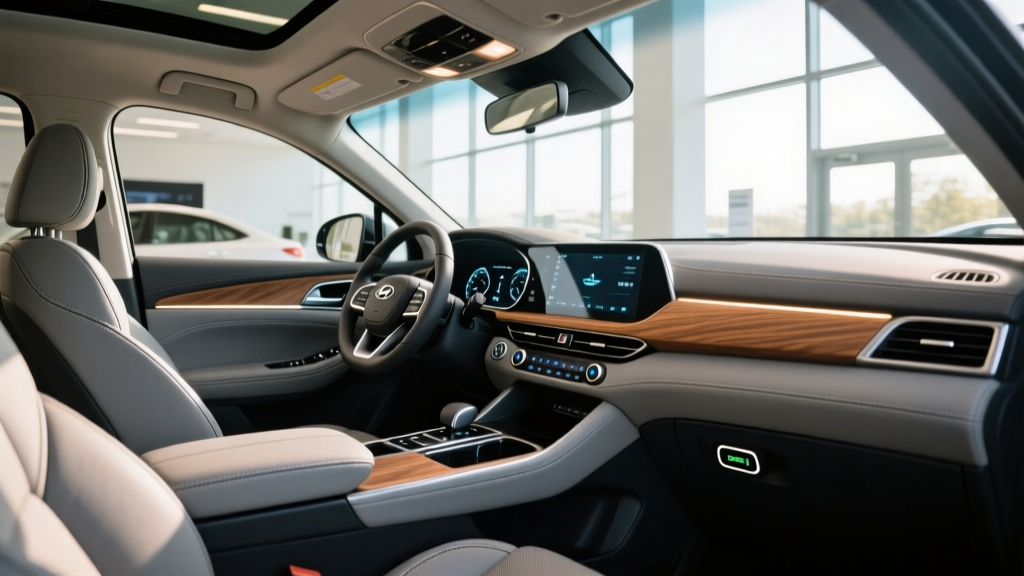
The Palisade Hybrid shares its cabin with the redesigned fourth-generation Palisade, which debuted with a more upscale, boxier design language. The hybrid powertrain does not compromise interior volume — the battery pack is compact enough to be packaged under the rear seats without eating into cargo or passenger space.
Seating and Passenger Room
The 2026 Palisade Hybrid is available in both seven-passenger (captain's chairs) and eight-passenger (bench second row) configurations across its trim lineup. Headroom and legroom remain generous in all three rows, with the third row accommodating adults on shorter trips — a rarity in the midsize SUV class.
- Front headroom: ~40.5 inches
- Second-row legroom: ~42.4 inches (bench configuration)
- Third-row legroom: ~33.5 inches
- Third-row headroom: ~38.1 inches
Cargo Volume
Because the hybrid system doesn't intrude on the cargo area, you get the same utility as the gas model:
- Behind third row: ~21 cubic feet
- Behind second row (third row folded): ~48 cubic feet
- Behind first row (all rear seats folded): ~87 cubic feet
Infotainment and Displays
The 2026 Palisade Hybrid features Hyundai's latest infotainment system with a standard 12.3-inch touchscreen (upper trims get a curved panoramic display combining the gauge cluster and infotainment). Wireless Apple CarPlay and Android Auto are standard across all trims. Available features include a digital key, head-up display, Hyundai Digital Key 2 (phone-as-key), and a rear-seat entertainment system on higher trims.
Interior Materials by Trim
Lower trims (SE, SEL) use cloth and synthetic leather (H-Tex), while the Limited and Calligraphy trims feature genuine Nappa leather, real wood trim, and suede headliners. The Calligraphy trim continues to position itself as a near-luxury experience at a mainstream price point.
Fuel Economy: EPA MPG and Real-World Expectations
The headline number for any hybrid is fuel economy, and the 2026 Palisade Hybrid delivers a substantial improvement over the gas-only V6 model.
| Configuration | City MPG | Highway MPG | Combined MPG |
|---|---|---|---|
| Palisade Hybrid FWD | 29 | 30 | 29 |
| Palisade Hybrid AWD | 27 | 28 | 27 |
| Palisade Gas V6 AWD (baseline) | 19 | 24 | 21 |
Source: fueleconomy.gov — EPA estimates. Your mileage will vary based on driving conditions, climate, and habits.
Real-World MPG: What to Actually Expect
Conventional hybrids like the Palisade Hybrid tend to perform closest to — or even slightly above — their EPA city ratings in stop-and-go traffic, where regenerative braking recaptures energy most effectively. On the highway, where the electric motor contributes less, expect real-world numbers to trend slightly below the EPA highway estimate.
Based on early owner reports and Hyundai's powertrain tuning:
- City / suburban driving: 27–31 MPG (AWD) — the hybrid system shines here
- Highway cruising (70–75 mph): 25–28 MPG (AWD) — less hybrid advantage at sustained speed
- Cold weather (below 35°F): Expect a 5–10% reduction due to cabin heating demands and reduced battery efficiency
- Towing: Significantly reduced, likely 15–18 MPG — the 5,000-lb tow rating still applies, but fuel consumption climbs sharply under load
For a family driving 15,000 miles per year, the jump from 21 MPG combined (gas) to 27 MPG combined (hybrid AWD) saves roughly 175 gallons of fuel annually — about $525–$700 per year at $3.00–$4.00 per gallon.
Powertrain Specs: Engine, Motor, and Horsepower
The 2026 Palisade Hybrid replaces the gas-only model's 3.8-liter V6 with a more efficient turbocharged four-cylinder paired with an electric motor integrated into the transmission housing.
| Engine | 2.5L turbocharged inline-4 |
| Electric motor | 47.7 kW (64 hp) permanent-magnet synchronous |
| Combined system output | ~290 horsepower / 310 lb-ft torque (estimated) |
| Transmission | 6-speed automatic with integrated motor |
| Drivetrain | FWD standard, HTRAC AWD available |
| 0–60 mph | ~7.2 seconds (estimated) |
| Towing capacity | 5,000 lbs (with factory tow package) |
| Fuel tank | 18.8 gallons |
| Total driving range | ~500–540 miles (combined, estimated) |
The turbocharged four-cylinder provides strong low-end torque, and the electric motor fills in any turbo lag, resulting in smooth, responsive acceleration from a stop. The combined output is competitive with the outgoing V6 while delivering roughly 28% better fuel economy.
Pricing, Trims, and Tax Credit Eligibility
The 2026 Palisade Hybrid is available across multiple trim levels, with pricing starting in the low $40,000s and climbing into the mid-$50,000s for the fully loaded Calligraphy trim.
| Trim | Drivetrain | Est. MSRP |
|---|---|---|
| SEL Hybrid | FWD | $42,500 |
| SEL Hybrid | AWD | $44,500 |
| Limited Hybrid | AWD | $49,500 |
| Calligraphy Hybrid | AWD | $54,000 |
Note: Pricing is based on Hyundai's announced MSRP structure for the 2026 model year. Destination charges (~$1,395) are additional. Confirm with your dealer for exact pricing.
Federal Tax Credit: Does the Palisade Hybrid Qualify?
No. Under current IRS §30D rules, the federal clean vehicle credit applies only to plug-in electric vehicles (BEVs and PHEVs) with a battery capacity of at least 7 kWh. The Palisade Hybrid's small (~1.5 kWh) battery does not meet this threshold, and as a conventional HEV, it is not eligible for the federal tax credit.
Key §30D requirements (for reference on PHEVs/BEVs):
- Vehicle must be a plug-in EV or PHEV with ≥7 kWh battery
- MSRP caps: $80,000 for SUVs/pickups/vans, $55,000 for sedans
- Buyer income caps: $300K joint / $225K head of household / $150K individual (MAGI)
- Battery component and critical mineral sourcing requirements (phased in through 2026)
- Point-of-sale transfer available — buyer can apply credit toward down payment
For full details, see the IRS Clean Vehicle Credits page.
Some states and local utilities offer rebates for conventional hybrids, though these are less common and typically smaller ($500–$1,500). Check your state energy office or utility provider for current programs.
Battery Warranty, Reliability, and Replacement Cost
Hybrid battery longevity is consistently one of the top concerns for buyers considering their first hybrid. Hyundai addresses this with one of the strongest hybrid battery warranties in the industry.
Hyundai Hybrid Battery Warranty
- Hybrid battery coverage: 10 years / 100,000 miles (whichever comes first)
- Hybrid system components: 10 years / 100,000 miles (motor, inverter, control unit)
- Powertrain warranty (engine/transmission): 10 years / 100,000 miles
- New vehicle limited warranty: 5 years / 60,000 miles
The hybrid battery warranty covers repair or replacement if the battery falls below a specified capacity threshold (typically 60–70% of original capacity) during the coverage period.
How Long Do Hybrid Batteries Actually Last?
Modern hybrid batteries — including those in the Palisade Hybrid — use nickel-metal hydride or lithium-ion chemistry designed for longevity rather than maximum energy density. Because the battery is small and never deeply discharged (the system keeps it in a narrow state-of-charge window), degradation is minimal.
Real-world data from Hyundai's hybrid lineup (Tucson Hybrid, Santa Fe Hybrid, Sonata Hybrid) shows that most hybrid batteries last well beyond 150,000 miles without significant issues. Taxi fleet data from Hyundai's earlier hybrid models has shown batteries lasting 200,000+ miles.
Battery Replacement Cost
If a hybrid battery does fail outside of warranty, replacement costs for Hyundai's hybrid systems typically range from $2,500 to $4,500 including parts and labor. This is considerably less than EV battery replacements ($8,000–$20,000+) because the hybrid battery is much smaller (~1.5 kWh vs. 75+ kWh in a BEV).
However, given Hyundai's 10-year/100,000-mile coverage and the proven durability of their hybrid components, most owners will never face this cost.
Palisade Hybrid vs. EV vs. Gas: Which Should You Choose?
The Palisade Hybrid occupies a specific niche. Here's a decision framework to help you determine if it's the right fit — or if you should consider the gas model, a PHEV, or a full EV instead.
Choose the Palisade Hybrid (HEV) if:
- You want significantly better fuel economy without changing your routine
- You don't have access to home or workplace charging
- You regularly drive long distances and don't want to plan around charging stops
- You need three rows and 5,000-lb towing in a mainstream-price SUV
- You plan to keep the vehicle 8–10+ years and want strong warranty coverage
Choose the Gas Palisade if:
- You drive fewer than 10,000 miles per year (fuel savings won't offset the hybrid premium)
- You're on the tightest possible budget and the $2,000–$3,000 hybrid premium matters
- You primarily tow heavy loads (where hybrid MPG advantage shrinks)
Consider a 3-Row PHEV (like CX-90 PHEV or XC90 Recharge) if:
- You have home Level 2 charging and a commute under 30 miles
- You want to drive most weekdays on electricity and use gas only for road trips
- You qualify for the §30D federal tax credit (up to $7,500)
Consider a Full EV (like Kia EV9 or Rivian R1S) if:
- You have reliable home charging and want zero tailpipe emissions
- You want the lowest per-mile "fuel" cost and minimal maintenance
- You qualify for the full $7,500 federal tax credit
- You're comfortable with DC fast charging on road trips (plan for 20–30 min stops)
Pros and Cons of the 2026 Palisade Hybrid
Pros
- ~27–29 MPG combined — a major improvement over the 21 MPG gas V6
- No plug-in charging required — works with your existing routine
- 10-year / 100,000-mile hybrid battery and powertrain warranty
- Full three-row seating and 5,000-lb towing preserved
- Spacious, upscale interior with no cargo-space compromise
- Smooth acceleration with turbo + electric motor torque fill
- ~500+ miles total range between fill-ups
Cons
- Not eligible for the $7,500 federal §30D tax credit
- ~$2,000–$3,000 price premium over equivalent gas trims
- Highway MPG gains are modest vs. city driving
- No PHEV variant available — no electric-only commuting
- Fuel savings take 3–5 years to recoup the hybrid premium (depending on mileage)
- Towing fuel economy drops significantly
Frequently Asked Questions
How many MPG does the 2026 Hyundai Palisade Hybrid get?
The EPA estimates the Palisade Hybrid at 29 MPG combined with FWD (29 city / 30 highway) and 27 MPG combined with AWD (27 city / 28 highway). Real-world results vary: expect 27–31 MPG in city driving and 25–28 MPG on the highway with AWD. Cold weather and towing reduce these figures.
Does the Palisade Hybrid need to be plugged in?
No. The Palisade Hybrid is a conventional hybrid (HEV). Its small battery charges through regenerative braking and the gasoline engine. You fuel it exactly like a regular car — there is no plug, no charging cable, and no electric-only driving mode.
Is the Palisade Hybrid available as a plug-in hybrid (PHEV)?
Not for the 2026 model year. Hyundai has not announced a Palisade PHEV variant. If you need plug-in electric range in a three-row SUV, competitors like the Mazda CX-90 PHEV (~26 miles electric-only) or Volvo XC90 Recharge (~35 miles electric-only) are current alternatives.
Does the Palisade Hybrid qualify for any tax credit?
The Palisade Hybrid does not qualify for the federal §30D Clean Vehicle Credit, which requires a plug-in vehicle with a battery of at least 7 kWh. Some state or utility rebates may apply to conventional hybrids, but these are limited. Check your state energy office for details.
Is the hybrid system reliable? What if the battery fails?
Hyundai's hybrid systems have proven reliable across their lineup (Sonata, Tucson, Santa Fe hybrids). The Palisade Hybrid is covered by a 10-year / 100,000-mile hybrid battery and component warranty. Out-of-warranty battery replacement costs approximately $2,500–$4,500, but most hybrid batteries last 150,000+ miles based on fleet and owner data.
How does the Palisade Hybrid interior compare to the gas model?
The interior is identical in layout, materials, and features. The hybrid battery is packaged under the rear seats and does not reduce passenger room or cargo volume. You get the same 21 cu ft behind the third row, the same infotainment system, and the same seating configurations (7 or 8 passengers).
Is the Palisade Hybrid worth the price premium over the gas model?
If you drive 12,000–15,000+ miles per year and keep vehicles for 5+ years, the fuel savings (~$525–$700/year) will recoup the $2,000–$3,000 hybrid premium within 3–5 years. Beyond that, you continue saving. For low-mileage drivers or those who plan to trade in within 2–3 years, the math is less compelling.
What is the total driving range of the Palisade Hybrid?
With an 18.8-gallon fuel tank and 27 MPG combined (AWD), the Palisade Hybrid can travel approximately 500–540 miles on a single tank under normal driving conditions. Highway-only driving may reduce this to ~470 miles; city-heavy driving can push it above 550 miles.