The 2018 Toyota RAV4 XLE Hybrid occupies a specific niche in the used-crossover market: it's a conventional hybrid (HEV) that requires no plug, no behavior change, and no charging infrastructure — yet delivers meaningfully better fuel economy than its gas-only counterpart. With the fourth-generation RAV4 Hybrid now in its final year before a major redesign, the 2018 XLE Hybrid represents a known-quantity proposition for buyers who want electrified efficiency without the complexity of a plug-in or full EV.
This guide breaks down exactly what you're getting with the 2018 RAV4 XLE Hybrid: EPA and real-world MPG, the powertrain specs, hybrid battery longevity, replacement cost expectations, and how it stacks up against the RAV4 Prime PHEV and full EVs for different driving lifestyles.
Powertrain and Performance Specs
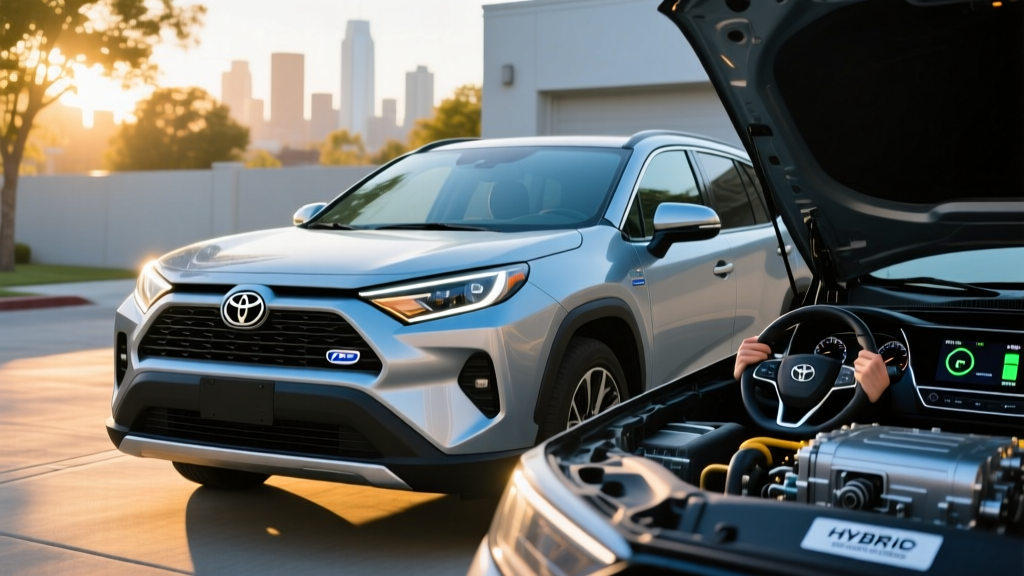
The 2018 RAV4 Hybrid pairs a 2.5-liter Atkinson-cycle four-cylinder gasoline engine with Toyota's Hybrid Synergy Drive system — two electric motor-generators integrated into a continuously variable transaxle. The combined system output is 194 horsepower, routed through an electronically controlled all-wheel-drive system (AWD-i) that uses a dedicated rear-axle electric motor rather than a mechanical driveshaft.
| Specification | Value |
|---|---|
| Powertrain Type | Conventional Hybrid (HEV) — no plug-in |
| Gas Engine | 2.5L Atkinson-cycle I4 |
| Combined System Output | 194 hp |
| Drivetrain | AWD-i (electronic rear motor) |
| Transmission | eCVT (planetary gearset) |
| Hybrid Battery | Nickel-Metal Hydride (NiMH), ~1.6 kWh |
| EPA Fuel Economy | 34 city / 30 highway / 32 combined MPG |
| 0–60 mph (est.) | ~8.1 seconds |
| Towing Capacity | 1,750 lbs |
| Cargo Volume (behind rear seats) | 38.4 cu ft |
A critical distinction for buyers: the 2018 RAV4 Hybrid uses a small nickel-metal hydride (NiMH) battery pack, not the larger lithium-ion pack found in the plug-in RAV4 Prime that debuted for the 2021 model year. This NiMH pack is recharged exclusively through regenerative braking and the gasoline engine. You never plug it in — it operates entirely as a self-charging system.
Fuel Economy: EPA Ratings vs. Real-World MPG
The EPA rates the 2018 RAV4 Hybrid at 34 MPG city, 30 MPG highway, and 32 MPG combined across all trims including the XLE. These figures come from fueleconomy.gov and apply to the AWD-i configuration standard on all Hybrid trims.
| Model | City MPG | Highway MPG | Combined MPG |
|---|---|---|---|
| 2018 RAV4 Hybrid AWD-i | 34 | 30 | 32 |
| 2018 RAV4 Gas AWD (2.5L) | 22 | 28 | 25 |
| Advantage (Hybrid) | +12 | +2 | +7 |
Real-World Expectations
Toyota hybrids consistently perform well in real-world driving, and many owners report matching or slightly exceeding EPA city figures thanks to the frequent engine-off, electric-only operation at low speeds. In stop-and-go urban driving, expect 33–36 MPG. Highway driving at sustained 70+ mph speeds typically yields 28–31 MPG, as the electric motor contributes less at higher velocities and aerodynamic drag dominates.
In cold weather (below 35°F), expect a 5–10% reduction in fuel economy. The gasoline engine runs more frequently to provide cabin heat and maintain operating temperature, reducing the electric-only driving intervals that boost city MPG. This is normal hybrid behavior, not a defect.
Over a full tank (~15.9-gallon fuel tank), real-world range typically falls between 450 and 520 miles depending on driving mix — a substantial advantage for road-trippers who don't want to plan charging stops.
HEV vs. PHEV vs. EV: Which Fits Your Driving Life?
The 2018 RAV4 XLE is a conventional hybrid (HEV). Toyota did not offer a plug-in hybrid (PHEV) version of this generation — the RAV4 Prime PHEV arrived with the redesigned 2021 model. Here's how the three electrified approaches compare for a buyer considering a used RAV4:
| Factor | HEV (2018 RAV4 Hybrid) | PHEV (2021+ RAV4 Prime) | BEV (e.g., Tesla Model Y) |
|---|---|---|---|
| Plug-in Required? | No | Yes (benefits greatly from home charging) | Yes (mandatory) |
| Electric-Only Range | ~0.5 mi at low speed | 42 mi (EPA) | 280–330 mi (varies by model) |
| Combined MPG / MPGe | 32 MPG | 94 MPGe (electric) / 38 MPG (gas) | 115–125 MPGe |
| Battery Size | ~1.6 kWh (NiMH) | 18.1 kWh (Li-ion) | 60–82 kWh (Li-ion) |
| Fueling/Charging | Gas station only | Gas + plug-in | Plug-in only |
| Used Price Range (2026) | ~$18,000–$23,000 | ~$30,000–$38,000 | ~$25,000–$40,000+ |
Choose the HEV (2018 RAV4 Hybrid) if: You lack home charging access, drive a mixed city/highway commute, want the lowest purchase price, and prefer the simplicity of gas-station refueling with a MPG boost. This is the zero-behavior-change option.
Choose a PHEV (used RAV4 Prime) if: You can charge at home, your daily commute is under 42 miles round-trip (covering most days on electricity alone), and you want a gas backup for longer trips without range planning.
Choose a full EV if: You have reliable home or workplace charging, your daily driving is under 250 miles, and you want to eliminate gasoline entirely while minimizing maintenance.
Hybrid Battery Longevity and Replacement Cost
Hybrid battery lifespan is the single most common concern among used-hybrid buyers. The 2018 RAV4 Hybrid's NiMH battery pack is a mature, well-proven technology — Toyota has been refining its Hybrid Synergy Drive system since the original 1997 Prius, and by 2018 the system was in its fourth generation of engineering.
Battery Warranty Coverage
Toyota's hybrid battery warranty for the 2018 RAV4 Hybrid is 8 years / 100,000 miles (whichever comes first) in most states, and 10 years / 150,000 miles in California and states that follow CARB emissions standards (including NY, MA, NJ, CT, RI, VT, ME, OR, WA, and others).
For a 2018 model, the standard 8-year/100k warranty expires in 2026. If you're buying in 2026, verify remaining warranty coverage with a Toyota dealer using the VIN. CARB-state vehicles retain coverage through 2028 or 150,000 miles.
Real-World Battery Lifespan Data
NiMH hybrid batteries in Toyota vehicles routinely last 150,000 to 200,000+ miles before significant degradation. Unlike the large lithium-ion packs in full EVs, the RAV4 Hybrid's small battery operates within a narrow state-of-charge window (roughly 40–80%) managed by the vehicle's computer, which dramatically reduces wear. The battery never fully charges or fully depletes during normal operation.
Individual cell failures within the pack are more common than complete pack failure. Many independent hybrid repair shops offer cell-level reconditioning or replacement for $500–$1,500, extending the pack's life without a full replacement.
Full Battery Replacement Cost
If the hybrid battery does require complete replacement, expect the following cost ranges:
- Toyota dealer (new OEM pack): $3,000–$4,500 including labor
- Independent hybrid specialist (remanufactured pack): $1,500–$2,500 including labor
- Used/salvage pack: $800–$1,500 (variable condition, shorter warranty)
For context, the gas-only RAV4 of the same era would likely need $2,000–$4,000 in transmission or engine work at similar mileage — costs the hybrid often avoids due to the eCVT's simplicity (no traditional gear sets, belts, or torque converter to wear out) and regenerative braking reducing brake pad wear.
Reliability, Maintenance, and Ownership Costs
The 2018 RAV4 Hybrid carries Toyota's reputation for long-term reliability, and the data supports it. The Hybrid Synergy Drive system eliminates several traditional failure points: there is no conventional starter motor, no alternator, no accessory drive belt, and no traditional automatic transmission. The eCVT planetary gearset has far fewer moving parts than a geared automatic or CVT with a push belt.
Brake pad life is typically extended to 80,000–120,000 miles thanks to regenerative braking handling the majority of deceleration. Oil change intervals remain at Toyota's standard 10,000 miles with synthetic oil.
Insurance costs for the 2018 RAV4 Hybrid are generally in line with the gas model — insurers don't typically surcharge for conventional hybrids the way they sometimes do for full EVs. Expect average annual premiums of $1,200–$1,800 depending on your state, driving record, and coverage level.
Known Issues to Watch
While the powertrain is robust, a few items warrant attention on a used 2018 RAV4 Hybrid:
- Inverter coolant pump: Toyota issued a recall on some 2018 RAV4 Hybrid models for the inverter coolant pump. Verify recall completion via NHTSA's recall lookup using the VIN.
- Rear differential fluid: The AWD-i rear electric motor/differential has its own fluid. Some owners report whine or noise at high mileage if this fluid was never changed — a $100–$150 service at any shop.
- 12V auxiliary battery: Like all modern vehicles, the RAV4 Hybrid has a standard 12V battery for electronics. It's located in the rear cargo area and typically lasts 4–6 years. A dead 12V battery will prevent the vehicle from starting, even if the hybrid battery is fully charged.
Tax Credits and Incentives
The 2018 Toyota RAV4 Hybrid is a conventional hybrid (HEV), not a plug-in vehicle. Under current IRS rules, conventional hybrids do not qualify for the federal §30D Clean Vehicle Credit. That credit applies only to plug-in electric vehicles (BEVs and PHEVs) meeting battery capacity, MSRP, income, and critical-mineral sourcing requirements.
There is no federal tax credit available for purchasing a used conventional hybrid. Some states historically offered rebates for hybrids, but most have redirected those incentives toward plug-in vehicles. Check your state's energy office or fueleconomy.gov's incentive finder for any remaining local programs.
The financial case for the 2018 RAV4 Hybrid rests entirely on fuel savings and lower maintenance costs rather than purchase incentives. At 32 MPG combined versus the gas model's 25 MPG, and with national gas prices averaging around $3.20/gallon (as of early 2026), the hybrid saves approximately $550–$700 per year in fuel costs for a driver covering 15,000 miles annually. Over five years, that's $2,750–$3,500 in fuel savings — meaningful for a vehicle in the $18,000–$23,000 used price range.
Pros and Cons: 2018 RAV4 XLE Hybrid
Pros
- 32 MPG combined with no plug-in required — zero behavior change
- Standard AWD-i for all-weather capability without a fuel-economy penalty
- Proven Toyota Hybrid Synergy Drive reliability with 200k+ mile battery lifespan
- Extended brake life from regenerative braking
- Simple eCVT with no traditional transmission failure points
- Spacious 38.4 cu ft cargo area
- Strong resale value retention
Cons
- Highway MPG (30) only marginally better than gas model (28)
- No electric-only driving range of practical significance
- Older NiMH battery chemistry (heavier, less energy-dense than Li-ion)
- Modest 194 hp — adequate but not quick for highway merging
- Infotainment system is dated by 2026 standards (no wireless CarPlay)
- 1,750-lb towing limit is low for the compact SUV segment
- Standard 8yr/100k battery warranty may be expiring in 2026
Frequently Asked Questions
How many MPG does the 2018 Toyota RAV4 XLE Hybrid get?
The EPA rates it at 34 MPG city, 30 MPG highway, and 32 MPG combined. In real-world driving, city MPG often reaches 33–36 thanks to electric motor assist at low speeds, while sustained highway driving at 70+ mph typically yields 28–31 MPG. Cold weather reduces these figures by 5–10%.
Does the 2018 RAV4 Hybrid need to be plugged in?
No. This is a conventional hybrid (HEV), not a plug-in hybrid (PHEV). The battery recharges through regenerative braking and the gasoline engine. You fuel it exclusively at gas stations, exactly like a conventional car.
How long does the hybrid battery last, and what does replacement cost?
Toyota's NiMH hybrid batteries commonly last 150,000–200,000+ miles. A full OEM replacement at a dealer runs $3,000–$4,500; a remanufactured pack from an independent hybrid specialist costs $1,500–$2,500. Individual cell repairs can cost as little as $500–$1,500.
Does the 2018 RAV4 Hybrid qualify for a tax credit?
No. Conventional hybrids (HEVs) do not qualify for the federal §30D Clean Vehicle Credit, which applies only to plug-in electric vehicles. There are no current federal incentives for purchasing a used conventional hybrid. The financial benefit comes from fuel savings, not purchase incentives.
Is the 2018 RAV4 Hybrid better than the gas model?
For most buyers, yes — if the price premium is reasonable. The hybrid delivers 7 more combined MPG, standard AWD, smoother stop-start behavior, extended brake life, and a simpler transmission. The trade-off is slightly less highway fuel economy advantage and a lower towing rating (1,750 lbs vs. the gas model's 1,500 lbs — actually comparable). If you drive mostly city miles, the hybrid's advantage is substantial.
What should I check before buying a used 2018 RAV4 Hybrid?
Verify the hybrid battery state of health via a Toyota dealer diagnostic scan or an independent hybrid shop. Check NHTSA for open recalls (especially the inverter coolant pump). Confirm remaining hybrid battery warranty using the VIN. Inspect the rear differential fluid condition. A pre-purchase inspection by a technician familiar with Toyota hybrids is strongly recommended — it typically costs $100–$200 and can reveal battery degradation invisible to a casual test drive.