The 2018 Toyota Highlander Hybrid at a Glance
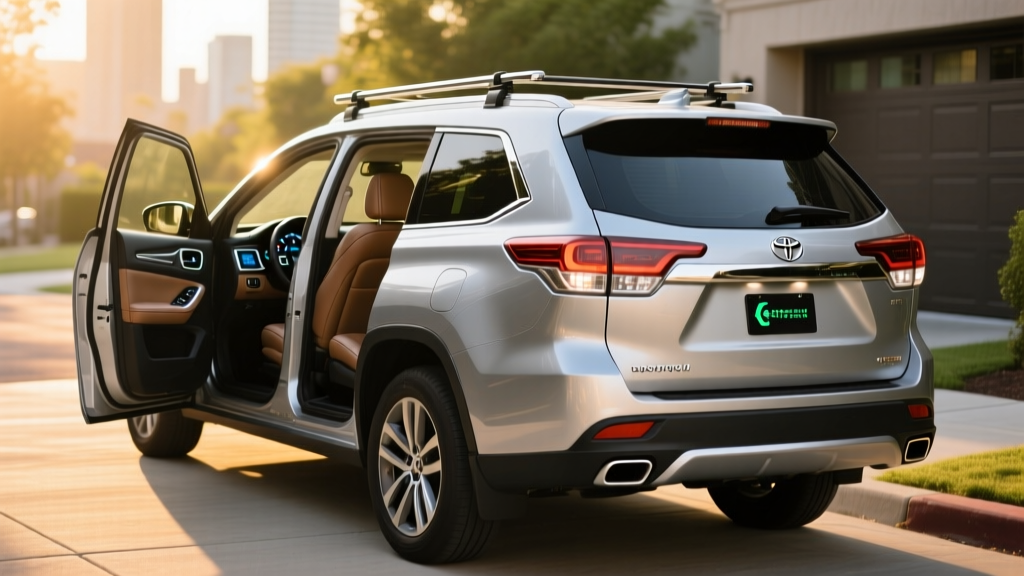
If you are shopping the used three-row SUV market in 2026 and want to cut fuel costs without plugging in, the 2018 Toyota Highlander Hybrid remains one of the most practical options on the road. It pairs a 3.5-liter V6 with Toyota's proven hybrid synergy drive to deliver 306 combined horsepower and an EPA-estimated 29 MPG combined — in a vehicle that seats up to eight and hauls families in comfort.
This is a conventional hybrid (HEV), not a plug-in hybrid (PHEV). You never plug it in. The battery recharges through regenerative braking and the gasoline engine. That distinction matters, because it means no charging infrastructure, no range anxiety, and no eligibility for the federal §30D EV tax credit. What you get instead is a drop-in fuel-economy upgrade over the gas-only Highlander with decades of Toyota hybrid reliability behind it.
A conventional hybrid (HEV) like the 2018 Highlander Hybrid uses a small battery (typically 1–2 kWh) charged by the engine and regen braking. You fuel it like any gas car. A plug-in hybrid (PHEV) has a larger battery (10–20+ kWh), can be plugged in, and offers 20–50 miles of electric-only driving before the gas engine takes over. The 2018 Highlander was never offered as a PHEV. If you want a Toyota PHEV with three rows, you would need to look at the RAV4 Prime (two rows) or the newer Grand Highlander Hybrid MAX (HEV only) — Toyota does not currently sell a three-row PHEV in the US.
Fuel Economy: EPA Ratings vs Real-World MPG
| Metric | EPA Estimate | Real-World Expectation |
|---|---|---|
| City MPG | 29 MPG | 28–32 MPG |
| Highway MPG | 27 MPG | 25–28 MPG |
| Combined MPG | 29 MPG | 27–30 MPG |
Source: fueleconomy.gov — 2018 Toyota Highlander Hybrid
The 2018 Highlander Hybrid's city MPG matches its combined rating — a hallmark of Toyota's hybrid system, which leans heavily on electric-motor assist at low speeds where gas engines are least efficient. In real-world driving, owners who do a lot of stop-and-go suburban commuting often report matching or slightly exceeding the 29 MPG city figure. Highway driving is where this hybrid loses its edge somewhat: at sustained 70–80 MPH speeds, the V6 does more of the work, and you can expect 25–27 MPG depending on terrain, temperature, and cargo load.
For a 5,000-pound three-row SUV, those numbers are genuinely impressive. The gas-only 2018 Highlander with the V6 and 8-speed automatic returns 20 city / 27 highway / 23 combined. That's a 6 MPG combined advantage for the hybrid — roughly a 26% improvement in fuel economy — translating to about $300–$450 in annual fuel savings at 15,000 miles per year and $3.30/gallon regular unleaded.
Powertrain and Performance Specs
| Specification | Value |
|---|---|
| Engine | 3.5L V6 (2GR-FKS) + 2 electric motors |
| Combined Horsepower | 306 HP |
| Engine HP (net) | 295 HP @ 6,000 RPM |
| Front Motor Output | 167 HP / 247 lb-ft |
| Rear Motor Output | 67 HP / 103 lb-ft |
| Transmission | eCVT (electronically controlled) |
| Drivetrain | AWD (electronic on-demand rear axle) |
| 0–60 MPH | ~7.6 seconds |
| Towing Capacity | 3,500 lbs |
| Hybrid Battery Type | Nickel-Metal Hydride (NiMH), ~1.9 kWh |
| Fuel Tank | 17.2 gallons (regular unleaded) |
| Total Driving Range | ~499 miles |
The hybrid system in the 2018 Highlander uses Toyota's Hybrid Synergy Drive with an electronically controlled CVT. There are no fixed gears — the eCVT uses a planetary gearset to blend engine and motor power seamlessly. The result is smooth, linear acceleration with none of the "rubber band" feel of older CVTs. The 306 HP combined output actually makes the hybrid the quickest Highlander in the 2018 lineup, beating the gas-only V6 by roughly half a second to 60 MPH.
The AWD system is worth noting: there is no mechanical driveshaft to the rear wheels. Instead, a dedicated rear electric motor engages the rear axle on demand — during acceleration, low-traction situations, or when the system detects front-wheel slip. This keeps weight down and packaging efficient but means the AWD is oriented toward on-road safety, not off-road crawling.
Hybrid Battery Lifespan, Warranty, and Replacement Cost
Toyota warranted the 2018 Highlander Hybrid's battery for 8 years / 100,000 miles in most states, and 10 years / 150,000 miles in California Air Resources Board (CARB) states (CA, CT, MA, ME, MD, NJ, NY, OR, RI, VT, WA). As a 2018 model, the original federal warranty will have expired by mid-2026 for most owners. CARB-state warranties may still be in effect for low-mileage examples.
The 2018 Highlander Hybrid uses a nickel-metal hydride (NiMH) battery pack — a chemistry Toyota has refined over more than 25 years since the original Prius. NiMH is less energy-dense than modern lithium-ion but extremely durable and thermally stable. Real-world data from high-mileage Toyota hybrids routinely shows these packs lasting 150,000–200,000+ miles with minimal capacity loss. The hybrid battery in this generation is not a frequent failure point.
If the battery does eventually need replacement, here is what to budget:
- Toyota dealership (new OEM pack): $3,500–$5,000 including labor
- Independent hybrid specialist (remanufactured pack): $2,000–$3,500 including labor
- Individual cell module replacement: $500–$1,500 if only a few cells have degraded (a viable repair for NiMH packs)
The hybrid system also includes the inverter, transaxle, and electric motors, which carry the same hybrid-system warranty. These components are generally robust, but the inverter is the second-most-expensive potential repair at $2,000–$3,500 if it fails outside warranty.
Used Pricing in 2026 and Tax Credit Eligibility
The 2018 Toyota Highlander Hybrid was originally sold in LE, XLE, and Limited trims with MSRPs ranging from roughly $40,000 to $49,000 when new. In the 2026 used market, expect to pay:
- LE trim (80,000–110,000 miles): $19,000–$24,000
- XLE trim (60,000–90,000 miles): $23,000–$28,000
- Limited trim (50,000–80,000 miles): $26,000–$32,000
Toyota Highlanders hold their value exceptionally well, and the hybrid variant commands a premium over the gas model on the used market — typically $1,500–$3,000 more for equivalent mileage and condition.
The 2018 Highlander Hybrid does not qualify for the federal §30D Clean Vehicle Credit ($7,500 for new EVs/PHEVs) because it is a conventional hybrid, not a plug-in vehicle. It also does not qualify for the Used Clean Vehicle Credit (§25E, up to $4,000), which applies only to used BEVs and PHEVs with a battery capacity of at least 7 kWh. The Highlander Hybrid's ~1.9 kWh NiMH pack falls well below that threshold. There is no federal tax incentive for purchasing this vehicle. Some states may offer minimal hybrid incentives — check your state's energy office for current programs.
Who Should Choose the 2018 Highlander Hybrid?
- 29 MPG combined in a three-row SUV
- 306 HP — the quickest 2018 Highlander
- Standard AWD via rear electric motor
- Toyota's legendary hybrid reliability
- No plug-in required — fuel and go
- Seats up to 8 passengers
- Proven NiMH battery with 150K+ mile track record
- No electric-only driving mode
- No federal tax credit eligibility
- Highway MPG drops to 25–27 real-world
- 3,500-lb towing (less than some competitors)
- Dated infotainment vs 2026 standards
- Original hybrid warranty mostly expired
- Used prices remain high for model year
Highlander Hybrid vs PHEV vs Full EV — Which Fits You?
| Factor | HEV (This Highlander) | PHEV (e.g., Chrysler Pacifica Hybrid) | BEV (e.g., Kia EV9) |
|---|---|---|---|
| Plug in? | No | Yes (optional) | Yes (required) |
| Electric-only range | None | 20–40 mi | 230–350 mi |
| Home charger needed? | No | Recommended | Yes (Level 2) |
| Federal tax credit | None | Up to $7,500 (new) | Up to $7,500 (new) |
| Best for | No home charging access | Short commutes + road trips | Home charging + low running costs |
| Fuel cost (annual est.) | $1,700–$2,100 | $900–$1,600 | $500–$800 |
The 2018 Highlander Hybrid is the right call if you cannot install a home charger (apartment living, street parking, no garage), regularly take long road trips where charging infrastructure is sparse, or simply want the lowest-complexity path to better fuel economy. It asks nothing of you except gasoline.
If you have home charging and a commute under 30 miles, a PHEV like the Chrysler Pacifica Hybrid (32 miles electric-only, seats 7) can run most daily trips on electricity while keeping the gas engine for road trips. The trade-off is higher purchase price, the need for a Level 2 home charger to maximize value, and a more complex powertrain.
A full BEV three-row SUV (Kia EV9, Tesla Model X) offers the lowest running costs and strongest tax incentives but demands reliable home or workplace charging and acceptance of current charging-infrastructure limitations on road trips.
Frequently Asked Questions
How many MPG does the 2018 Highlander Hybrid get?
The EPA rates the 2018 Toyota Highlander Hybrid at 29 city / 27 highway / 29 combined MPG. In real-world driving, expect 28–32 MPG in city and suburban use, and 25–28 MPG on the highway. Cold weather, heavy cargo loads, and sustained high-speed driving will push figures toward the lower end.
Is the 2018 Highlander Hybrid a plug-in hybrid?
No. The 2018 Highlander Hybrid is a conventional hybrid (HEV). It cannot be plugged in and has no electric-only driving range. The battery recharges through regenerative braking and the gasoline engine. Toyota has never offered a plug-in variant of the Highlander.
Is this hybrid reliable and what is battery replacement cost?
Toyota's hybrid powertrain is among the most reliable in the industry. The NiMH battery pack in the 2018 Highlander Hybrid commonly lasts 150,000–200,000+ miles. If replacement is needed, expect $3,500–$5,000 at a Toyota dealer or $2,000–$3,500 at an independent hybrid shop for a remanufactured pack. The eCVT transaxle is also highly durable with no traditional transmission fluid to change on the standard interval.
Does the 2018 Highlander Hybrid qualify for any tax credit?
No. The federal §30D Clean Vehicle Credit and the §25E Used Clean Vehicle Credit apply only to plug-in electric vehicles (BEVs and PHEVs) with a battery capacity of at least 7 kWh. The Highlander Hybrid's ~1.9 kWh NiMH battery does not meet this threshold. Check IRS.gov for current credit rules. Some state-level incentives may exist for efficient vehicles — consult your state energy office.
How does the 2018 Highlander Hybrid compare to the gas-only model?
The hybrid gets about 6 MPG more combined (29 vs 23), produces more power (306 HP vs 295 HP), and comes standard with AWD. The trade-off is a higher purchase price — both when new and on the used market. At 15,000 miles per year, the fuel savings typically offset the used-price premium in 4–6 years depending on gas prices.
What should I check when buying a used 2018 Highlander Hybrid?
Prioritize a pre-purchase inspection that includes a hybrid battery health check (many Toyota dealers can pull the battery block voltage data). Look for consistent block voltages — a wide variance suggests cell degradation. Also verify the hybrid system warranty status based on the in-service date and your state's CARB designation. Check for the standard recalls and service campaigns at NHTSA.gov.