The 2009 Honda Civic Hybrid at a Glance
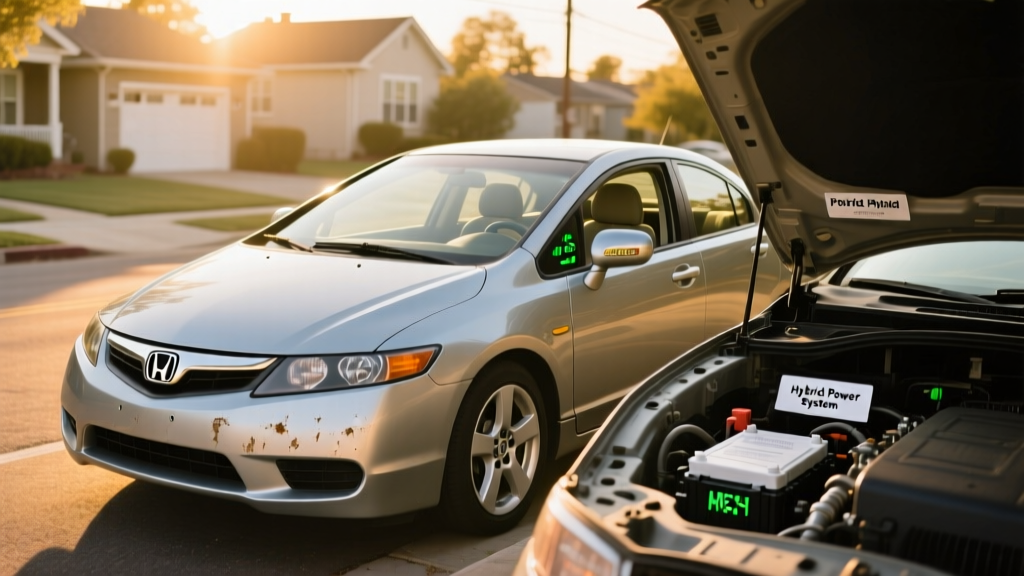
The 2009 Honda Civic Hybrid occupies a specific niche in the used-car market: it is a conventional hybrid electric vehicle (HEV) — not a plug-in — that Honda built during the era when the Toyota Prius dominated the efficiency conversation. Powered by Honda's Integrated Motor Assist (IMA) system, the Civic Hybrid pairs a 1.3-liter four-cylinder gasoline engine with a small electric motor sandwiched between the engine and the continuously variable transmission (CVT). The result, when new, was one of the most fuel-efficient compact sedans available in the United States.
If you are researching the 09 Honda Civic Hybrid in 2026, you are likely evaluating it as a budget-friendly used vehicle for commuting, rideshare driving, or a first car for a new driver. This guide covers everything you need to know: real-world fuel economy, IMA battery health and replacement costs, powertrain specs, and whether this 17-year-old hybrid still earns its keep against modern alternatives.
Fuel Economy: EPA Ratings vs. Real-World MPG
The EPA rated the 2009 Honda Civic Hybrid at 40 MPG city / 45 MPG highway / 42 MPG combined when equipped with the CVT (the only transmission offered for the hybrid trim that year). These figures come from fueleconomy.gov, the official source for EPA fuel-economy data.
| Metric | Value |
|---|---|
| City MPG | 40 |
| Highway MPG | 45 |
| Combined MPG | 42 |
| Fuel Type | Regular Unleaded (87 octane) |
| Fuel Tank Capacity | 13.2 gallons |
| Estimated Total Range | ~554 miles |
Real-World MPG: What Owners Actually Report
Honda's IMA system in this generation is a mild hybrid — the electric motor assists the gasoline engine rather than driving the wheels independently. Real-world fuel economy varies significantly based on driving style, climate, and battery condition:
- City driving (stop-and-go): 38–44 MPG. The IMA system recaptures energy during braking and assists during acceleration, which is where hybrids shine. Many owners report matching or slightly exceeding the EPA city figure in warm weather.
- Highway cruising (65–75 mph): 40–47 MPG. The Civic Hybrid's lean-burn i-VTEC engine is efficient at steady speeds, though aerodynamic drag and tire condition affect results.
- Cold weather penalty: Expect a 5–12% drop in fuel economy when ambient temperatures fall below 40°F. The engine runs richer during warm-up, cabin heating demands more energy, and battery efficiency decreases.
- With a degraded IMA battery: 30–36 MPG combined. This is the critical variable for used buyers. If the nickel-metal hydride (NiMH) battery pack has lost significant capacity, the electric assist diminishes, and the gasoline engine shoulders more of the load.
Powertrain Specifications and Performance
The 2009 Civic Hybrid uses Honda's second-generation IMA system. Unlike Toyota's Hybrid Synergy Drive (which can propel the Prius on electric power alone at low speeds), the IMA system is a parallel hybrid — the electric motor and gasoline engine are mechanically linked and cannot operate independently to drive the wheels.
| Specification | Value |
|---|---|
| Engine | 1.3L i-VTEC inline-4 (LDA2) |
| Engine Horsepower | 95 hp @ 6,000 rpm |
| Electric Motor Output | 20 hp (15 kW) |
| Combined System Output | 110 hp @ 6,000 rpm |
| Combined Torque | 123 lb-ft @ 1,000–2,500 rpm |
| Transmission | CVT (Continuously Variable) |
| Drivetrain | Front-Wheel Drive |
| 0–60 mph (est.) | ~11.5 seconds |
| IMA Battery Chemistry | Nickel-Metal Hydride (NiMH) |
| IMA Battery Capacity | ~0.35 kWh (nominal) |
The performance profile is leisurely by modern standards. The 110 combined horsepower and CVT tuning prioritize efficiency over acceleration. Merging onto highways requires planning, and passing at speed demands patience. This is a commuter car, not a performance vehicle — and that is by design.
IMA Battery Lifespan, Degradation, and Replacement Cost
The IMA battery is the single most important factor when evaluating a used 2009 Honda Civic Hybrid in 2026. This NiMH pack is small — approximately 0.35 kWh — and was designed for assist duty, not electric-only propulsion. But its health directly determines fuel economy, drivability, and whether the car triggers the dreaded IMA warning light.
• Original warranty: 8 years / 80,000 miles (10 years / 150,000 miles in CARB states including California, New York, Massachusetts, and others adopting California emissions standards).
• Warranty coverage threshold: Honda warranted the IMA battery against defects causing capacity loss below approximately 60% of original.
• Current status (2026): All factory warranties have expired. The vehicle is 17 years old — any battery replacement will be out of pocket unless covered by an aftermarket warranty.
• Expected NiMH lifespan: 10–15 years or 120,000–180,000 miles before significant degradation. Many original batteries have already been replaced at least once.
Signs of IMA Battery Degradation
When test-driving or inspecting a used 2009 Civic Hybrid, watch for these indicators:
- IMA warning light on dashboard: Illuminates when the system detects a fault. This can indicate individual cell failure, temperature sensor issues, or overall capacity loss.
- Recalibration cycling: The battery gauge rapidly drops and then recharges repeatedly. This "recal" behavior indicates the battery management system is struggling to estimate state of charge accurately — a hallmark of cell imbalance.
- Reduced fuel economy: A drop from the expected 40+ MPG to the low-to-mid 30s suggests diminished electric assist.
- Auto-stop not engaging: The IMA system normally shuts off the engine at stops to save fuel. If the engine idles at red lights instead, the battery may lack sufficient charge to restart it reliably.
- Charging/discharging bars: On the dashboard IMA display, if the charge indicator rarely shows more than 2–3 bars or stays fully charged without discharging during acceleration, capacity is likely diminished.
Battery Replacement Options and Costs
| Option | Estimated Cost | Notes |
|---|---|---|
| New OEM Honda IMA Battery | $2,000–$3,000 | Includes part + labor at dealership. Availability may be limited in 2026. |
| Aftermarket New NiMH Pack | $1,200–$1,800 | Third-party suppliers (e.g., BumbleBee Batteries, Dorman). Common choice for older Civics. |
| Refurbished/Reconditioned Pack | $600–$1,000 | Replaced individual cells. Shorter lifespan; verify warranty terms. |
| DIY Cell Replacement | $200–$500 | For experienced hobbyists. Requires discharging, balancing, and safety precautions with NiMH cells. |
For most used buyers, the aftermarket new NiMH pack is the best value. It restores full IMA functionality at roughly half the cost of an OEM replacement. Factor this into your purchase budget — if the seller hasn't replaced the battery recently, plan for a $1,200–$1,800 expense within the first year of ownership.
Pricing, Value, and Tax Credit Eligibility
The 2009 Honda Civic Hybrid was originally priced at approximately $22,600 MSRP (single trim level). In the 2026 used-car market, expect to pay:
- $3,500–$5,500 for an example with 120,000–180,000 miles and an original or refurbished IMA battery
- $5,500–$7,500 for a well-maintained example with under 100,000 miles and a recently replaced aftermarket or OEM battery
- $7,500–$9,000 for a low-mileage, single-owner specimen with full service records and a fresh battery
Does the 2009 Civic Hybrid Qualify for Any Tax Credits?
No. The federal hybrid tax credit (which existed under the Energy Policy Act of 2005) applied only to the original purchaser and was subject to manufacturer phase-out caps. Honda's hybrid credit phase-out was triggered in 2007–2008 after the company sold its 60,000th qualifying hybrid. By the time the 2009 Civic Hybrid reached dealers, the federal credit had already been eliminated for Honda hybrids.
Additionally, the current IRS §30D Clean Vehicle Credit applies only to new battery electric vehicles (BEVs) and fuel cell electric vehicles (FCEVs), plus qualifying new plug-in hybrids (PHEVs) with at least 7 kWh of battery capacity. The 2009 Civic Hybrid, as a conventional HEV with a 0.35 kWh battery, does not qualify under any current federal incentive program.
Some states and municipalities offer used EV/PHEV incentives or emissions-reduction rebates that may cover older hybrids — check with your state's energy office or department of environmental quality for current programs.
Who Should Buy the 2009 Civic Hybrid — and Who Shouldn't
The decision to purchase a 17-year-old hybrid in 2026 comes down to budget, use case, and risk tolerance. Here is a practical framework:
- Your total vehicle budget is under $8,000 and you need maximum fuel efficiency at minimum cost
- You commute in stop-and-go city traffic where the IMA system delivers its best MPG gains
- You have access to a trusted independent mechanic familiar with Honda IMA systems
- You can absorb a potential $1,200–$1,800 battery replacement within your first year
- You want a simple, proven powertrain without plug-in charging requirements
- You want modern safety features — the 2009 Civic lacks electronic stability control (standard only from 2010+), blind-spot monitoring, automatic emergency braking, or lane-keeping assist
- You need strong acceleration for highway merging or mountain driving
- You want electric-only driving capability — consider a used PHEV like the Toyota Prius Prime or Honda Clarity
- You lack budget flexibility for unexpected repairs (transmission, suspension, and A/C components on 17-year-old vehicles)
- You want warranty coverage — this vehicle is sold as-is in nearly all cases
Hybrid vs. PHEV vs. Full EV — Which Fits You?
| Factor | HEV (e.g., 2009 Civic Hybrid) | Used PHEV (e.g., 2017 Prius Prime) | Used BEV (e.g., 2018 Leaf) |
|---|---|---|---|
| Typical Used Price (2026) | $4,000–$8,000 | $12,000–$18,000 | $9,000–$15,000 |
| Plugs In? | No | Yes (120V/240V) | Yes (120V/240V/DC) |
| Electric-Only Range | 0 miles | 20–25 miles | 80–150 miles |
| Fuel Cost per Mile | ~$0.08–$0.10 | ~$0.03–$0.08 | ~$0.03–$0.05 |
| Home Charging Needed? | No | Recommended | Essential |
| Federal Tax Credit (Used) | None | Up to $4,000 (§25E)* | Up to $4,000 (§25E)* |
*The IRS §25E Previously Owned Clean Vehicle Credit provides up to $4,000 (or 30% of sale price, whichever is lower) for qualifying used EVs and PHEVs purchased from a dealer for $25,000 or less. Income caps apply: $75,000 single / $150,000 joint filers. The 2009 Civic Hybrid does not qualify — it is a conventional HEV, not a PHEV or BEV.
Reliability and Long-Term Ownership Costs
The 2009 Civic Hybrid carries a mixed reliability reputation. The underlying Civic platform — suspension, brakes, interior, electrical accessories — is generally robust and benefits from Honda's parts availability. The IMA system, however, introduces specific failure modes that conventional Civics do not face.
Common Issues to Inspect
- IMA battery failure: The most common and costly issue. Budget for replacement as described above.
- CVT shudder or slipping: Honda's CVTs from this era can develop judder under acceleration, particularly if the transmission fluid was not changed at recommended intervals (every 30,000–60,000 miles with Honda HMMF fluid). A CVT replacement runs $2,500–$4,000.
- Motor mount wear: The engine motor mounts, particularly the passenger-side mount, are known to deteriorate, causing vibration at idle. Replacement: $200–$400.
- A/C compressor: The A/C system on 2006–2011 Civics is prone to compressor failure. Budget $800–$1,200 for a full A/C repair if the system is not blowing cold.
- Clear coat peeling: Honda paint from this era, particularly in white and silver, is notorious for clear coat failure. Cosmetic only, but affects resale value.
For a NHTSA safety and recall history check, enter the VIN at nhtsa.gov/recalls to verify all open recalls have been addressed.
Frequently Asked Questions
How many MPG does the 2009 Honda Civic Hybrid actually get?
The EPA rates it at 40 city / 45 highway / 42 combined MPG. In real-world driving with a healthy IMA battery, most owners report 38–46 MPG depending on conditions. With a degraded battery, expect 30–36 MPG combined. Cold weather and aggressive driving reduce figures further.
Does the 2009 Civic Hybrid need to be plugged in?
No. It is a conventional hybrid (HEV), not a plug-in hybrid. The small NiMH battery recharges through regenerative braking and the gasoline engine. You fuel it exclusively at a gas station with regular 87-octane unleaded.
How far can it drive on electric power alone?
Zero miles. The IMA system cannot propel the car on electric power alone. The electric motor only assists the gasoline engine during acceleration. This is fundamentally different from a PHEV (like the Prius Prime) or a BEV (like the Nissan Leaf), which can drive on electricity exclusively.
Is the 2009 Civic Hybrid reliable in 2026?
The Civic platform is generally reliable, but the IMA battery and CVT are known weak points on a 17-year-old vehicle. Reliability depends entirely on maintenance history and whether the IMA battery has been replaced. A well-maintained example with a fresh battery can be dependable daily transportation. An neglected example can become a money pit.
What does it cost to replace the IMA battery?
Aftermarket new NiMH battery packs cost $1,200–$1,800 installed. OEM Honda replacements run $2,000–$3,000 if still available. Refurbished packs cost $600–$1,000 but offer shorter lifespans. DIY cell replacement is possible for $200–$500 but requires technical skill.
Does the 2009 Honda Civic Hybrid qualify for any federal tax credit?
No. The original hybrid tax credit was phased out for Honda in 2008. The current §30D credit applies only to new EVs and PHEVs, and the §25E used-vehicle credit applies only to used BEVs and PHEVs. As a conventional HEV, the Civic Hybrid qualifies for no federal incentive.
Should I buy a 2009 Civic Hybrid or save for a newer used hybrid?
If your budget is strictly under $8,000 and you need a car now, a well-inspected 2009 Civic Hybrid with a fresh battery can be an efficient commuter. If you can stretch to $12,000–$16,000, a 2016–2019 Toyota Prius or Honda Insight offers better fuel economy (52–56 MPG), modern safety features (automatic emergency braking, lane-keeping), and a younger battery with more remaining life.