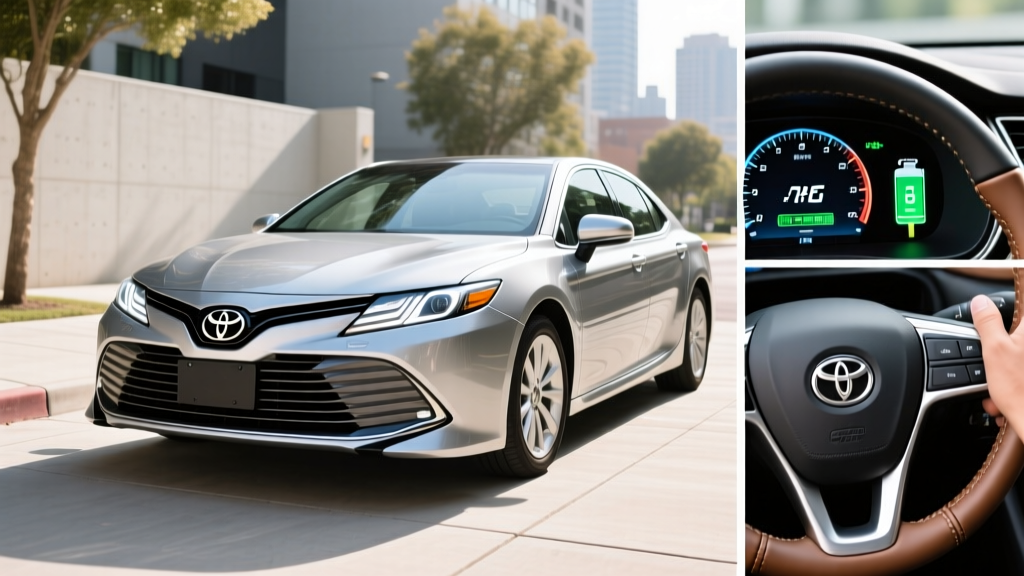
The 2018 Toyota Camry Hybrid marked the debut of Toyota's eighth-generation Camry on the TNGA-K platform, bringing a lower center of gravity, sharper handling, and a significantly more efficient hybrid powertrain. For used-car shoppers in 2026, it remains one of the most compelling midsize hybrid sedans on the market — offering real-world fuel economy that frequently exceeds its EPA estimates, proven long-term reliability, and a battery system designed to outlast the car itself. This guide breaks down everything you need to know before buying one today.
HEV vs PHEV: Where the 2018 Camry Hybrid Fits
The 2018 Toyota Camry Hybrid is a conventional hybrid electric vehicle (HEV). It does not plug in. The car charges its small traction battery through regenerative braking and the gasoline engine. You will never need to find a charging station or install a home charger — you simply fuel it with gasoline like any other car, and the hybrid system handles energy recapture automatically.
This is a critical distinction from a plug-in hybrid (PHEV) like the Toyota Prius Prime or the RAV4 Prime, which carries a larger battery (typically 13–18 kWh), offers 25–42 miles of electric-only driving, and must be plugged in to realize its full efficiency benefit. The Camry was never offered as a PHEV in any model year.
Conventional Hybrid (HEV) — 2018 Camry Hybrid: No plug. 1.6 kWh battery. Gasoline only. 52 MPG combined. Zero behavior change required from a gas car.
Plug-in Hybrid (PHEV) — e.g., RAV4 Prime: Plugs in. ~18 kWh battery. ~42 mi electric-only range, then operates as HEV. Requires home or work charging access to maximize value.
Battery Electric (BEV) — e.g., Tesla Model 3: No gas engine. 60–82 kWh battery. 270–360 mi range. Requires regular charging. Lowest per-mile fuel cost but highest upfront price.
Fuel Economy: EPA Ratings and Real-World MPG
The EPA rates the 2018 Camry Hybrid across three trims, and efficiency varies slightly depending on wheel size and weight:
| Trim | City MPG | Highway MPG | Combined MPG |
|---|---|---|---|
| LE | 51 | 53 | 52 |
| SE | 44 | 47 | 46 |
| XLE | 44 | 47 | 46 |
The LE trim achieves its superior 52 MPG combined thanks to lighter 16-inch wheels, low-rolling-resistance tires, and slightly less equipment weight. The SE and XLE trims ride on 18-inch alloy wheels with stickier rubber, trading roughly 6 MPG for improved grip and a sportier stance.
Real-world MPG reality check: Toyota's hybrid system excels in stop-and-go city driving, where regenerative braking recaptures energy and the electric motor handles low-speed propulsion. Owners routinely report 54–58 MPG in city driving in the LE trim, exceeding the EPA city estimate. Highway cruising at 75+ MPH tends to yield 44–48 MPG in the LE, slightly below the EPA highway number, because aerodynamic drag dominates and the 2.5L engine carries more of the load. In mixed driving, expect 48–54 MPG real-world in the LE and 42–47 MPG in SE/XLE trims. Source: fueleconomy.gov — 2018 Camry Hybrid.
With a 13.2-gallon fuel tank, the LE trim delivers a theoretical maximum range of roughly 686 miles on a single tank at the EPA combined rate. Real-world mixed driving yields 630–710 miles between fill-ups depending on conditions — one of the longest ranges of any non-diesel sedan sold in the US.
Powertrain Specs: Engine, Motor, and Combined Output
| Specification | Detail |
|---|---|
| Engine | 2.5L inline-4 (A25A-FXS), Atkinson cycle |
| Engine Output | 176 HP / 163 lb-ft torque |
| Electric Motor | 88 kW (118 HP) / 149 lb-ft torque |
| Net Combined System HP | 208 HP |
| Transmission | eCVT (planetary gearset, not belt-driven) |
| Traction Battery | 1.6 kWh, Nickel-Metal Hydride (NiMH), 245V |
| Drivetrain | Front-wheel drive |
| 0–60 MPH | ~7.5 seconds |
| Fuel Tank | 13.2 gallons |
| Curb Weight | 3,572–3,682 lbs (varies by trim) |
The 208 combined horsepower represented a significant jump from the prior-generation Camry Hybrid's 200 HP, and the new TNGA-K chassis delivered noticeably better cornering composure. Toyota's eCVT is a planetary gearset — not the rubber-band-style belt CVT found in some competitors — giving linear, predictable acceleration without the droning sensation associated with older CVTs.
The 1.6 kWh NiMH battery is small by EV standards (a Tesla Model 3 carries 60–82 kWh), but it's precisely sized for its role: buffering regenerative braking energy, enabling brief electric-only propulsion at low speeds, and smoothing engine start-stop transitions. It is not designed for sustained electric-only driving.
Battery Longevity, Warranty, and Replacement Cost
Hybrid Battery Warranty (Original): 10 years / 150,000 miles in CARB states (CA, CT, ME, MD, MA, NJ, NY, OR, RI, VT, WA, and others adopting California emissions standards). 8 years / 100,000 miles in all other states.
For a 2018 model in 2026: The original warranty is approaching expiration on calendar-year basis (8 years from the 2018 in-service date). Most examples will still carry remaining coverage under the 150,000-mile CARB provision if mileage is under threshold. Verify with a Toyota dealer using the VIN.
The 2018 Camry Hybrid uses a Nickel-Metal Hydride (NiMH) traction battery, which Toyota has deployed across millions of hybrids since the 1997 Prius. NiMH chemistry is less energy-dense than the lithium-ion packs in modern EVs, but it is extraordinarily well-proven for longevity. Real-world data from fleet operators and high-mileage owners shows NiMH hybrid batteries routinely lasting 180,000–250,000+ miles with minimal capacity loss, because the hybrid system keeps the battery in a narrow state-of-charge window (roughly 40–80%), avoiding the deep cycles that accelerate degradation.
Battery replacement cost (2026 estimates):
- New OEM battery from Toyota: ~$3,000–$4,000 (parts) + $500–$800 labor = $3,500–$4,800 total
- Refurbished/remanufactured battery: $1,500–$2,500 installed from independent hybrid specialists
- Individual module replacement: Some shops can replace only the failed modules within the pack for $500–$1,200, extending the pack's life at lower cost
For context, a conventional car of the same age will likely need $3,000–$5,000 in transmission, timing chain, or turbocharger repairs over the same mileage. The hybrid battery is not the financial liability many buyers fear — and the fuel savings over 150,000 miles typically offset replacement cost several times over.
Reliability Track Record and Ownership Costs
Toyota's hybrid powertrain is among the most reliable vehicle systems ever mass-produced. The 2018 Camry Hybrid carries strong reliability ratings from both Consumer Reports and J.D. Power. Key reliability factors:
- No traditional starter motor — the hybrid motor-generator starts the engine, eliminating a common failure point
- No alternator — the hybrid system generates electricity, removing another wear component
- Regenerative braking — significantly reduces wear on friction brake pads and rotors; many owners report original brake pads lasting 80,000–100,000+ miles
- eCVT planetary gearset — has no belts, cones, or clutch packs to wear out; Toyota's eCVT is essentially maintenance-free
- Atkinson-cycle engine — runs lower peak cylinder pressures than conventional engines, reducing long-term mechanical stress
The primary maintenance items remain standard: oil changes (0W-16 synthetic, every 10,000 miles), cabin air filter, tire rotation, and coolant service. The inverter cooling system uses a separate coolant loop that Toyota recommends inspecting periodically but rarely needs service.
Used Pricing in 2026 and Tax Credit Eligibility
As of early 2026, used 2018 Toyota Camry Hybrid pricing typically falls in these ranges depending on mileage, condition, and trim:
- LE (base): $16,000–$20,000 (60,000–100,000 miles)
- SE (sport): $17,500–$21,500
- XLE (premium): $19,000–$24,000
Federal tax credit status: The 2018 Camry Hybrid does not qualify for the federal §30D new clean vehicle credit, as it is a used conventional hybrid — not a plug-in vehicle. However, if purchased from a dealer for $25,000 or less, it may qualify for the Used Clean Vehicle Credit (IRC §25E), which provides 30% of the sale price, up to $4,000. However, this credit applies only to qualified plug-in electric vehicles and fuel cell vehicles — and the conventional Camry Hybrid (HEV) does not meet the plug-in requirement. Therefore, no federal tax credit is available for this vehicle. Always verify current rules at IRS.gov.
Some states offer their own incentives for used hybrid purchases or hybrid registration — check your state's department of revenue or energy office for current programs.
2018 Camry Hybrid vs Alternatives: Decision Framework
Choose the 2018 Camry Hybrid if:
- You want 50+ MPG with zero behavior change — no plugs, no charging apps, no range planning
- You drive 15,000+ miles per year and want to minimize fuel spend ($900–$1,100/year at 15K mi/yr and $3.30/gal)
- You value Toyota's long-term reliability and low maintenance costs
- You need a spacious midsize sedan with a large trunk (15.1 cu ft) and comfortable rear seats
Look at a PHEV (RAV4 Prime, Prius Prime) instead if:
- You have home charging access and a commute under 40 miles — you could drive months without using gas
- You want electric-only driving for daily errands while keeping gas flexibility for road trips
Look at a full EV (Model 3, Ioniq 6, Equinox EV) instead if:
- You have reliable home Level 2 charging and want the lowest per-mile energy cost (~$0.04–$0.06/mi vs ~$0.07/mi for the Camry Hybrid)
- You want to eliminate oil changes, engine maintenance, and emissions testing entirely
✓ Pros
- 52 MPG combined (LE) — among the highest of any midsize sedan
- Proven NiMH battery with 200K+ mile track record
- Strong reliability, low maintenance costs
- Comfortable ride, spacious interior, large trunk
- Good standard safety suite (TSS-P: auto emergency braking, lane keep, adaptive cruise)
- No plug-in required — zero lifestyle adjustment
✗ Cons
- SE/XLE trims drop to 46 MPG combined (18-inch wheels)
- No all-wheel-drive option (AWD-e arrived in 2020 model year)
- Infotainment system dated by 2026 standards; no wireless CarPlay on 2018
- Rear visibility slightly compromised by trunk design
- NiMH battery, while durable, is heavier and less energy-dense than lithium-ion
- No federal tax credit available
What to Inspect When Buying a Used 2018 Camry Hybrid
If you're evaluating a specific vehicle, prioritize these checks:
- Hybrid battery health check: Any Toyota dealer can run a hybrid battery diagnostic via Techstream. Ask for the battery's internal resistance readings and state-of-health report. This takes 15 minutes and is often free or under $50.
- Brake pad thickness: Regen braking preserves pads, but at 80,000+ miles, check remaining material. Budget $200–$400 for a front pad/rotor job if needed.
- 12V auxiliary battery age: Like all modern cars, the Camry Hybrid has a standard 12V battery that powers electronics. If it's original or over 4 years old, plan to replace it (~$180–$250).
- Inverter coolant level and condition: Check the pink Toyota Super Long Life Coolant in the inverter reservoir. It should be clean and at the fill line.
- Tire condition: The LE's low-rolling-resistance tires are specific compounds — replacing them with standard all-seasons may reduce MPG by 2–4 MPG.
- VIN check for recalls: Verify at NHTSA.gov that all recall campaigns (if any) have been completed.
Frequently Asked Questions
How many MPG does the 2018 Toyota Camry Hybrid actually get?
The EPA rates the LE trim at 51 city / 53 highway / 52 combined. The SE and XLE trims are rated at 44 city / 47 highway / 46 combined. In real-world driving, owners frequently exceed these numbers in city traffic (54–58 MPG in the LE) while highway driving at 75+ MPH may return slightly less (44–48 MPG in the LE). Expect 48–54 MPG overall in mixed driving for the LE trim.
Does the 2018 Camry Hybrid need to be plugged in?
No. The 2018 Camry Hybrid is a conventional hybrid (HEV). It charges its own battery through regenerative braking and the gasoline engine. You never plug it in. You simply fill it with regular unleaded gasoline.
How long will the hybrid battery last, and what does replacement cost?
Toyota's NiMH hybrid batteries routinely last 180,000–250,000+ miles. The original warranty covers 8 years/100,000 miles (10 years/150,000 miles in CARB states). If replacement is needed, expect $3,500–$4,800 for a new OEM battery or $1,500–$2,500 for a quality refurbished unit installed at a hybrid specialist.
Is the 2018 Camry Hybrid reliable compared to a gas-only Camry?
Yes — the hybrid powertrain eliminates several wear components (starter motor, alternator, traditional transmission clutches) and reduces brake wear through regenerative braking. Toyota's hybrid system has been in continuous production since 1997 with exceptional reliability data. The hybrid typically costs less to maintain over 150,000 miles than its gas-only counterpart.
Does the 2018 Camry Hybrid qualify for any tax credit?
No. As a conventional hybrid (not a plug-in vehicle), the 2018 Camry Hybrid does not qualify for the federal §30D new vehicle credit or the §25E used clean vehicle credit. Some states may offer minor incentives for hybrid ownership — check your state's energy or revenue department.
What's the difference between the LE, SE, and XLE trims?
The LE is the efficiency-focused base trim with 16-inch wheels and 52 MPG combined. The SE adds sport-tuned suspension, 18-inch wheels, paddle shifters, and a blacked-out grille at the cost of 6 MPG. The XLE offers premium features (leather-trimmed seats, upgraded audio, ambient lighting) also on 18-inch wheels at 46 MPG combined. All share the identical 208 HP powertrain.
How does the 2018 Camry Hybrid compare to the 2018 Honda Accord Hybrid?
The Accord Hybrid (48 MPG combined) uses a two-motor system that feels more like EV driving at low speeds. The Camry Hybrid edges it out on EPA combined MPG (52 vs 48 in base trims) and has a longer track record of hybrid battery durability. The Accord offers slightly more rear legroom and a more refined infotainment interface. Both are excellent choices; the Camry wins on pure efficiency and proven long-term hybrid reliability.