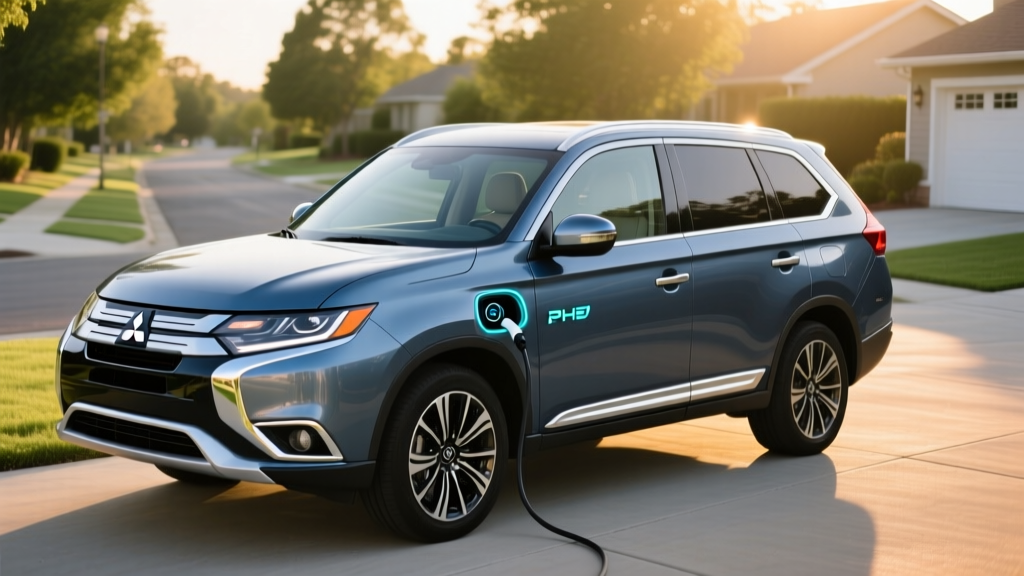
The 2018 Mitsubishi Outlander PHEV occupies a specific niche in the used electrified-vehicle market: it is one of the few plug-in hybrid SUVs from its era that offers standard all-wheel drive, DC fast charging, and a usable electric-only range for daily commuting — all at a depreciated price that undercuts newer PHEVs by thousands. If you are evaluating a used 2018 Mitsubishi Outlander PHEV in 2026, you need to know exactly what this powertrain delivers, where it falls short, and whether the battery has held up after eight years on the road.
This guide covers the real-world numbers, battery health considerations, and ownership economics you need to decide if a used 2018 Outlander PHEV fits your driving pattern — or if a conventional hybrid or full EV makes more sense.
HEV vs PHEV: What the Outlander Actually Is
Before diving into specs, it is essential to distinguish between a conventional hybrid (HEV) and a plug-in hybrid (PHEV). The Outlander PHEV is a plug-in hybrid, meaning it has a larger battery you charge by plugging into an external power source, and it can drive on electric power alone for a limited distance.
| Feature | Conventional Hybrid (HEV) | Plug-In Hybrid (PHEV) |
|---|---|---|
| Plug in to charge? | No — charges via regenerative braking and engine | Yes — plug in for full electric range |
| Electric-only range | 0–2 miles at low speed | Typically 15–40 miles (model-dependent) |
| Battery size | 1–2 kWh | 8–20+ kWh |
| Gas engine role | Primary propulsion, assisted by electric motor | Backup after battery depletes; also assists under heavy load |
| Best for | Drivers without home charging access | Drivers who can charge at home and want EV-like daily commuting |
The 2018 Outlander PHEV uses a 2.0-liter four-cylinder engine paired with two electric motors (one front, one rear) and a 12.0 kWh lithium-ion battery pack. When the battery is depleted, it operates as a series/parallel hybrid — the engine can drive the wheels directly at highway speeds or act as a generator to feed the electric motors at lower speeds.
EPA Fuel Economy and Electric-Only Range
The EPA rates the 2018 Mitsubishi Outlander PHEV at 22 miles of electric-only range and 25 MPG combined once the battery is depleted and the vehicle operates in hybrid mode. Here is the full breakdown according to fueleconomy.gov:
| Metric | EPA Rating |
|---|---|
| Electric-only range | 22 miles |
| Combined MPGe (electric + gas) | 74 MPGe |
| Gas-only MPG — Combined | 25 MPG |
| Gas-only MPG — City | 25 MPG |
| Gas-only MPG — Highway | 26 MPG |
| Total combined range (EV + gas) | ~310 miles |
| Fuel tank capacity | 11.3 gallons |
Real-World Range Reality Check
The EPA's 22-mile electric range was measured under ideal conditions. In real-world 2026 driving, expect 16–20 miles of usable electric range from a used 2018 Outlander PHEV, depending on battery degradation, ambient temperature, and driving style. Highway speeds above 65 mph and winter temperatures below 40°F will push you toward the lower end. In hybrid mode, real-world MPG often lands between 23–27 MPG, with city driving slightly favoring the electric motors' regenerative braking advantage.
Battery, Charging, and the CHAdeMO Advantage
The 2018 Outlander PHEV's 12.0 kWh battery pack (approximately 10.0 kWh usable) is smaller than most modern PHEVs. For context, the 2026 Toyota RAV4 Prime carries an 18.1 kWh pack for 42 miles of electric range. But the Outlander PHEV has a trick that most PHEVs — even today — lack: CHAdeMO DC fast charging.
| Charging Metric | Specification |
|---|---|
| Battery capacity (total / usable) | 12.0 kWh / ~10.0 kWh |
| Battery chemistry | Lithium-ion (NMC) |
| Level 1 charging (120V household) | ~8 hours for full charge |
| Level 2 charging (240V, J1772) | ~3.5 hours for full charge |
| DC fast charging (CHAdeMO) | 0–80% in ~25 minutes |
| DC fast charge peak rate | ~22 kW |
| Onboard charger max (AC) | 3.3 kW |
The CHAdeMO connector is a critical caveat. CHAdeMO infrastructure in the US has stagnated as the industry standardized on CCS and, more recently, NACS (Tesla's connector). As of 2026, finding a functioning CHAdeMO DC fast charger requires planning — most Electrify America and EVgo stations have shifted to CCS/NACS. The PlugShare app is essential for locating compatible chargers on road trips.
The 3.3 kW onboard AC charger is another limitation. Even on a Level 2 home charger, you are limited to 3.3 kW draw, meaning a full charge takes roughly 3.5 hours rather than the 1.5–2 hours some newer PHEVs achieve at 6.6 kW or 7.2 kW.
Powertrain, Performance, and Drivetrain
The Outlander PHEV's powertrain is unconventional. The 2.0-liter Atkinson-cycle four-cylinder produces 119 horsepower on its own, but combined with the front electric motor (80 hp / 101 lb-ft) and rear electric motor (80 hp / 144 lb-ft), the system delivers a combined output that Mitsubishi rates at approximately 197 horsepower.
| Performance Spec | Value |
|---|---|
| Combined system output | ~197 hp |
| Gas engine | 2.0L 4-cyl, 119 hp |
| Front electric motor | 80 hp / 101 lb-ft |
| Rear electric motor | 80 hp / 144 lb-ft |
| 0–60 mph | ~10.5 seconds |
| Drivetrain | Standard AWD (twin-motor, no mechanical driveshaft) |
| Transmission | Single-speed reduction gear (EV mode); direct-drive clutch (highway gas mode) |
| Towing capacity | 1,500 lbs |
The twin-motor AWD system is fully electric — there is no mechanical connection between the front and rear axles. This gives the Outlander PHEV competent traction in snow and rain, though it is not designed for serious off-road use. The 10.5-second 0–60 time means this is a comfort-oriented SUV, not a performance vehicle. Merging onto highways requires planning when fully loaded.
Reliability, Battery Degradation, and Warranty
The 2018 Outlander PHEV benefits from Mitsubishi's long-standing hybrid expertise (the Outlander PHEV launched in Japan in 2013 and became the world's best-selling PHEV for several years). However, reliability is mixed compared to Toyota's hybrid dominance.
Battery and Powertrain Warranty (When New)
- Main drive battery: 10 years / 100,000 miles (capacity retention warranty)
- Powertrain: 10 years / 100,000 miles
- Basic vehicle: 5 years / 60,000 miles
- Capacity threshold: Mitsubishi warrants the battery against dropping below approximately 70% of original capacity during the warranty period
Note: For a 2018 model in 2026, the 10-year/100,000-mile battery warranty may still apply if the vehicle has fewer than 100,000 miles. Verify warranty transferability with a Mitsubishi dealer using the VIN.
Real-world battery degradation data for the 2018 Outlander PHEV suggests most examples retain 75–85% of original battery capacity after 6–8 years and 60,000–90,000 miles. Owners who regularly DC fast-charged or who lived in hot climates (Arizona, Texas) tend to see slightly more degradation. A replacement battery pack, should one be needed out of warranty, typically costs between $6,000–$9,000 including labor, based on dealer parts pricing and independent hybrid-battery specialists.
According to NHTSA records, the 2018 Outlander PHEV has relatively few complaints and no major battery-related recalls, though there was a recall related to the electric motor control unit on some earlier model years. Always run the VIN through NHTSA's recall lookup before purchasing.
Used Pricing and Tax Credit Eligibility
As of early 2026, used 2018 Mitsubishi Outlander PHEV pricing typically falls between $14,000 and $21,000, depending on mileage, condition, trim (SEL or GT), and region. The GT trim adds features like a Rockford Fosgate audio system and heated front seats, commanding a premium of $1,500–$2,500 over the SEL.
When new, the 2018 Outlander PHEV qualified for a $5,836 federal tax credit under the previous §30D rules (the credit amount was based on battery capacity). That credit is no longer available for new purchases of this model. However, the used EV tax credit (officially the Previously-Owned Clean Vehicle Credit under §25E) may apply:
- Credit amount: 30% of the sale price, up to a maximum of $4,000
- Vehicle requirements: Must be purchased from a licensed dealer, sale price must not exceed $25,000, model year must be at least two years older than the current calendar year (a 2018 qualifies in 2026)
- Buyer income caps: $75,000 single / $112,500 head of household / $150,000 joint (modified adjusted gross income)
- Frequency limit: One used clean vehicle credit per three-year period
At a typical dealer price of $18,000, the 30% calculation yields $5,400 — but the cap limits the credit to $4,000. This effectively brings a well-equipped used 2018 Outlander PHEV down to $14,000–$17,000 after the credit, making it one of the most affordable ways into a plug-in hybrid SUV. Consult a tax professional and review IRS §25E guidelines to confirm your eligibility.
Who Should Buy the 2018 Outlander PHEV?
Choose the 2018 Outlander PHEV If:
- You have Level 2 home charging and a commute under 20 miles round-trip (you will drive mostly on electricity)
- You need AWD for snow or rain but cannot afford a newer RAV4 Prime or Sportage PHEV
- You want the lowest entry price into a PHEV SUV and can accept older infotainment technology
- You occasionally road-trip and want gas-engine backup without range anxiety
Look Elsewhere If:
- Your daily commute exceeds 25 miles and you want full electric coverage (consider a newer PHEV with 35+ miles of range, or a full EV)
- You rely on public DC fast charging — CHAdeMO availability is limited and shrinking
- You prioritize acceleration, modern safety tech (AEB, lane centering), or Apple CarPlay/Android Auto (none standard on the 2018 model)
- You want a third-row seat — the Outlander PHEV seats five only
Pros
- Standard AWD via twin electric motors
- CHAdeMO DC fast charging (rare for PHEVs)
- Low used pricing after depreciation
- Eligible for up to $4,000 used EV tax credit
- Comfortable ride quality and quiet cabin in EV mode
- 10-year battery warranty may still have remaining coverage
Cons
- Only 22 miles EPA electric range (less in real-world use)
- Slow 3.3 kW Level 2 onboard charger
- CHAdeMO public charging infrastructure is declining
- Dated infotainment — no Apple CarPlay/Android Auto on base trim
- Modest 197 hp and 10.5-second 0–60
- Fuel economy in gas mode (25 MPG) trails Toyota RAV4 Hybrid
Frequently Asked Questions
How many MPG does the 2018 Mitsubishi Outlander PHEV get?
The EPA rates it at 25 MPG combined (25 city / 26 highway) in hybrid mode after the battery is depleted. Real-world owners typically report 23–27 MPG depending on driving conditions. In electric mode, it achieves 74 MPGe combined.
How far can the 2018 Outlander PHEV go on electric only?
The EPA rates it at 22 miles of electric-only range. With battery degradation on a used 2026 example, expect 16–20 miles in real-world conditions. Cold weather and highway speeds reduce this further.
Hybrid vs PHEV vs EV — which fits my lifestyle?
If you can charge at home and your daily driving is under 20 miles, a PHEV like the Outlander gives you near-EV daily costs with gas backup for road trips. A conventional hybrid (HEV) like the RAV4 Hybrid makes more sense if you cannot charge at home — you get 40 MPG without plugging in. A full EV (like a used Chevy Bolt or Tesla Model Y) is best if you have home charging, want zero tailpipe emissions, and are comfortable with 200+ miles of range and DC fast charging on road trips.
Is the 2018 Outlander PHEV reliable, and what does a battery replacement cost?
Overall reliability is average for the segment. The powertrain is proven, but Mitsubishi's build quality and electronics lag behind Toyota and Honda. The main battery pack is warrantied for 10 years/100,000 miles, and most examples retain 75–85% capacity after 8 years. Out-of-warranty battery replacement runs $6,000–$9,000.
Does the 2018 Outlander PHEV qualify for any tax credit in 2026?
Not the original $5,836 new-vehicle credit. However, if you buy from a licensed dealer for $25,000 or less and meet the IRS income caps ($75K single / $150K joint), you may qualify for the used clean vehicle credit of up to $4,000 under §25E. Always verify eligibility with a tax professional and the IRS guidelines.
Can I charge the 2018 Outlander PHEV at home on a regular outlet?
Yes. Level 1 charging on a standard 120V household outlet takes approximately 8 hours for a full charge — adequate if you plug in overnight. For faster charging, a 240V Level 2 outlet (like a dryer outlet or dedicated EV charger) cuts the time to about 3.5 hours, limited by the vehicle's 3.3 kW onboard charger.
What is the total driving range on a full tank and full battery?
With a full 11.3-gallon tank and a fully charged battery, the combined range is approximately 310 miles (22 miles electric + ~288 miles on gas).