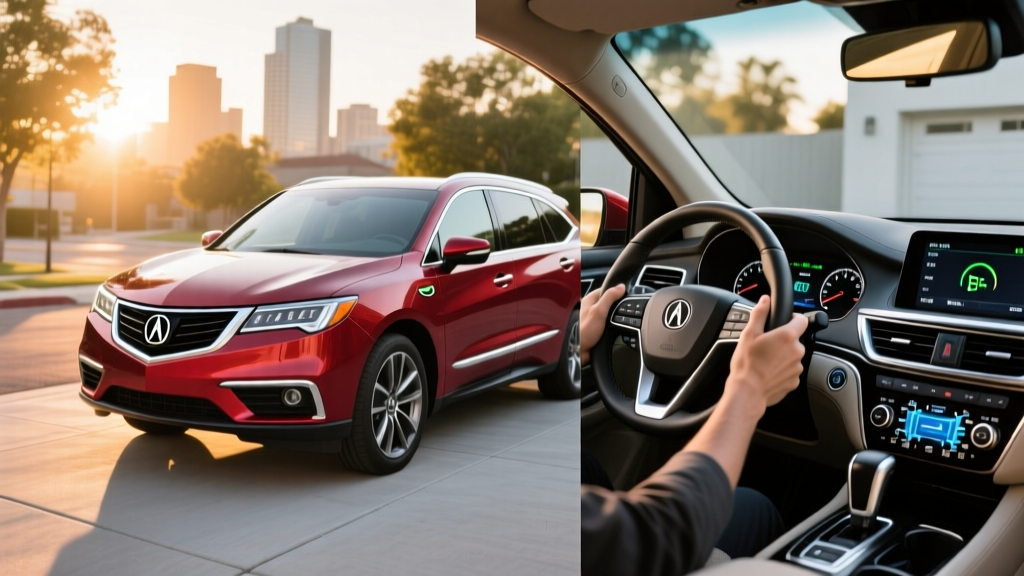
The 2017 Acura MDX Sport Hybrid was the luxury brand's first hybrid SUV, pairing a 3.0-liter V6 with a three-motor system to deliver all-wheel drive and a meaningful efficiency bump over its gas-only sibling. Now that this model lives exclusively on the used market, it represents an interesting proposition for buyers who want luxury SUV space without committing to a plug-in hybrid or full battery-electric vehicle. This guide covers the exact numbers you need to evaluate one today.
HEV vs PHEV: What the 2017 Acura Hybrid SUV Actually Is
The 2017 Acura MDX Sport Hybrid is a conventional hybrid electric vehicle (HEV), not a plug-in hybrid (PHEV). That distinction matters enormously for ownership expectations:
Conventional Hybrid (HEV) — MDX Sport Hybrid
- No plug, no charging cable required
- Battery recharges via regenerative braking and the gasoline engine
- Small battery (~1.3 kWh usable) — assists the engine but cannot drive on electric power alone for meaningful distances
- Electric motors provide torque fill, enable AWD, and improve city MPG
Plug-In Hybrid (PHEV) — Not Offered by Acura in 2017
- Requires plug-in charging (Level 1 or Level 2)
- Larger battery (typically 13–20 kWh) enabling 20–40 miles of electric-only driving
- Can operate as a pure EV for short commutes before the engine engages
- May qualify for federal or state incentives (HEVs generally do not)
Acura did not offer any PHEV in 2017, and as of 2026, Acura's electrified lineup still centers on the MDX with its conventional hybrid variant and the all-electric ZDX. If you need plug-in capability in a Honda-family SUV, the closest contemporary option was the Honda Clarity PHEV (discontinued) or the current CR-V Hybrid, which is also an HEV.
Fuel Economy: EPA MPG and Real-World Expectations
The headline reason buyers chose the MDX Sport Hybrid over the standard V6 MDX was fuel economy. Here are the official EPA figures from fueleconomy.gov:
| Metric | MDX Sport Hybrid (HEV) | 2017 MDX Gas (V6, AWD) |
|---|---|---|
| City MPG | 26 | 18 |
| Highway MPG | 27 | 26 |
| Combined MPG | 27 | 21 |
| Annual Fuel Cost (est.) | ~$2,650 | ~$3,400 |
The combined 27 MPG represents a 29% improvement over the gas-only AWD model. The biggest gain is in city driving, where the hybrid system's regenerative braking and electric torque assist shine — a 44% improvement from 18 to 26 MPG city.
Real-World MPG: What Owners Actually Report
Conventional hybrids like the MDX Sport Hybrid often meet or slightly exceed their EPA city rating because stop-and-go traffic maximizes regenerative braking. Owner-reported data on Fuelly and Edmunds forums clusters around 25–28 MPG combined in mixed driving. Highway-only trips at 75+ MPH tend to return 25–26 MPG, since the electric motors contribute less at sustained high speeds and the 3.0L V6 does the heavy lifting.
In cold weather (below 30°F), expect a 5–10% reduction, putting combined economy in the 23–25 MPG range. The engine runs more frequently to provide cabin heat and maintain battery temperature, reducing the hybrid system's efficiency advantage.
Powertrain and Performance Specs
The MDX Sport Hybrid's powertrain is genuinely sophisticated — a setup borrowed in concept from the NSX supercar, adapted for a three-row luxury SUV.
| Specification | 2017 Acura MDX Sport Hybrid |
|---|---|
| Engine | 3.0L V6, SOHC i-VTEC |
| Engine Output | 257 HP / 218 lb-ft torque |
| Electric Motors | 3 motors (1 front, 2 rear — Twin Motor Unit) |
| Combined System Output | 321 HP / 289 lb-ft torque |
| 0–60 MPH | 6.2 seconds (est.) |
| Drivetrain | SH-AWD (torque-vectoring rear motors) |
| Transmission | 7-speed dual-clutch automatic (no torque converter) |
| Hybrid Battery | ~1.3 kWh lithium-ion (located under rear seats) |
| Curb Weight | ~4,680 lbs |
| Towing Capacity | 5,000 lbs (with ATF cooler) |
| Seating | 7 passengers (3 rows) |
The rear Twin Motor Unit is the engineering highlight. Each rear wheel has its own electric motor, enabling true torque vectoring — the system can send more torque to the outside rear wheel during cornering, improving handling in a way that mechanical AWD systems cannot. This gives the Sport Hybrid a noticeably more planted feel in curves compared to the gas MDX's conventional AWD, despite the extra ~270 lbs of hybrid hardware.
The 7-speed dual-clutch transmission is unconventional in an SUV. It shifts quickly but can feel slightly jerky at very low speeds (parking lot maneuvers), a characteristic of DCT designs. Acura added a clutch pack to smooth launches, but some owners note low-speed hesitation that takes getting used to.
Battery Warranty, Lifespan, and Replacement Cost
Hybrid Battery Warranty (Original)
- Coverage: 8 years / 100,000 miles (10 years / 150,000 miles in CARB states including CA, NY, MA, and others)
- Capacity threshold: Acura covers defects and significant capacity loss that impairs hybrid system function
- Current status for 2017 models: Federal 8-year warranty expired in 2025; CARB-state 10-year coverage may still apply through 2027 if under 150,000 miles
How Long Does the Hybrid Battery Last?
The MDX Sport Hybrid's lithium-ion battery pack is relatively small (~1.3 kWh) and is managed conservatively — the system never fully charges or fully depletes it, keeping the state of charge in a narrow band to maximize longevity. This buffer strategy is standard across Honda/Acura hybrids and significantly extends cycle life.
Based on data from high-mileage Honda Accord Hybrid and Insight owners (which share similar IMA/two-motor architectures), Acura hybrid batteries typically last 150,000–200,000+ miles before significant degradation. The 2017 model year is still relatively young — the oldest examples are approaching 8–9 years old in 2026, and widespread battery failures have not been a pattern.
Battery Replacement Cost
If replacement becomes necessary outside warranty:
- OEM dealer replacement: $3,000–$4,500 (parts + labor)
- Refurbished/remanufactured pack: $1,800–$2,800 from independent hybrid specialists
- Individual cell module replacement: $500–$1,200 if only specific modules have degraded (requires diagnostic equipment and a qualified hybrid technician)
For a used 2017 MDX Sport Hybrid purchase, request a hybrid battery health check. Many Acura dealers can read the battery's state of health (SoH) via the OBD-II diagnostic system. A pack showing 85%+ SoH at 80,000 miles is in excellent shape.
Pricing on the Used Market and Tax Credit Reality
The 2017 Acura MDX Sport Hybrid originally carried an MSRP of approximately $52,000–$58,000 depending on trim (Technology Package, Advance Package, or Entertainment Package). In the 2026 used market, well-maintained examples with 60,000–100,000 miles typically sell for $20,000–$28,000, depending on condition, mileage, and package level.
Tax Credit Eligibility
The 2017 MDX Sport Hybrid did not qualify for the federal §30D plug-in vehicle tax credit when new, and it does not qualify now. Under current IRS rules, the §30D credit applies only to battery-electric vehicles (BEVs) and plug-in hybrids (PHEVs) with a minimum battery capacity of 7 kWh. As a conventional hybrid with a ~1.3 kWh battery, the MDX Sport Hybrid is ineligible.
There is also no federal used-EV credit (§25E) available for conventional hybrids — that $4,000 credit applies only to used BEVs and PHEVs. Some states may offer modest incentives for hybrid purchases, but these vary by jurisdiction. Check your state's energy office or DMV for current programs.
Who Should Choose This Hybrid vs. a PHEV or Full EV?
Buy the 2017 MDX Sport Hybrid if:
- You want a three-row luxury SUV with better fuel economy but cannot charge at home (apartment living, no garage access)
- You drive 15,000+ miles per year in mixed city/highway conditions where the hybrid's city MPG advantage pays off
- You want Acura's SH-AWD torque vectoring for all-weather confidence without the complexity of plug-in charging
- Your budget is $20K–$28K and you need seven seats
- You want to avoid range anxiety entirely — the hybrid runs on gasoline with no behavior change from a conventional car
Consider a PHEV (e.g., Toyota RAV4 Prime, Volvo XC60 Recharge) if:
- You have Level 2 home charging and a commute under 30–40 miles round trip
- You want to drive most daily miles on electricity but need gas flexibility for road trips
- You want to access HOV lane privileges or state incentives available to PHEVs
Consider a Full EV (e.g., Tesla Model X, Rivian R1S) if:
- You have reliable home charging and your daily driving is under 250 miles
- You want to eliminate gasoline costs and maintenance entirely
- You qualify for the §30D federal tax credit on a new EV purchase (up to $7,500, subject to MSRP caps, income limits, and battery sourcing requirements per IRS guidelines)
Reliability, Ownership Costs, and Known Issues
The 2017 MDX Sport Hybrid's reliability record is generally solid but carries some model-year-specific notes that used buyers should investigate:
Known Issues to Check
- 9-speed automatic (gas model) vs. 7-speed DCT (hybrid): The gas MDX uses a ZF 9-speed that drew complaints for hunting gears. The hybrid's 7-speed DCT is a different transmission entirely and avoids those issues, but it can exhibit low-speed shudder. Test-drive in stop-and-go conditions.
- Infotainment: The 2017 dual-screen Acura system is widely criticized for lag and an unintuitive interface. This is a frustration, not a reliability defect, but it affects daily usability.
- Brake feel: The regenerative braking system blends into friction braking, and some owners report a slightly non-linear pedal feel. This is normal for hybrids but can take adaptation.
- TPMS and electronics: Minor electrical gremlins (sensor warnings, screen freezes) appear in NHTSA complaints at typical rates for a 2017 luxury vehicle.
Maintenance Cost Comparison
Hybrid maintenance is similar to the gas MDX with a few differences:
- Brakes last longer: Regenerative braking reduces wear on friction pads. Many hybrid owners report 80,000+ miles on original brake pads.
- No transmission fluid concerns unique to hybrid: The 7-speed DCT requires fluid changes per Acura's schedule (~30,000–60,000 mile intervals).
- Coolant system: The hybrid system has a separate inverter coolant loop — ensure it's been serviced per schedule.
- Tires: The Sport Hybrid's extra weight (~270 lbs more than gas AWD) and instant electric torque can accelerate tire wear slightly. Budget for replacement at 35,000–45,000 miles.
Insurance costs for the used Sport Hybrid are moderate — typically $1,400–$2,000 annually for a clean-record driver, depending on state and coverage level. Get a quote before purchasing, as luxury SUV insurance varies significantly by ZIP code.
Pros and Cons at a Glance
Pros
- 27 MPG combined — 29% better than gas MDX AWD
- 321 HP with torque-vectoring SH-AWD provides confident handling
- No plug-in charging required — zero behavior change from a gas car
- 7-seat luxury SUV with 5,000-lb towing capacity
- Hybrid battery managed conservatively for long lifespan
- Strong value on the used market ($20K–$28K)
Cons
- No electric-only driving capability (this is an HEV, not a PHEV)
- No federal or state tax credit eligibility
- 7-speed DCT can feel jerky at low parking-lot speeds
- Dated dual-screen infotainment system
- Hybrid battery replacement cost ($3K–$4.5K) if needed out of warranty
- Heavier than gas model, slightly reducing cargo payload
Frequently Asked Questions
How many MPG does the 2017 Acura MDX Sport Hybrid get?
The EPA rates it at 26 city / 27 highway / 27 combined MPG. Real-world owner reports cluster around 25–28 MPG combined in mixed driving. City driving yields the best results thanks to regenerative braking; sustained highway speeds above 75 MPH return closer to 25 MPG.
Can the 2017 MDX Sport Hybrid drive on electric power only?
Not in any meaningful way. As a conventional hybrid (HEV), the electric motors assist the gasoline engine and enable torque-vectoring AWD, but the vehicle cannot travel significant distances on electricity alone. The ~1.3 kWh battery is too small for EV-only operation. If you need electric-only commuting, you need a PHEV or BEV.
Does the 2017 Acura hybrid SUV qualify for any tax credit?
No. The federal §30D new clean vehicle credit and the §25E used clean vehicle credit apply only to plug-in hybrids (PHEVs) and battery-electric vehicles (BEVs). The MDX Sport Hybrid is a conventional hybrid (HEV) with no plug and a battery too small to meet the 7 kWh minimum threshold. No federal tax credit is available. Some states may offer minor incentives — check your state energy office.
Is the hybrid battery reliable, and what does replacement cost?
Acura's hybrid batteries are managed conservatively (never fully charged or depleted) and typically last 150,000–200,000+ miles. The original warranty was 8 years/100,000 miles (10 years/150,000 miles in CARB states). If replacement is needed out of warranty, expect $3,000–$4,500 for an OEM pack or $1,800–$2,800 for a refurbished unit from a hybrid specialist.
How does the 2017 MDX Sport Hybrid compare to the gas MDX?
The hybrid delivers 27 MPG combined vs. 21 MPG for the gas AWD model — a 29% improvement. It also produces 321 HP vs. 290 HP, and the torque-vectoring rear motors give it noticeably better cornering grip. The trade-offs are a slightly higher used purchase price, a DCT transmission that can be jerky at low speeds, and no tax credit eligibility.
Should I buy the 2017 MDX Sport Hybrid or a newer hybrid SUV?
If your budget is $20K–$28K and you need a three-row luxury hybrid SUV, the 2017 MDX Sport Hybrid offers strong value. Newer alternatives like the 2024+ Acura MDX (gas only, no current hybrid variant) or the Toyota Grand Highlander Hybrid (35–36 MPG, but not a luxury brand) start at $40K+. The 2017 model is the right pick if you want luxury features at a used price and accept the older infotainment technology.
Does the hybrid system require special maintenance?
Beyond the standard Acura maintenance schedule, the hybrid system requires periodic inverter coolant checks and hybrid system diagnostic scans. Most Acura dealers can perform these. Independent hybrid specialists are also an option and often charge less. The hybrid battery air intake filter (located near the rear seats) should be inspected and cleaned to prevent overheating.