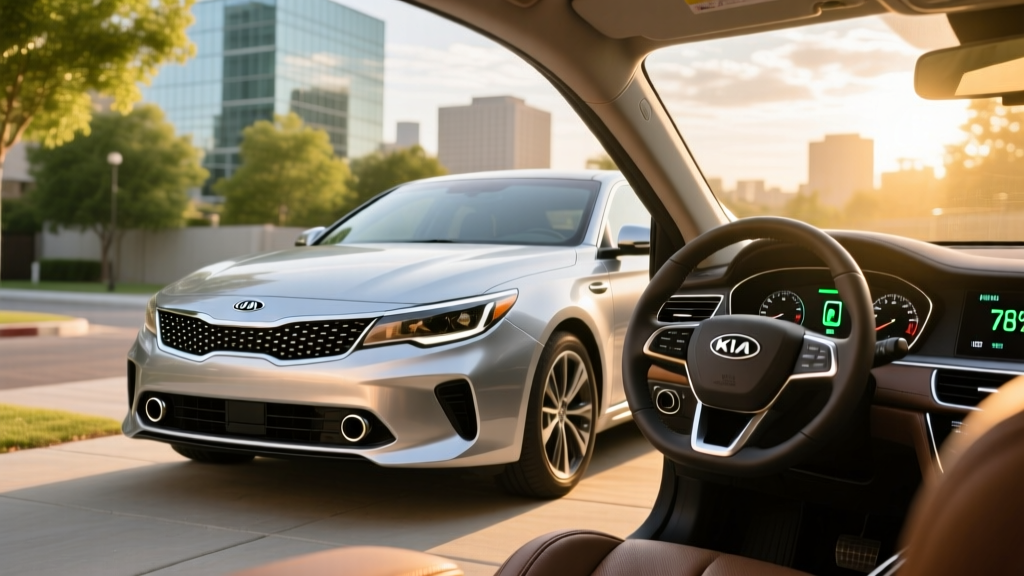
Quick Verdict: The 2018 Kia Optima Hybrid in 2026
If you're shopping the used midsize sedan market for a fuel-efficient daily driver that doesn't require a plug, the 2018 Kia Optima Hybrid remains one of the most compelling picks. With an EPA-rated 41 MPG combined, a proven 2.0-liter Atkinson-cycle powertrain, and Kia's generous 10-year hybrid battery warranty (partially transferable to second owners), it delivers hybrid efficiency without the complexity or range anxiety of a full EV.
For 2026 used-car buyers, the Optima Hybrid sits in a sweet spot: depreciated enough to be affordable (typically $11,000–$16,000 depending on mileage and trim), yet modern enough to include Apple CarPlay, Android Auto, and available advanced driver-assistance features. Let's break down the exact numbers you need before buying.
2018 Kia Optima Hybrid Specs at a Glance
| Specification | 2018 Optima Hybrid | 2018 Optima Plug-In Hybrid |
|---|---|---|
| Powertrain Type | HEV (no plug) | PHEV (plug-in capable) |
| Engine | 2.0L Atkinson I4 | 2.0L Atkinson I4 |
| Combined Horsepower | 192 hp | 202 hp |
| Electric Motor Output | 38 kW (51 hp) | 50 kW (67 hp) |
| Battery Capacity | 1.62 kWh (Li-ion) | 9.8 kWh (Li-ion) |
| EPA City MPG | 40 MPG | 40 MPG (hybrid mode) |
| EPA Highway MPG | 43 MPG | 43 MPG (hybrid mode) |
| EPA Combined MPG | 41 MPG | 41 MPG (hybrid mode) / 97 MPGe (EV mode) |
| Electric-Only Range (PHEV) | N/A | 29 miles (EPA) |
| Transmission | 6-speed automatic | 6-speed automatic |
| 0–60 mph (est.) | ~8.3 seconds | ~7.8 seconds |
| Drivetrain | FWD | FWD |
Source: EPA Fuel Economy
Fuel Economy: EPA Ratings vs. Real-World MPG
The 2018 Kia Optima Hybrid carries EPA ratings of 40 city / 43 highway / 41 combined MPG. These numbers hold up well in practice — and in some conditions, owners report exceeding them.
Hybrids inherently shine in stop-and-go city driving because regenerative braking recaptures energy that a conventional car wastes as heat at each stoplight. Many Optima Hybrid owners on fuel-tracking platforms report city MPG in the 42–45 range during warm-weather commuting. Highway driving is where hybrids give back some advantage: at sustained 70–80 mph speeds, the electric motor contributes less and the 2.0L engine does most of the work. Expect highway MPG in the 38–42 range depending on speed, terrain, and tire condition.
Cold-weather reality check: In freezing temperatures (below 32°F), expect a 5–10% MPG drop. The engine runs more frequently to maintain cabin heat and battery temperature, reducing electric-motor assist time. Winter MPG of 36–38 combined is typical in northern climates.
| Driving Scenario | EPA Rating | Real-World Expectation |
|---|---|---|
| City (stop-and-go) | 40 MPG | 40–45 MPG |
| Highway (70–80 mph) | 43 MPG | 38–42 MPG |
| Combined | 41 MPG | 38–43 MPG |
| Cold weather (below 32°F) | — | 36–38 MPG |
The Optima Plug-In Hybrid: Electric-Only Range and Charging
Kia also offered the 2018 Optima as a Plug-In Hybrid (PHEV) — a fundamentally different vehicle despite the shared nameplate. The PHEV pairs the same 2.0L engine with a larger 50 kW electric motor and a 9.8 kWh lithium-ion battery pack, enabling 29 miles of EPA-rated electric-only driving before the gasoline engine kicks in.
For commuters with a round trip under 30 miles and access to a home charger, the PHEV can operate as a de facto EV most weekdays, only burning gasoline on longer weekend trips. Total combined range (electric + gasoline) exceeds 500 miles.
Charging the PHEV: The Optima PHEV uses a standard J1772 connector for Level 1 (120V household outlet) and Level 2 (240V) charging. On a Level 2 station at approximately 3.3 kW, the 9.8 kWh battery charges from empty to full in roughly 3 hours. On a standard 120V outlet (Level 1 at ~1.4 kW), expect about 7–8 hours — feasible for overnight charging. The Optima PHEV does not support DC fast charging, which is typical for PHEVs of this era given the relatively small battery.
Choose the HEV if: You don't have reliable access to a plug at home or work, you want maximum simplicity, and your commute involves a mix of city and highway miles.
Choose the PHEV if: You can install a Level 2 charger at home (or have workplace charging), your daily round trip is under 30 miles, and you want to minimize gasoline consumption without committing to a full EV.
Powertrain Deep Dive: How the Hybrid System Works
Both the HEV and PHEV variants of the 2018 Optima use Kia's parallel hybrid architecture, which is notably different from Toyota's series-parallel Hybrid Synergy Drive. Kia pairs its 2.0L Atkinson-cycle four-cylinder engine (154 hp on its own) with an electric motor mounted between the engine and a conventional 6-speed automatic transmission. This means the Optima Hybrid shifts gears like a regular car — you'll feel distinct gear changes, unlike the rubber-band CVT sensation in a Toyota Camry Hybrid.
The combined system output is 192 hp for the HEV and 202 hp for the PHEV. Acceleration is adequate rather than thrilling: 0–60 mph takes approximately 8.3 seconds in the HEV. The electric motor provides immediate torque fill at low speeds, making the car feel peppy around town even if it runs out of breath at highway merging speeds.
Regenerative braking is adjustable via steering-wheel paddles in the HEV, allowing drivers to increase regen aggressiveness for more one-pedal-like behavior in city traffic — though it won't bring the car to a complete stop like a true one-pedal EV system.
Battery Longevity, Warranty, and Replacement Cost
As of 2026, a 2018 Optima Hybrid is 8 years old. If you're the original owner, you still have up to 2 years of battery warranty remaining (through the 2028 model year or 100,000 miles, whichever comes first). Second owners should check whether the 5-year/60,000-mile transferred warranty has expired.
Battery degradation in practice: The 1.62 kWh battery in the HEV variant is small and operates within a narrow state-of-charge window (roughly 40–80%), which significantly reduces degradation stress. Most Kia hybrid owners report minimal capacity loss over 100,000+ miles. The PHEV's 9.8 kWh pack sees wider charge cycles but still benefits from active thermal management.
Replacement cost: If the hybrid battery does fail out of warranty, a replacement pack for the Optima Hybrid typically runs $2,000–$3,500 for the HEV and $4,000–$6,000 for the PHEV, including labor. Third-party remanufactured batteries are increasingly available at the lower end of that range. For context, most hybrid batteries from this generation are lasting well beyond 150,000 miles with proper maintenance.
Pricing, Trims, and Tax Credit Eligibility in 2026
The 2018 Kia Optima Hybrid was offered in two trims when new: the base Hybrid (starting around $26,800 MSRP) and the Hybrid EX (starting around $31,500). The Plug-In Hybrid was offered in a single well-equipped trim at approximately $36,700 MSRP.
In the 2026 used market, expect to pay:
- Optima Hybrid (HEV): $11,000–$16,000 depending on mileage, condition, and trim
- Optima Plug-In Hybrid (PHEV): $13,000–$18,000
Tax credit status: The federal §30D new clean vehicle credit is not available for used purchases of the 2018 Optima Hybrid or PHEV in 2026. However, the §25E used clean vehicle credit may apply to the PHEV variant (not the conventional HEV) if purchased from a licensed dealer. This credit provides up to $4,000 or 30% of the sale price (whichever is less), subject to buyer income caps ($75,000 single / $150,000 joint) and a sale price cap of $25,000. Since most used PHEV Optimas sell under $25,000, this credit is potentially accessible. Always verify current eligibility rules on IRS.gov and consult a tax professional before claiming.
Conventional hybrids (HEVs) have not qualified for federal purchase incentives since the early Toyota Prius era. The HEV's value proposition is purely fuel savings, not tax benefits.
Ownership Costs: Hybrid vs. Gas vs. EV
To put the Optima Hybrid's efficiency into dollars: at $3.20/gallon (a reasonable 2026 national average) and 15,000 miles per year, the Optima Hybrid's 41 MPG combined works out to approximately $1,170 per year in fuel. A comparable gas-only 2018 Optima (rated at 28 MPG combined) would cost about $1,714 per year — a difference of roughly $544 annually in the hybrid's favor.
Compared to a used EV like a 2018 Nissan Leaf or Chevrolet Bolt, the Optima Hybrid costs more per mile to "fuel" but avoids the charging-infrastructure dependency and potential battery-replacement risk of an aging EV. For buyers without home charging access, the hybrid's advantage is decisive.
✅ Pros
- 41 MPG combined — proven real-world efficiency
- No plug required — works anywhere gas is sold
- Conventional 6-speed automatic feels natural
- Spacious midsize cabin with good cargo room (15.9 cu ft trunk)
- Strong safety ratings (IIHS Top Safety Pick)
- Apple CarPlay / Android Auto standard
- Hybrid battery warranty may still have coverage
❌ Cons
- Modest acceleration (8.3 sec 0–60)
- Trunk space reduced vs. gas model due to battery placement
- Hybrid battery replacement cost if out of warranty ($2,000–$3,500)
- No federal tax credit for used HEV purchase
- Ride quality firm on larger optional wheels
- Discontinued after 2020 model year (limited new parts supply long-term)
Who Should Buy the 2018 Kia Optima Hybrid?
- Choose the Optima Hybrid if you want a proven, affordable midsize sedan with 40+ MPG, you lack home charging access, and you want zero lifestyle change from your current gas car.
- Choose the Optima PHEV if you can charge at home, your commute is under 30 miles round trip, and you want EV-like daily driving with gas-engine backup for road trips.
- Choose a full EV instead if you have reliable Level 2 home charging, your daily drive is under 150 miles, and you want to eliminate gasoline and oil changes entirely.
- Choose a conventional gas car if you drive very few miles per year (under 8,000), where the hybrid's fuel savings won't offset even the modest used-price premium.
The 2018 Optima Hybrid makes the most sense for high-mileage commuters who rack up 15,000+ miles annually in mixed city/highway driving. At that mileage, the fuel savings over a gas-only midsize sedan pay back the used-price premium within 2–3 years. For low-mileage drivers, the math is less compelling — a well-maintained gas-only Optima or a Honda Accord may cost less upfront with minimal annual fuel penalty.
Frequently Asked Questions
How many MPG does the 2018 Kia Optima Hybrid get?
The EPA rates the 2018 Optima Hybrid at 40 city / 43 highway / 41 combined MPG. In real-world driving, owners typically see 38–45 MPG combined depending on driving style, climate, and route. City driving tends to yield higher MPG than highway due to regenerative braking.
How far can the Optima Plug-In Hybrid go on electric only?
The 2018 Optima PHEV achieves an EPA-rated 29 miles of electric-only range on a full charge of its 9.8 kWh battery. Real-world electric range varies from 24–32 miles depending on temperature, speed, and terrain. After the battery depletes, the car seamlessly transitions to hybrid mode at 41 MPG combined.
Is the 2018 Kia Optima Hybrid reliable?
The Optima Hybrid's powertrain has proven reliable in owner surveys and long-term tests. The 2.0L Atkinson-cycle engine is understressed, and Kia's hybrid system has fewer failure points than some competitors. The main long-term concern is the hybrid battery, though most are lasting 150,000+ miles. Check remaining warranty coverage via a Kia dealer before purchasing.
What does hybrid battery replacement cost?
Out-of-warranty replacement for the Optima HEV battery runs approximately $2,000–$3,500, while the PHEV's larger pack costs $4,000–$6,000 installed. Remanufactured and refurbished packs are available at lower prices. Most batteries from this generation outlast the car's economic life.
Does the 2018 Optima Hybrid qualify for any tax credit?
The conventional Hybrid (HEV) does not qualify for any federal tax credit. The Plug-In Hybrid (PHEV) may qualify for the §25E used clean vehicle credit of up to $4,000 when purchased from a dealer, subject to income limits and the $25,000 sale-price cap. Verify eligibility at IRS.gov and consult a tax professional.
Does the Optima Hybrid need to be plugged in?
No. The conventional Optima Hybrid (HEV) never needs to be plugged in — it charges its 1.62 kWh battery through regenerative braking and the gasoline engine. Only the Plug-In Hybrid (PHEV) variant benefits from being plugged in to charge its larger 9.8 kWh battery for electric-only driving.
For official fuel economy data, see fueleconomy.gov. For safety ratings, check IIHS and NHTSA.