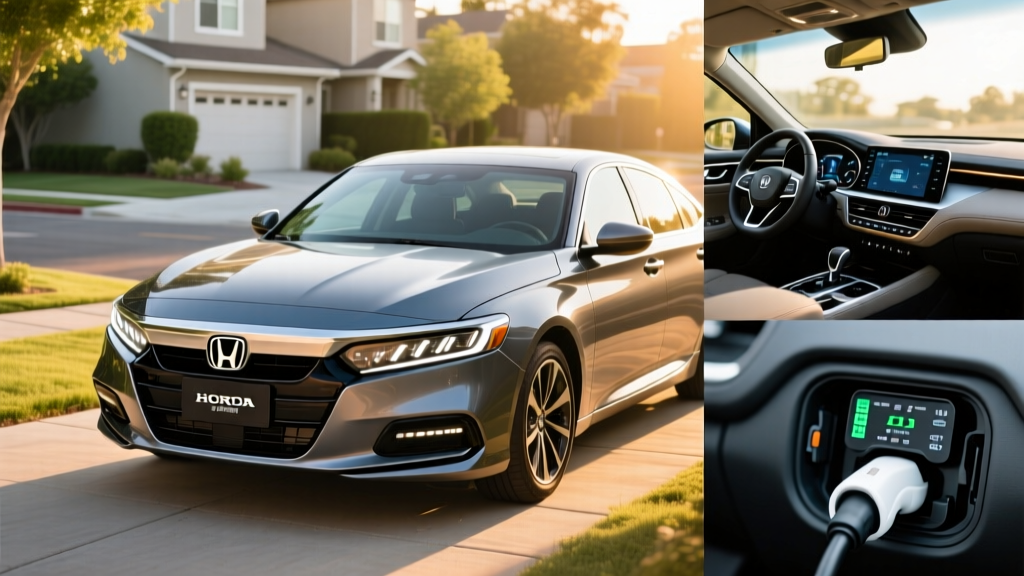
The 2018 Honda Accord Hybrid arrived as part of the 10th-generation Accord redesign, pairing a 2.0-liter Atkinson-cycle four-cylinder with a two-motor hybrid system for a combined 212 horsepower. For used-car shoppers in 2026, it remains one of the most efficient midsize sedans available on the secondary market, with EPA ratings that still hold up against newer competitors. This guide breaks down the real-world fuel economy, battery longevity, ownership costs, and how the 2018 Accord Hybrid stacks up against plug-in hybrids and full EVs.
HEV vs PHEV: What the 2018 Accord Hybrid Actually Is
The 2018 Honda Accord Hybrid is a conventional hybrid electric vehicle (HEV). It does not plug in. The small 1.5 kWh lithium-ion battery charges exclusively through regenerative braking and the gasoline engine. There is no electric-only driving range to speak of — the electric motor assists the engine and enables brief low-speed electric movement, but the gas engine is always part of the equation.
This distinction matters because buyers sometimes confuse HEVs with plug-in hybrid electric vehicles (PHEVs) like the Toyota Prius Prime or the now-discontinued Honda Clarity Plug-In Hybrid. A PHEV has a larger battery (typically 8–18 kWh), can be plugged into a wall outlet or Level 2 charger, and delivers 25–45 miles of electric-only range before the gas engine kicks in. The 2018 Accord Hybrid does none of that. You fuel it like a normal car and never think about charging.
Fuel Economy: EPA Ratings and Real-World MPG
| Metric | EPA Rating | Real-World Expectation |
|---|---|---|
| City MPG | 47 MPG | 48–52 MPG (hybrids excel in stop-and-go) |
| Highway MPG | 47 MPG | 42–46 MPG (sustained 70+ mph reduces regen benefit) |
| Combined MPG | 48 MPG | 44–49 MPG depending on driving mix |
The Accord Hybrid's two-motor system — which Honda calls its Intelligent Multi-Mode Drive (i-MMD) — operates differently than Toyota's planetary-gear hybrid setup. At low speeds, the electric motor drives the wheels while the engine acts as a generator. At highway speeds, a lockup clutch connects the engine directly to the wheels for efficiency. The result is remarkably consistent city and highway ratings, both at 47 MPG per fueleconomy.gov.
In real-world ownership, many drivers report exceeding the EPA city estimate. Hybrids recover more energy in traffic-dense urban driving, where regenerative braking is constant. Highway driving at 75–80 mph, especially with A/C running, will pull numbers down to the low-to-mid 40s. Cold weather (below 35°F) can reduce fuel economy by 5–10% as the engine runs longer to heat the cabin and bring the catalytic converter to operating temperature.
Powertrain Specs: 212 HP Without Sacrificing Efficiency
| Specification | 2018 Accord Hybrid |
|---|---|
| Engine | 2.0L Atkinson-cycle 4-cylinder |
| Engine HP / Torque | 146 HP / 129 lb-ft |
| Electric Motor HP / Torque | 181 HP / 232 lb-ft |
| Combined System Output | 212 HP |
| Transmission | e-CVT (no traditional gears) |
| 0–60 MPH | ~7.1 seconds |
| Drivetrain | Front-wheel drive |
| Battery Capacity | 1.5 kWh (lithium-ion) |
| Plug-In Charging | No (HEV only) |
| EPA Combined MPG | 48 MPG |
| Fuel Tank | 12.8 gallons |
| Total Range | ~614 miles |
Honda's i-MMD system uses the electric motor as the primary drive source in most conditions. The gasoline engine either generates electricity for the motor or, at steady highway speeds, clutches directly to the wheels. This architecture gives the Accord Hybrid a more linear, EV-like acceleration feel compared to the rubber-band effect of older Toyota e-CVT systems. The 212 combined horsepower is competitive with the turbocharged 1.5L gas Accord (192 HP) and noticeably quicker than the 2018 Toyota Camry Hybrid (208 HP).
Hybrid Battery Longevity, Warranty, and Replacement Cost
Original Warranty: Honda covered the 2018 Accord Hybrid's IMA (Integrated Motor Assist) battery for 8 years / 100,000 miles in most states and 10 years / 150,000 miles in CARB states (California, New York, Massachusetts, and others that follow California emissions standards).
For 2026 Buyers: A 2018 model is now 8 years old. If the car was originally sold in a CARB state, some battery warranty coverage may still apply depending on mileage. In non-CARB states, the original 8-year/100k warranty has likely expired. Always check the vehicle's original sale state and current odometer reading.
Honda's hybrid battery packs have proven durable in practice. The 1.5 kWh lithium-ion battery in the Accord Hybrid is relatively small and operates within a conservative state-of-charge window — it never fully charges or fully discharges, which significantly reduces degradation stress. Reports of premature battery failure on the 10th-generation Accord Hybrid are rare compared to early-generation hybrids from the 2000s.
If replacement is needed out of warranty, a new OEM hybrid battery from Honda typically runs $2,000–$3,500 including parts and labor. Third-party remanufactured batteries are available for $1,200–$2,000 installed. Given the battery's track record, most buyers of a well-maintained 2018 Accord Hybrid should not budget for an imminent replacement — but it's worth confirming the battery's health via an OBD-II scan tool that reads hybrid battery state-of-health (SoH) percentage during a pre-purchase inspection.
Pricing in 2026: Used Market and Tax Credit Reality
The 2018 Honda Accord Hybrid originally started at approximately $29,990 for the base Hybrid trim and climbed to around $34,990 for the Touring trim. In the 2026 used market, expect to pay:
- Hybrid (base): $15,000–$18,500 (60k–90k miles)
- Hybrid EX-L: $17,000–$21,000 (50k–80k miles)
- Hybrid Touring: $19,000–$23,000 (40k–70k miles)
Tax credit eligibility: The 2018 Accord Hybrid does not qualify for the federal §30D new clean vehicle credit, which applies only to new plug-in vehicles (BEVs and PHEVs) meeting battery sourcing and MSRP requirements. It also does not qualify for the used clean vehicle credit (up to $4,000 or 30% of sale price, whichever is less) because that credit applies only to used BEVs and PHEVs — conventional hybrids are excluded. Check IRS guidelines for current eligibility rules.
Some states offer their own incentives for hybrid purchases, but these are increasingly rare and typically target plug-in vehicles. Check your state's energy office or DMV for any active programs.
Accord Hybrid vs PHEV vs Full EV: Which Fits Your Driving Life?
Choose the 2018 Accord Hybrid if:
- You have no access to home or workplace charging (apartment, street parking)
- You want zero behavior change — just buy gas less often
- You drive a mix of city and highway and want strong MPG in both
- You want a proven, low-risk used car with Honda reliability
- Your budget is under $22,000
Consider a PHEV or full EV instead if:
- You can install a Level 2 home charger (240V, ~$500–$1,500 install)
- Your commute is under 30 miles round-trip (a PHEV covers it on electricity alone)
- You want to qualify for the §30D tax credit ($7,500 new / up to $4,000 used, BEV/PHEV only)
- You want to reduce or eliminate gasoline use entirely
- You're willing to spend $25,000+ for a newer plug-in vehicle
The decision ultimately comes down to charging access and budget. If you can charge at home, a used PHEV like a 2019–2021 Toyota Prius Prime (25 miles electric-only) or a used BEV like a 2019 Chevrolet Bolt EV (259 miles EPA) will deliver lower per-mile energy costs — roughly $0.04–$0.06 per mile on electricity versus $0.09–$0.12 per mile in the Accord Hybrid at current gas and electricity prices. But if charging isn't an option, the Accord Hybrid's 48 MPG combined is hard to beat without plugging in.
Reliability, Safety, and What to Inspect Before Buying
The 2018 Accord Hybrid earned a Top Safety Pick+ rating from the IIHS and a 5-star overall rating from NHTSA. Honda Sensing — the brand's suite of driver-assistance features including adaptive cruise control, lane-keeping assist, forward collision warning, and automatic emergency braking — comes standard on every 2018 Accord Hybrid trim. Note that this is a SAE Level 1 driver-assist system: it provides steering and braking support but requires full driver attention at all times.
Common items to inspect on a used 2018 Accord Hybrid:
- Hybrid battery SoH: Request a dealer or independent shop scan showing battery health percentage. Anything above 85% is excellent for an 8-year-old pack.
- 12V battery: Like all modern cars, the Accord Hybrid has a conventional 12V battery that powers electronics. These typically last 3–5 years and are a common roadside-stranding culprit if neglected.
- Transmission fluid: Honda's e-CVT doesn't have traditional gears, but it does use fluid that should be inspected. Some owners report smoother operation after a drain-and-fill at 60k miles.
- Brake wear: Regenerative braking reduces friction brake use significantly. Original brake pads at 80k+ miles are common on Accord Hybrids — but inspect rotors for surface rust from light use.
- Software updates: Confirm that the powertrain control module (PCM) and infotainment system have received all Honda-issued updates. Early 2018 models had a few TSBs related to hybrid system software.
Ownership Costs: How the Accord Hybrid Compares
| Annual Cost Category | 2018 Accord Hybrid (48 MPG) | 2018 Accord 1.5T Gas (33 MPG) | Used BEV (~120 MPGe) |
|---|---|---|---|
| Fuel/Energy (15k mi/yr) | ~$1,094 (gas at $3.50/gal) | ~$1,591 (gas at $3.50/gal) | ~$563 (at $0.15/kWh) |
| Maintenance (avg/yr) | ~$400 | ~$500 | ~$250 |
| Insurance (avg/yr) | ~$1,500 | ~$1,400 | ~$1,700 |
| Annual Total | ~$2,994 | ~$3,491 | ~$2,513 |
The Accord Hybrid saves roughly $500 per year in fuel compared to the turbocharged gas Accord. Over a 5-year ownership period, that's approximately $2,500 in fuel savings — which largely offsets the premium these models command on the used market versus their gas counterparts. A used BEV will save even more on fuel and maintenance, but comes with charging-infrastructure requirements and higher insurance premiums.
Frequently Asked Questions
How many MPG does the 2018 Honda Accord Hybrid get?
The EPA rates the 2018 Accord Hybrid at 47 city / 47 highway / 48 combined MPG. Real-world city driving often yields 48–52 MPG thanks to regenerative braking, while sustained highway driving at 75+ mph typically returns 42–46 MPG.
Does the 2018 Accord Hybrid need to be plugged in?
No. The 2018 Accord Hybrid is a conventional hybrid (HEV). It charges its own 1.5 kWh battery through regenerative braking and the gasoline engine. There is no plug, no charging cable, and no electric-only driving range of practical significance.
Is the 2018 Accord Hybrid reliable?
Yes. Honda's i-MMD hybrid system has proven durable, and the 10th-generation Accord platform is well-regarded. The hybrid battery is designed to last the life of the vehicle under normal use, with conservative charge/discharge windows minimizing degradation. Check hybrid battery SoH during a pre-purchase inspection.
What does it cost to replace the hybrid battery?
A new OEM replacement runs $2,000–$3,500 installed. Remanufactured third-party batteries are available for $1,200–$2,000 installed. However, widespread battery failure on this generation is uncommon — most owners will never need a replacement.
Does the 2018 Accord Hybrid qualify for any tax credit?
No. Federal clean vehicle tax credits (§30D for new vehicles and the used clean vehicle credit) apply only to plug-in vehicles — BEVs and PHEVs with sufficient battery capacity. Conventional hybrids like the Accord Hybrid do not qualify for any federal purchase incentive.
How does it compare to the Toyota Camry Hybrid?
The 2018 Toyota Camry Hybrid (LE) rates at 52 MPG combined versus the Accord Hybrid's 48 MPG. However, the Accord offers more horsepower (212 vs 208), a larger trunk, and a more engaging driving feel. The Camry Hybrid wins on pure efficiency; the Accord Hybrid wins on space and performance. Both are strong used buys.
Is Honda Sensing self-driving?
No. Honda Sensing is a SAE Level 1 driver-assistance system. It provides adaptive cruise control and lane-centering support, but the driver must remain fully engaged, hands on the wheel, and eyes on the road at all times. It is not autonomous driving.
The 2018 Honda Accord Hybrid remains a smart used buy in 2026 for drivers who want excellent fuel economy without changing their refueling habits. With 48 MPG combined, a spacious cabin, strong safety ratings, and Honda's reputation for longevity, it occupies a practical sweet spot between gas-only sedans and plug-in alternatives that require charging infrastructure.