Quick Verdict: The 2018 Camry Hybrid Still Delivers Class-Leading MPG
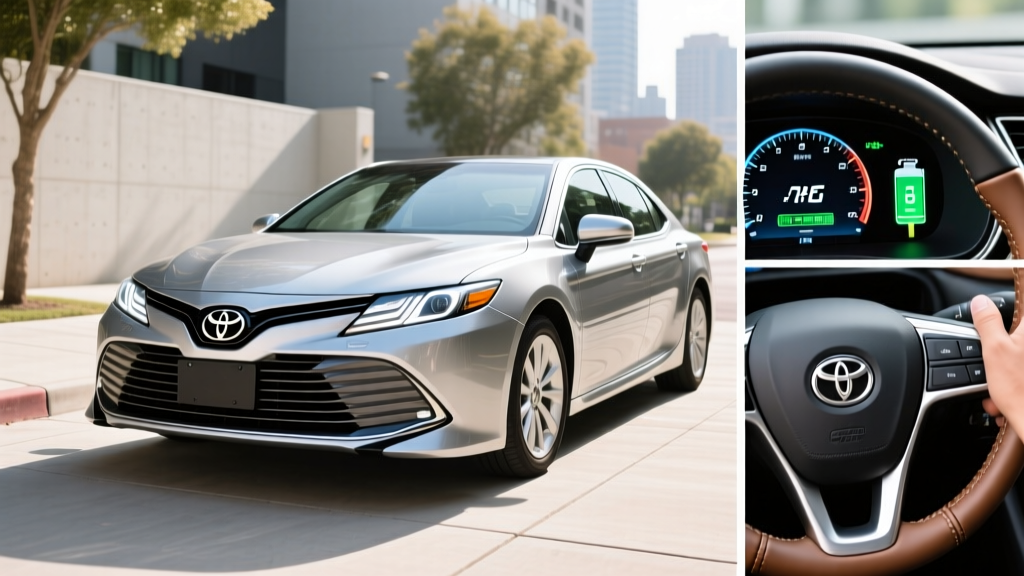
The eighth-generation Toyota Camry Hybrid launched for the 2018 model year on Toyota's TNGA-K platform, and its EPA-rated fuel economy remains competitive with brand-new hybrids nearly a decade later. If you're researching 2018 hybrid Camry MPG figures as a used-car buyer in 2026, you're looking at one of the most efficient midsize sedans ever sold in the US — with real-world numbers that frequently exceed the EPA sticker in city driving.
This guide covers the exact EPA ratings by trim, what you'll actually see at the pump, the hybrid battery's longevity and warranty status, and how this conventional hybrid (HEV) stacks up against plug-in hybrids and full EVs in today's market.
2018 Camry Hybrid EPA MPG: Official Ratings by Trim
Toyota offered the 2018 Camry Hybrid in three trims: LE, SE, and XLE. The LE trim achieves the highest fuel economy thanks to lighter weight and low-rolling-resistance tires, while the SE and XLE carry a slight penalty from larger wheels and additional equipment.
| Trim | City MPG | Highway MPG | Combined MPG |
|---|---|---|---|
| LE | 51 | 53 | 52 |
| SE | 44 | 47 | 46 |
| XLE | 44 | 47 | 46 |
Source: EPA Fuel Economy Guide
The LE's 52 MPG combined rating was exceptional for a midsize sedan in 2018 and still holds up against 2026 competitors. For context, the 2026 Honda Accord Hybrid rates at 48 MPG combined, and the 2026 Hyundai Sonata Hybrid achieves 47 MPG combined. The Camry Hybrid LE's advantage comes from Toyota's fourth-generation Hybrid Synergy Drive system paired with a highly efficient 2.5-liter Dynamic Force engine.
Real-World MPG: What Owners Actually Report
EPA estimates are tested under controlled conditions, but the 2018 Camry Hybrid has a well-documented tendency to exceed its EPA rating in real-world city driving. This is characteristic of Toyota's series-parallel hybrid system, which maximizes electric-motor usage at low speeds and in stop-and-go traffic where the gas engine is least efficient.
- City / commuter driving: 48–55 MPG (often exceeds EPA's 51)
- Highway (70–75 mph): 42–48 MPG (below EPA's 53 — common for hybrids)
- Mixed driving: 46–52 MPG
- Cold weather (below 35°F): 38–44 MPG (engine runs more for cabin heat)
Highway driving is where hybrids lose their advantage relative to the EPA sticker. At sustained 70+ mph speeds, the electric motor contributes less and aerodynamic drag dominates. If your commute is primarily highway miles, expect numbers closer to the mid-40s. If you drive mostly in the city or in heavy traffic, you'll likely beat the EPA estimate regularly.
Owner-reported data on Fuelly.com shows a lifetime average around 47–49 MPG across all trims, which aligns with mixed-use expectations. Some hypermilers report consistent low-to-mid 50s in warm-weather city driving using Eco mode and anticipatory braking to maximize regenerative energy capture.
Powertrain Specs: 2018 Camry Hybrid Drivetrain Breakdown
| Specification | Detail |
|---|---|
| Engine | 2.5L 4-cylinder Dynamic Force (A25A-FXS) |
| Engine HP | 176 hp @ 5,700 rpm |
| Engine Torque | 163 lb-ft @ 3,600 rpm |
| Electric Motor | Permanent magnet synchronous (88 kW / 118 hp) |
| Combined Net HP | 208 hp |
| Transmission | eCVT (planetary gearset, not belt-driven) |
| Hybrid Battery | 1.6 kWh nickel-metal hydride (NiMH), LE trim |
| Hybrid Battery (SE/XLE) | 1.6 kWh lithium-ion (Li-ion) |
| 0–60 mph | ~7.5 seconds |
| Drivetrain | Front-wheel drive |
| Fuel Tank | 13.2 gallons |
| Total Range (LE) | ~686 miles (EPA combined) |
The 208 combined horsepower is a meaningful improvement over the previous-generation Camry Hybrid's 200 hp, and the TNGA-K platform gave the 2018 model substantially better handling dynamics. Toyota's eCVT is not a traditional continuously variable transmission with a steel belt — it uses a planetary gearset that seamlessly blends power from the gas engine and electric motor. This design has proven extremely durable, with very few reported failures.
HEV vs PHEV vs EV: Which Powertrain Fits You?
The 2018 Camry Hybrid is a conventional hybrid (HEV). It does not have a plug, cannot be charged from an outlet, and has no electric-only driving range beyond brief low-speed assists. It generates all its electricity onboard through regenerative braking and the gas engine. This is fundamentally different from a plug-in hybrid (PHEV) or a battery electric vehicle (BEV).
| Factor | HEV (2018 Camry Hybrid) | PHEV (e.g., 2026 RAV4 Prime) | BEV (e.g., 2026 Tesla Model 3) |
|---|---|---|---|
| Plug-in charging | No — never plugs in | Yes — Level 1 or Level 2 | Yes — Level 1, 2, or DC fast |
| Electric-only range | None (motor assists only) | 25–42 miles typical | 250–360+ miles |
| Gasoline required | Yes — always | Yes — after battery depletes | No |
| Federal tax credit (§30D) | Not eligible | Up to $7,500 (if eligible) | Up to $7,500 (if eligible) |
| Home charging needed | No | Recommended | Essential |
| Maintenance | Oil changes + standard | Oil changes + standard | Minimal (no oil, fewer fluids) |
| Used price (2026 market) | $16,000–$23,000 | $30,000–$42,000 | $22,000–$38,000 |
Choose the 2018 Camry Hybrid (HEV) if: You want maximum fuel efficiency with zero lifestyle change — no charging, no plug, no range planning. You live in an apartment or lack home charging access. You want a proven, low-risk used car with strong reliability data.
Choose a PHEV if: You have home charging and a short commute (under 30 miles) that could be fully electric, but you also take road trips where gas flexibility matters.
Choose a BEV if: You have reliable home charging, want to eliminate gas entirely, and your daily driving falls within the vehicle's range.
Hybrid Battery Warranty, Lifespan, and Replacement Cost
The most common concern for used hybrid buyers is battery longevity. Here's the good news: Toyota's hybrid batteries have an excellent track record of outlasting their warranty periods by significant margins.
- Hybrid battery coverage: 8 years / 100,000 miles (10 years / 150,000 miles in CARB states: CA, CT, ME, MD, MA, NJ, NY, OR, RI, VT, WA, and others adopting California emissions standards)
- Hybrid system components: Same 8/100k or 10/150k coverage
- Coverage threshold: Battery must fall below a defined capacity/performance level — not just any degradation
For a 2018 model, the federal 8-year/100,000-mile warranty expires in 2026. CARB-state 10-year/150,000-mile coverage extends through 2028.
In practice, Toyota's NiMH and Li-ion hybrid battery packs routinely last 150,000–200,000+ miles before needing replacement. The 2018 Camry Hybrid's battery is far smaller (1.6 kWh) than a PHEV or BEV pack, which means less stress per cell and less degradation concern. The battery is never deeply cycled — Toyota's hybrid system keeps it in a narrow state-of-charge window (roughly 40–80%) to maximize longevity.
If replacement is needed: A new OEM hybrid battery from Toyota costs approximately $2,500–$4,000 including labor. Refurbished or aftermarket replacement packs run $1,500–$2,500 installed. Independent hybrid-specialty shops can often replace individual failed modules within the pack for $500–$1,200, extending the pack's life at a fraction of full replacement cost.
According to NHTSA complaint data, premature hybrid battery failure in the 2018 Camry Hybrid is rare. The more common failure point is the 12-volt auxiliary battery (a standard lead-accent battery that powers electronics), which is a $200–$300 replacement and unrelated to the hybrid traction system.
Tax Credits and Incentives: What Applies to a 2018 Camry Hybrid?
This is where conventional hybrids differ sharply from PHEVs and BEVs. The 2018 Camry Hybrid does not qualify for the federal §30D clean vehicle tax credit — that credit applies only to plug-in electric vehicles with a minimum battery capacity of 7 kWh. The Camry Hybrid's 1.6 kWh battery is far below this threshold.
There is also no federal used-EV credit (§25E) available, as that credit is limited to used plug-in vehicles (PHEVs and BEVs) sold for $25,000 or less through a licensed dealer.
Some states offer modest incentives for hybrid purchases, but these are increasingly focused on plug-in vehicles. Check your state's energy office or department of environmental quality for current programs. As a used purchase in 2026, your primary financial advantage is the fuel savings, not tax incentives.
- ❌ Federal §30D new clean vehicle credit — not eligible (HEV, no plug)
- ❌ Federal §25E used clean vehicle credit — not eligible (HEV, no plug)
- ⚠️ State hybrid incentives — varies by jurisdiction; check state resources
- ✅ Fuel cost savings — at $3.40/gal gas and 12,000 miles/year, saves ~$900–$1,100 annually vs a 28 MPG gas midsize sedan
Ownership Costs and Fuel Savings in 2026
At current used-car prices, the 2018 Camry Hybrid represents a strong value proposition. Here's how the economics work for a typical buyer:
| Cost Factor | 2018 Camry Hybrid LE | 2018 Camry Gas (4-cyl LE) |
|---|---|---|
| Used purchase price (2026 avg) | $17,500–$21,000 | $15,000–$18,500 |
| EPA combined MPG | 52 | 32 |
| Annual fuel cost (12,000 mi @ $3.40/gal) | $785 | $1,275 |
| 5-year fuel cost | $3,923 | $6,375 |
| 5-year fuel savings vs gas model | $2,452 | |
| Estimated maintenance (5 yr) | $2,200–$2,800 | $2,400–$3,000 |
| Insurance (avg annual) | $1,300–$1,600 | $1,250–$1,550 |
The hybrid premium in the used market is typically $2,000–$3,000 over the equivalent gas model. With annual fuel savings of roughly $490, you'll recoup the purchase premium in about 4–6 years depending on your mileage. If you drive more than 12,000 miles per year — especially city miles — the payback period shortens considerably.
Insurance costs are nearly identical between the hybrid and gas Camry. Maintenance is slightly lower on the hybrid because regenerative braking reduces wear on brake pads (expect 60,000–80,000+ miles on original pads), and the hybrid system has no additional fluid changes or belt replacements beyond the standard gas-engine service items.
Pros and Cons: 2018 Camry Hybrid as a Used Buy
- Class-leading 52 MPG combined (LE trim)
- Real-world city MPG often exceeds EPA estimate
- Proven Toyota reliability; hybrid battery longevity well documented
- No charging infrastructure needed — fill up at any gas station
- Strong resale value retention for a 7–8 year old vehicle
- 208 hp provides adequate passing power; better than prior generation
- TNGA-K platform: improved ride, handling, and safety vs 2012–2017 Camry
- Standard Toyota Safety Sense-P (pre-collision, lane departure, auto high beams, adaptive cruise)
- No federal tax credit eligibility (HEV, not plug-in)
- Highway MPG falls below EPA estimate at sustained 70+ mph speeds
- SE and XLE trims drop to 46 MPG combined — still good but less exceptional
- Small 1.6 kWh battery provides no meaningful electric-only driving
- Trunk space slightly reduced vs gas Camry (battery placement)
- Cold-weather MPG drops 15–20% due to engine running for cabin heat
- No Apple CarPlay / Android Auto in 2018 model year (added for 2019)
- Original 8-year hybrid warranty expiring in 2026 for federal-coverage states
Who Should Buy the 2018 Camry Hybrid?
The 2018 Camry Hybrid is the right choice if you want a used midsize sedan that delivers exceptional fuel economy with zero lifestyle adjustments. It's ideal for:
- Commuters with city-heavy routes — stop-and-go traffic is where this car shines brightest, regularly returning 50+ MPG
- Rideshare drivers — the fuel savings directly impact earnings, and Toyota's reliability minimizes downtime
- Apartment dwellers without charging access — no plug required; you'll never need to think about charging infrastructure
- Budget-conscious buyers — a $17,000–$21,000 used hybrid with 52 MPG and strong reliability data is difficult to beat on total cost of ownership
- First-time hybrid buyers — the driving experience is nearly identical to a gas Camry; the hybrid system works invisibly in the background
It's not the right choice if you want electric-only commuting (look at a PHEV like the RAV4 Prime or a used Prius Prime), if you want to eliminate gasoline entirely (consider a used BEV), or if you need all-wheel drive (the 2018 Camry Hybrid is FWD only; AWD-e was introduced for 2020).
Frequently Asked Questions
How many MPG does the 2018 hybrid Camry get?
The 2018 Toyota Camry Hybrid LE is EPA-rated at 51 city / 53 highway / 52 combined MPG. The SE and XLE trims rate at 44 city / 47 highway / 46 combined. In real-world driving, city MPG often exceeds the EPA estimate while highway MPG tends to fall 4–6 MPG below the sticker at sustained speeds above 70 mph.
Does the 2018 Camry Hybrid need to be plugged in?
No. The 2018 Camry Hybrid is a conventional hybrid (HEV), not a plug-in hybrid (PHEV). It charges its small 1.6 kWh battery internally through regenerative braking and the gasoline engine. You never plug it in — you simply fill it with gas like any conventional car.
Is the 2018 Camry Hybrid reliable, and what does battery replacement cost?
The 2018 Camry Hybrid has strong reliability ratings. Toyota's hybrid system is one of the most proven in the industry, with millions of units on the road globally. The hybrid battery is warranted for 8 years/100,000 miles (10 years/150,000 in CARB states). If replacement is needed after warranty, expect $2,500–$4,000 for a new OEM pack or $1,500–$2,500 for a refurbished unit. Most packs last well beyond 150,000 miles.
Does the 2018 Camry Hybrid qualify for any tax credit?
No. The federal §30D clean vehicle tax credit and the §25E used clean vehicle credit both require a plug-in vehicle with a minimum battery capacity. The Camry Hybrid is a conventional HEV and does not qualify for any federal EV tax credits. Some states may offer minor incentives for hybrids — check your state's energy office.
How does the 2018 Camry Hybrid compare to a full EV for daily commuting?
For a 20-mile round-trip city commute, the Camry Hybrid will use roughly 0.4 gallons of gas per day (about $1.36 at $3.40/gal). A comparable EV like a used Chevrolet Bolt or Tesla Model 3 would use about 6–8 kWh of electricity per day (about $0.80–$1.20 at residential rates). The EV saves marginally more per mile, but requires home charging access and a higher upfront purchase price. The Camry Hybrid offers 80–90% of the fuel cost benefit with none of the charging logistics.
What is the difference between the LE, SE, and XLE hybrid trims?
The LE uses a NiMH battery pack and 16-inch wheels for maximum efficiency (52 MPG combined). The SE adds sport-tuned suspension, 18-inch wheels, and a Li-ion battery pack but drops to 46 MPG combined. The XLE adds premium interior features, also with a Li-ion pack and 46 MPG combined. The Li-ion pack in the SE/XLE is slightly lighter and more energy-dense but doesn't offset the larger wheels' rolling resistance penalty.