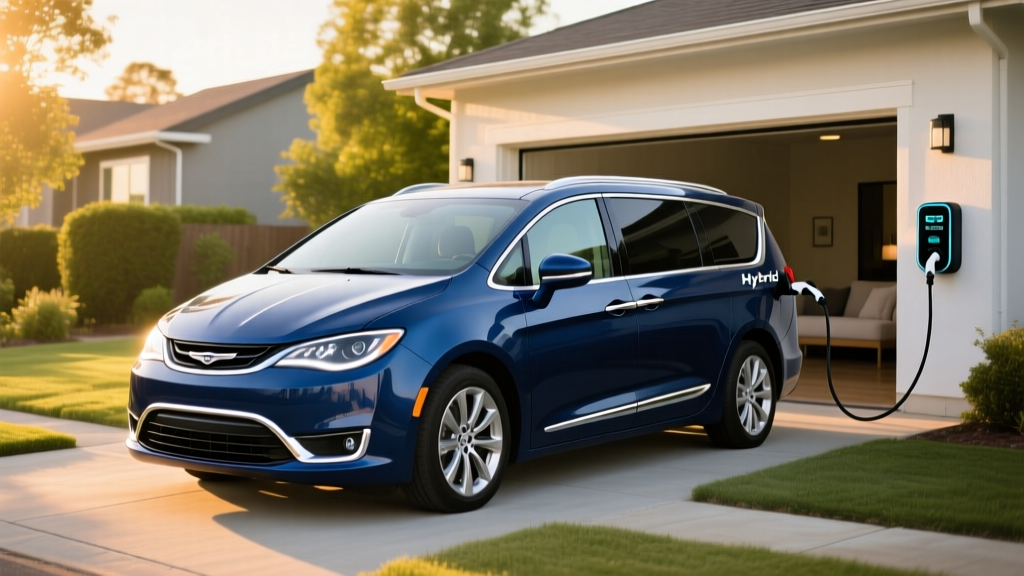
The 2018 Chrysler Pacifica Hybrid occupies a unique space in the used-minivan market: it's the only plug-in hybrid (PHEV) minivan from that era, and it remains one of the most practical ways to combine electric-only school runs with gas-powered road trips. With 33 miles of EPA-rated electric range and a combined 84 MPGe when the battery is charged, it can meaningfully cut fuel costs for families who plug in regularly. But as a used purchase in 2026, buyers need to understand the battery's age, real-world efficiency, and whether this PHEV still makes financial sense compared to newer alternatives.
2018 Pacifica Hybrid Specs at a Glance
| Specification | 2018 Chrysler Pacifica Hybrid |
|---|---|
| Powertrain Type | Plug-in Hybrid (PHEV) |
| Engine | 3.6L V6 Atkinson-cycle + 2 electric motors |
| Combined Horsepower | 260 hp |
| Transmission | eFlite SI-EVT (electrically variable) |
| Battery Capacity | 16 kWh lithium-ion (usable ~13 kWh) |
| EPA Electric Range | 33 miles |
| EPA Combined MPGe (charge-sustaining + electric) | 84 MPGe |
| EPA MPG (gas only, battery depleted) | 32 combined (29 city / 30 hwy) |
| Total Combined Range | ~566 miles (electric + gas) |
| Level 2 Charge Time (240V, 32A) | ~2 hours |
| Level 1 Charge Time (120V, 12A) | ~14 hours |
| DC Fast Charging | Not supported |
| Drivetrain | Front-wheel drive |
| 0-60 mph | ~7.1 seconds |
| Seating | 7 passengers |
| Original MSRP (base Hybrid Premium) | $42,290 |
HEV vs PHEV: What the Pacifica Hybrid Actually Is
Conventional Hybrid (HEV): A standard hybrid like the Toyota Sienna Hybrid uses a small battery (~1.6 kWh) charged entirely by regenerative braking and the gas engine. You never plug it in. It improves MPG but offers no electric-only driving beyond low-speed creep.
Plug-in Hybrid (PHEV): The 2018 Pacifica Hybrid has a much larger 16 kWh battery that you plug into a wall outlet or Level 2 charger. This enables 33 miles of genuine electric-only driving at highway speeds before the gas engine engages. Once the battery depletes, it operates as a conventional hybrid at 32 MPG combined.
Full EV (BEV): A battery-electric vehicle has no gas engine at all — zero tailpipe emissions, 250-350+ miles of range, but requires commitment to charging infrastructure.
The Pacifica Hybrid's value proposition hinges on that PHEV flexibility: plug in nightly for a 33-mile electric commute, and use gas only for longer trips. If you never plug it in, you're carrying 600+ pounds of dead battery weight and getting worse MPG than a conventional hybrid minivan would deliver.
Fuel Economy: EPA vs Real-World Numbers
| Condition | City | Highway | Combined |
|---|---|---|---|
| EPA (charge-sustaining, gas only) | 29 MPG | 30 MPG | 32 MPG |
| EPA (combined with electric, MPGe) | 84 MPGe | ||
| Real-world (gas only, mixed driving) | 26-28 MPG | 28-30 MPG | 27-29 MPG |
| Real-world (daily electric + gas mix) | Highly variable: 40-65+ MPGe depending on plug-in frequency | ||
According to fueleconomy.gov, the 2018 Pacifica Hybrid rates at 32 MPG combined when operating on gasoline alone. In real-world driving, owners typically see 27-29 MPG combined in charge-sustaining mode — slightly below the EPA sticker, which is common for heavier vehicles in mixed traffic.
The 84 MPGe figure only applies when you start with a full battery and blend electric and gas driving. MPGe (miles per gallon equivalent) converts the energy in electricity to a gasoline-equivalent number for comparison. If you charge nightly and drive under 33 miles daily, your actual gasoline consumption could approach zero on weekdays, making the effective cost-per-mile dramatically lower than the gas-only figure suggests.
Electric-Only Range and Charging
The EPA rates the 2018 Pacifica Hybrid at 33 miles of electric-only range on a full charge. In real-world conditions:
- Mild weather (60-75°F), city/suburban: 30-34 miles — you'll meet or slightly beat the EPA estimate at lower speeds where regen braking recovers energy.
- Highway (70+ mph): 22-27 miles — aerodynamic drag and sustained speeds deplete the battery faster.
- Cold weather (below 30°F): 20-25 miles — battery chemistry loses efficiency, and cabin heating draws significant power. The Pacifica Hybrid uses a resistive heater, not a heat pump, which hits range harder in winter.
Charging is straightforward but limited to AC power:
| Level | Voltage/Amps | Power (kW) | 0-100% Time | Miles Added Per Hour |
|---|---|---|---|---|
| Level 1 (included cord) | 120V / 12A | ~1.4 kW | ~14 hours | ~2.5 miles |
| Level 2 (home/public) | 240V / 32A | ~7.2 kW | ~2 hours | ~16 miles |
| DC Fast Charge | N/A | N/A | N/A | Not supported |
The lack of DC fast charging is the Pacifica Hybrid's most notable limitation. You cannot top up at a highway fast charger — only Level 1 (standard outlet) and Level 2 (240V home charger or public AC station) are supported. For a PHEV with 33 miles of range, this is less of a problem than it seems: most owners charge overnight at home and rarely need public charging. But if you lack home charging access, the 14-hour Level 1 time makes daily plug-in impractical.
Powertrain and Driving Dynamics
The Pacifica Hybrid pairs a 3.6-liter Atkinson-cycle V6 with two electric motors integrated into the eFlite SI-EVT transmission. Combined output is 260 horsepower — adequate for a 5,000-pound minivan but not brisk. The 0-60 mph time of approximately 7.1 seconds is respectable for the class, and the electric motors deliver immediate torque for confident merging.
Driving modes include:
- Hybrid mode: The system automatically blends electric and gas power for optimal efficiency.
- Electric mode: Forces battery-only operation until the charge depletes (up to ~85 mph).
- eSave mode: Preserves battery charge by running the gas engine more — useful if you want to save electric miles for a city destination later in your trip.
Regenerative braking is moderate — not aggressive enough for true one-pedal driving, but it recovers meaningful energy in stop-and-go traffic. The transition between electric and gas power is generally smooth, though the engine can sound coarse under hard acceleration, a common Atkinson-cycle trait.
Battery Health, Warranty, and Replacement Cost
Original Battery Warranty: 8 years / 100,000 miles (10 years / 150,000 miles in CARB states including California, New York, Massachusetts, and others). Coverage applies to defects and capacity loss below 70% of original capacity.
2026 Reality Check: A 2018 model is now 8 years old. The standard 8-year warranty is expiring or has expired for most original owners, unless the vehicle was registered in a CARB state (10-year coverage extends through 2028). If you're buying used, verify the in-service date and registration state to determine remaining coverage.
Lithium-ion battery degradation in the Pacifica Hybrid has been generally moderate. Owners reporting on forums and fueleconomy.gov typically see 10-15% capacity loss after 5-7 years and 60,000-80,000 miles, translating to roughly 28-30 miles of electric range instead of the original 33. Some high-mileage examples have fared worse, particularly in hot climates where sustained heat accelerates degradation.
If the battery fails out of warranty, replacement cost from a Chrysler dealer runs $6,500-$8,500 including parts and labor. Third-party refurbished or replacement options are emerging in 2026 at $4,000-$5,500, but availability varies. Before buying any used 2018 Pacifica Hybrid, request a battery health report from a dealer (State of Health percentage) or use an OBD-II scanner with a compatible app to check current capacity versus the original 16 kWh.
Pricing and Tax Credit Eligibility in 2026
The 2018 Pacifica Hybrid originally started at $42,290 (Hybrid Premium trim) and reached ~$48,000 for the Hybrid Limited. In the used market as of early 2026, expect to pay:
- 60,000-80,000 miles: $18,000-$24,000
- 80,000-120,000 miles: $14,000-$19,000
- 120,000+ miles: $11,000-$15,000
Used EV Tax Credit (§25E): The 2018 Pacifica Hybrid qualifies for the federal used clean vehicle credit under IRS §25E — up to $4,000 or 30% of the sale price, whichever is less. Requirements include:
- Sale price must be $25,000 or less
- Buyer income caps: $75,000 single / $112,500 head of household / $150,000 joint
- Vehicle must be at least 2 model years old (2018 qualifies in 2026)
- Must purchase from a licensed dealer (private-party sales do not qualify)
- Credit is non-refundable — you must have tax liability to use it
- Transferrable at point of sale as a down payment reduction (dealer must be IRS-registered)
At a typical used price of $16,000-$22,000, the Pacifica Hybrid often falls under the $25,000 cap, making the full $4,000 credit available to eligible buyers. This effectively brings the purchase price to $12,000-$18,000 — strong value for a 7-passenger PHEV minivan. Consult a tax professional to confirm your eligibility, as income limits and dealer registration requirements apply.
The original §30D new-vehicle credit is not available for 2018 purchases made in 2026 — that credit applies only to new vehicles.
Reliability and Ownership Considerations
The 2018 Pacifica Hybrid has a mixed reliability record. The hybrid powertrain itself — the electric motors, eFlite transmission, and battery — has proven reasonably durable. However, the Pacifica platform has drawn complaints for non-powertrain issues:
- Electrical gremlins: Infotainment system freezes, power sliding door malfunctions, and sensor errors are the most common complaints on NHTSA.
- Stow 'n Go limitation: Unlike the gas Pacifica, the Hybrid's second-row seats do not fold into the floor — the battery occupies that space. You can remove them manually, but it's a two-person job. Third-row seats still fold flat.
- No AWD: The Pacifica Hybrid is front-wheel drive only. If you need all-wheel drive, the gas Pacifica offers it; the Hybrid does not.
For a family minivan used primarily for school runs, groceries, and commuting — exactly the PHEV sweet spot — the Pacifica Hybrid's electric range covers most daily needs. Just budget for potential electrical-system repairs and verify battery health before purchase.
Who Should Choose the 2018 Pacifica Hybrid?
Choose the 2018 Pacifica Hybrid if:
- You need a minivan and want to reduce fuel costs with electric-only daily driving under 30 miles
- You have access to home Level 2 charging (or at least a dedicated 120V outlet in your garage)
- You want the flexibility to take gas-powered road trips without range anxiety
- You qualify for the $4,000 used EV tax credit, bringing the effective price well under $20,000
- You can accept FWD-only and non-stowing second-row seats
Choose a full EV (like the Kia EV9 or Tesla Model X) if:
- Your daily driving regularly exceeds 33 miles and you want to eliminate gas entirely
- You have reliable home and workplace charging
- You want lower maintenance costs (no oil changes, no gas engine upkeep)
- You're willing to spend $40,000+ for a newer EV minivan or SUV
Choose a conventional hybrid (like the Toyota Sienna Hybrid) if:
- You cannot charge at home and don't want to rely on plug-in behavior
- You want AWD availability
- You prefer the simplicity of never thinking about charging
- You want full Stow 'n Go seating flexibility (Sienna doesn't offer this either, but the gas Pacifica does)
Pros and Cons
Pros
- Only PHEV minivan in its class — no direct competitor at this price
- 33 miles electric range covers most daily family driving
- 32 MPG gas-only is solid for a 5,000-lb minivan
- Eligible for $4,000 used EV tax credit under §25E
- Smooth electric-only operation, adequate 260 hp combined
- Comfortable ride, spacious cabin, good safety features
Cons
- No DC fast charging — Level 2 only
- Second-row seats don't fold into the floor (battery in the way)
- FWD only — no AWD option
- Mixed reliability record for electronics and accessories
- Battery warranty expiring on most 2018 models in 2026
- $6,500-$8,500 out-of-warranty battery replacement cost
- Resistive cabin heater reduces winter electric range significantly
Frequently Asked Questions
How many MPG does the 2018 Pacifica Hybrid get?
The EPA rates it at 32 MPG combined (29 city / 30 highway) when running on gasoline after the battery is depleted. When combining electric and gas driving from a full charge, it achieves 84 MPGe. Real-world gas-only driving typically yields 27-29 MPG combined.
How far can the 2018 Pacifica Hybrid go on electric only?
The EPA rates it at 33 miles of electric-only range. Real-world results range from 20-25 miles in cold weather to 30-34 miles in mild city driving. Highway speeds and winter temperatures reduce this significantly.
Does the 2018 Pacifica Hybrid qualify for a tax credit in 2026?
It is not eligible for the new-vehicle §30D credit (that applies only to new purchases). However, it qualifies for the §25E used clean vehicle credit: up to $4,000 or 30% of the sale price, whichever is less, if the sale price is $25,000 or less and the buyer meets income requirements.
Is the 2018 Pacifica Hybrid reliable, and what does a battery replacement cost?
The hybrid powertrain is generally durable, but the Pacifica platform has known issues with electronics, infotainment, and power accessories. Battery degradation is typically 10-15% after 5-7 years. Out-of-warranty battery replacement costs $6,500-$8,500 at a dealer, or $4,000-$5,500 from third-party providers.
Can I charge the 2018 Pacifica Hybrid at a DC fast charger?
No. The Pacifica Hybrid only supports Level 1 (120V) and Level 2 (240V) AC charging. It has no DC fast-charge port. A full Level 2 charge takes about 2 hours.
Do the second-row seats fold into the floor?
No. The battery pack occupies the under-floor compartment that the gas Pacifica uses for Stow 'n Go second-row seating. You can physically remove the second-row seats, but they don't fold flat into the floor. The third row still folds flat.
Hybrid vs PHEV vs EV — which fits my family?
If you can charge at home and your daily driving is under 30 miles, the Pacifica Hybrid (PHEV) gives you electric daily driving with gas backup for road trips. If you can't charge at home, a conventional hybrid like the Toyota Sienna Hybrid (36 MPG combined) is simpler. If you want zero gas use and have charging access, a full EV minivan like the newer Kia EV9 offers 270+ miles of range but at a significantly higher price.