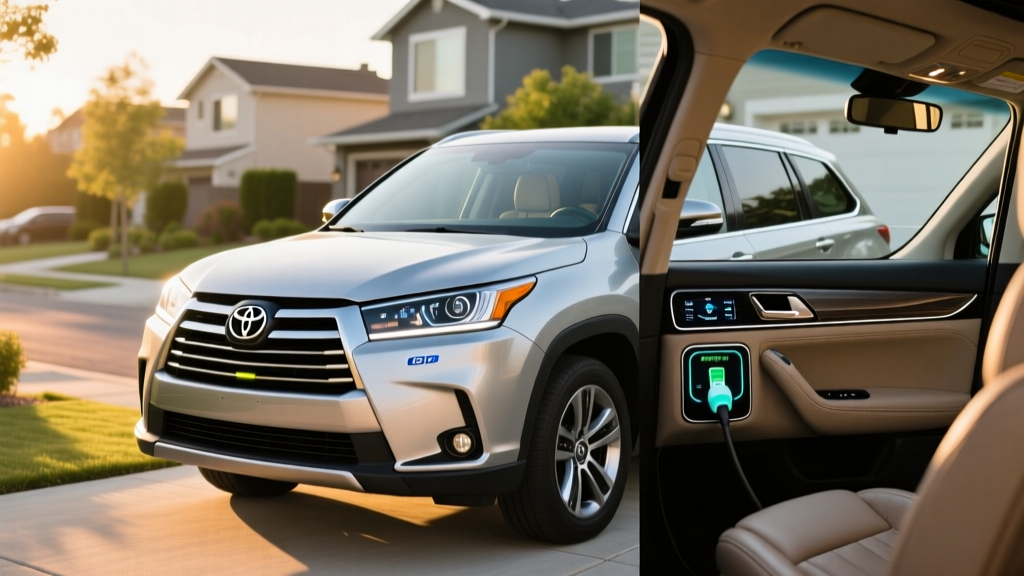
The 2017 Toyota Highlander Hybrid sits at an interesting crossroads in the used three-row SUV market. It pairs a 3.5-liter V6 with Toyota's proven hybrid synergy drive to deliver 306 combined horsepower and an EPA-estimated 29 MPG combined — figures that still hold up nearly a decade later. For buyers searching for a 17 Highlander Hybrid, understanding what this powertrain delivers in the real world, what battery replacement might cost, and how it stacks against newer hybrids and full EVs is essential before signing any paperwork.
This guide breaks down everything a prospective used buyer or current owner needs to know: exact fuel economy numbers, powertrain specs, battery longevity data, real-world ownership economics, and whether this hybrid SUV still makes sense in a market now flooded with plug-in hybrids and three-row EVs.
HEV vs PHEV: What the 2017 Highlander Hybrid Actually Is
Before evaluating fuel economy and ownership costs, it's critical to understand what type of electrified vehicle the 2017 Highlander Hybrid is — and what it isn't.
Conventional Hybrid (HEV) — This Is the 2017 Highlander Hybrid
- No plug required. The battery charges through regenerative braking and the gasoline engine.
- No electric-only driving range beyond very low-speed, short-distance creep (under ~1 mile at parking-lot speeds).
- Fuel economy gains come from engine stop-start, regenerative braking recapturing energy, and the electric motor assisting during acceleration.
- No federal tax credit eligibility under current IRS §30D rules, which apply only to plug-in vehicles (PHEVs and BEVs).
Plug-In Hybrid (PHEV) — Not Available for the Highlander Until 2026
- Requires plugging in to charge a larger battery (typically 15–25 kWh).
- Offers 30–45 miles of electric-only range before the gas engine engages.
- May qualify for partial or full federal tax credits depending on battery capacity and sourcing.
- Toyota did not offer a Highlander PHEV (called the Highlander Prime in some markets) in the US for the 2017 model year. The first plug-in Highlander variant arrived for the 2026 model year.
If you're looking at a 2017 Highlander Hybrid, you're looking at a self-charging HEV. You will never need to plug it in, and you cannot charge it from a wall outlet or public charger. This is a feature, not a limitation, for buyers who lack home charging access but still want better fuel economy than a gas-only SUV.
Fuel Economy: EPA Ratings vs Real-World MPG
The 2017 Highlander Hybrid uses Toyota's Hybrid Synergy Drive with a 3.5L V6 and two electric motors (front and rear) delivering electronic on-demand AWD. Here are the official EPA fuel economy estimates from fueleconomy.gov:
| Driving Cycle | EPA Estimate | Real-World Expectation |
|---|---|---|
| City | 29 MPG | 28–32 MPG (hybrids often exceed EPA in stop-and-go) |
| Highway | 27 MPG | 24–27 MPG (sustained high-speed driving reduces regen benefit) |
| Combined | 29 MPG | 26–30 MPG depending on driving mix |
Why Hybrids Often Beat EPA in the City
Unlike gas-only vehicles, hybrids recover kinetic energy during braking and use the electric motor for low-speed propulsion where gasoline engines are least efficient. Owners who do a lot of city and suburban driving — the exact scenario where regenerative braking cycles frequently — often report 30–32 MPG in mixed urban use. Highway-heavy commutes at 75+ MPH reduce the hybrid advantage because aerodynamic drag dominates and there's less braking to recapture energy.
Cold-Weather and High-Altitude Considerations
Expect a 5–10% fuel economy reduction in winter months (below 35°F). The gasoline engine runs more frequently to heat the cabin and bring the catalytic converter to operating temperature. This is normal hybrid behavior and not a sign of battery degradation.
Comparison: 2017 Highlander Hybrid vs Gas-Only Highlander
The gas-only 2017 Highlander with the 3.5L V6 and 8-speed automatic returns an EPA-estimated 20 city / 24 highway / 22 combined MPG. The hybrid's 29 MPG combined represents a 32% improvement in fuel economy — translating to roughly $400–$600 in annual fuel savings depending on local gas prices and annual mileage (based on 15,000 miles/year at $3.50/gallon).
Powertrain Specs: 306 HP with Electronic AWD
| Specification | 2017 Highlander Hybrid |
|---|---|
| Engine | 3.5L V6 (2GR-FXE, Atkinson cycle) |
| Engine Output | 295 HP @ 6,000 RPM / 263 lb-ft torque |
| Front Electric Motor | 167 HP / 247 lb-ft |
| Rear Electric Motor | 67 HP / 103 lb-ft |
| Net Combined System Output | 306 HP |
| Transmission | eCVT (planetary gearset, not a belt-driven CVT) |
| Drivetrain | Electronic On-Demand AWD (eAWD) |
| Hybrid Battery | ~1.9 kWh nickel-metal hydride (NiMH) |
| 0–60 MPH | ~7.8 seconds |
| Towing Capacity | 3,500 lbs |
| Seating | 7 or 8 passengers (trim-dependent) |
Toyota's eCVT in this generation is a power-split device using planetary gears — not the rubber-belt continuously variable transmissions found in some competitors. This design has proven exceptionally durable, with very few reported failures even at high mileage. The rear electric motor provides AWD traction without a mechanical driveshaft, reducing weight and drivetrain loss.
The 1.9 kWh NiMH battery pack is small by modern standards, but it only needs to buffer energy for acceleration assist and regenerative capture — it doesn't need to store miles of electric-only range. Toyota deliberately keeps the state of charge within a narrow window (roughly 40–80%) to maximize battery cycle life, which is why these packs routinely last 150,000+ miles.
Battery Longevity, Warranty, and Replacement Cost
Battery lifespan is the single biggest concern for used hybrid buyers. Here's the data:
Original Factory Warranty
- Hybrid battery: 8 years / 100,000 miles (10 years / 150,000 miles in California and CARB-adopting states)
- Hybrid system components: 8 years / 100,000 miles
- Powertrain: 5 years / 60,000 miles
Source: Toyota Warranty Guide
Real-World Battery Lifespan
The 2017 Highlander Hybrid's NiMH battery has an excellent longevity track record. Based on owner reports and fleet data:
- Typical lifespan: 150,000–200,000+ miles before noticeable capacity loss
- Degradation symptom: Reduced fuel economy (2–4 MPG drop) and more frequent engine cycling, not a sudden failure
- Failure mode: Individual cell imbalance rather than full-pack death — repairable by replacing specific modules
Battery Replacement Cost (2026 Pricing)
| Option | Cost Range | Notes |
|---|---|---|
| New OEM Toyota battery | $3,500–$5,000 | Dealer-installed, full warranty |
| Remanufactured battery | $1,800–$2,800 | Reconditioned cells, 1–3 year warranty |
| Individual cell/module repair | $500–$1,200 | Independent hybrid specialist, requires diagnostics |
| Used/salvage battery | $800–$1,500 | Risky — unknown remaining life |
For a 2017 model now approaching 8–9 years old, the original factory warranty has likely expired unless the vehicle was purchased late in the model year and has low mileage. Budget-conscious buyers should have a hybrid-system diagnostic scan performed before purchase — any shop with a Toyota-compatible scanner can read hybrid battery state of health (SoH) data.
Trim Levels, Pricing, and Tax Credit Eligibility
Original 2017 MSRP (When New)
| Trim | Original MSRP |
|---|---|
| LE | $36,030 |
| XLE | $40,430 |
| Limited | $44,980 |
| Limited Platinum | $47,830 |
Current Used Market Pricing (Early 2026)
Expect to pay $18,000–$28,000 for a 2017 Highlander Hybrid depending on mileage, condition, and trim. Lower-mileage Limited Platinum examples command the top of that range, while high-mileage LE models sit near the bottom.
Tax Credit Eligibility
The 2017 Highlander Hybrid does not qualify for the federal §30D clean vehicle tax credit. Under current IRS rules, the credit applies only to plug-in electric vehicles (BEVs and PHEVs) with a minimum battery capacity of 7 kWh. As a conventional HEV with a ~1.9 kWh NiMH pack and no plug-in capability, the Highlander Hybrid is ineligible.
Some states offer modest incentives for used hybrid purchases, but these vary widely by jurisdiction. Check your state's energy or environmental agency website for current programs.
2017 Highlander Hybrid vs Alternatives: Which Should You Choose?
Pros
- Proven, durable hybrid powertrain with 200K+ mile potential
- 306 HP provides confident highway merging and passing
- 29 MPG combined in a 3-row, 7/8-passenger SUV
- No plug-in charging required — works for apartment/condo dwellers
- Electronic AWD without the fuel economy penalty of mechanical AWD
- Strong Toyota reliability reputation and parts availability
- 3,500-lb towing capacity adequate for small trailers and boats
Cons
- No electric-only driving range — always burns gasoline
- Dated infotainment (no Apple CarPlay/Android Auto in 2017)
- Third-row space is tight for adults on long trips
- No federal tax credit eligibility
- NiMH battery (older chemistry vs modern lithium-ion)
- Higher used prices than comparable gas-only Highlanders
- Hybrid battery replacement cost ($2K–$5K) if it fails post-warranty
Decision Framework
Choose the 2017 Highlander Hybrid if:
- You need a 3-row SUV but can't charge at home (no garage, apartment living)
- Your driving is mostly city/suburban where the hybrid system maximizes MPG
- You want Toyota reliability with better fuel economy than a gas-only SUV
- You tow occasionally but don't need heavy-duty truck capability
Choose a newer PHEV (like the 2026 Highlander Prime) if:
- You have home Level 2 charging and a commute under 35 miles
- You want electric-only daily driving with gas-engine backup for road trips
- You want to qualify for the federal §30D tax credit (up to $7,500, income/MSRP/sourcing rules apply)
Choose a full EV (like the Kia EV9 or Tesla Model X) if:
- You have reliable home charging and your trips rarely exceed 250 miles
- You want zero tailpipe emissions and the lowest per-mile fuel cost
- You're willing to plan DC fast-charging stops on road trips
Stick with a gas-only SUV if:
- Your annual mileage is very low (under 8,000 miles) — the hybrid premium won't pay back
- You frequently tow over 4,000 lbs
- You want the lowest possible purchase price
Reliability Ratings and Safety
The 2017 Highlander earned strong safety marks that hold up today:
- IIHS: Top Safety Pick+ (with optional front crash prevention) — the highest rating available. Check IIHS ratings for detailed crash-test results.
- NHTSA: 5-Star Overall Safety Rating
- Toyota Safety Sense P (TSS-P): Standard on all 2017 Highlander Hybrid trims, including pre-collision system with pedestrian detection, lane departure alert with steering assist, automatic high beams, and full-speed-range dynamic radar cruise control
Mechanically, the 2GR-FXE V6 and Toyota's hybrid synergy drive are among the most reliable powertrains in the industry. The eCVT planetary gearset has no belts, clutches, or bands to wear out. Common maintenance items are no different from a gas Highlander: oil changes (0W-20 synthetic, every 10,000 miles), brake fluid, coolant, and transmission fluid. Notably, hybrid Highlanders often have longer brake pad life than gas models because regenerative braking reduces friction-brake usage — many owners report 80,000+ miles on original brake pads.
Ownership Costs: 5-Year Estimate for a Used 2017 Highlander Hybrid
| Category | Estimated 5-Year Cost | Notes |
|---|---|---|
| Purchase Price (XLE, avg mileage) | $23,000 | Mid-range used example |
| Fuel (15K mi/yr @ $3.50/gal, 28 MPG avg) | $9,375 | ~$1,875/year |
| Insurance | $7,500–$9,000 | Varies by state/driver profile |
| Maintenance | $2,500–$3,500 | Lower than gas models (fewer brake jobs, no timing belt) |
| Potential Hybrid Battery | $0–$3,500 | Most won't need replacement in this window |
| Total Estimated 5-Year | $42,375–$48,375 | Excluding depreciation on purchase |
For comparison, a gas-only 2017 Highlander at 22 MPG combined would cost roughly $11,930 in fuel over the same period — a difference of about $2,555 more in fuel alone. The hybrid premium at purchase is typically recouped within 3–4 years of average driving.
Frequently Asked Questions
How many MPG does the 2017 Highlander Hybrid get?
The EPA rates it at 29 city / 27 highway / 29 combined MPG. In real-world city-heavy driving, many owners report 30–32 MPG. Highway-dominated commutes at higher speeds typically return 24–27 MPG.
Does the 2017 Highlander Hybrid need to be plugged in?
No. It is a conventional hybrid (HEV), not a plug-in hybrid (PHEV). The battery charges itself through regenerative braking and the gasoline engine. There is no charging port on this vehicle.
How far can it drive on electric power alone?
Essentially zero meaningful electric-only range. The hybrid system may propel the vehicle at very low speeds (under 25 MPH) for short distances in parking lots, but the gasoline engine is always running during normal driving. If you want electric-only commuting, you need a PHEV or full BEV.
Is the 2017 Highlander Hybrid reliable?
Yes. Toyota's hybrid synergy drive and the 2GR-FXE V6 are among the most reliable powertrains produced in the last two decades. The eCVT uses a planetary gearset with no wear-prone belts or clutches. The hybrid battery typically lasts 150,000–200,000+ miles.
What does a replacement hybrid battery cost?
A new OEM battery runs $3,500–$5,000 installed at a dealer. Remanufactured options cost $1,800–$2,800, and individual cell repairs at hybrid specialists can cost $500–$1,200. Most 2017 Highlanders will not need a battery replacement for several more years if the pack is currently healthy.
Does the 2017 Highlander Hybrid qualify for any tax credit?
No. The federal §30D clean vehicle credit applies only to plug-in vehicles (PHEVs and BEVs). As a conventional HEV, the Highlander Hybrid does not qualify. Some states may offer small used-vehicle incentives — check your local programs.
Does the 2017 Highlander Hybrid have Apple CarPlay or Android Auto?
No. Toyota did not add Apple CarPlay to the Highlander until the 2019 model year, and Android Auto came in 2020. The 2017 model uses Toyota's Entune infotainment system with Bluetooth audio and a USB port. Aftermarket head-unit replacements are available if smartphone integration is a priority.
How does the hybrid AWD system work?
The 2017 Highlander Hybrid uses electronic on-demand AWD (eAWD). There is no mechanical driveshaft to the rear wheels. Instead, a dedicated 67 HP rear electric motor powers the rear axle when the system detects front-wheel slip or when extra traction is needed. This means the AWD system adds virtually no weight or parasitic loss compared to a mechanical AWD system.