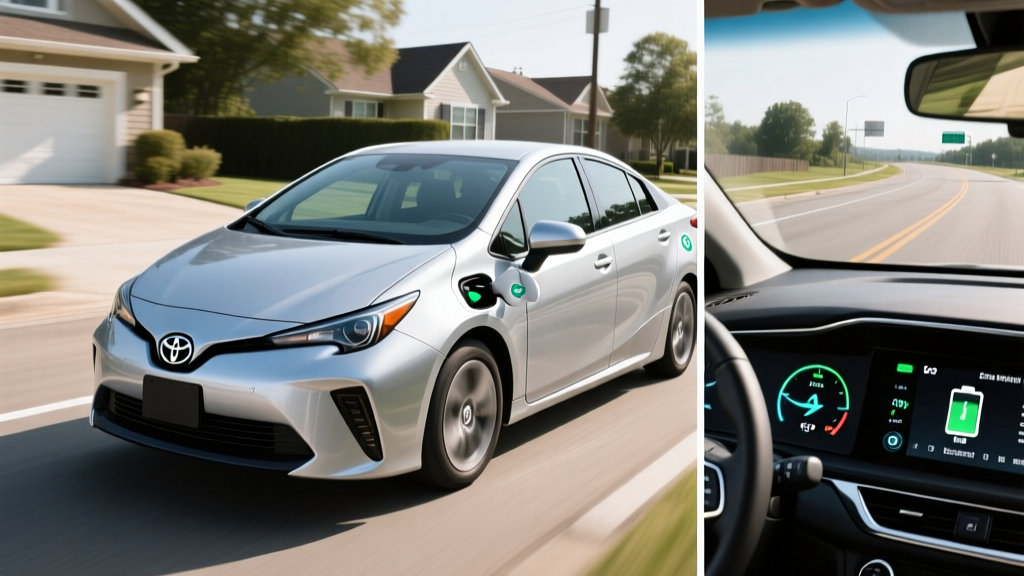
The fourth-generation Toyota Prius (model code XW50) debuted with a radical restyle and a meaningful efficiency bump that still holds up nearly a decade later. For used-car shoppers researching 2017 Prius hybrid MPG, the headline number is 52 MPG combined on the EPA cycle — but the real story involves how that figure translates to actual daily driving, what the battery looks like after 8+ years on the road, and whether this HEV still makes financial sense against modern plug-in hybrids and full EVs.
This guide covers the complete fuel-economy picture, powertrain specs, long-term battery reliability, and ownership economics you need before buying a used 2017 Prius in 2026.
2017 Toyota Prius EPA MPG and Real-World Fuel Economy
The 2017 Prius comes in two distinct efficiency tiers depending on trim. The base Prius Two (and Two Eco with lighter wheels and low-rolling-resistance tires) achieves the highest numbers, while higher trims with larger alloy wheels and added equipment sacrifice a small amount of efficiency.
| Trim Group | City MPG | Highway MPG | Combined MPG | Notes |
|---|---|---|---|---|
| Two Eco | 58 | 53 | 56 | Lightest trim, low-rolling-resistance tires |
| Two / Three / Four / Four Touring | 54 | 50 | 52 | Standard trims, 15" alloy wheels |
| Prius Prime (PHEV) | 54 (hybrid mode) / 133 MPGe | 50 / — | 52 / 133 MPGe | Plug-in variant, separate powertrain |
Source: EPA Fuel Economy Guide — 2017 Toyota Prius
Real-World MPG: What Owners Actually See
The Prius is one of the rare vehicles where real-world fuel economy often exceeds the EPA sticker in city driving. The hybrid system recovers kinetic energy during stop-and-go braking, so urban commutes with frequent stops play directly to its strengths. On aggregated owner-reported data (Fuelly, Edmunds long-term tests), the 2017 Prius averages between 48–54 MPG combined in mixed driving.
- City-heavy commute: 52–58 MPG (regen braking maximizes efficiency)
- Mixed driving: 48–54 MPG
- Highway-only at 70+ mph: 44–48 MPG (aerodynamic drag dominates, less regen benefit)
- Cold weather (below 32°F): 40–46 MPG (engine runs more to heat cabin and battery)
The cold-weather penalty is significant: the gasoline engine must run more frequently to warm the catalytic converter, heat the cabin, and maintain battery temperature. Expect a 10–15% drop in winter months in northern climates. This is a fundamental characteristic of all parallel hybrids, not a defect.
Powertrain Specs: Engine, Motor, and Combined Output
The 2017 Prius uses Toyota's fourth-generation Hybrid Synergy Drive, pairing a 1.8-liter Atkinson-cycle four-cylinder engine with two motor-generators and a planetary gearset that serves as an electronically controlled continuously variable transmission (eCVT).
| Gasoline Engine | 1.8L 4-cyl Atkinson cycle (2ZR-FXE) |
| Engine Horsepower | 96 HP @ 5,200 rpm |
| Engine Torque | 105 lb-ft @ 3,600 rpm |
| Electric Motor (MG2) | 71 HP / 120 lb-ft |
| Combined Net System HP | 121 HP |
| Transmission | eCVT (planetary gearset) |
| Drive Type | Front-wheel drive (AWD-e available on later model years, not 2017) |
| Hybrid Battery | 0.75 kWh usable, Nickel-Metal Hydride (NiMH) or Lithium-Ion depending on trim |
| Curb Weight | 3,042–3,130 lbs |
| 0–60 mph | ~9.8 seconds |
A critical distinction for used buyers: the Prius Two Eco and some trims use a lithium-ion (Li-ion) hybrid battery pack, while the standard Prius Two and higher trims use a nickel-metal hydride (NiMH) pack. Both chemistries are proven, but Li-ion is lighter and slightly more energy-dense, contributing to the Eco trim's higher EPA rating. You can verify which battery your specific vehicle has via the under-hood label or VIN decoder.
HEV vs PHEV: Understanding the 2017 Prius Lineup
Toyota sold two distinct Prius variants for the 2017 model year, and confusing them is a common buyer mistake.
| Attribute | Prius (HEV) | Prius Prime (PHEV) |
|---|---|---|
| Plug-in Charging Required? | No — self-charging via regen + engine | Yes — plug in to access EV mode |
| Electric-Only Range | ~1 mile at low speed | 25 miles (EPA) |
| Total Range (full tank + charge) | ~600 miles | ~640 miles (25 EV + 615 hybrid) |
| Battery Capacity | 0.75 kWh usable | 6.1 kWh usable (8.8 kWh total) |
| Battery Chemistry | NiMH or Li-ion (trim dependent) | Lithium-Ion |
| Charge Time (120V Level 1) | N/A | ~5.5 hours |
| Charge Time (240V Level 2) | N/A | ~2 hours |
| DC Fast Charging | No | No |
| EPA Combined MPG (hybrid mode) | 52 | 52 |
| MPGe (EV mode) | N/A | 133 MPGe |
| Combined System HP | 121 HP | 121 HP |
The conventional Prius (HEV) never needs to be plugged in. It charges its small battery entirely through regenerative braking and the gasoline engine. You simply fuel it like any other car and drive.
The Prius Prime (PHEV) has a larger battery and can travel up to 25 miles on electricity alone before the engine engages. To benefit from that EV range, you need access to a standard 120V outlet or a 240V Level 2 charger. If you never plug it in, it operates as a regular hybrid at 52 MPG — you just carry around extra battery weight for no benefit.
Battery Longevity, Warranty, and Replacement Cost
For any used hybrid purchase, the traction battery is the single largest financial risk. Here's what the data shows for the 2017 Prius.
- Standard states: 8 years / 100,000 miles (whichever comes first)
- CARB states (CA, NY, MA, and 11 others): 10 years / 150,000 miles
- Coverage threshold: Battery capacity below ~60% of original, or failure
For a 2017 model in 2026, the standard 8-year/100k warranty has expired for most vehicles. CARB-state vehicles with the 10-year/150k warranty may still have partial coverage depending on mileage. This makes a pre-purchase battery health check essential.
How Long Do Prius Batteries Actually Last?
The Prius hybrid battery is one of the most proven components in the automotive industry. Real-world fleet data and owner surveys consistently show:
- Average lifespan: 150,000–200,000 miles or 12–15 years before significant degradation
- Failure rate before 150k miles: Under 5% based on Consumer Reports reliability surveys
- Degradation pattern: Gradual capacity loss (roughly 1–2% per year), rarely sudden failure
When a hybrid battery does need replacement, costs have decreased substantially as the supply of refurbished and aftermarket packs has grown:
| Option | Cost Range | Warranty |
| New OEM Toyota battery | $2,000–$2,500 (parts + labor) | 1 year / unlimited miles |
| Refurbished/reconditioned pack | $800–$1,500 (parts + labor) | 1–3 years typical |
| Individual module replacement | $200–$600 (if only 1-2 cells bad) | Varies by shop |
| Aftermarket new pack (e.g., Dorman) | $1,500–$2,000 (parts + labor) | 2–3 years typical |
A key diagnostic step before buying: use an OBD-II scanner with hybrid-specific software (such as Dr. Prius or Torque Pro) to read individual battery module voltages. A healthy pack shows all modules within 0.2V of each other. Wider variance signals impending cell failure.
Used 2017 Prius Pricing in 2026
As a nine-year-old vehicle, the 2017 Prius trades entirely on the used market. Pricing varies significantly with mileage, condition, and battery health.
| Condition / Mileage | Approximate Price Range |
| Under 60k miles, excellent condition | $16,000–$19,500 |
| 60k–100k miles, good condition | $12,500–$16,000 |
| 100k–150k miles, fair condition | $9,000–$12,500 |
| Over 150k miles or battery issues noted | $6,500–$9,000 |
Tax Credit Eligibility
The 2017 Prius (HEV) does not qualify for the federal §30D new clean vehicle credit — that credit applies only to new plug-in vehicles meeting battery sourcing and MSRP requirements. The used EV credit (§25E) of up to $4,000 applies only to used plug-in vehicles (BEVs and PHEVs), meaning the conventional Prius HEV is ineligible for any federal tax credit.
The 2017 Prius Prime (PHEV) could theoretically qualify for the §25E used clean vehicle credit (up to $4,000 or 30% of sale price, whichever is less) if purchased from a dealer, priced under $25,000, and the buyer meets income limits ($75,000 single / $150,000 joint). Verify current eligibility on IRS.gov §25E, as rules and qualifying model lists update periodically.
2017 Prius vs Modern Alternatives: What Should You Buy?
The hybrid and EV landscape has shifted dramatically since 2017. Here's how the fourth-gen Prius stacks up against current options for a buyer in 2026.
- Proven, ultra-low-cost powertrain with massive parts availability
- 52 MPG combined with zero plug-in infrastructure needed
- Low annual fuel cost: ~$850/year at 15k miles and $3.20/gal
- Strong resale value retention for its age
- Every mechanic can work on it; no dealer dependency
- Modest 121 HP — slow highway merging and passing
- Infotainment feels dated (no standard Apple CarPlay/Android Auto in 2017)
- Rear visibility compromised by split rear window and spoiler
- No federal tax credit eligibility (HEV)
- Ride comfort and cabin noise lag behind 2024+ competitors
Decision Framework: Which Powertrain Fits Your Life?
Choose the 2017 Prius (HEV) if:
- You cannot charge at home or work (apartment, street parking, no outlet access)
- Your budget is under $15,000 and you want maximum MPG per dollar
- You drive mostly city/suburban miles where hybrid regen shines
- You want minimal ownership complexity — no plugs, no charging apps, no range planning
Choose a PHEV (e.g., current Prius Prime, RAV4 Prime) if:
- You have home charging and a commute under 40 miles (covers most daily driving on electricity)
- You want EV-like daily costs with gas-engine flexibility for road trips
- You qualify for the §25E used credit or §30D new credit
Choose a full BEV (e.g., Tesla Model 3, Hyundai Ioniq 6) if:
- You have reliable Level 2 home charging
- Your typical trips fall within 250+ miles of EPA range
- You want the lowest per-mile energy cost (~$0.04–0.06/mile vs $0.06–0.08/mile for the Prius)
- You want to eliminate oil changes, spark plugs, and exhaust-system maintenance entirely
Reliability Record and Common Issues
The 2017 Prius earns strong marks across major reliability indices. IIHS rated it a Top Safety Pick when equipped with Toyota Safety Sense P (standard on all trims). Consumer Reports has historically given this generation above-average reliability scores.
Beyond the hybrid battery, items to inspect on a high-mileage 2017 Prius include:
- Inverter coolant pump: Can fail around 120k–150k miles; listen for unusual whining from the engine bay
- EGR (exhaust gas recirculation) valve and cooler: Carbon buildup can cause rough idle or head gasket stress — a known issue on the 2ZR-FXE engine; cleaning or replacement runs $300–$600
- Brake actuator assembly: The regenerative braking system uses an electro-hydraulic actuator that can fail at high mileage; replacement is $1,200–$1,800 at a dealer
- 12V auxiliary battery: Located in the rear cargo area; replacement every 4–5 years is typical (~$200–$300 for an AGM group 12V)
Frequently Asked Questions
How many MPG does the 2017 Prius actually get?
The EPA rates the 2017 Prius at 54 city / 50 highway / 52 combined (standard trims) and 58/53/56 for the Two Eco trim. Real-world owners report 48–54 MPG combined, with city-heavy driving often exceeding the EPA number and sustained highway driving or cold weather reducing it to 40–48 MPG.
Does the 2017 Prius need to be plugged in?
No. The standard 2017 Prius is a conventional hybrid (HEV). It charges its battery entirely through regenerative braking and the gasoline engine. You never plug it in. The Prius Prime variant is a plug-in hybrid (PHEV) that benefits from being plugged in but can also operate as a regular hybrid without charging.
How far can the 2017 Prius Prime go on electric only?
The 2017 Prius Prime has an EPA-rated 25 miles of electric-only range at speeds up to about 84 mph. After the battery depletes, it switches to hybrid mode and operates at 52 MPG combined, giving a total range of roughly 640 miles on a full charge plus a full tank.
Is the 2017 Prius hybrid battery reliable, and what does replacement cost?
Yes — Toyota's hybrid batteries have a well-documented lifespan of 150,000–200,000 miles with a failure rate under 5% before 150k miles. Replacement costs range from $200–$600 for individual module repair to $800–$1,500 for a refurbished pack or $2,000–$2,500 for a new OEM battery. The original warranty was 8 years/100,000 miles (10 years/150,000 miles in CARB states), which has largely expired for 2017 models by 2026.
Does the 2017 Prius qualify for any tax credit?
The conventional 2017 Prius (HEV) does not qualify for any federal tax credit — neither the §30D new vehicle credit nor the §25E used vehicle credit, as both require a plug-in vehicle. The 2017 Prius Prime (PHEV) may qualify for the §25E used clean vehicle credit (up to $4,000) if purchased from a dealer for under $25,000 and the buyer meets income caps. Always verify current rules at IRS.gov.
How does the 2017 Prius compare to the current-generation Prius?
The 2023+ fifth-generation Prius offers 194 HP (vs 121), available AWD, 57 MPG combined, and modern infotainment with wireless CarPlay. However, it starts around $28,000 new. A used 2017 Prius at $12,000–$16,000 delivers roughly 90% of the fuel economy at half the cost — a compelling value proposition if you don't need the power or tech upgrades.
What should I check before buying a used 2017 Prius?
Prioritize a hybrid battery health scan (individual module voltage spread should be under 0.2V), verify maintenance records for the inverter coolant system and EGR service, check for brake actuator warning lights on the dash, and confirm the 12V auxiliary battery age. A pre-purchase inspection at a Toyota dealer or hybrid-specialist shop ($150–$250) is strongly recommended for any example over 80,000 miles.