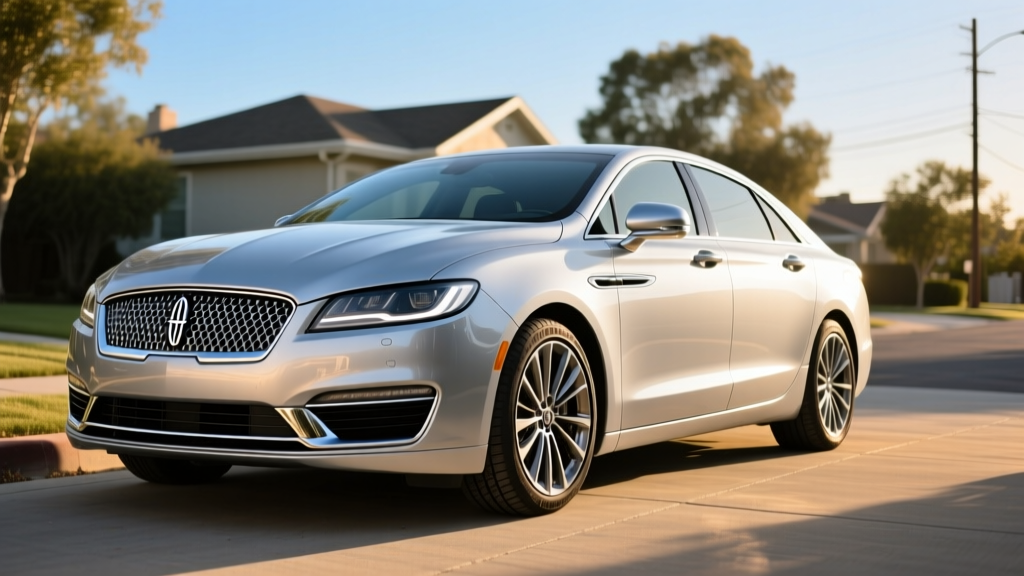
The 2017 Lincoln MKZ Hybrid occupies a specific niche in the used-car market: a midsize luxury sedan that sips fuel like a compact while delivering the quiet, cushioned ride Lincoln buyers expect. With an EPA rating of 40 MPG combined, it remains one of the most efficient luxury sedans ever sold in the United States — and on the used market in 2026, it's an affordable entry point into hybrid ownership.
But buying a nine-year-old hybrid raises legitimate questions. How does the battery hold up? What does replacement cost? And does this conventional hybrid (HEV) still make financial sense compared to a modern plug-in hybrid (PHEV) or a full battery-electric vehicle (BEV)? This guide answers every question a prospective 2017 Lincoln MKZ Hybrid buyer needs to ask.
2017 Lincoln MKZ Hybrid: Fuel Economy and Powertrain Specs
The 2017 MKZ Hybrid pairs a 2.0-liter Atkinson-cycle four-cylinder engine with an electric motor integrated into a continuously variable transmission (CVT). Combined output is 188 horsepower — adequate for relaxed cruising, though not what you'd call quick. The 0–60 mph time sits around 8.4 seconds, which is leisurely by modern luxury-sedan standards.
| Metric | Value |
|---|---|
| EPA City | 42 MPG |
| EPA Highway | 38 MPG |
| EPA Combined | 40 MPG |
| Fuel Tank Capacity | 14.0 gallons |
| Total Driving Range (EPA) | ~560 miles |
| Combined Horsepower | 188 HP |
| Drivetrain | Front-wheel drive |
| Transmission | eCVT (planetary gearset) |
Source: fueleconomy.gov — 2017 Lincoln MKZ Hybrid
The MKZ Hybrid's Atkinson-cycle engine and regenerative braking shine in city driving, where many owners report exceeding the 42 MPG city estimate — sometimes reaching 44–46 MPG in stop-and-go traffic. Highway efficiency is less impressive; at sustained 75 mph, expect 35–37 MPG. In mixed driving, real-world combined figures of 38–41 MPG are typical. Cold weather (below 35°F) reduces fuel economy by roughly 5–10% due to engine warm-up cycles and reduced battery efficiency.
HEV vs. PHEV vs. EV: Which Powertrain Fits You?
The 2017 Lincoln MKZ is a conventional hybrid (HEV). This is a critical distinction. It does not plug in, has no electric-only driving range to speak of (the small battery assists the gas engine but cannot propel the car on electricity alone for meaningful distances), and requires zero changes to your fueling routine. You simply fill it with regular unleaded gasoline and drive.
| Factor | HEV (this car) | PHEV | BEV (Full EV) |
|---|---|---|---|
| Plug-in Required? | No | Yes (for EV range) | Yes |
| Electric-Only Range | ~0.5 mi (low speed) | 20–45 mi typical | 200–400+ mi |
| Fuel/Charging | Gas station only | Gas + plug-in | Plug-in only |
| Home Charging Needed? | No | Recommended | Essential |
| Tailpipe Emissions | Reduced | Reduced (zero in EV mode) | None |
| Used Price (2026) | $12,000–$20,000 | $18,000–$35,000 | $15,000–$40,000+ |
Choose the HEV (2017 MKZ Hybrid) if: You don't have reliable access to home or workplace charging, you want a low-maintenance luxury sedan with strong city fuel economy, and your budget is under $20,000.
Consider a PHEV instead if: You have a garage or driveway where you can install a Level 2 charger, your daily commute is under 40 miles, and you want to drive mostly on electricity while keeping a gas engine for road trips.
Consider a full EV instead if: You have home charging, drive under 250 miles daily, want to eliminate gasoline entirely, and can budget for higher upfront cost offset by lower operating expenses.
Battery Health, Warranty, and Replacement Cost
The 2017 MKZ Hybrid uses a 1.4 kWh (gross) lithium-ion traction battery pack. This is a small battery by design — it buffers regenerative braking energy and assists the gas engine during acceleration, but it doesn't store enough energy for sustained electric driving.
When new, Lincoln covered the MKZ Hybrid's battery with an 8-year/100,000-mile warranty (10 years/150,000 miles in California Air Resources Board states). For a 2017 model, the standard 8-year federal warranty expired in 2025. The 10-year CARB-state warranty extends through 2027. If you're buying in a CARB state (CA, CT, ME, MD, MA, NJ, NY, OR, RI, VT, WA, CO, NV, NM, and others adopting CARB standards), verify remaining coverage with a Lincoln dealer using the VIN.
How Long Do MKZ Hybrid Batteries Last?
Ford/Lincoln hybrid battery packs from this generation have demonstrated strong longevity. The 1.4 kWh lithium-ion pack is conservatively sized and operates within a narrow state-of-charge window (roughly 40–60% SoC), which significantly reduces degradation stress. Data from fleet operators and owner forums suggest most MKZ Hybrid batteries retain 90%+ of original capacity at 150,000 miles. Failures before 200,000 miles are uncommon but not unheard of.
Battery Replacement Cost
If the traction battery does fail outside warranty, here's what to budget:
- New OEM battery from Lincoln: $3,000–$4,500 (parts + labor at dealer)
- Refurbished/remanufactured battery: $1,500–$2,500 (installed at independent hybrid specialists)
- Individual cell module replacement: $500–$1,200 (if only one or two modules are weak — requires a shop with hybrid diagnostic capability)
The small battery size keeps replacement costs manageable compared to a full EV pack. For context, a 75 kWh EV battery replacement can run $10,000–$20,000+. The MKZ Hybrid's 1.4 kWh pack is a fraction of that.
Reliability and Ownership Costs
The 2017 MKZ Hybrid benefits from Ford's extensive hybrid powertrain experience — the same basic hybrid system architecture debuted in the Ford Fusion Hybrid and has been iteratively refined since 2010. The eCVT transmission is a planetary gearset with no belts, clutches, or traditional friction components, making it one of the most durable transmission designs in the automotive industry.
Common issues reported by owners and tracked by NHTSA include:
- 12V auxiliary battery drain — the conventional 12V battery (not the hybrid traction battery) can die if the car sits unused for extended periods. This is a $150–$250 replacement.
- Infotainment glitches — the SYNC 3 system is generally stable but can freeze; software updates resolve most issues.
- Brake actuator recalls — check the NHTSA VIN lookup for open recalls, particularly related to the regenerative braking system transition.
Overall maintenance costs are low. There's no transmission fluid to change at regular intervals (the eCVT uses a lifetime fluid), regenerative braking extends pad life (many owners report 80,000+ miles on original brake pads), and the Atkinson-cycle engine runs under less thermal stress than a conventional engine.
| Spec | Value |
|---|---|
| Engine | 2.0L Atkinson-cycle I4 |
| Electric Motor | AC synchronous permanent-magnet |
| Combined Output | 188 HP |
| Traction Battery | 1.4 kWh lithium-ion |
| EPA City / Highway / Combined | 42 / 38 / 40 MPG |
| 0–60 mph | ~8.4 seconds |
| Curb Weight | ~3,870 lbs |
| Cargo Volume | 11.1 cu ft (trunk) |
| Seating | 5 passengers |
| Original MSRP (base) | $42,460 |
| Used Price Range (2026) | $12,000–$20,000 |
Tax Credits and Incentives
Because the 2017 MKZ Hybrid is a conventional HEV (not a plug-in hybrid or full EV), it does not qualify for the federal §30D clean vehicle tax credit. That credit, currently up to $7,500 for new qualifying EVs and PHEVs, requires plug-in capability and minimum battery capacity thresholds that conventional hybrids don't meet.
There is also no federal used-EV credit (§25E, up to $4,000) available, as that credit applies only to used battery-electric and plug-in hybrid vehicles — not conventional hybrids.
State-level incentives for conventional hybrids are essentially nonexistent in 2026. Most state programs have shifted entirely to plug-in vehicles. A handful of states previously offered hybrid rebates, but these have been discontinued or converted to EV-only programs.
The financial case for the 2017 MKZ Hybrid rests entirely on its low used purchase price and strong fuel economy — not on tax incentives.
Who Should Buy the 2017 Lincoln MKZ Hybrid?
Buy the 2017 MKZ Hybrid if:
- You want a luxury sedan under $20,000 with low fuel costs
- You drive primarily in city or suburban traffic (where hybrids shine)
- You lack access to home or workplace plug-in charging
- You want minimal powertrain complexity — no plug, no range planning
- You value a quiet, comfortable ride over sporty handling
Look elsewhere if:
- You drive mostly highway miles (a modern diesel or efficient turbo sedan may match its highway MPG)
- You want electric-only commuting (you need a PHEV or BEV)
- You need all-wheel drive (the MKZ Hybrid is FWD only; the AWD MKZ was gas-only)
- You prioritize the latest infotainment and driver-assistance tech
- You want current-year warranty coverage on the battery
- 40 MPG combined — best-in-class for a luxury sedan
- Quiet, composed ride quality
- Low used-market pricing ($12K–$20K)
- Proven, durable hybrid powertrain
- No plug-in charging required
- Strong city MPG (often exceeds EPA)
- Modest 188 HP — slow acceleration
- FWD only — no AWD option
- Trunk reduced to 11.1 cu ft (battery placement)
- Original battery warranty largely expired
- Dated SYNC 3 infotainment vs. modern systems
- No tax credit eligibility
Frequently Asked Questions
How many MPG does the 2017 Lincoln MKZ Hybrid get?
The EPA rates the 2017 MKZ Hybrid at 42 MPG city, 38 MPG highway, and 40 MPG combined. In real-world driving, city MPG often exceeds the EPA estimate (44–46 MPG in heavy stop-and-go traffic), while sustained highway driving at 75 mph typically yields 35–37 MPG. Cold weather reduces these figures by 5–10%.
Does the 2017 Lincoln MKZ Hybrid need to be plugged in?
No. The MKZ Hybrid is a conventional hybrid (HEV). It charges its small 1.4 kWh battery through regenerative braking and the gasoline engine. You never plug it in — you simply refuel at a gas station like any other car.
How far can the 2017 MKZ Hybrid drive on electric power alone?
Effectively zero meaningful distance. The hybrid battery assists the gas engine and enables brief low-speed electric-only movement (such as creeping through a parking lot), but it cannot sustain electric-only driving at road speeds. This is not a plug-in hybrid — there is no usable EV range.
Is the 2017 Lincoln MKZ Hybrid reliable?
Yes. The Ford/Lincoln hybrid powertrain in this generation is well-proven, with hundreds of thousands of fleet and consumer miles accumulated across the Fusion Hybrid and MKZ Hybrid. The eCVT transmission is mechanically simple and durable. The main reliability concern is the aging 12V auxiliary battery, not the hybrid traction battery. Check NHTSA for any open recalls before purchasing.
What does it cost to replace the hybrid battery?
A new OEM replacement from a Lincoln dealer runs $3,000–$4,500 installed. Refurbished batteries from independent hybrid specialists cost $1,500–$2,500. Individual module repairs can cost $500–$1,200 if only partial degradation is found. Most batteries last well beyond 150,000 miles without significant issues.
Does the 2017 MKZ Hybrid qualify for any tax credit?
No. As a conventional hybrid, it does not qualify for the federal §30D new-vehicle credit or the §25E used-EV credit. State incentives for non-plug-in hybrids have largely been discontinued. The value proposition is based on low purchase price and fuel savings, not tax incentives.
Should I buy this hybrid or a full EV?
If you can charge at home and your daily driving is under 250 miles, a modern used EV (such as a 2020–2023 Chevrolet Bolt or Nissan Leaf) offers lower operating costs and zero tailpipe emissions. However, if you lack charging access, regularly drive long distances, or want to spend under $15,000 on a luxury sedan, the MKZ Hybrid is a pragmatic choice with zero lifestyle adjustment required.